
14 min read
More Than an LMS: Add Community, Q&A and Events Around Your Courses

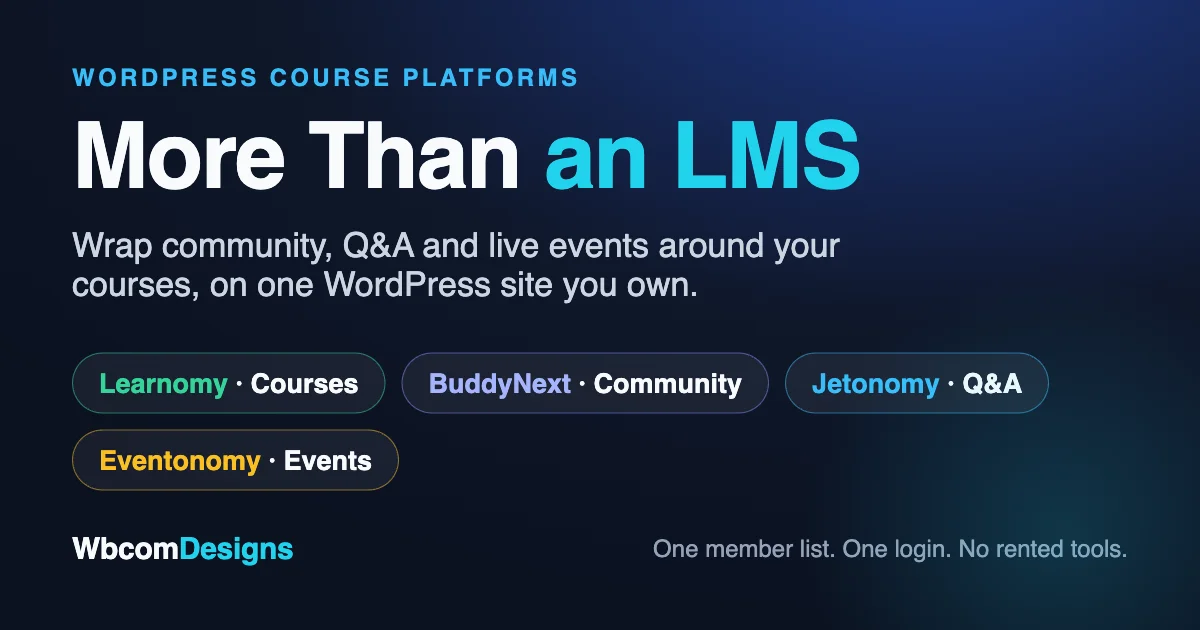
Your LMS is only a third of the platform
Most WordPress course sites launch with a good LMS and a checkout, and stop there. The lessons are organized, the payment works, the certificate downloads. Then the questions start. A student is stuck on module three and has nowhere to ask. Another wants to know if anyone else works in the same field. A third signs up for a live workshop that lives in a Zoom link buried in an email from six weeks ago. The course is fine. The online course community around it, the part that keeps people enrolled, is missing.
That gap is where most owners reach for rented tools. They add a Circle or Mighty Networks space for discussion, a Discord or Facebook group for chatter, a separate forum for support questions, and a ticketing service for live sessions. Four subscriptions, four logins, four places for a member to feel lost, and four monthly invoices that grow with headcount. The learning happens in your LMS, but the community that keeps people enrolled happens on someone else’s servers.
There is another way to build it, and it runs entirely on the WordPress site you already own. This guide walks through how to wrap a real online course community, a searchable question and answer layer, and live events around your courses using four self-hosted plugins that share one user list and one login. If you build course sites for clients, this is also a repeatable stack you can stand up once and reuse.
What an online course community actually needs
Before adding anything, it helps to name the jobs a course platform has to do beyond delivering video. There are four, and each maps to a different kind of interaction.
The first is the course itself: structured lessons, quizzes, progress tracking, selling, and proof of completion. This is the job an LMS is built for, and it is the one part most sites get right.
The second is belonging. People finish courses they feel part of. A private feed where members introduce themselves, post wins, and see familiar names does more for completion rates than another reminder email. This is a social layer, not a support layer.
The third is answers that last. Learners ask the same questions in every cohort. In a chat tool those answers scroll away in an hour. What you want is a structured place where a question gets asked once, an answer gets marked correct, and the next learner finds it through search instead of asking again.
The fourth is live moments. Office hours, cohort kickoffs, workshops, and study sessions are what turn a lonely self-paced course into a program people talk about. That means a real events system with RSVPs and a calendar, not a link pasted into a lesson.
Once the four jobs are separated, the tooling choice gets clearer. You do not need one giant platform that does all four badly. You need four focused pieces that share the same members. On WordPress, that is exactly what you can assemble.
The course core: Learnomy
Learnomy is the simplest LMS for WordPress, and it carries the first job on its own. You build courses and lessons, sell them with built-in Stripe and PayPal, run quizzes, and issue signed certificates, all from your own site with no chain of paid add-ons to assemble first.
For anyone evaluating a LearnDash alternative, the appeal is how little you have to bolt on to get to a working, selling course. Payments are part of the core, so there is no separate commerce plugin to configure before you can take money. Quizzes and certificates are included, so assessment and proof of completion are not extras. If you run a program with more than one teacher, instructor payouts are handled, which matters the moment your course business becomes a small marketplace of educators rather than a single creator. If you are still comparing tools, our guide to the best WordPress plugins for course creators covers the wider field.
Because Learnomy stores its members as normal WordPress users, everything that follows in this guide reads from the same account. A learner who buys a course is a member of your site, not a row in a third-party database you rent access to. That single fact is what makes the next three layers possible without integrations, sync jobs, or single-sign-on glue.
What to set up first
Start with one course, priced and published, with a short quiz and a certificate at the end. Confirm the buy flow works with a test payment, and confirm the certificate carries the learner’s name. This gives you a real enrolled user to test the community, question, and event layers against, instead of building three more systems against an empty course.
A place for students to talk: BuddyNext
BuddyNext is a free community plugin for WordPress, and it carries the belonging job. It gives your site an activity feed, member profiles, spaces, private messaging, and moderation, self-hosted on the site you own. For the BuddyPress ecosystem this is the social layer that used to require stitching several plugins together.
The feature that matters most for courses is spaces. A space is a contained area where a group of members posts, replies, and shares files. Create one space per course, or one per cohort if you run dated intakes, and enrollment becomes membership in a room full of people doing the same thing at the same time. The activity feed then surfaces what those people are doing: someone finished module two, someone shared a project, someone asked for feedback.
Messaging keeps the one-to-one conversations on your site instead of scattering them across personal email and social apps. Moderation gives you the controls to keep a growing space healthy, which becomes necessary faster than most owners expect once a community passes a few hundred members.
Wiring it to the course
Because BuddyNext uses the same WordPress users as Learnomy, a buyer can be added to a course space automatically as part of enrollment. New members land in a room that is already active, see the introductions of people ahead of them, and have somewhere to post the moment they feel stuck or proud. That is the difference between a course someone finishes alone and a program someone belongs to.
For a self-hosted community, the ownership point is not abstract. Every post, profile, and message lives in your database. If you move hosts, redesign the site, or change how you sell, the community moves with you. Nothing is trapped behind an export button on a platform that can change its pricing or its rules next quarter.
Questions that get answered and stay answered: Jetonomy
A social feed is the wrong shape for support. Questions posted to a feed get a few replies and then sink, and the same question returns in the next cohort. The right shape is a structured question and answer system, which is the job Jetonomy does.
Jetonomy is a self-hosted forum and Q&A community plugin for WordPress. It gives you structured discussion with accepted answers, an ideas roadmap, a show and tell area, and a social feed, in one plugin. For a course, the course Q&A layer is the part that pays for itself. A learner asks a question, other learners or an instructor answer, and the best answer gets marked as accepted. The next person who hits the same wall finds that answer through search instead of asking again.
Over a few cohorts this compounds into something valuable: a knowledge base written by your own learners and teachers, sitting on your own domain, indexed by search engines, pulling in people who searched the exact problem your course solves. A chat tool never gives you that. Its answers are gone by the next morning, and none of them help your search traffic.
The roadmap and show and tell
Two smaller Jetonomy areas are worth turning on for a course. The ideas roadmap lets learners suggest what they want taught next and vote on it, which tells you what to build before you build it. The show and tell area gives people a place to post finished work, which is both motivating for the poster and persuasive for prospects who visit and see real results from real students.
Live sessions and cohorts: Eventonomy
Self-paced courses have a completion problem. Live moments fix it, because a date on a calendar creates a reason to show up. Eventonomy runs events, RSVPs, ticketing, and calendars on your own WordPress site, with a free core and paid power, and no per-ticket platform fees.
For a course business the useful events are recurring and small: weekly office hours where learners bring questions, a kickoff call for each new cohort, a workshop that goes deeper than the recorded lessons, and study sessions members can host themselves. Eventonomy gives each of these an RSVP so you know who is coming, a calendar so members can plan around them, and a record that lives beside the course rather than in a scheduling tool you pay for separately.
The no per-ticket fee point is not a small one. Platforms that take a cut of every ticket turn a paid workshop into a math problem, and they make free RSVP-only events feel like a waste of a paid tier. Running events on your own site means a cohort of five hundred costs the same as a cohort of five, and a free study session costs nothing to schedule.
Cohort-based courses
If you run cohort-based courses, Eventonomy is the spine of the schedule. Each cohort gets a kickoff, a set of live sessions, and a wrap. Combined with a BuddyNext space for that cohort and a Jetonomy area for its questions, a dated intake stops being a spreadsheet you manage by hand and becomes a set of connected pieces on one site, all reading from the same member list.
Why one self-hosted site beats four rented tools
Assembled, these four plugins turn a course into a platform: Learnomy for the courses, BuddyNext for the community, Jetonomy for the questions, and Eventonomy for the events. The reason to run them together on WordPress instead of renting four services comes down to a few practical advantages.
One member list, one login. A learner has a single account. They buy a course, join its space, ask a question, and RSVP to a session without ever creating a second profile or being handed off to another domain. Every extra login is a place people drop out, and this setup removes three of them.
You own the data. Every lesson, post, answer, and RSVP lives in your database. Your community is not a tenant on a platform that can raise prices, change terms, or shut down. If you migrate hosts or rebuild the site, the whole platform comes with you.
Costs do not scale with headcount. Rented community and event tools charge more as you add members and sell tickets. Self-hosted plugins do not. Your bill is hosting plus whatever Pro tiers you choose, not a percentage of your growth.
It compounds into search traffic. Accepted answers and public discussion sit on your domain and get indexed. Over time the question layer becomes a source of new learners who found you by searching the exact problem your course teaches. Rented tools keep that value on their domain, not yours.
It is a repeatable build. For agencies and freelancers, this is a stack you configure once and deliver to any client who sells courses or memberships. The same four plugins fit a coding bootcamp, a yoga teacher training, an association’s certification program, or a creator’s paid community, with only the content and branding changing between builds.
Keeping a growing community healthy
A quiet community needs no rules. A busy one does, and the shift happens faster than most owners plan for. Once a space passes a few hundred active members, spam accounts, off-topic threads, and the occasional argument arrive on their own. Handling that on a rented platform means learning that platform’s moderation tools and hoping they fit. Handling it on your own site means the controls sit where your team already works.
BuddyNext includes moderation for the social layer, so posts and members can be reviewed, flagged, and removed without leaving WordPress. Jetonomy adds the controls a question and answer area needs, where accepting answers and curating duplicates keeps the knowledge base clean instead of letting it fill with noise. Because both use standard WordPress roles, you can hand a trusted learner or a hired moderator exactly the access they need and nothing more, using the same role system that runs the rest of the site.
Planning for moderation early is part of treating a course as a platform rather than a product. The tools are there in the stack from the start, so growth becomes a matter of turning on controls you already own, not migrating to a bigger service the month things get busy.
What this looks like for a real program
Consider a six-week coding bootcamp sold to about two hundred learners a year in dated cohorts. On day one the founder had a course in Learnomy and nothing else. Learners watched the lessons, passed the quizzes, and then went quiet. Completion sat around forty percent, and the same three questions arrived by email every single week.
The first change was a BuddyNext space per cohort. New learners were added to their cohort room at enrollment, posted an introduction, and started answering each other before the founder woke up. The feed made progress visible, and people who saw peers finishing module three pushed to catch up. Completion moved without a single new lesson being recorded.
The second change was a Jetonomy area for questions. Those three weekly emails became three accepted answers, and by the third cohort most new learners found the answer through search before they thought to ask. The founder’s support time dropped, and the answer pages began pulling in strangers who had searched the same error message and discovered the bootcamp.
The third change was a weekly office-hours event in Eventonomy. A standing Wednesday call with an RSVP gave the cohort a reason to keep pace, and the recording went back into the course. None of this required a second platform or a sync job. It was four plugins reading one member list on one WordPress site.
What each layer replaces
It helps to see the stack against the rented tools it stands in for, because the savings and the ownership are easier to judge that way.
- Learnomy replaces a hosted course platform plus a separate commerce add-on. Courses, payments, quizzes, and certificates sit in one plugin on your site.
- BuddyNext replaces a Circle or Mighty Networks subscription and the scattered Facebook group. The social layer lives with your members instead of on a network you rent.
- Jetonomy replaces a hosted help desk or a Discord that loses every answer within a day. Questions become a searchable knowledge base on your domain.
- Eventonomy replaces a ticketing service that takes a cut of every seat. RSVPs, calendars, and paid tickets run at a flat cost you control.
Four monthly bills that grow with your audience become a set of plugins on hosting you already pay for. The community, the answers, and the event history all stay yours.
Selling access: memberships and bundles
Once the layers share one member list, how you sell gets more flexible. You can sell a single course, or you can sell a membership that grants a bundle of courses plus access to the community space and the live sessions. Because enrollment, community membership, and event RSVPs all key off the same WordPress user, a membership tier can open all of it at once and close it when a subscription lapses. For a focused comparison of the course tools that pair well with recurring access, see our roundup of the best LMS options for membership sites.
That is the difference between selling a video and selling a program. A video is a one-time purchase people forget. A program with an active space, a growing answer library, and a weekly session is something people renew to stay part of. For a course business chasing recurring revenue rather than one-off sales, the community and event layers are not extras. They are the reason the subscription keeps its value month after month.
Common questions
Do these plugins need single sign-on to work together?
No. All four use standard WordPress users. A person who buys a course in Learnomy is already the same account in BuddyNext, Jetonomy, and Eventonomy. There is no sync, no bridge, and no second login to configure.
Is this a real LearnDash alternative?
For many course sellers, yes. Learnomy includes payments, quizzes, certificates, and instructor payouts in its core, so the base build needs fewer paid add-ons before you can sell. Test it against your own course structure and payment needs before you commit either way.
Can an agency reuse this for clients?
That is one of its strengths. The four plugins are a fixed stack you configure once and hand to any client selling courses or memberships. Only the content, branding, and pricing change from build to build, which makes it a predictable delivery rather than a custom project each time.
What does it cost to run at scale?
Hosting plus whichever Pro tiers you choose. Unlike rented community and ticketing services, none of the four plugins charge more as your membership grows or as you sell more tickets, so a large cohort costs the same to run as a small one.
A build order that works
You do not need all four layers on day one. The sensible path adds them as the community earns them.
Start with Learnomy and get one course selling. Nothing else matters until a learner can buy and complete a course. Once you have paying members, add BuddyNext and give each course a space so those members have somewhere to talk. When the same questions start repeating, bring in Jetonomy so answers get written once and found forever. When you are ready to add live moments and cohorts, add Eventonomy and put dates on the calendar. Each layer reads from the members you already have, so every step is an addition, not a migration.
Built this way, a course site stops being a video library with a paywall and becomes an online course community people belong to, ask questions in, and show up for. That is what keeps members enrolled, and it runs on a WordPress site you own from top to bottom.
If you are planning a course platform, or rebuilding one that has grown past a single LMS, start with Learnomy and add the community, question, and event layers as you grow. For help designing the full stack or standing it up for a client, the team at Wbcom Designs builds community and learning platforms on WordPress every day.
Related reading