
7 min read
Your Loyalty Perk Is Worth More Than Its Usage Numbers Say

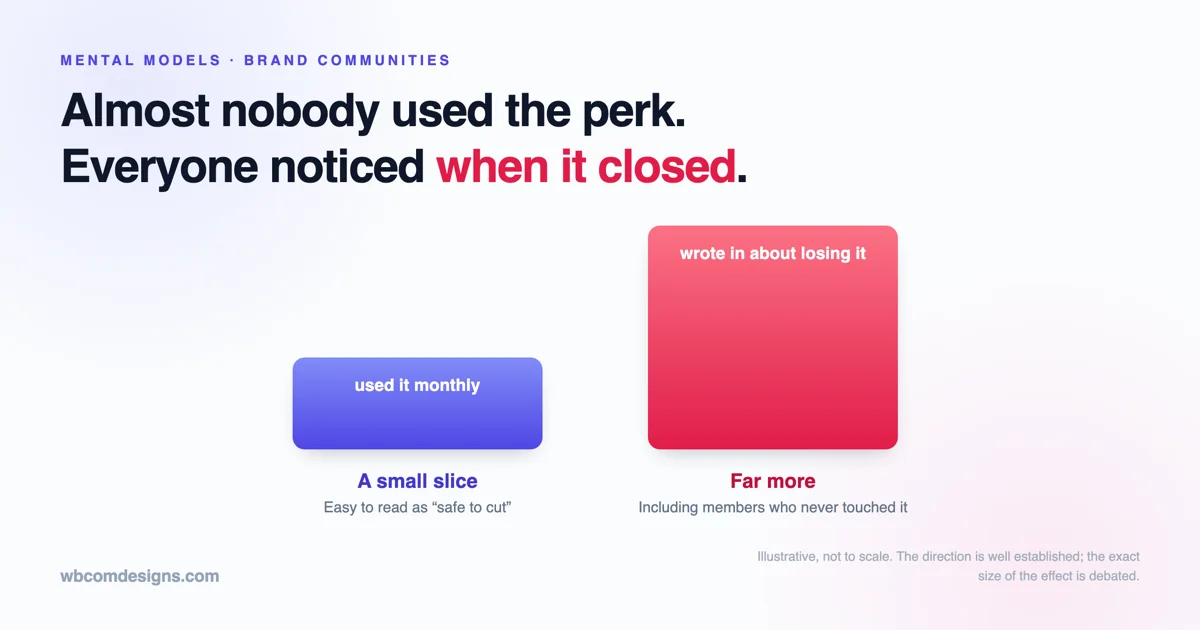
Somewhere in your brand community there is a perk almost nobody uses. An early-access channel. A quarterly call with the product team. A members-only discount that shows up in maybe two percent of orders. When the time comes to simplify the offer, that perk is the obvious cut. The usage data practically volunteers it.
Cut it and you will hear from members who never used it once.
This is the brand-community version of a pattern we cover in our main piece on loss aversion and why members fear losing what they have. The general rule is that losses land harder than equivalent gains. In a brand community the rule takes a specific and expensive shape, because so much of what you offer is status rather than utility.
Usage data cannot see the reason people value a perk
A perk does two jobs. It gets used, and it signals that the member is the kind of person who could use it. Your analytics only measure the first job.
The early-access channel is a good example. Ten percent of members might read it in a given month. But a much larger group knows it exists, knows they have access to it, and files that away as part of what membership means. They are not reading it. They are holding it.
When you remove it, the readers lose a channel and everyone else loses a piece of what they thought they had bought. The second group is larger and, because their loss is harder to articulate, their complaints tend to arrive as something vaguer and more damaging: the community is not what it used to be.
We are not arguing that you should never cut an underused perk. Plenty of them genuinely deserve to go. The argument is narrower: usage numbers are the wrong instrument for predicting the cost of removal, because the value being destroyed was never fully captured in usage to begin with.
Status tiers make every change a demotion
Brand communities lean on tiers more than most. Bronze, silver, gold. Insider, founder, ambassador. The structure works because it gives members something to climb toward, and it creates a problem the moment the ladder moves.
Restructure your tiers and some members will land lower than they were, even when their actual benefits stay identical or improve. A member who was gold under the old system and is now in the middle band of a five-tier system has lost nothing measurable. They have lost the word gold.
That sounds trivial written down. It does not read as trivial to the member, because status is the whole point of a tier and the label is the status.
The practical guard is to let people keep the label. If you are rebuilding a tier system, map every existing member onto the new structure at a rank that reads as equal or better, and absorb the awkwardness in the naming rather than pushing it onto the member. A tier system with one slightly odd legacy band is a smaller problem than a few hundred people who were publicly downgraded by an internal reorganisation they did not ask for.
The grandfathering question in a brand context
Grandfathering is well understood in pricing. In brand communities it applies to access as much as to money, and it is used far less often than it should be.
The instinct when simplifying an offer is to move everyone onto the new structure at once, because running two systems is a maintenance cost and an explanation cost. That instinct is usually right about the cost and usually wrong about the comparison, because the alternative is not free either.
| Approach | What it costs you | What it costs the member |
|---|---|---|
| Move everyone to the new structure immediately | Low ongoing maintenance, one difficult announcement | An immediate, visible loss of something they had |
| Grandfather existing members indefinitely | Two structures to maintain and explain forever | Nothing, which is the point |
| Grandfather with a published end date | Two structures for a defined window | A loss, but a scheduled and foreseeable one |
| Replace the perk with something of similar standing | The work of building the replacement | A trade rather than a removal |
The third row is the one most brand communities should reach for and most skip. A dated sunset converts an ambush into an appointment. Members who know in March that something ends in September have six months to adjust their expectations, and the ones who care most have time to tell you why, which is information you want before the change rather than after it.
Founding members are a promise you already made
Almost every brand community has an early cohort who joined before the thing was obviously going to work. They got in cheap, or free, or with perks that made sense when there were four hundred members and make no sense at forty thousand.
They are also, disproportionately, the people who vouch for you in public.
The temptation to normalise this group is strong, and it is worth resisting harder than the spreadsheet suggests. What a founding member holds is not really the discount. It is the evidence that they were right about you early. Taking it back does not just cost you the goodwill of that member, it costs you the story they tell, and that story is doing marketing work you are not paying for.
Where the economics genuinely will not sustain a legacy cohort, say so plainly and directly to that group before you say it publicly. The difference between a founding member who was told first and one who found out from a banner is the difference between a disappointed advocate and a former one.
Removing a perk without the backlash
None of this argues for a museum of features you can never touch. Brand communities accumulate cruft like every other product, and clearing it is legitimate work. The sequence matters more than the decision.
- Announce before removing, with a date far enough out that members can absorb it as news rather than as an event happening to them.
- Say what replaces it, or say plainly that nothing does and why. Members forgive a straight answer more readily than a reframe.
- Tell the heaviest users of that specific perk directly, not through the general announcement. They are a short list and they will find out anyway.
- Keep the label even when the contents change, if the label carries status.
- Never pair a removal with a price increase in the same message. Each change deserves to be judged on its own.
That last point is worth dwelling on. Bundling a cut with an increase reads as a single act of taking, and members will price it as one, which means you pay the goodwill cost of both changes at once and get credit for neither.
What this looks like in practice
Brand communities built on BuddyNext, the free Community OS for WordPress, tend to express perks as space access, member types, and role-based visibility. The mechanics of a sunset are therefore mostly mechanics of access: keeping a space readable but archived rather than deleting it, keeping a role in place with reduced privileges rather than stripping it, giving members an export of anything they created inside a space that is closing.
Points and badges through WB Gamification, a 100% free gamification plugin for WordPress, raise the same question in a sharper form, because a badge is almost pure status. If badge criteria change, existing holders keeping their badge costs nothing and removing it costs a great deal, which makes it one of the easier calls in this whole area.
The tooling is not what decides any of this. A platform can archive a space or delete it, and can retire a badge quietly or revoke it loudly, using the same features either way. What we can say is that archiving, exporting, and grandfathering are cheap when the platform supports them and expensive when it does not, and that a community which cannot easily do the gentle version of a change will find itself doing the harsh version by default.
The rule underneath
A brand community is a place where people hold things: a rank, an access level, a badge, a rate, the knowledge that they were early. Almost none of it is expensive for you to maintain, and all of it is disproportionately expensive to take back.
Before cutting anything, the question is not whether the usage justifies the maintenance. It is whether the perk is doing status work that the usage numbers were never going to show you. Most of the time, in a brand community, it is.
For the general mechanism behind all of this, including where it crosses into manipulation, see the main piece on loss aversion in communities. The related but distinct question of why members stay for what they have already spent is covered in our piece on sunk cost.
Related reading