
18 min read
Loss Aversion: Why Members Fear Losing What They Have

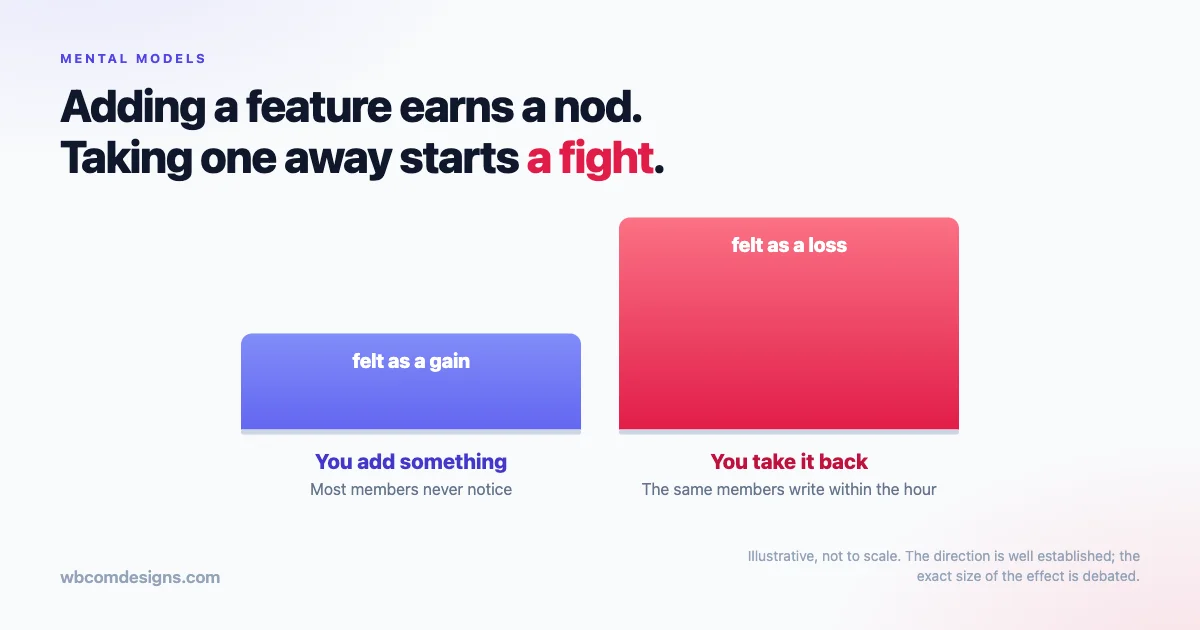
A member who has never had access to a private space does not think about it. A member who had that space for a year and then loses it will write you an angry email within the hour. The feature might be small. The reaction never is.
We have watched this pattern play out across enough communities and course platforms to trust it more than almost any other rule of thumb we operate by.
That gap between how people react to gains and how they react to losses has a name. It is called loss aversion, and it explains a surprising amount of what makes running an online community or a paid course harder than the product roadmap suggests.
This post is part of our series applying decision-science ideas to community and course platforms. It sits close to a companion piece on sunk cost, which looks at a related but distinct reason people stay put, a comparison we return to below.
The asymmetry that runs communities
Here is the pattern in plain terms. Add a feature that members never had, and you get a modest bump in satisfaction, if anyone notices at all. Remove a feature members have used for months, and you get complaints, cancellations, and forum posts calling it a betrayal, even when the feature was minor and used by a small fraction of the group.
The size of the reaction is not proportional to the size of the change. It is proportional to whether something felt like it belonged to the member already. Ownership, even informal, changes the emotional math.
This is why an operator can spend months building a well-received feature and then wipe out that goodwill in a single afternoon by taking away something nobody had asked to keep.
We see this constantly with community platforms and course sites, where the product is built from accumulated member behaviour: posts, connections, progress, badges, comment history. Every one of those becomes something a member can lose, whether or not the platform intended it that way.
A community plugin or a course tool is, functionally, a machine for creating things members can lose. That is not a criticism. It is simply what building a persistent community product means.
Once you see the asymmetry, you start noticing it everywhere: in how members react to a redesign, in how they respond to a price change, in how a single revoked badge produces more outrage than granting a hundred new badges produced goodwill.
What loss aversion actually says
Loss aversion comes out of prospect theory, the framework Daniel Kahneman and Amos Tversky proposed in 1979 as an alternative to the standard economic model of how people weigh outcomes. Their core finding was that losses and gains are not evaluated on the same scale.
A loss of a given size is felt more strongly than a gain of the same size is enjoyed. You can read the original framing and its history on Wikipedia’s loss aversion entry, which is a reasonable starting point before going to the source papers.
A closely related idea is the endowment effect: people place a higher value on something once they own it than they placed on it before they owned it. Give someone a mug, then ask them to sell it back, and they will typically ask for more than they would have paid to buy it. Ownership itself shifts the valuation, not just the object’s usefulness.
We want to be careful here, because this territory gets oversimplified constantly in product and marketing writing. You will often see a specific ratio quoted, the claim that losses hurt roughly twice as much as equivalent gains feel good. That number comes from early experiments and has been repeated so often it sounds like settled fact. It is not.
Follow-up research and later reviews have questioned whether the effect is that large, whether it holds at that size across contexts, and whether some published estimates were inflated by how the original studies were designed and reported. Some researchers argue the whole effect is smaller and more context-dependent than the popular version suggests.
The honest summary is this: loss aversion is a reliable direction of travel, not a fixed multiplier you can plug into a spreadsheet. Losses tend to loom larger than equivalent gains, and the effect shows up across many domains including money, time, and social standing.
Its exact size depends on context, the type of loss, and how it is framed. Treat any product decision built on a precise ratio with scepticism, including ones you read in an article like this one.
That caveat does not weaken the practical point. Even a modest, context-dependent asymmetry is enough to explain why a small removed feature generates more anger than a large added one generates thanks, and why every decision covered below is worth thinking through before you ship it.
| The change | How a new member experiences it | How an existing member experiences it |
|---|---|---|
| A feature is removed | Never notices, has nothing to compare against | Feels like something was taken away, even if rarely used |
| A price rises | Sees the current price as simply the price | Feels the gap between what they paid and what they now owe |
| A limit is introduced | Treats the limit as a normal product boundary | Feels restricted by something that used to be unlimited |
| The interface is redesigned | Learns the new layout with no prior expectation | Has to relearn a workflow that already worked for them |
| A privilege is revoked | Never had it, so nothing changes for them | Experiences it as a demotion or a public correction |
Where loss aversion helps honestly
Loss aversion is not automatically a manipulation tool. Some of the most ordinary mechanics in community and course products lean on it in ways that are simply fair descriptions of value the member actually created.
The free trial is the clearest example. A trial works partly through simple exposure, letting someone try before they buy, but it also works because ownership starts accumulating before payment does.
By the time a trial ends, a member may have built a profile, joined a few discussions, started a course module, or made a connection with another member. Cancelling now means giving up something real, not something hypothetical.
That distinction matters and is the test we come back to throughout this piece: is the loss real, and did the member actually build the thing they stand to lose? A trial that converts because someone made genuine progress is doing something legitimate. It is showing the member an honest picture of what they would be walking away from, not inventing a reason for them to stay.
This connects to something we cover in our piece on community liquidity: what a member would actually lose by leaving depends on how much real value the community has generated for them.
A community with genuine liquidity, active discussion, useful connections, content worth returning to, gives members something authentic to lose. A quiet, thin community has nothing to hold onto no matter how cleverly its retention screens are worded. You cannot manufacture loss aversion in a place that never gave anyone anything to lose.
It is worth separating this from sunk cost, since the two ideas get blended together constantly and they are not the same mechanism. Sunk cost is backward-looking: a member stays because of what they already spent, time, money, effort, even though that spending cannot be recovered either way.
Loss aversion is forward-looking: a member stays because of what they would give up going forward. Our earlier piece on sunk cost in online communities covers the backward-looking half of this pair.
Both explain why people stick with something that has stopped serving them, but they pull on different psychological levers, and a healthy product should not need to lean on either one to keep people around.
Where it becomes manipulation
The same asymmetry that makes an honest free trial work is exactly what makes dark patterns effective. The mechanism does not care whether the loss it exploits is real. This is where operators need to hold themselves to a stricter standard than “does it move the metric.”
A short, incomplete list of manufactured loss, the kind built specifically to create pressure rather than to describe something true:
- Artificial scarcity: a stated limited quantity on a digital product that has no actual supply constraint.
- Countdown timers on offers that reappear identically the next time the member visits.
- “Your spot expires soon” messaging on a course or community that has no capacity limit.
- Threats to delete a member’s data or history to pressure a renewal, when keeping that data costs the platform nothing.
- Streaks engineered so that missing a single day feels like losing weeks of progress, even when nothing of substance was actually lost.
That last one deserves its own note, because streaks sit right at the boundary between a genuinely useful nudge and a manufactured one. A streak can be a fair, motivating reflection of consistent effort. It becomes manipulative the moment the number itself, rather than anything the member actually built, becomes the thing they are afraid to lose.
Our piece on the Zeigarnik effect and unfinished courses covers this same boundary from a different angle: open loops and progress indicators are useful when they reflect something real and manipulative when they exist purely to generate anxiety about an artificial state.
The plain test is the one we keep returning to: is the loss real, and did the member build the thing they would be losing, or did the operator invent it to create pressure that would not otherwise exist?
A lot of the playbooks recommending these tactics get repeated uncritically because they were written by, or about, products that happened to survive and grow.
Our piece on survivorship bias in community case studies makes the wider point: the tactics that show up in “what worked for us” case studies are drawn from a sample of winners, and nobody writes the case study for the ten communities that used the same countdown timers and manufactured scarcity and quietly failed anyway.
| The mechanic | Real or manufactured | Why |
|---|---|---|
| A free trial ending | Real | The member built actual profile, content, or progress during the trial |
| A countdown on an evergreen offer | Manufactured | The offer returns unchanged after the timer expires, so nothing was actually at risk |
| Losing access to content you posted | Real | The member’s own contribution is the thing being withheld |
| A streak counter resetting | Depends | Real if it reflects genuine consistency; manufactured if the number itself is the only thing at stake |
| “Only 3 spots left” on an unlimited product | Manufactured | There is no actual capacity constraint being described |
| Grandfathered pricing ending on a published date | Real | The old rate genuinely goes away on a date the member was told in advance |
The migration and pricing problem
This is where loss aversion causes the most damage to operators who do not plan for it, because pricing changes are one of the few losses that are unavoidable in the normal life of a product.
Raising prices on existing members costs far more goodwill than charging new members a higher rate ever will, even when the increase is identical in money terms. A new member never knew the old price existed.
An existing member experiences the increase as something being taken from them personally, a rate they had, that they were promised implicitly by having paid it before, now gone.
This is the entire logic behind grandfathering. Letting existing subscribers keep their original rate while new signups pay the current one is not generosity for its own sake.
It is a direct response to the asymmetry: the goodwill cost of removing a rate someone already has is disproportionate to the revenue gained by forcing everyone onto new terms immediately. A grandfathered plan converts a loss into something that simply does not happen to existing members at all.
The same logic applies to removing a feature, and it needs a longer runway than adding one does. Adding a feature can happen instantly and members will simply discover it. Removing a feature needs advance notice, a stated reason, and ideally a replacement, because the member is losing something they had already built habits and expectations around.
A few practical patterns we recommend to operators making a pricing or plan change:
- Grandfather existing members onto their current rate wherever the business can sustain it, and set a clear, published date if grandfathering has a limit.
- Give advance notice measured in months, not days, for any material price increase.
- State the reason plainly. Members forgive increases they understand far more than ones that arrive silently.
- Never bundle a price increase with an unrelated feature cut in the same announcement. Let each change stand on its own so members can evaluate it fairly.
None of this is about avoiding necessary price increases. Costs rise, and platforms have to charge accordingly. It is about recognising that the goodwill cost of a change is not symmetrical with its financial size, and planning the rollout with that asymmetry in mind rather than being surprised by the backlash afterward.
Redesigns and feature removal
Every redesign takes something away from someone. This is true even when the new version is objectively better by every measure the team cared about while building it. A member who had learned exactly where to click now has to relearn, and relearning registers as a loss regardless of how much nicer the new layout is.
The complaints that follow a redesign are not evidence that the redesign was wrong. They are close to guaranteed, and the loudest complaints will usually come from the people who used the old version the most, which means they are often your best and most active members.
That correlation is worth sitting with before dismissing the feedback as simple resistance to change.
A workable approach for any feature removal or major redesign follows a short, repeatable sequence:
| Step | What it protects against | What it looks like |
|---|---|---|
| Announce before removing | The feeling of something disappearing without warning | A dated notice sent well ahead of the change, not a changelog line after the fact |
| State the replacement | The sense that nothing is being offered in return | A clear explanation of what the member gets instead, and why it serves the same need |
| Keep both paths running | Forcing a hard cutover before people are ready | An overlap period where the old and new options both work |
| Offer an export | The fear of losing data or content permanently | A simple way to download or preserve whatever the member built under the old system |
| Grandfather existing users where possible | Punishing loyalty with the same treatment as new signups | Existing members keep access to the old behaviour for a defined period, or permanently |
| Tell the heaviest users directly | Your most engaged members finding out secondhand | A personal note, not just a banner, to the accounts who will feel the change hardest |
None of these steps are expensive relative to the goodwill they preserve. Running two systems in parallel for a few weeks costs engineering time. Losing your most active members over a redesign they found out about from a support ticket costs considerably more, and it costs it permanently.
Downgrade and cancellation flows
The moment a member decides to cancel is exactly when loss aversion is strongest, and exactly when it is easiest for a platform to abuse. The member is actively weighing what they are about to give up. A dishonest flow leans into that moment as hard as it can. An honest flow respects it.
We can describe both approaches plainly, because the contrast is not subtle.
A dark-pattern cancellation flow hides the cancel button behind account settings several layers deep, forces a phone call or live chat instead of a self-serve option, buries the actual cancel action behind repeated retention offers the member has to click through, and uses guilt-oriented language built to make leaving feel like abandoning something rather than a simple account decision.
An honest cancellation flow does the opposite. It states clearly what the member keeps, whether that is downloaded content, existing posts, or continued access until the end of a paid period. It states clearly what the member loses, without softening it or hiding it in fine print.
It lets the member complete the cancellation in one or two clicks, with a retention offer presented once, not repeated as an obstacle.
We think the honest version is also the better business decision, not just the more defensible one. A clean exit preserves the member’s option to come back, and members who leave on good terms are far more likely to return, recommend the product to someone else, or simply not write a public review describing how hard it was to get out.
A forced, frustrating cancellation turns a routine account change into a story the member tells other people, which is a worse outcome than the lost subscription itself.
Practically, we recommend a self-serve cancel path reachable in two clicks from account settings, a single retention offer shown once and dismissible without friction, plain language describing exactly what is kept and what is lost, and a confirmation step that does not require a phone call or a support ticket to complete.
The one that trips up moderation
Loss aversion shows up in a place many community operators do not expect: the earned privilege. A badge, a rank, a moderator title, a trust level that unlocks posting without review. These are exactly the kind of thing a member built through effort and time, which makes losing them land far harder than never having received them.
Removing a privilege a member earned reads as a punishment even when the removal is procedural, routine, or entirely reasonable given the circumstances. A moderator stepping down after months of inactivity, a trust level recalculated after a policy update, a badge revoked because the criteria changed: none of these are personal, but they are frequently experienced that way, because the member built something and now it is gone.
The fix is not to avoid ever removing privileges. Communities need the ability to adjust roles as circumstances change. The fix is to make earned privileges explicitly conditional from the moment they are granted, so a later removal is a known rule taking effect rather than a punishment appearing out of nowhere.
A few concrete practices that make this work in real communities:
- State the conditions for keeping a privilege at the same time you grant it, not after someone loses it and asks why.
- Build in a routine review cycle, so members expect that trust levels and roles get reassessed periodically, rather than experiencing review as a surprise audit.
- Separate the person from the role in your language. “This trust level has been recalculated under the current criteria” reads very differently from “you have been demoted.”
- Give notice and a path back where circumstances allow it, rather than a silent, permanent removal.
Community and course platforms built with role and trust structures like these in mind, the kind we design into products such as Jetonomy, tend to handle this better simply because the conditions are visible from the start, not bolted on after the first complaint.
The underlying rule is the same one running through this whole piece: a loss that was foreseeable and explained lands as fair. A loss that arrives without warning lands as an attack, regardless of how justified it actually was.
When retention becomes the target
There is a trap specific to teams that measure their success by a retention number. Once retention becomes the metric everyone optimises, loss-based mechanics become the fastest lever available to move it, because they work reliably and quickly, at least in the short term.
This is a direct case of Goodhart’s Law, the idea that a measure stops being a good measure once it becomes the target people are optimising for. Our piece on Goodhart’s Law and community metrics covers the general version of this problem.
Loss aversion is one of the clearest ways it plays out in practice: retention can be pushed upward using manufactured scarcity, guilt-based cancellation flows, and artificial streaks, all of which raise the number while quietly making the product worse for the people trapped inside it.
A retention number that improved because members found more real value looks identical on a dashboard to a retention number that improved because members found it harder to leave. The dashboard cannot tell the difference. Only a genuine look at what actually changed, and an honest question about which of these two things happened, will surface it.
The practical guard against this is to pair every retention metric with a second measure that cannot be gamed by loss-based pressure: unprompted referrals, voluntary upgrades, unsolicited positive mentions in support tickets, or members who left and came back on their own.
If retention rises while all of those stay flat or fall, the retention number is very likely being manufactured rather than earned, and it is worth stopping to check before optimising further.
What we build, and who decides
We should be honest about our own position here. We build the plugins that make many of these mechanics easy to ship: streaks, badges, tiered access, cancellation flows, pricing tiers, trial periods. A community platform like BuddyNext can implement either the honest version of every pattern in this piece or the manipulative version, using largely the same underlying features.
The mechanic itself is neutral. A countdown timer is just a countdown timer. What makes it honest or manipulative is whether the thing it describes is real, and that decision does not live in the plugin.
It lives with the operator who configures it, writes the copy around it, and decides whether the urgency it communicates corresponds to anything actually true.
We think this distinction matters enough to say plainly rather than leave implied. Tools do not have intentions. The people running the community or the course do, and the choice of how to use loss aversion, honestly or otherwise, sits entirely with them.
Putting it into practice
Loss aversion is not a trick to add to a growth checklist. It is a description of how members actually experience change, and it applies whether or not you plan around it. The choice is only whether you plan around it honestly.
A short set of questions worth running through before shipping any change that touches what members have, whether that is a feature, a price, a role, or an interface:
- Is the loss this change creates real, or did we invent it to create pressure?
- Did the member build the thing they stand to lose, or are we describing something that was never really theirs?
- Have we given enough notice that the loss feels like a known outcome rather than an ambush?
- Is there a genuine replacement, or are we just taking something away?
- Would we be comfortable explaining this change, in plain language, to the member most affected by it?
Communities and courses are, by nature, places where members accumulate real things worth keeping: relationships, progress, reputation, content. That accumulation is what gives a platform genuine gravity, the kind that holds people because the place is actually worth staying in.
Loss aversion will always be present in any product built on accumulated value. The question every operator has to answer, repeatedly and honestly, is whether the losses on the table are the real ones that come from something worth building, or the manufactured ones that only exist because someone decided pressure was easier than value.
Related reading