
15 min read
Survivorship Bias: The Community Case Studies You Never See

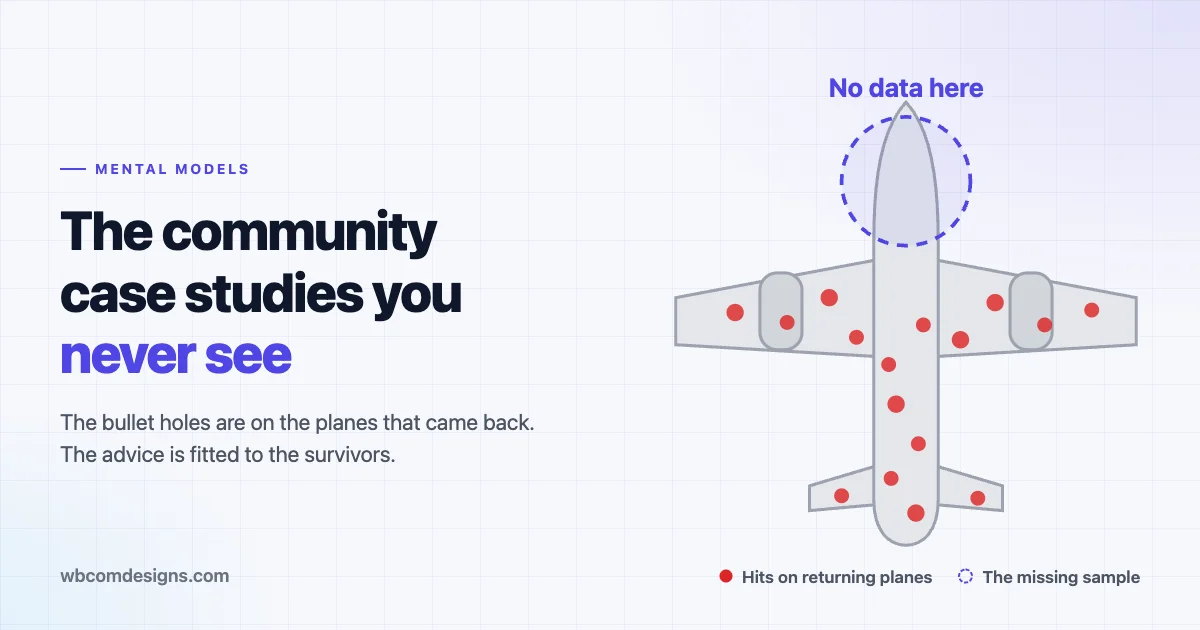
Search “how we grew our online community” and you get thousands of posts. Search “why our online community died” and you get almost nothing. That gap is not because success is more common than failure. It is because the communities that failed mostly stopped existing quietly, and nobody writes a retrospective about a thing that never had an audience to read it.
This is survivorship bias, and it is probably the single most under-priced risk in how community builders learn their craft. Every playbook, every “we hit 50,000 members” post, every conference talk on stage is drawn from a sample that has already been filtered by success. The filter is invisible, so the sample looks complete. It is not.
Where the term comes from
The clearest version of this problem comes from World War II, and it is well documented enough that we can describe it accurately rather than embellish it. During the war, the U.S. military wanted to add armor to bomber aircraft, but armor is heavy, and heavy planes fly worse and carry less fuel and fewer bombs. The armor had to go somewhere specific, not everywhere.
Military analysts studied the planes that returned from missions. They mapped where the bullet holes clustered on the fuselage and wings, and the natural next step was to propose reinforcing those areas, since that is where the damage kept showing up.
Abraham Wald, a statistician working with the Statistical Research Group at Columbia University, pointed out the flaw. The analysts were only looking at planes that made it home. The bullet holes on those planes showed where a plane could take a hit and still fly back. They did not show where a hit was fatal.
Wald’s conclusion inverted the recommendation. The armor belonged on the areas of the returning planes that had no bullet holes, because planes hit in those areas were the ones that did not return, and so never entered the sample being studied at all. The data set itself was built from survivors, and a bad reading of a survivor-only data set produces the exact opposite of the right answer.
A few things make this example durable rather than just a good story:
- The mistake was made by careful analysts looking at real data, not by anyone being lazy or careless.
- The data was accurate. Every bullet hole recorded really was there. The error was entirely in what the data set was missing.
- The fix required someone to ask a question about the planes that were not in the room, which is a much harder habit than reading the planes that were.
A second version of the same problem
The bomber example is about a data set that excludes the failures at the point of collection. There is a second, slower version of survivorship bias worth naming separately: the record only preserves what happened to survive over time.
Old buildings often look better built than new ones, and old music often sounds better curated than new music. Part of the reason is that the ugly buildings from any given decade were demolished, and the forgettable songs from any given decade were, well, forgotten.
What remains from the past has already been filtered by durability and by taste, repeatedly, for years. Comparing “the best of the old” against “the average of the new” is not a fair comparison, but it feels like one.
Community case studies suffer from both versions at once. The bomber version: the failed communities never got studied in the first place, because nobody wrote them up.
The archive version: even the failures that were briefly documented (a launch post, an early roadmap, a “we’re excited to announce”) tend to get deleted, taken offline, or simply buried under newer content from other projects, while the winners keep their history visible and get referenced again and again.
What this looks like in community building
Nearly everything a community builder reads to learn the craft is written by people whose community worked. That is not a flaw in any individual post. It is a structural fact about who has the platform, the time, and the motivation to write a retrospective.
The people running a lively 8,000-member space have a reason to explain themselves. The people who spent a year on a community that topped out at 40 members and quietly stopped posting do not.
A few consequences follow directly from that structure, and they are worth stating plainly because they change how you should read the next case study you open.
- The advice is bullet holes on returning planes. A tactic described in a success story shows that the tactic was survivable, not that it caused the success. A community that grew despite a confusing onboarding flow proves onboarding chaos did not kill it. It does not prove onboarding chaos helped, and it definitely does not mean you should copy the chaos.
- Base rates are missing entirely. Suppose, hypothetically, that 500 communities launched last year with the same daily-prompt ritual, and 5 of them got large. Those 5 will produce 5 case studies about daily prompts. The other 495 will produce zero, because there is no incentive to publish a story about a ritual that did not work.
- Success gets over-attributed to the visible tactic. The Discord server, the specific ritual, the tool choice, the launch tweet thread, these are the parts that are easy to describe and easy to copy, so they get all the credit in the writeup. The unglamorous or unrepeatable factors, an existing audience, a founder with free time and no other obligations, a funding runway, one unusually generous early member who set the tone, get a sentence or get skipped.
- Failure is quiet and asymmetric. A successful community announces itself constantly: new members, new posts, a “we just hit X” milestone. A failed community does the opposite of announcing anything. It just goes silent. There is no closing post most of the time, so the visible sample keeps looking more representative of “what works” every single year, purely because the failures keep leaving without saying anything.
- Selection happens at the input too, not only the output. A lot of well-known community case studies come from categories that were already easier: developer tools with a built-in problem to solve, fitness with strong existing motivation, fandoms with passion that predates the community entirely. Running the identical playbook in a category with no natural pull tends to fail quietly, and again, nobody counts that failure anywhere.
None of this means the successful communities did nothing right. It means the write-up cannot tell you which of the things they did were load-bearing and which were just present. Those are very different claims, and case studies collapse them into one.
Mapping the bomber problem onto community advice
The parallel is close enough that it helps to lay it out side by side. Here is the bomber problem and the community-advice problem in the same table, row by row.
| In Wald’s problem | In community advice | What the mistake produces |
|---|---|---|
| The returning planes | The communities that got big enough to write a case study or give a conference talk | A sample that only contains outcomes we already know worked |
| The bullet holes on those planes | The tactics and rituals described in the case study (the Discord setup, the launch sequence, the content cadence) | Evidence of what a community can survive, mistaken for evidence of what caused it to thrive |
| The missing planes (shot down, never returned) | The communities that ran the same or similar playbooks and never grew, never wrote anything, and are not searchable | An invisible failure population, so the visible sample looks like the whole population |
| The proposed fix (armor where the holes are) | “Do what the successful communities did” (copy the ritual, the tool, the tactic verbatim) | Reinforcing the parts that were already proven survivable, while ignoring the actual cause of failure |
| The correct fix (armor where there are no holes on returning planes) | Identify the preconditions the successful community had that you do not, and address those, or accept the tactic alone won’t save you | A fix aimed at the real gap instead of the visible one |
Five places survivorship bias shows up in practice
Survivorship bias is not one mistake, it is a pattern that recurs across nearly every category of community decision. The table below breaks down five common areas where a case study tells you something real, but not the thing you actually need to know.
| What the case study shows | What it cannot show | Question to ask instead |
|---|---|---|
| A growth tactic (a specific launch channel, a referral loop, a partnership) that preceded a big jump in members | Whether the tactic caused the jump, or whether the jump was already underway from something upstream, such as a repeatable acquisition loop rather than a one-time push | Is this a loop that compounds on its own, or a single tactic that happened once and got credit for the whole curve? See our piece on community-led growth for the loop-versus-tactic distinction. |
| An engagement ritual (daily prompt, weekly thread, a challenge) that the community still runs | How many members the ritual actually reaches versus how many were already active for other reasons, and whether the ritual would have worked without an already-engaged core | Would this ritual survive being the ONLY thing keeping people around, or is it riding on engagement that already existed? |
| A moderation policy (light-touch, hands-off, community self-policing) described as central to the culture | Whether the community was small enough, or aligned enough on norms already, for light moderation to be survivable at all | What size and what level of disagreement was this policy tested against, and do we match that? |
| A platform or tool choice (a specific forum software, chat platform, or all-in-one community product) | Whether the tool caused retention or simply did not get in the way of a community that was going to retain members regardless | What would this community look like on a worse tool? If the honest answer is “about the same,” the tool was not the cause. |
| A pricing or membership model (free tier, paid-only, tiered access) presented as the reason for sustainable revenue | Whether the model worked because of genuine unmet demand in that niche, or would have worked with almost any reasonable model given the demand | Is there a real job the community does for members that nothing else does, or did the pricing model just happen to be attached to a niche that was going to work anyway? Our Jobs to Be Done post covers how to test for genuine unmet need directly. |
Where the real cause hides
Case studies love member counts because a number is easy to put in a headline. “We grew to 12,000 members” reads clean.
But a large, mostly silent membership can hide a community that has almost no functioning core, while a smaller, tightly active one can be doing far better on the metric that actually matters: whether members can find each other, get a response, and trade value with reasonable speed.
That underlying property, whether the community actually has enough active supply and demand meeting each other in a workable window, is closer to what we’ve written about as liquidity in an online community. A case study built around headline member count almost never mentions liquidity, because liquidity does not show up in a screenshot of a dashboard. It shows up in whether a new member’s first question gets answered inside a day or sits for three weeks. Case studies report the number that survived into the writeup, not the number that would tell you the truth.
The founders who don’t publish
There is a specific and common failure mode worth naming directly: the founder who keeps a community alive past the point where it is working, because they have already put a year of unpaid time, a chunk of savings, or their public reputation into it.
Shutting it down means admitting that investment did not pay off, so instead the community limps along at a fraction of its early energy, sometimes for years, run by someone who privately knows it is not working but keeps going anyway.
That pattern has a name too, and it is the subject of a companion post: sunk cost in an online community. It matters here because it explains part of why failures stay invisible even after they have effectively already failed. A community that is “still running” but has stopped growing, stopped attracting new members, and stopped producing anything worth writing about is not the same as a community that shut its doors. It just never gets counted as a failure, and it never gets written up either, because there is nothing flattering to say and the founder is not ready to say the unflattering version.
What to do instead
None of this means case studies are worthless. It means they need to be read the way Wald read the bomber data: as a partial, filtered picture that has to be corrected before it is useful. Here is a working process.
- Look for the negative space. Read a case study and ask what the community did NOT have to solve. If every example you can find had a founder who already had an audience, a mailing list, or a following before day one, that audience is doing real work, and the tactics described afterward are mostly decoration on top of it.
- Hunt for failures on purpose. They exist, they are just unindexed. Dead subreddits with a last post from years ago. Discord servers with a general channel that has gone silent since some point last year. Forums where the newest thread is old enough to have out-of-date screenshots. Archived project communities linked from a GitHub README that nobody maintains anymore. Read the last six months of activity before it went quiet. That stretch, not the launch announcement, is where the actual lesson sits.
- Ask what would have to be true. Before copying any tactic from a case study, write down the specific preconditions the source community had: existing audience, category with built-in demand, funding runway, a co-founder doing moderation full time, timing relative to a competitor’s shutdown. Then check, honestly, how many of those you actually have. A tactic without its preconditions is a costume, not a cause.
- Prefer mechanisms over tactics. A mechanism is a statement about why behavior changes: people answer questions faster when they can see someone is visibly waiting for a reply. A tactic is one specific implementation of that mechanism: a “waiting on you” tag, a public queue, a response-time badge. Mechanisms tend to transfer across contexts. Tactics often do not, because they were built for a specific platform, audience size, or culture that will not match yours.
- Run your own small tests and record the ones that fail. Your own failed experiments are the one unbiased sample you actually have access to, because you were there for all of them, not just the ones that worked. Write the failures down somewhere, on purpose, because human memory does exactly what the public record does: it keeps the wins and lets the losses fade, which quietly rebuilds the same bias inside your own head.
- Be suspicious of round numbers and single-cause stories. “We hit 10,000 members in six months because of X” is a headline shape, not a causal claim. Real growth in a community is usually the product of several things happening at once, some of them lucky, some of them structural, and very few of them reducible to one clean cause that fits in a sentence.
A useful test for any tool, template, or theme choice too: would this decision hold up if the community had 50 members instead of 5,000? Products like BuddyX or Jetonomy can support either scale, but the scale itself was never the thing the tool provided. The tool just did not get in the way.
Applying this to our own posts
We should be honest about something here rather than let this stay comfortable. This blog is itself a source of the exact bias it just described. When we publish a post explaining what works in community building, we are drawing on patterns we have seen succeed, in projects we chose to write about, described after the fact. That is a survivor sample too, and it has the same blind spot as every case study we just criticized.
We do not think that invalidates the advice. But it means the honest move is to tell you to apply the same scrutiny to us that we are asking you to apply to everyone else. When a post here says a particular onboarding pattern or moderation approach “works,” ask what that claim is actually built on: our own client work, which is itself a set of communities that engaged us and stuck around long enough to be worth writing about, not a random sample of every community that ever tried something similar.
This connects directly to a companion piece on Goodhart’s Law and community metrics. That post makes the case that any metric we choose to optimize for eventually gets gamed or distorted once it becomes the target. Survivorship bias and Goodhart’s Law point at the same underlying problem from two directions: Goodhart’s Law is about the metrics we pick becoming unreliable once they matter to us, and survivorship bias is about the sample of stories we tell becoming unreliable because failure does not get counted. Read together, they are a reasonable argument for trusting fewer headline numbers and fewer clean narratives, including ours, and trusting more direct observation of your own community’s actual behavior.
A short checklist for reading the next case study
Next time a “how we did it” post crosses your feed, before adopting anything from it, run through a short list of questions rather than taking the narrative at face value.
- Does this post name what the founder already had before day one (audience, funding, an existing network)?
- Is the tactic described as a repeatable loop, or a single event that happened once and got credited with everything after it?
- Could this community have failed with the identical playbook in a slightly less favorable category, and would we ever have heard about it if it had?
- Is the headline number a count (members, downloads, signups) or a measure of actual activity and response speed?
- What does the mechanism behind this tactic claim about human behavior, separate from the specific implementation?
- If we ran this exact playbook and it did not work, would we ever hear about that from anyone else, or only find out the hard way ourselves?
That last question is the one worth sitting with. Almost every case study you will ever read was written by someone whose plane made it home. That tells you the tactic did not kill the flight. It does not tell you whether the tactic mattered, whether the outcome would have happened anyway, or what actually shot down the planes you never hear about. The lesson from Wald’s work was never “study the survivors harder.” It was “go find out what happened to the ones that did not survive, because that is where the real answer is sitting, unrecorded, waiting for someone to ask about it.”
Related reading