
9 min read
Rest Days Are Part of Training. Your Streak Counter Disagrees.

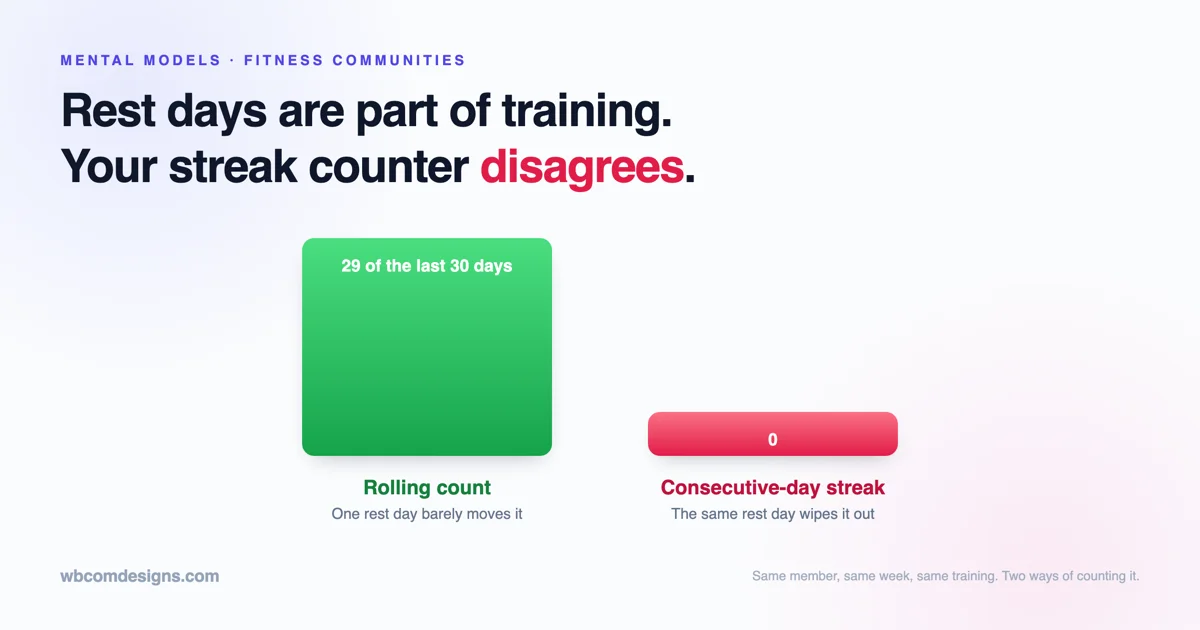
Fitness communities have a problem no other kind of community has. The thing they are trying to encourage requires rest, and the mechanics they use to encourage it punish rest.
A streak counter does not know the difference between a member who skipped because they lost interest and a member who skipped because their coach programmed a deload week. It resets both to zero. One of those members deserved it and the other was following instructions.
This is where loss aversion gets genuinely awkward in a fitness context. The fear of losing a streak is a powerful motivator, and in this specific domain it can motivate behaviour that is bad for the member.
The mechanic fights the physiology
Training adaptation happens during recovery, not during the session. Any coach will say this. Rest days are not a gap in the programme, they are part of it, and the same is true of the week off after a hard block and the six weeks after an injury.
Now put a daily streak on top of that. The member with a 120-day run is being told, in the clearest visual language your platform has, that the correct number of rest days is zero. When their body says otherwise they face a choice between the training and the counter, and a surprising number of people pick the counter.
What you get is members training through minor injuries to protect a number, then disappearing for two months when the minor injury becomes a real one. The streak mechanic did not cause the injury. It did remove the off-ramp that would have prevented it.
There is a second failure that is quieter and more common. A member breaks a long streak, feels the loss disproportionately, and concludes that the run is over in a way that makes returning pointless. The counter reading zero is a statement about their identity as much as their attendance. People do not come back from that quickly, and some do not come back at all.
What to count instead
The fix is not to abandon consistency tracking. Consistency is genuinely the thing that matters in fitness, more than intensity and far more than any single session. The fix is to count it in a way that survives an ordinary week.
| What you track | What a rest day does to it | What it teaches the member |
|---|---|---|
| Consecutive-day streak | Destroys it | Never stop, at any cost |
| Sessions per week, against a target | Nothing, if they hit the target | Plan your week; rest is budgeted |
| Rolling 30-day count | Barely moves it | One day is one day |
| Activity heatmap over months | Leaves one lighter square | Look at the pattern, not the last 24 hours |
| Streak with grace days | Absorbs it | Consistency tolerates real life |
The bottom three rows all describe the same underlying idea: give the member a view of their history where a gap is visibly small. A heatmap of the last ninety days showing sixty filled squares tells the truth about someone’s consistency. A counter reading 1 tells them they have nothing, which is false, and they know it is false, which is its own kind of damage to your credibility.
WB Gamification, a 100% free gamification plugin for WordPress, supports streaks with grace periods and milestone rewards at 7, 30, 100 and 365 days, so a rest day does not have to cost a member their run. Pair the counter with a longer view of activity, such as a calendar or heatmap of training days, so a gap reads as one day rather than a reset. Whether you configure grace periods generously or not at all is the actual decision, and it is yours rather than the plugin’s.
Leaderboards and the member who was fifth
Fitness communities love leaderboards, and leaderboards create losses on a schedule.
A member who has been in the top ten for three months and drops to fourteenth has lost something they held. Nothing about their training necessarily got worse. Someone else’s got better, or a new member arrived, or they took the rest week their programme called for. The loss is real to them regardless of the reason.
Two things make this manageable. The first is scoping: a leaderboard among everyone rewards volume and punishes anyone with a job, while a leaderboard scoped to a small group, a class, or a training block is a comparison between people in genuinely similar situations. Losing a place among fifteen people you know is a normal week. Losing a place among four thousand strangers is noise you have been asked to care about.
The second is resetting on purpose. A leaderboard that resets weekly or monthly makes falling a normal event rather than a loss, because everyone starts level again on a known date. Cohort leagues work on this principle, and it is a better fit for fitness than an all-time ranking that quietly punishes anyone who has been a member longer than they have been consistent.
The comeback problem
Every fitness community has members who were active, stopped, and have not returned. Injury, illness, a new job, a baby. The barrier to their return is rarely fitness. It is the account.
Logging back in means seeing the streak at zero, the rank collapsed, the badges that stopped at March. The platform greets them with an inventory of what they lost. That is a strange thing to do to someone who just decided to start again, and it is entirely a design choice.
The alternative is not to hide the history. It is to frame the return as a return rather than a restart. A community that can say welcome back and show the member the sixty sessions they did last year is telling them something true and useful. One that shows a zeroed counter is telling them something true and useless.
Practically, this means keeping historical achievements permanently rather than expiring them, separating lifetime totals from current-period metrics so a break only affects the second, and putting the returning member back into a group rather than leaving them to rejoin a leaderboard from the bottom.
A setup that respects rest
Put together, a fitness community that rewards consistency without punishing recovery looks something like this:
- Count sessions against a weekly target as the main measure, so a planned rest day is part of hitting it, not a failure.
- Keep a streak if members like it, but give it grace periods long enough to survive a deload week or a short illness.
- Show history over months, on a calendar or heatmap, next to any counter, so one gap stays visibly small.
- Scope leaderboards to small groups (a class, a training block, a Space for one discipline) and reset them on a known schedule.
- Make badges and lifetime totals permanent, separate from current-period numbers, so a break never erases what a member achieved.
- Welcome people back, with a message that shows what they did before and an invitation into an active group, rather than a profile full of zeros.
- Let coaches mark planned rest, where your tools allow it, so the community’s mechanics and the programme agree.
None of this makes the community less motivating. It moves the motivation from fear of a reset to the pull of people who notice when someone is missing, which is the kind that survives injuries, holidays and new babies.
Talking to members about rest
Mechanics are only half of it. The community’s own language matters too. Celebrate rest weeks in announcements the same way you celebrate personal bests. Ask coaches and long-standing members to post about their deloads, not only their hardest sessions. When someone returns from an injury, the first replies they see should be about the comeback, not about what they missed. Members copy what the community praises, so praise the behaviour that keeps people training for years.
A welcome-back message can be this simple, sent automatically or by a coach when someone logs a session after a long gap:
Welcome back, Sam. Last year you logged 64 sessions with us, and that work does not disappear. The Tuesday strength group meets tonight and has two other members easing back in. Start where you are; we will see you there.
It names what they did, points them to people rather than a ranking, and treats the return as the start of the next block rather than a restart from zero. Write two or three versions so regular returners do not see the same words each time.
How to tell whether it is working
Changing a streak rule is easy. Knowing whether it helped takes a few numbers you probably already have.
- Return rate after a break. Of the members who went quiet for two weeks or more, how many came back within the next two months? This is the number a punishing streak hurts most, and the one a welcome-back flow should lift.
- Weekly active members, not daily. Fitness is weekly by nature. A community where most members train three or four times a week is healthy even if the daily figure looks uneven.
- Drop-off right after a broken streak. If members who lose a long run tend to vanish within days, the counter is doing harm, whatever it does for engagement before the break.
- What members say in check-ins. Posts about training through pain to keep a run going are an early warning that the mechanic is winning over the programme.
Look at these for a few months before and after any change, and compare similar seasons, since January and summer behave very differently. A small fall in daily logins alongside a rise in members coming back after injuries is a good trade: you have swapped anxious attendance for a community people return to.
Where the honest version lands
A fitness community has an unusual amount of genuine value for a member to lose, and almost none of it is the counter. The training partners who notice when someone is missing. The coach who knows the member’s history. The record of what they lifted in January and can compare to now. Those are real, they are hard to rebuild elsewhere, and none of them require a mechanic that punishes rest.
Communities running on BuddyNext, the free community platform for WordPress, tend to express this as Spaces per discipline or per training group, where the thing a member would lose by leaving is a specific set of people rather than a position in a global ranking. That is the more durable form of the same pull, and it does not ask anyone to train on a day they should be resting.
The test from our main piece applies cleanly here. Is the loss real, and did the member build the thing they stand to lose? Sixty sessions is real. A counter that reads zero because of one Tuesday is not.
For the general mechanism, see loss aversion and why members fear losing what they have. For why a bigger community can paradoxically produce less individual engagement, see the Ringelmann effect.
Frequently asked questions
Are streaks good for fitness communities?
They build habits, but a daily streak with no grace period tells members that the right number of rest days is zero. Use weekly targets or streaks with grace periods, so consistency is rewarded without punishing recovery.
How do you stop members quitting after they break a streak?
Keep lifetime totals and badges permanent, show their history over months rather than a single counter, and greet returning members with what they achieved before and an active group to rejoin.
What should a fitness community track instead of daily streaks?
Sessions per week against a personal target, a rolling 30-day count, or a long-term activity calendar. Each rewards consistency while letting planned rest days count as part of the programme.
Should a fitness community use leaderboards?
Yes, if they are scoped to small groups and reset on a known schedule. An all-time leaderboard across the whole community rewards volume and punishes anyone who rests, works or gets injured.
Related reading