
7 min read
The 90-9-1 Rule for Online Communities

Open the member list of almost any online community and you’ll find the same shape underneath, no matter what the community is about. Roughly ninety percent of the people in it will never post anything at all. About nine percent will show up occasionally, a comment here, a reaction there. And somewhere around one percent will account for most of what actually gets created: the threads that start conversations, the answers that get bookmarked, the posts that make a stranger decide to stay. That’s the 90-9-1 rule, and it isn’t a warning sign. It’s the physics of the room you’re standing in.
I used to read that ratio as a problem to solve, a leaky funnel where 90% of the people I’d worked hard to bring in were “wasted.” If you’ve read the piece on the growth loop, you already know where that thinking goes wrong: it treats silence as absence, when most of the time it’s just a different kind of presence.
In this pieceWhat the split actually says
Why this isn’t a bug in your community
The wrong goal: trying to convert the 90%
The real job: protecting the 1%, rewarding the 9%
People move between the three groups more than you think
A real panel, not a mockup
How the ratio shows up by what you’re running
The one move that matters this week
What the split actually says
The numbers aren’t exact, and nobody who cites them means them to be. What they’re pointing at is a shape: participation in any group, online or off, distributes unevenly, and it distributes unevenly by a wide margin, not a little one. A handful of people do most of the visible work. A larger group does some of it, sometimes, when something specific pulls them in. And the majority, the actual majority, watches.
Jakob Nielsen popularized the numbers back in community forums and wikis, long before “community platform” was a product category. The ratio has held up, loosely, across contexts wildly different from each other: open-source contributors, Wikipedia editors, Reddit threads, brand forums, course cohorts. Not because ninety is a magic number. Because the underlying cause, the effort gap between reading and writing, is the same everywhere.
Why this isn’t a bug in your community
Reading a post costs a few seconds. Writing one costs a decision: what to say, how to say it, whether it’s worth the exposure of saying it in front of people who might disagree. That gap in cost is where the 90% live, and no amount of “engagement” nudging closes a gap that’s structural rather than motivational. You are not failing to activate them. You’re asking them to cross a cost they were never going to cross for a comment box.
Sit with that for a second, because it changes what you’re actually managing. You are not managing a community of contributors with a rounding error of lurkers attached. You’re managing a small core of contributors, a slightly larger ring of occasional participants, and a much larger audience that reads without writing, and all three groups need the community to keep existing, or none of the value gets made or gets consumed.
The wrong goal: trying to convert the 90%
The most expensive mistake I see is a community team that sets “reduce lurking” as a KPI. It sounds reasonable. It’s usually a trap. The 90% aren’t a conversion funnel stuck at the top; they’re the actual audience the 1% is performing for, whether either group realizes it or not. A thread with three replies and four hundred silent readers isn’t underperforming. It’s doing exactly what it was for.
Chase the 90% hard enough and you’ll usually get one of two outcomes, neither good. Either you annoy them with prompts and gamified nudges until some of them leave entirely, or you succeed in getting low-effort posts out of people who had nothing to say, which dilutes the feed the 9% and the 1% actually rely on to find each other. Either way you’ve spent real effort making the community slightly worse for the people who were doing the real work.
The real job: protecting the 1%, rewarding the 9%
If the 90% aren’t the lever, what is? The other two groups, and they need almost opposite treatment. The 1% need protecting more than they need motivating. They’re already motivated, that’s what makes them the 1%, and the fastest way to lose them is to let moderation lapse, let low-value noise bury their posts, or quietly extract their labor without ever acknowledging it came from a person rather than “engagement.”
The 9% are a different job entirely: they need a reason to cross the line one more time than they otherwise would. Not a badge for its own sake, a genuine signal that showing up occasionally was noticed and mattered. A reply from a real person. A small piece of recognition attached to something they actually said. The 9% are the group most responsive to structure, because they’re already halfway across the cost gap that stops the 90% cold.
People move between the three groups more than you think
Here’s the part that gets missed in most explanations of this ratio: it’s not three castes, it’s three states, and people move through all of them over the life of a single membership. Someone lurks for two months, posts one comment during a topic they happen to know well, gets a genuine reply, and posts again the next week. That’s a 90%-to-9% transition, and it happened because something crossed the cost gap for exactly one moment, not because a dashboard nudged them.
The 1% were the 9% once too, usually for longer than anyone remembers, before some specific moment, a thread they knew more about than anyone else, a question nobody had answered well, pulled them the rest of the way in. Your job isn’t to convert the 90% en masse. It’s to keep enough low-friction, well-timed crossing points open that the drift between states keeps happening one person at a time, the way it always actually does.
A real panel, not a mockup
Here’s what that structure looks like when it’s working, not as a diagram but as an actual space.
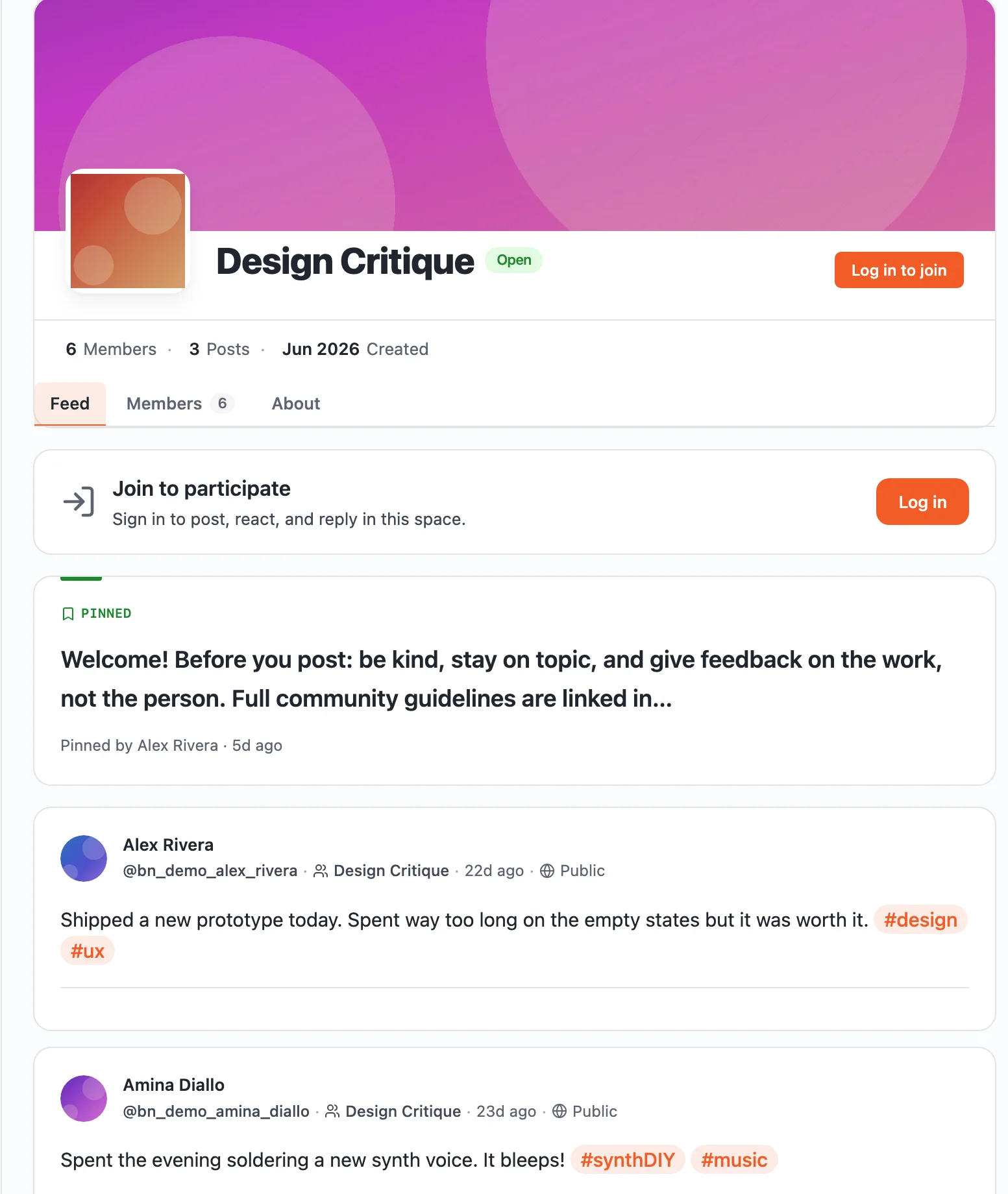
This is a real, public Space, reachable without an account. The pinned rules at the top are a small act of protecting the core: they tell a newcomer what this place is for before they ever have to learn it the hard way from a stranger’s tone. The posts underneath come from a small, consistent set of contributors, not the entire membership, and that’s not a shortfall. It’s exactly what a healthy 1% looks like from the outside: a handful of people carrying a conversation that a much larger, silent audience is reading.
How the ratio shows up by what you’re running
The 90-9-1 split holds everywhere, but what the 1% are actually doing changes by niche, and it’s worth naming the difference rather than treating every community the same. In a brand community, the 1% are usually your most burnable, most valuable unpaid staff. In a course community, the 9% asking questions in discussion are a better retention signal than anything in your analytics dashboard. In a fitness community, the 1% posting results are doing marketing you couldn’t otherwise afford. In a hobbyist community, the split is often healthier than founders assume, and the real mistake is trying to fix a ratio that was never broken.
If you’ve read the piece on the viral coefficient, there’s a direct connection here worth naming: the invitations that actually convert almost always trace back to something the 1% made, not something the 90% did. Protecting the people who create the value and the growth math both point at the same small group.
The one move that matters this week
You don’t need a program to act on this ratio. You need one habit: this week, find the handful of people doing the real work in your community, and tell them, specifically, what they made and why it mattered. Not a mass email. Not a badge auto-awarded by a script. A real reply from a real person who noticed.
Then look for one person sitting in the 9%, someone who commented once or twice, and give them a reason to do it again, a direct question only they can answer, a genuine thank-you attached to their name. That’s the whole mechanism. Not converting the 90%. Not measuring engagement. Just keeping the door open for the handful of people who were always going to walk through it, if someone noticed when they did.
Looking for a free alternative to GamiPress or myCred? Explore WB Gamification, our 100% free engagement layer featuring Duolingo-style cohort leagues, daily login streaks, and zero add-on fees.
Read Article → Explore WB Gamification →Related reading