
7 min read
The Growth Loop Your Community Doesn’t Have

Most communities run on a funnel, not a loop, and almost nobody notices until they try to explain why growth feels harder every single month instead of easier.
A funnel is linear. Money or effort goes in one end, members trickle out the other, and the moment you stop pushing, it stops producing. A loop is different. A loop takes what one member produces and turns it into the reason a stranger shows up next month, without you paying for it again. If you read the piece on choosing a North Star Metric, that metric tells you whether this week worked. A growth loop tells you something different and arguably more important: whether next month is going to be easier than this one, or exactly as hard.
In this pieceWhat a growth loop actually is
The part nobody notices they’re missing
What this actually looks like on a real platform
The three things a loop actually needs
The failure that looks like success
The pushback: “but I don’t want everything public”
Where this actually lives inside BuddyNext
What the loop actually looks like depending on what you’re running
The test, if you want one
What a growth loop actually is
The structure is short enough to hold in your head: Input, Action, Output, and then the output becomes the input for the next cycle. Someone shows up (Input), does something (Action), and what they produce (Output) is the thing that pulls the next person in. Not a metaphor, an actual mechanical loop, the same one that makes a compounding system compound.
A funnel never closes that circle. Someone shows up, does something, and the output stays inside, visible only to people who already joined. You got one member’s worth of value from that action and nothing else. Do it again next month, pay again, chase again.
A gym membership is a funnel. A gym where members post their transformation photos somewhere strangers can see them, and strangers show up because of it, is a loop. Same gym, same members, completely different growth math.
The part nobody notices they’re missing
Here’s the uncomfortable diagnostic. Take one genuinely good piece of content your community produced this month, a great answer, a real transformation, a finished project someone was proud of. Now trace it. Did it ever reach a single person who wasn’t already a member?
For most communities, the honest answer is no. Not because the content wasn’t good. Because it was born behind a login wall, in a private space, in a platform that doesn’t let search engines or outsiders see a single pixel of it without an account first. The content was excellent and it changed nothing about next month’s growth, because it never left the room.
A community with no loop isn’t failing. It’s just permanently, structurally dependent on you bringing in every single new member yourself, forever, because nothing it produces internally ever escapes to do that work for you.
What this actually looks like on a real platform
This is easier to see with something concrete instead of a diagram, so here’s a real one.
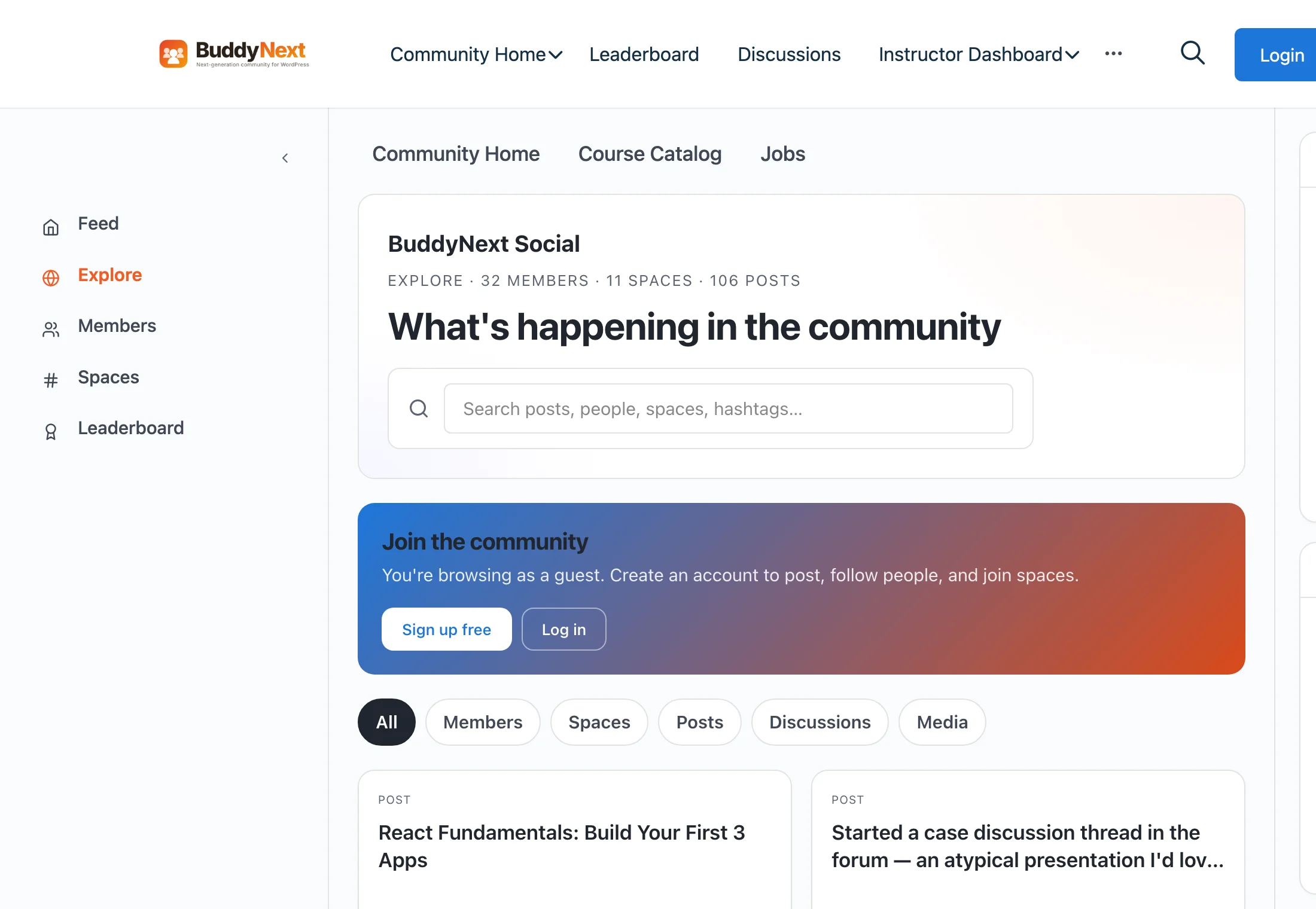
That’s a real, publicly reachable page, not a members-only feed. It was loaded as a logged-out guest, no account, no session, and it still shows real posts, a real search bar, and real people to discover. Anyone who lands on it from a search engine or a shared link sees actual content without logging in first. That’s the entire mechanical difference between a loop and a funnel, made visible in one screenshot. If that page required an account to view, the loop would already be broken before it started.
The three things a loop actually needs
Skip any one of these and the loop stops closing, no matter how good the community is otherwise.
The output has to be visible outside the walls. Not eventually, not after someone joins, before. If the only way to see a member’s great answer is to already be a member, you’ve built a funnel wearing a loop’s marketing copy.
The output has to stand on its own. A screenshot that only makes sense with context nobody outside has is not going to pull anyone in. A finished project, a solved problem, a public certificate, those work because a total stranger can understand the value without any onboarding at all.
And the path from encountering it to joining has to be short. If a stranger finds something great and then hits a five-step signup flow with a credit card field, most of them bounce before the loop ever closes. The gap between “I found this” and “I’m in” has to be small enough that curiosity survives the trip.
The failure that looks like success
The specific trap is that a community can look completely healthy by every internal number while having zero loop at all. Engagement’s fine. Posts are happening. Members are helping each other. And every single one of those good outcomes is trapped, so none of it is doing a single thing for next month’s growth.
This is why a thriving-looking community can still be entirely dependent on ads, cold outreach, or the founder personally posting on social media every week to bring in new people. The community itself never got a chance to pull its own weight, because it was never built to let anything out.
The pushback: “but I don’t want everything public”
Fair, and this isn’t an argument for making the whole community public. Most of what happens inside a healthy community should stay inside, the vulnerable questions, the half-formed ideas, the conversations that only work because everyone in them already trusts each other. Forcing all of that into public view would kill the very thing that made it worth joining.
The loop doesn’t need everything. It needs a small, deliberate slice, the pieces that are genuinely impressive or useful on their own, made visible on purpose. A certificate. A finished project. A resolved public question. That’s a curation decision, not a privacy sacrifice, and it’s usually a much smaller list than people assume before they actually sit down and make it.
The second version of this pushback is quieter: “our members would feel exposed.” That’s worth taking seriously, and the fix isn’t forcing exposure, it’s opt-in. Let the member choose to make their certificate public, choose to share their transformation, choose to let their answer be indexed. The loop still closes. It just closes through consent instead of default settings nobody agreed to.
Where this actually lives inside BuddyNext
If you’re running the community on BuddyNext, the free tier already ships the piece most platforms charge for or skip entirely: Explore and unified search that work with JavaScript off, meaning the content is genuinely server-rendered and reachable, not trapped behind a client-side app that only renders after login. Hashtags with trending are the same idea from a different angle, a real aggregation surface a stranger can land on without an account.
None of that guarantees a loop by itself. You still have to choose to make the right content public, still have to make the join step short. But it removes the excuse that the platform made it impossible. The mechanical piece is there for free, the same way the tracking piece was in the walkthrough on tracking your North Star Metric inside BuddyNext, this is the companion decision: know if this week worked, and know if what you produced this week is doing any work for you next month.
What the loop actually looks like depending on what you’re running
The mechanics change shape by niche, the same way the value moment did in the North Star Metric series. A brand community’s loop runs on a customer’s public answer ranking in search and reaching the next customer with the identical problem before they ever open a ticket. A course’s loop runs on a public, verifiable certificate a student is proud enough to put on LinkedIn, doing recruiting work no ad ever could. A fitness community’s loop runs on a shared result, a streak, a transformation, something a friend sees and wants for themselves. A hobby community’s loop runs on a finished project escaping the platform entirely, screenshotted and shared somewhere the next hobbyist happens to be scrolling.
Four different mechanisms, same underlying test in every one: does what gets made inside ever reach someone who isn’t already in.
The test, if you want one
Pick the single best thing your community produced this week. Not the average post, the best one. Now ask honestly whether a total stranger, no account, no context, could stumble onto it and understand why it’s worth their time.
If the answer is no, you don’t have a loop yet. You have a funnel with good content trapped inside it, and next month is going to cost exactly as much as this one did, in ads, in outreach, in you personally showing up to bring in every new face by hand.
Fix the leak at the output, not the input. Everyone’s instinct is to spend more on the top of the funnel. The cheaper fix, and the one that actually compounds, is making sure the thing your best members already made this week has somewhere to go.
Related reading