
4 min read
The 90% Silently Finishing Your Course Aren’t Lurkers


Course communities have a version of the 90-9-1 rule that trips people up in a specific way: the 90% here aren’t idly scrolling, they’re doing the actual thing you sold them, watching lessons, taking quizzes, working through the material, without ever posting a word in the discussion area. Treat that silence as disengagement and you’ll misread your best students as your least invested ones.
The real signal isn’t in the 90% at all. It’s in the 9% who show up in discussion, and once you see why, it changes what you watch first every week.
Silent completion isn’t lurking
A student who finishes every module, passes every quiz, and never posts once has done exactly what the course promised: they learned the material. Posting in a discussion thread was never part of that transaction, and plenty of adults learning a new skill in their limited spare time have zero interest in performing that learning publicly. Reframe them from “the 90% we haven’t activated” to “the majority who are getting what they paid for,” and a lot of misguided community tactics stop making sense as a priority.
That doesn’t mean discussion is worthless, it means it’s a different instrument measuring a different thing. If completion tells you whether the content works, discussion tells you whether the content is landing in a way people want to talk about, which is a much earlier warning system for a course that’s about to have a retention problem.
Why the 9% are your earliest warning system
A question posted in module three, “wait, does this apply if I’m using the older version,” is a small act of visible confusion, and visible confusion is data the silent 90% never give you. For every person who asks a question out loud, there are usually several more hitting the identical wall quietly, either muscling through confused or quietly falling behind and eventually not finishing at all. The 9% who ask are, without meaning to, running your retention diagnostics before churn ever shows up in a report.
This is the piece worth watching weekly, not monthly: not how many people posted, but what they got stuck on. A cluster of similar questions around the same lesson is a much faster signal that something needs fixing than waiting for a cohort’s completion numbers to quietly dip a month later.
A real space paired to a real course
Here’s what that discussion layer looks like attached to an actual course, not a mockup.
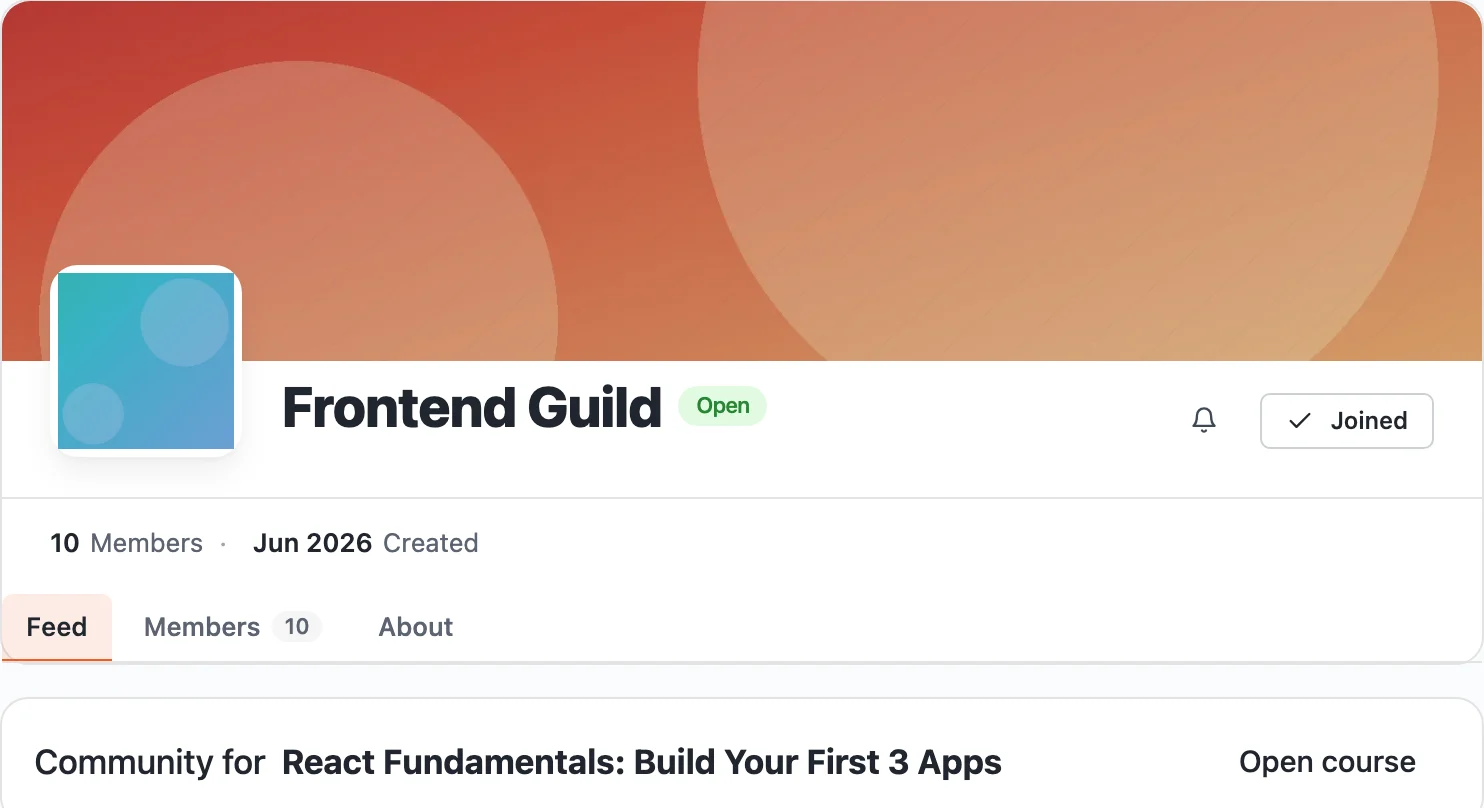
This is a real course-linked Space, the kind of pairing where a question posted here is genuinely close to the lesson that prompted it, not buried in a generic catch-all forum three clicks away. That proximity matters more than it looks: the closer discussion sits to the exact point of confusion, the more of the 9% will actually cross the gap and ask, instead of closing the tab and quietly falling behind.
The ratio shifts between cohort and evergreen courses
The 90-9-1 split isn’t identical across every course format, and it’s worth knowing which one you’re running before you worry about a discussion board that looks quiet. A live cohort, where everyone moves through the material together on a shared schedule, naturally pulls more of the 9% into visible participation, because a question posted this week is still relevant to classmates who are on the exact same lesson right now. The shared timing does some of the activation work for you.
An evergreen, self-paced course has no such shared moment. A student hitting module three in isolation, with no cohort moving alongside them, has less reason to post a question that nobody else is currently positioned to see as relevant. That’s not a sign your evergreen course is failing at community the way a cohort would be; it’s a structurally quieter format, and holding it to a cohort’s discussion volume is comparing two different mechanisms as if they were one.
Instructor time is the scarce resource, so triage it
Not every question from the 9% needs the instructor personally. A teaching assistant, or a returning student who’s already solved the exact problem, can answer most of the routine confusion faster and just as well, which frees the instructor’s limited time for the handful of questions that actually reveal a real gap in the course itself. Answering everything personally feels generous. It’s often a worse use of the one resource, instructor attention, that’s hardest to replace.
The instructor’s job is narrower and more valuable than answering every thread: watch for the pattern across questions, not the individual question, and step in personally only when a real fix to the course is called for.
What to actually track instead of headcount
Drop “posts per week” as a health metric for a course community. It rewards volume, not signal, and volume from a discussion board full of confused students looks identical, on a dashboard, to volume from a thriving one. Track something narrower instead: which lessons generate the most questions relative to their enrollment, and whether the same question keeps recurring across cohorts without ever getting folded back into the lesson itself.
Then close the loop publicly. When three students ask a version of the same question, answer it once, visibly, in the thread, and consider it a bug in the course content rather than a gap in the student. That single habit does more for the silent 90% than any prompt asking them to “introduce yourself in the community,” because it fixes the actual thing they were quietly struggling with, whether or not they ever said so out loud.
Looking for a self-hosted LMS with zero platform fees? Explore Learnomy, our standalone WordPress academy engine with direct Stripe/PayPal checkouts, Ed25519-signed certificates, and LearnDash importers.
Read Article → Explore Learnomy →Related reading