
4 min read
The 1% Posting Results Are Your Best Marketing Channel

Fitness communities make the 90-9-1 rule unusually visible, because the 1% here aren’t just talking, they’re posting proof: a photo of the finished race, a screenshot of a personal record, a before-and-after nobody asked them to share. That single post does more honest selling than any page on your site ever will, and most fitness communities barely notice they’re sitting on it.
The 90% who log workouts privately, never posting a thing, aren’t failing to engage. They’re using the tracking half of the product exactly as intended. The marketing is happening somewhere else entirely, in the small stream of results the 1% choose to make public.
Results are shareable in a way most content isn’t
A finished 5K time, a strength milestone, a visible before-and-after: these carry their own proof, no caption required. That’s rare. Most community content needs context to land with a stranger; a fitness result mostly speaks for itself, which is exactly why one post from your 1% can pull in a new member the way a well-run ad campaign would, at zero media spend.
This is where the 90-9-1 split stops being a management problem and starts being a distribution channel, if you treat it that way on purpose instead of hoping it happens.
The mistake: treating every member like a potential poster
The instinct, once you notice how valuable a posted result is, is to push everyone toward posting: streak reminders, “share your progress” prompts, gamified badges for going public. Most of this pressure lands on the 90%, who were never going to post regardless, and it does nothing for the actual lever, because the 1% already post without being asked. Prompting doesn’t create willingness. It just annoys the people who weren’t going to comply anyway.
The better use of that energy is making it effortless for the people who are already inclined to share. Not a mandatory checkbox, a low-friction, well-placed moment right after a milestone is logged, when the impulse to show someone is already at its highest and the only thing standing between them and a post is one extra tap.
A real achievements page, not a mockup
Here’s what that visible proof looks like on an actual public page.
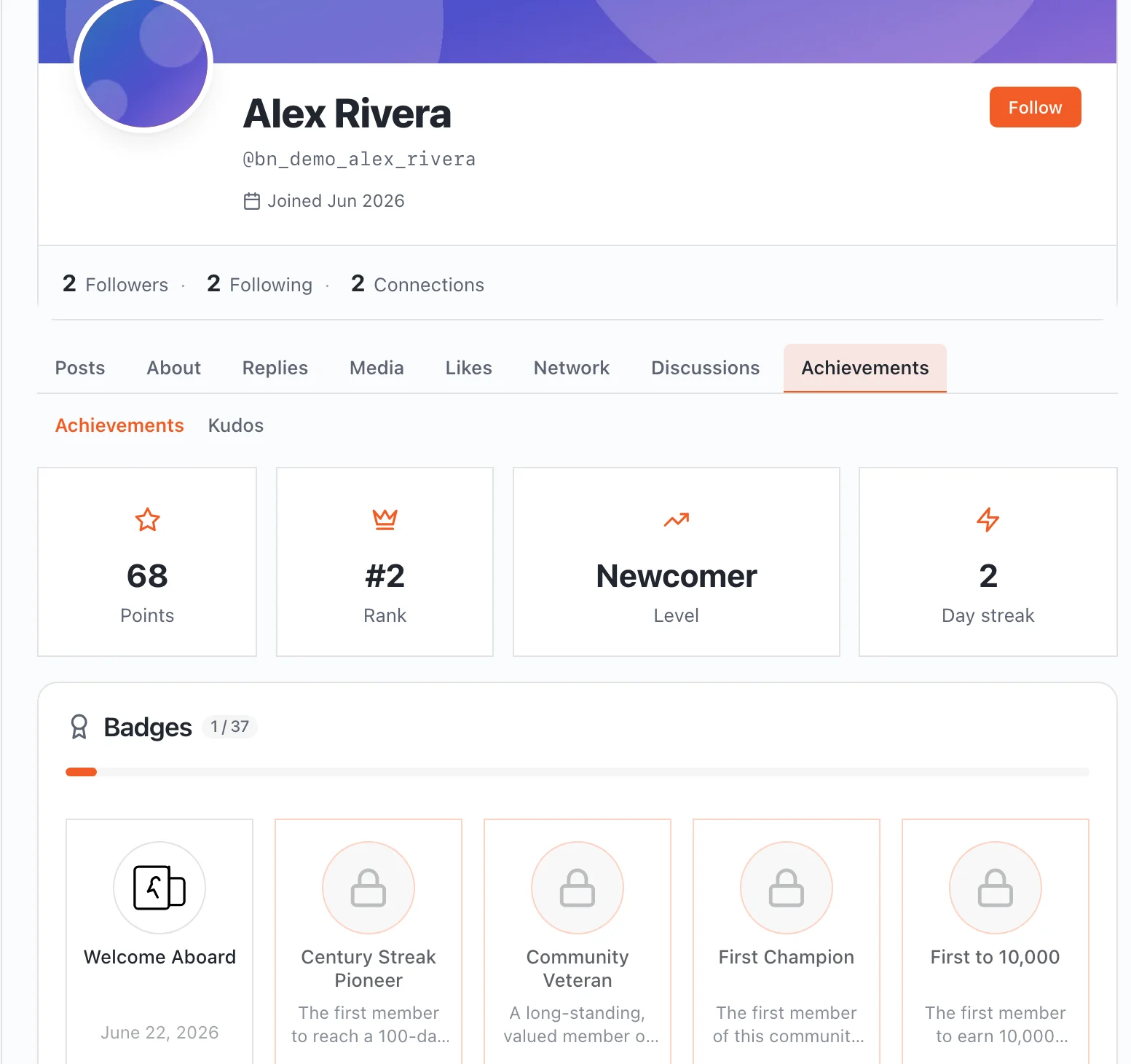
This is a real, public achievements page, reachable without an account. A page like this does two jobs at once: it gives the poster a real reason to share their own profile, and it gives anyone who lands on it, invited or just searching, visible proof that the community rewards real results rather than empty participation. Notice this member hasn’t unlocked most of the available badges yet. That’s honest, and honesty is part of what makes a shared result convincing to a stranger deciding whether to join.
Not everyone wants their fitness journey visible, and that’s fine
There’s a version of this ratio that’s easy to miss if you only look at the numbers: some of the 90% aren’t quiet because they lack a result worth sharing. They’re quiet because a fitness journey can be a genuinely private thing, tangled up with body image, weight history, or a slow start they’re not ready to make public yet. Pushing everyone toward visibility ignores that a meaningful share of your membership has a real reason to keep their progress to themselves, and no amount of prompting closes that gap, because it was never about friction to begin with.
That’s a reason to make sharing easy for the people who want it, not a reason to treat non-sharing as an engagement failure to be solved. A private log that’s genuinely useful on its own, no audience required, is doing its job for that member, even if it never produces a single public post.
Solo pursuits and group sports don’t share this ratio evenly
A running or lifting community, built around individual results, tends to have a sharper 90-9-1 split, because the achievement genuinely belongs to one person and sharing it is a personal choice each time. A team-sport or group-class community behaves a little differently: a shared game or class result gives multiple people a reason to post about the same event, which quietly widens the 9% without anyone deliberately trying to widen it.
Neither shape is better. It’s worth knowing which one you’re actually running before assuming a quiet solo-sport community needs the same fix a quiet group-sport one might.
What to actually do with this
Stop measuring “posts per member” as your engagement number. It’s the wrong denominator. Track instead how many of your genuine milestone moments, PRs, race finishes, weight goals, actually get shared publicly, and work on lowering the friction at that exact moment rather than nagging the whole membership generally.
Then go find your current 1% and ask them, directly, what would make sharing a result feel worth doing again next time. Not a survey. A conversation. The answer is rarely “more badges.” It’s usually something closer to “someone noticed the last one,” which costs you nothing and is the entire reason a public achievements page works better than any push notification you could design.
Related reading