
8 min read
The Viral Coefficient For Online Communities


There’s a single number that tells you whether your community grows itself or whether you have to grow it by hand forever. It’s called the viral coefficient, usually written K, and it’s not a vibe or a vague sense of momentum. It’s arithmetic. Every existing member sends some number of invitations, some fraction of those invitations convert into new members, and multiply those two together and you get the number of new members each current member brings in on average. If that number is above one, the community grows on its own. If it’s below one, it doesn’t, no matter how good it feels inside.
Almost every community’s K is below one, and this piece is partly about making peace with that. If you’ve read the piece on the growth loop, the viral coefficient is the math underneath it, the actual formula that turns “does our community compound” from a feeling into a number you can calculate and, more importantly, move.
In this pieceThe formula, and what each half means
Why almost every community’s K is below one
Why K below one is usually fine, and sometimes the goal
The two levers, and which one to actually pull
The friction tax on the conversion half
A real conversion surface, not a diagram
The trap: chasing virality instead of compounding
Where this lives inside BuddyNext
How K breaks down by what you’re running
The test, if you want one
The formula, and what each half means
K equals the average number of invitations each member sends, multiplied by the average rate at which those invitations convert into new members. Two numbers, multiplied. That’s the whole thing. A community where each member invites four people and one in four accepts has a K of one, exactly at the break-even line. Bump either number and you cross into self-sustaining growth. Drop either and you fall back into needing outside acquisition to grow at all.
What makes this useful rather than just tidy is that the two halves are completely different problems with completely different fixes. The first half, invitations sent, is about motivation and mechanism, whether members want to bring people in and whether it’s easy to do. The second half, conversion rate, is about what a newly-invited person actually lands on and whether it’s worth joining. You can be great at one and terrible at the other, and the multiplication is unforgiving: a huge number of invitations times a near-zero conversion rate is still near zero.
Why almost every community’s K is below one
The honest reason is that both halves are hard, and they’re hard in ways that compound against each other. Most members never invite anyone, not because they dislike the community, but because nothing ever prompted them to and there was no obvious moment or mechanism for it. So the average invitations-per-member number is usually far lower than founders assume, often well under one before conversion is even considered.
Then the conversion half takes another bite. Even when a member does share, the person on the receiving end lands on something, a signup wall, an empty-looking page, a community whose value isn’t obvious in the first ten seconds, and most of them bounce. Multiply a small invitation number by a small conversion rate and you land well below one, which is exactly where most real communities sit. That’s not a failure. It’s the default, and pretending otherwise is how founders end up chasing a viral moment that was never mathematically available to them.
Why K below one is usually fine, and sometimes the goal
Here’s the reframe that matters most. A viral coefficient above one means true exponential growth, and true exponential growth is both rare and, for most communities, not actually the right target. A K of, say, 0.5 doesn’t mean the community is dying. It means every two members bring in one more on their own, which meaningfully amplifies whatever other acquisition you’re doing, cutting the real cost of every new member roughly in half.
That’s compounding, not virality, and compounding is the durable, achievable version of the goal. A community that reliably runs at K of 0.4 or 0.6, paired with steady ordinary acquisition, grows faster and cheaper every single month than one obsessed with hitting the mythical K above one. The trap isn’t having a K below one. The trap is treating a below-one K as a problem to be fixed with a viral gimmick instead of a number to be steadily, unglamorously improved.

The two levers, and which one to actually pull
Because K is a multiplication of two numbers, you improve it by improving either half, and the two require completely different work. Raising invitations-per-member means giving people real reasons and real moments to invite others: a natural point in the experience where sharing makes sense, a member whose achievement is worth showing off, a discussion someone genuinely wants a friend to see. Raising conversion means making sure that when an invited person arrives, they land on something obviously alive and obviously worth joining, not an empty room or a wall.
For most communities, the conversion half is the higher-leverage lever early on, because it’s usually the more broken of the two and because improving it makes every existing invitation worth more retroactively. There’s no point driving more invitations into a funnel that converts almost nobody. Fix where invited people land first, then work on getting more of them invited. The order matters, and most founders get it backwards.
The friction tax on the conversion half
The single most common, most fixable drag on the conversion half is friction at the join step. Every additional thing you ask an invited person to do before they experience any value, create an account, verify an email, fill out a profile, get past a paywall, cuts the conversion rate again, and because K is a multiplication, each cut hits the whole coefficient. A community that requires an account just to see what’s inside is taxing its own viral coefficient at the exact moment it can least afford to.
The fix is letting an invited person experience real value before asking them for anything. If they can land on a shared link and immediately see genuine, alive content, real people, real discussion, without a wall in the way, the conversion half of K climbs, and it climbs for every invitation at once. Lowering join friction is often the single highest-return move available on the entire coefficient.

A real conversion surface, not a diagram
Here’s what a strong conversion surface actually looks like, reachable without an account.
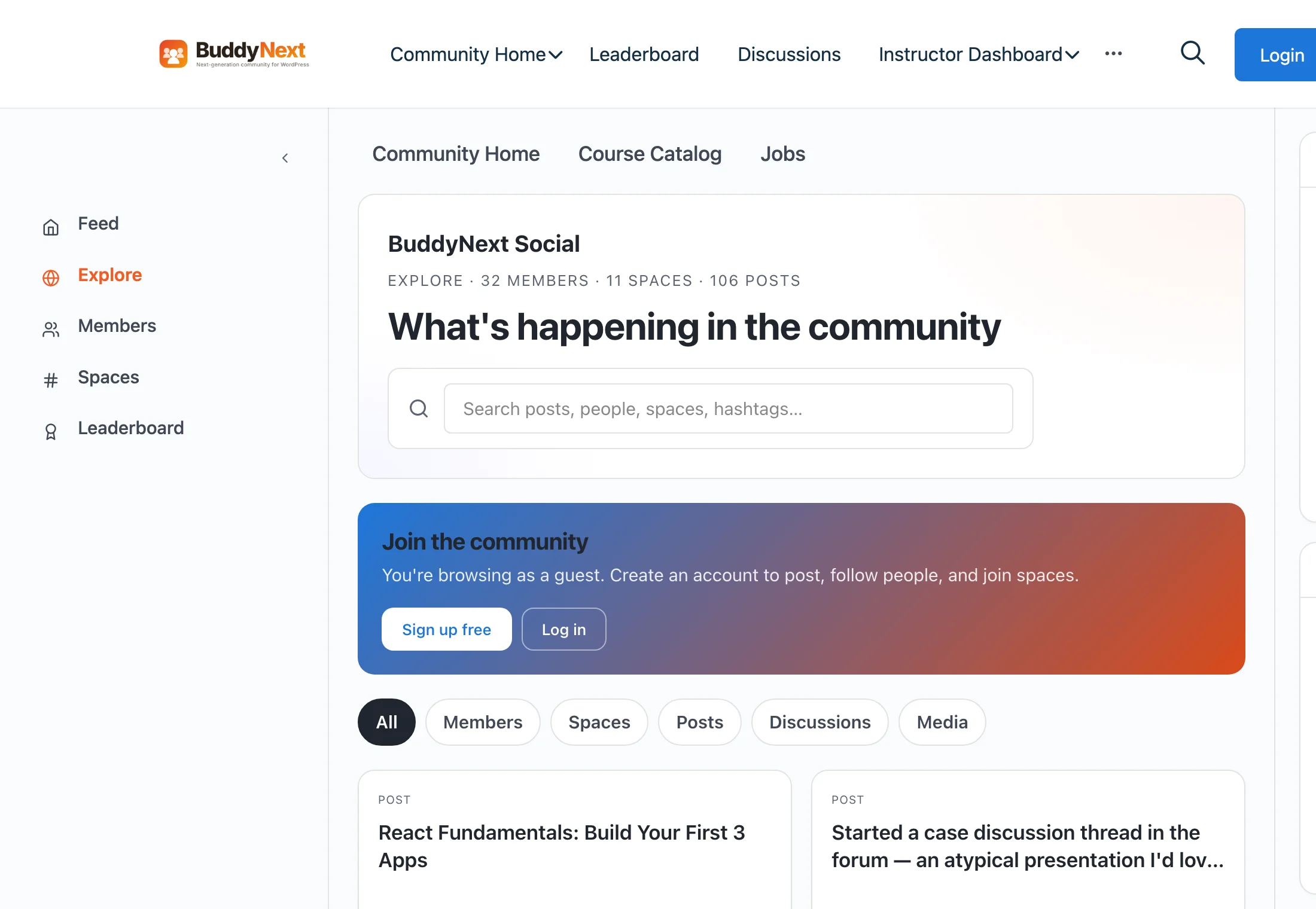
This is a real, public page, loaded as a logged-out visitor, no account, no session. Someone who follows a shared link lands here and immediately sees real posts, real people, a real search bar, proof that the community is alive, before being asked to sign up for anything. That’s the conversion half of K working as it should: the invited person experiences value first and decides to join second. If this page had been a login wall instead, the identical number of invitations would have converted a fraction as many people, and the whole coefficient would have dropped with it.
The trap: chasing virality instead of compounding
The specific failure the viral coefficient exposes is the founder who pours effort into a viral gimmick, a referral contest, a gamified invite blast, a share-to-unlock scheme, while the conversion half of their K sits broken underneath it. The gimmick temporarily lifts the invitation number, but the invited people still land on the same weak surface and still don’t convert, so the coefficient barely moves and the founder concludes virality “doesn’t work for us.”
Virality was never the realistic goal. A steadily improving K, driven by real reasons to invite and a genuinely strong place to land, is. The communities that look like they went viral almost never did in the mathematical sense. They just quietly got their K from 0.3 to 0.7 and let ordinary acquisition compound on top of it, which produces growth that looks explosive in hindsight and felt like patient, unglamorous work the entire time it was happening.
Where this lives inside BuddyNext
If you’re running the community on BuddyNext, both halves of K have real levers. On the invitation side, native invites and shareable public content give members real, low-effort ways to bring people in. On the conversion side, the same public Explore and search covered in the growth loop piece means an invited person lands on something alive rather than a wall, and social login removes a chunk of the friction tax at the join step. None of it forces a K above one. It just removes the platform-level excuses for a K lower than it should be.
How K breaks down by what you’re running
What counts as an invitation and what drives a conversion change shape by niche, the same way the growth loop’s mechanics did. A brand community’s K often runs on a public answer reaching the next customer through search rather than a literal invite at all. A course community’s K runs on a shared certificate that converts a stranger in the graduate’s network. A fitness community’s K runs on a shared result that a friend wants for themselves. A hobbyist community’s K runs on finished work escaping the platform and pulling in the next person who searches for exactly that thing. Four different invitation mechanisms, one identical equation underneath.
The test, if you want one
You don’t need perfect analytics to estimate your K. Over a recent stretch, roughly how many new members came from an existing member sharing, inviting, or being seen, divided by the number of members you had. That’s a rough K. It will almost certainly be below one, and that’s the starting point, not the verdict.
Then ask the more useful question: of the two halves, which is more broken, are members barely inviting anyone, or are invited people barely converting when they arrive. Fix the more broken half first, usually conversion, usually friction. You don’t need to reach a K above one. You need to move it from wherever it is toward wherever it could be, because even a small, steady improvement in a compounding number is worth more than a viral moment you were never going to get.
Related reading