
6 min read
Small Headcount, Large Value: Sizing A Certification Market

A certification course inverts the usual relationship between market size and value. Its addressable market, counted in people, is often small, sometimes a specific profession, a specific compliance requirement, a specific industry role. And yet it can be a far larger business than a consumer course with a hundred times the headcount, because the buyer is frequently an institution, the value per unit is high, and the willingness to pay is set by regulatory or professional necessity rather than personal discretion. Small headcount, large value, is the certification market’s defining shape.
If you’ve read the piece on market sizing for course businesses, this is the certification version, where a small addressable headcount hides a large addressable value.
In this pieceCount value, not heads
The institutional buyer changes the market
The real SOM: contracts, not students
The trust gate on your obtainable market
A real verifiable credential, the product itself
Why a narrow market is the advantage
Where this lives inside Learnomy
The test, if you want one
Count value, not heads
The instinct with any course is to size the market by headcount, how many people could take it. For a certification course, that instinct badly understates the market, because it counts each person as one small consumer sale when the real transaction is often an institution paying a premium for documented, verifiable proof. A certification market of a few thousand people can be worth more than a consumer market of hundreds of thousands, because value per unit, not headcount, is where the size actually lives.
So the first correction is to size the market in value, not people. The addressable market isn’t the number of individuals who might get certified, it’s that number times what certification is actually worth to whoever pays for it, which for compliance and professional credentials is frequently a large multiple of a consumer course price. A small, alarming headcount often conceals a genuinely large addressable value.

The institutional buyer changes the market
The defining feature of a certification market is that the buyer is frequently not the student. An employer purchases compliance training for its staff. A professional body requires and reimburses continuing education. A company budgets for certifying its team. This changes the market’s shape fundamentally: price sensitivity drops, because the person choosing isn’t paying personally, and the sale is often one transaction covering many students rather than many individual purchases.
This is why certification markets are measured in contracts and seats-per-contract, not individual enrollments. One institutional deal can be worth what hundreds of consumer sales would be, and it converts through procurement rather than a checkout page. The market you can obtain isn’t a count of interested individuals, it’s a count of institutions you can reach and win, times the seats each represents, which is a completely different, and usually far more valuable, calculation.
The real SOM: contracts, not students
The honest obtainable market for a certification business is the number of institutional relationships you can realistically win, times the seats each brings, times the price, plus whatever direct individual sales exist alongside. It’s a contract-based number, not a student-based one, and it’s often surprisingly concentrated, a handful of significant institutional relationships can constitute most of the obtainable market, which makes each one disproportionately important.
This concentration cuts both ways. It means the obtainable market can be captured through a manageable number of relationships rather than mass marketing to individuals, which suits a small team. But it also means each relationship carries real weight, and losing or failing to close a major institutional deal removes a large chunk of the obtainable market at once. Sizing this business means thinking in named accounts, not in a diffuse population of learners.
The trust gate on your obtainable market
A certification market has a gate no consumer course faces: the credential has to be trusted by whoever relies on it, or the entire value collapses. An institution won’t pay a premium for certification that its own auditors, regulators, or hiring managers won’t accept. This means a chunk of your theoretically addressable market is unobtainable until the credential is genuinely credible, verifiable, defensible, and, where it matters, appropriately accredited.
The trust gate is often the real binding constraint on a certification business’s obtainable market, more than reach or demand. A course with weak, unverifiable credentials has a small obtainable market even in a large addressable one, because the buyers who most value certification are precisely the ones who most scrutinize it. Widening the obtainable market frequently means strengthening the credential’s credibility, not reaching more people, the exact infrastructure point the burn rate piece on certification makes about upfront cost.
A real verifiable credential, the product itself
Here’s what the actual product a certification market buys looks like, reachable without an account.
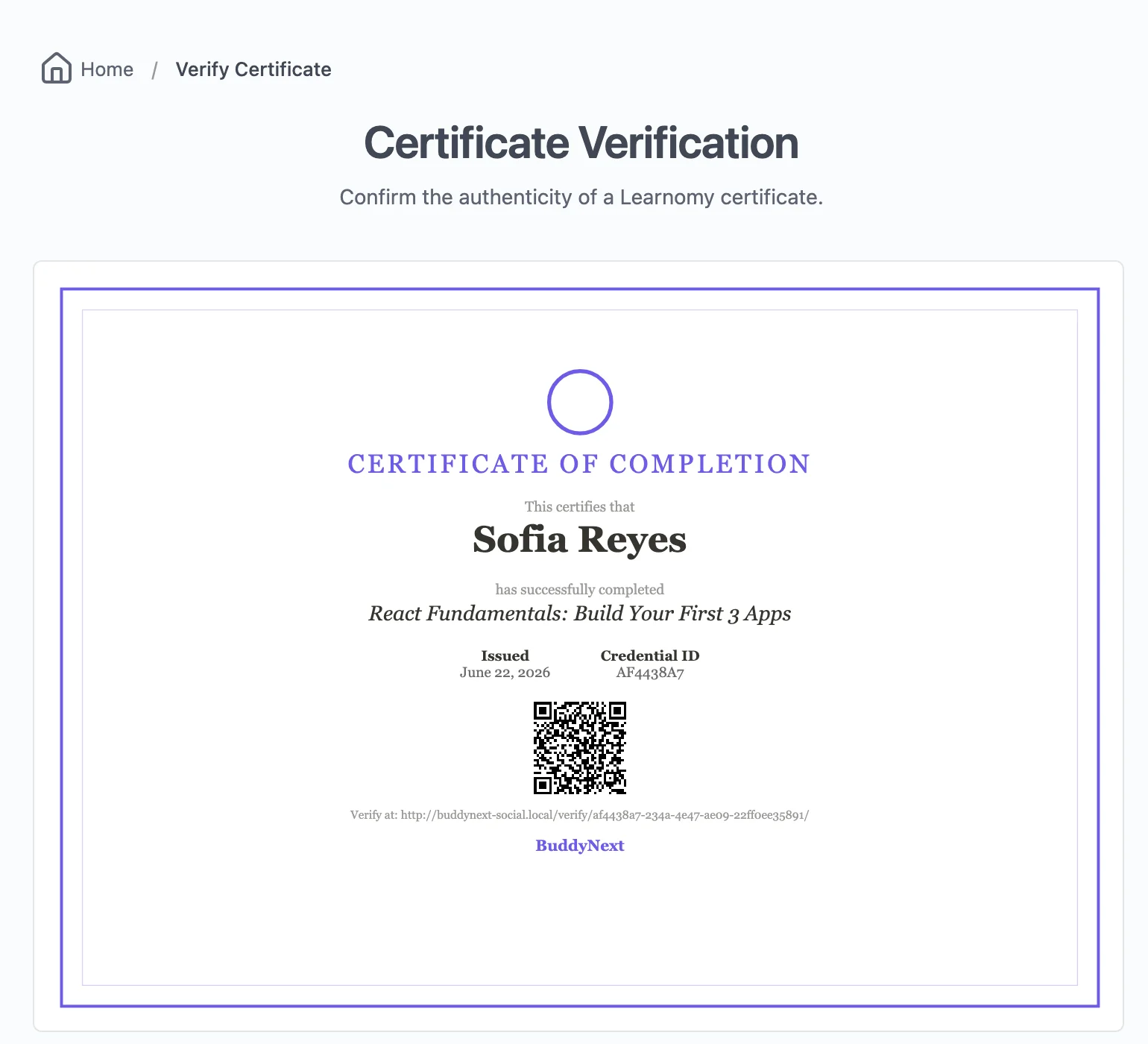
A real credential ID, a real QR code, a live public verification page. For a certification market, this is the product, not a bonus attached to the course. The obtainable market is only as large as the set of buyers who will accept this credential as genuine, which is exactly why the verifiability is the market-sizing lever, not a nice-to-have. A trustworthy, checkable credential widens the obtainable market by making more institutional buyers willing to pay; a weak one shrinks it to almost nothing regardless of demand.
Why a narrow market is the advantage
The small addressable headcount that would frighten a consumer course creator is often a certification business’s advantage. A narrow, well-defined professional or compliance niche means less competition, a clearer set of institutional buyers to reach, and a credential that can become the recognized standard for its specific slice. Being the trusted certification for a small, defined field is a far stronger position than being one of many general courses in a huge, diffuse market.
This is why certification businesses thrive in exactly the narrow niches that scare volume-focused creators. You don’t need a large market; you need to be the credible standard in a small, well-bounded one, where the institutional buyers are identifiable and the value per relationship is high. The narrow market that looks like a limitation is what lets a certification course become the obvious, trusted choice, which is worth far more than volume in a market too broad to own.
Where this lives inside Learnomy
If you’re building certification courses on Learnomy, the free tier ships the verification infrastructure that actually determines your obtainable market: Ed25519-signed certificates, a real credential ID, and a public verify page that institutional buyers can check. That’s not a feature, it’s the thing that widens the market by making the credential trustworthy enough for the buyers who most scrutinize it. The addressable headcount is fixed by your niche; the obtainable value depends on whether the credential holds up when someone checks.
The test, if you want one
Size the market in value, not heads. Estimate the institutional relationships you can realistically win, the seats each represents, and the price, plus direct individual sales, that’s your obtainable market, a contract-based number, not a headcount. Then ask whether the binding constraint is really demand, or whether it’s the credibility of your credential, which is what actually gates how much of the market will pay.
A certification business sized on institutional value rather than individual headcount is sized on the truth, and the truth is that a small, trusted, well-defined market is worth far more than a large, diffuse one you’re just another course in. The narrow niche isn’t the ceiling. The credential’s credibility is, and that you can actually build.
Related reading