
6 min read
Your Cohort Market Is Capped By Seats, Not Demand


A cohort-based course has a market constraint no other model shares, and it’s not on the demand side. Your obtainable market isn’t capped by how many people want your course, it’s capped by how many you can actually serve well at once. Seats per cohort, times cohorts per year, equals a hard ceiling on units, and that ceiling has nothing to do with the size of your addressable market. You can have a huge TAM and a tiny obtainable market at the same time, purely because a live cohort can only hold so many people before the thing that makes it valuable breaks.
If you’ve read the piece on market sizing for course businesses, this is the cohort-specific version, where the SOM is throughput-limited rather than demand-limited.
In this pieceThe throughput cap
Why a big TAM barely helps you
The real SOM: seats times cohorts
The three levers, and what each costs
A real cohort-sized course, not a fantasy one
Why the cap is liberating
Where this lives inside Learnomy
The test, if you want one
The throughput cap
A live cohort’s value comes from things that don’t scale: real instructor attention, real interaction, a real group moving together. Those are exactly the things that degrade as the cohort gets bigger. Past some size, the instructor can’t give real attention, the interaction thins out, and the cohort stops being a cohort and becomes a broadcast with a chat box. That breaking point is your quality ceiling on seats, and it’s usually far lower than the demand would allow.
This makes a cohort business’s obtainable market a throughput number, not a demand number. However many people want in, you can only actually serve a bounded number per cohort at the quality the model promises, and only run a bounded number of cohorts per year before the instructor burns out. The market you can obtain is the product of those two bounded numbers, and demand above that line simply doesn’t convert to revenue, no matter how large it is.
Why a big TAM barely helps you
For most businesses, a bigger addressable market is straightforwardly good, more room to grow. For a cohort business, a bigger TAM past a certain point barely matters, because you were never going to serve most of it anyway. If your throughput caps you at a few hundred students a year, it makes little practical difference whether ten thousand or ten million people want your course. You’ll serve the same few hundred either way.
This is counterintuitive and worth sitting with. The cohort creator obsessing over growing their addressable market is often optimizing the one number that isn’t their constraint. Demand above throughput is invisible to the revenue line. The constraint is delivery capacity, and until that’s addressed, a bigger market is just a longer waitlist, not more revenue.

The real SOM: seats times cohorts
The honest obtainable market for a cohort business is close to arithmetic: the number of seats you can fill at real quality, times the number of cohorts you can run at sustainable effort, times your price. That’s your annual revenue ceiling, and it’s a genuinely knowable number, far more concrete than a demand-based SOM. You’re not estimating a fuzzy share of a market, you’re multiplying capacity by cadence by price.
Knowing this number changes how you plan. It tells you immediately whether the business can hit your income goal at your current price and capacity, and if it can’t, it tells you exactly which of three levers has to move. There’s no fantasizing about capturing more of the market, because the market above your throughput was never obtainable. The whole plan lives inside seats times cohorts times price.
The three levers, and what each costs
Because the SOM is seats times cohorts times price, you grow it by moving one of those three, and each has a real cost. More seats per cohort risks the quality that made the cohort worth a premium, the very thing the model sells. More cohorts per year risks instructor burnout, the founder-energy limit that ends so many cohort businesses. And a higher price risks pushing past what your specific serviceable market will pay, shrinking the demand you were filling seats from.
The art of a cohort business is choosing which lever to move and paying its cost deliberately rather than accidentally. A creator who wants more revenue and just crams more people into each cohort often destroys the product without realizing it. One who raises price to match the genuine value of a small, high-touch cohort usually grows revenue without touching quality or cadence at all, which is why price is often the right lever and cramming rarely is.
A real cohort-sized course, not a fantasy one
Here’s what a real, honestly-sized course actually looks like, reachable without an account.
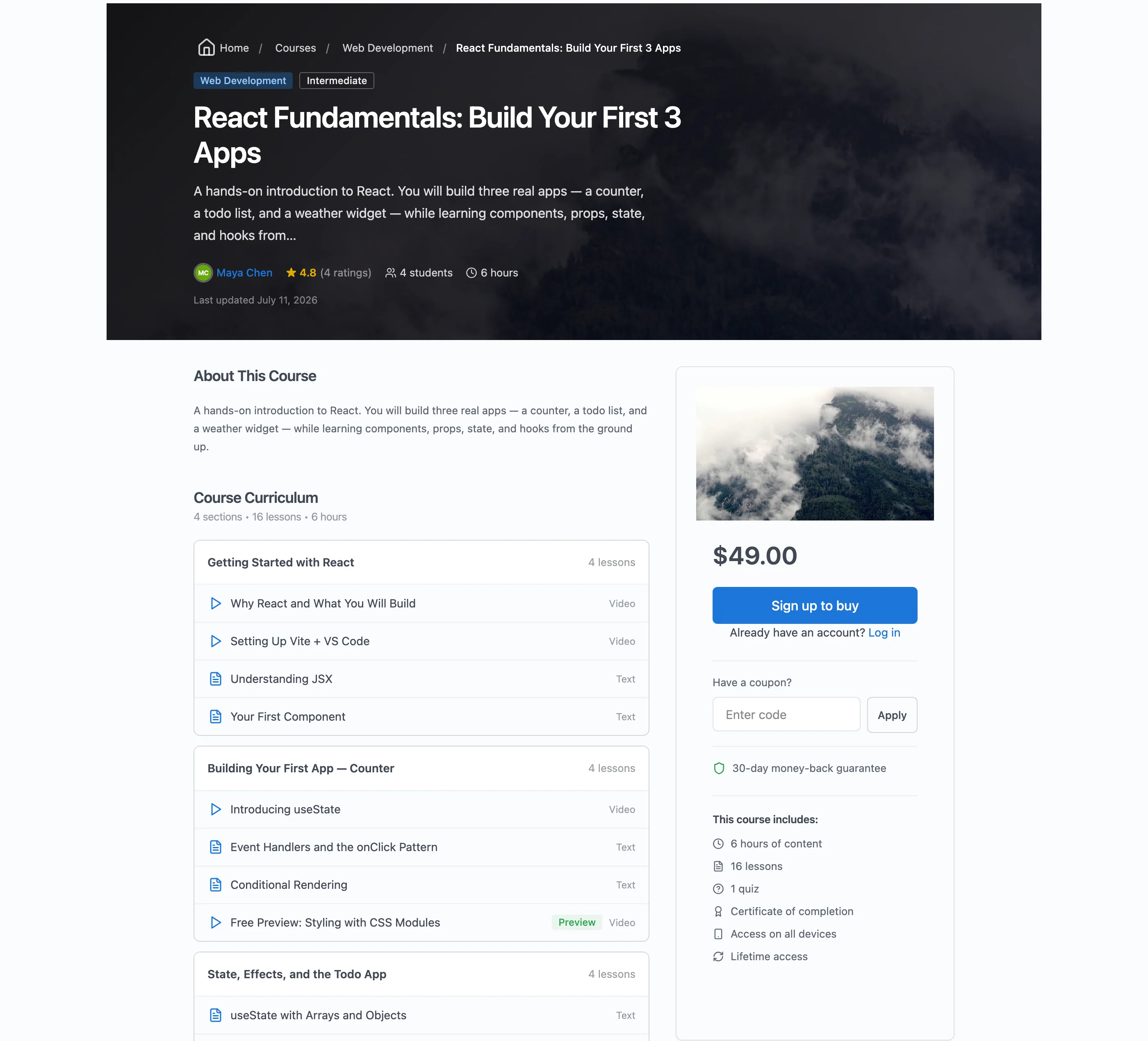
Notice the student count, modest, concrete, real. This is the honest scale of a real course, not the thousands a demand fantasy imagines. For a cohort model, a number like this isn’t a disappointment, it’s the throughput reality, and it’s exactly the number the business should be planned around. A cohort that’s genuinely full at a sustainable size, run at a sustainable cadence, at a price that reflects its real value, is a healthy business, even though the enrollment number looks small next to the total demand for the topic.
Why the cap is liberating
The throughput cap feels like a limit and is, in one specific way, liberating: it means you don’t need a huge market to win. A cohort business that only needs to fill a few hundred seats a year can thrive in a niche far too small for a scale product, because it was only ever going to serve a small number anyway. The tiny addressable market that would kill an evergreen course is often plenty for a cohort, because the cohort’s ceiling is below the niche’s floor.
This is why cohort models pair so well with narrow, specialized topics. You don’t need millions of interested people. You need enough to fill your bounded seats at your premium price, which is a much smaller and much more capturable number. The cap that seems to limit your ambition actually frees you to serve a market too small for anyone chasing scale, and to charge properly for doing it well.
Where this lives inside Learnomy
If you’re running cohorts on Learnomy, real enrollment tracking keeps your seats-times-cohorts math honest, so you’re planning against actual throughput rather than aspirational demand. Pairing it with BuddyNext lets a cohort sustain quality at a slightly larger size, since real peer interaction offloads some of the attention that would otherwise cap seats at the instructor’s personal limit, which is one honest way to raise the seat lever without breaking the product.
The test, if you want one
Multiply three numbers: the seats you can fill at real quality, the cohorts you can run at sustainable effort, and your price. That’s your annual obtainable market, and it’s your real revenue ceiling. Compare it to your income goal. If it falls short, the fix is a specific lever, seats, cadence, or price, not a bigger addressable market, which was never your constraint.
Size a cohort business on throughput, not demand, and choose which lever to move with open eyes about its cost. A full cohort at a sustainable size and a proper price is a real, healthy business, and the demand you’ll never serve above your throughput was never the market, however large it looked.
Related reading