
5 min read
Unlimited Capacity, Zero Sales: The Evergreen Reach Bottleneck

An evergreen course has the opposite market constraint from a cohort. There’s no throughput cap, you can sell to a hundred thousand people as easily as a hundred, the marginal cost of one more sale is close to nothing. Which means the size of your addressable market isn’t the limit at all. The limit is entirely on the other side: reach. An evergreen course’s obtainable market is bottlenecked not by how many you can serve, but by how many you can actually find, and that reframes the whole sizing exercise around a single question, can you get discovered.
If you’ve read the piece on market sizing for course businesses, this is the evergreen version, where the SOM is reach-limited rather than capacity-limited.
In this pieceWhy capacity isn’t your constraint
Reach is the entire bottleneck
The real SOM: your reach, not your market
The discovery problem nobody budgets for
A real evergreen course, sized honestly
The compounding fix for reach
Where this lives inside Learnomy
The test, if you want one
Why capacity isn’t your constraint
An evergreen course, once built, serves any number of students at essentially no additional cost. There’s no cohort to fill, no instructor attention to ration, no delivery ceiling. This is the model’s great advantage, and it has a subtle consequence for market sizing: your serviceable capacity is effectively unlimited, which means capacity is never your obtainable-market constraint. Whatever caps your SOM, it isn’t how many you can serve.
Founders coming from any capacity-limited world find this genuinely disorienting. All the instincts about scaling delivery, hiring, managing throughput are irrelevant. You could serve the entire addressable market tomorrow if it showed up. The problem is it won’t show up, and the reason it won’t is the only thing that actually sizes an evergreen business: reach.
Reach is the entire bottleneck
If you can serve everyone but can’t reach everyone, then your obtainable market is exactly as big as your reach, and no bigger. This is the defining fact of an evergreen course business. Two creators with the identical course and the identical addressable market will have wildly different obtainable markets purely because one can get in front of people and the other can’t. The course is the same; the reach is everything.
This is why so many genuinely excellent evergreen courses sell almost nothing. The quality was never the constraint, and neither was the market, plenty of people wanted the thing. The constraint was that nobody could find it. An evergreen course with no reach has an obtainable market of nearly zero regardless of how large its addressable market is, because addressable means nothing when it’s unreachable.

The real SOM: your reach, not your market
The honest obtainable market for an evergreen course is a reach number, not a demand number. It’s the count of people you can actually get in front of, through search, through content, through referrals, through whatever channels you genuinely have, times your conversion rate. That’s your SOM, and notice what’s absent from it: the total size of the addressable market, which drops out entirely because it isn’t the binding constraint.
This is clarifying, because it points every ounce of effort at the one thing that actually moves the number. For a cohort business, growth means capacity. For an evergreen business, growth means reach, full stop. Every hour spent on discovery, on content that ranks, on referral mechanisms, directly expands the obtainable market. Every hour spent worrying about the size of the total market is wasted on a number that was never the constraint.
The discovery problem nobody budgets for
The trap specific to evergreen courses is assuming that “build it and they will come” describes reach. It describes capacity, the course will indeed serve anyone who arrives, but it says nothing about arrival. Most evergreen creators budget carefully for building the course and not at all for the ongoing work of getting found, then wonder why an excellent course with unlimited capacity sells to almost no one.
Reach doesn’t happen for free just because the course is good and always available. It has to be built deliberately, through the kind of educational content and shareable outcomes that pull people in over time. An evergreen business that treats reach as an afterthought has effectively sized its obtainable market at zero, no matter how good the course or how large the demand, because the one thing that determines the number was never worked on.
A real evergreen course, sized honestly
Here’s what a real evergreen course actually looks like, reachable without an account.
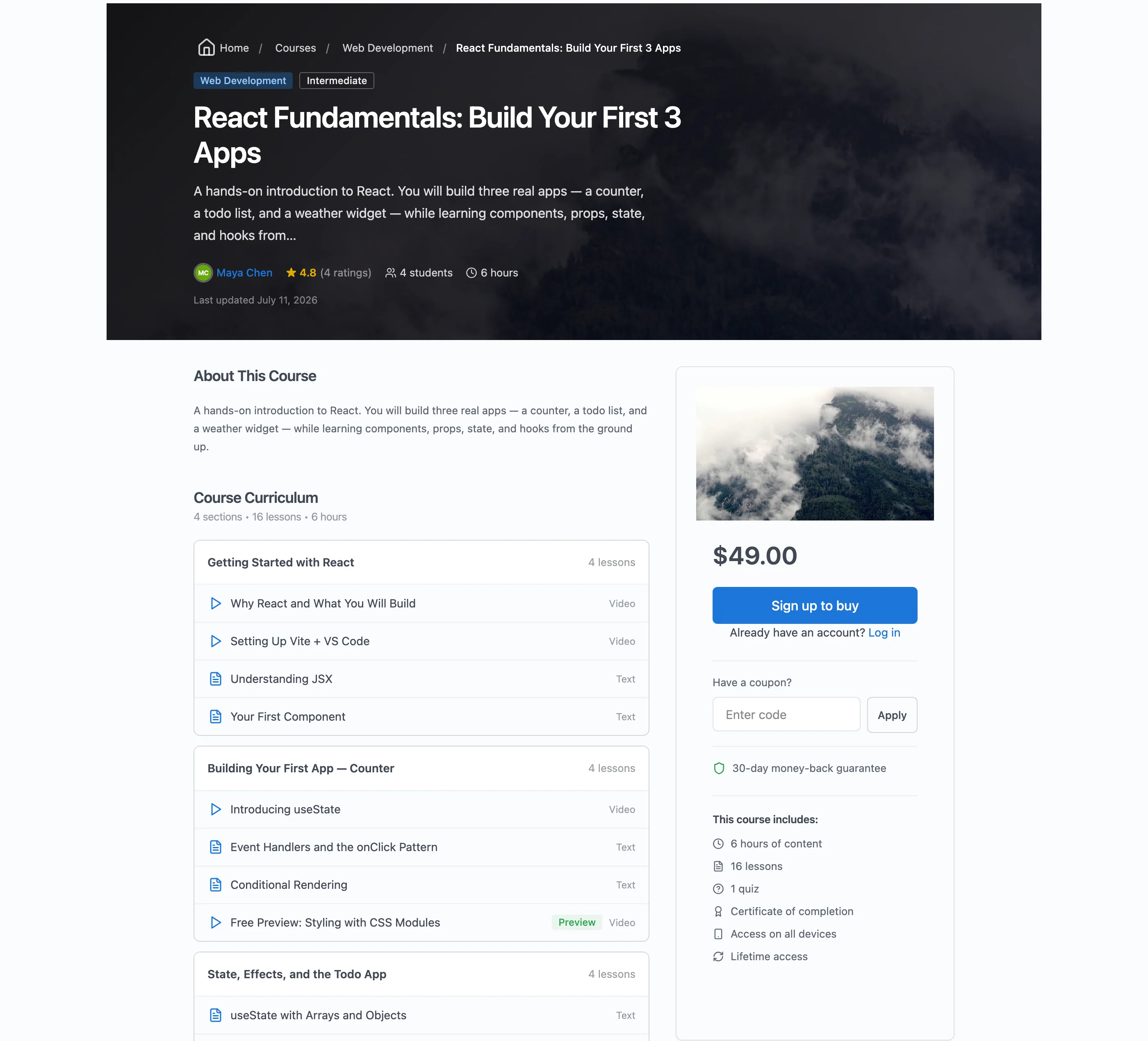
A one-time price, lifetime access, self-paced, the marginal cost of the next sale is nearly zero. The student count on a course like this isn’t a capacity number, capacity was never the limit, it’s a reach number. It reflects exactly how many people the course actually got in front of and converted, not how many it could serve. For an evergreen course, that enrollment figure is a direct readout of reach, which is the only thing that ever sized it, and growing it means growing reach, not building more capacity that already sits idle.
The compounding fix for reach
The good news about a reach-limited market is that reach can compound, in a way capacity never can. A cohort business hits its throughput ceiling and stays there. An evergreen business can keep expanding its reach, and each expansion is permanent, a piece of content that ranks keeps pulling people in, a shared outcome keeps referring the next buyer, the same growth-loop mechanism the piece on course certificates describes. Reach built once keeps working, which means the obtainable market of an evergreen course can grow indefinitely if the reach engine keeps running.
This is the evergreen model’s real long-game advantage. The unlimited capacity is only valuable if reach eventually fills it, but because reach compounds, a patient evergreen business can grow its obtainable market for years off work already done. The capacity was always there waiting; the whole game is slowly, compoundingly, filling it.
Where this lives inside Learnomy
If you’re running an evergreen course on Learnomy, verifiable, shareable certificates turn each graduate into a small piece of reach, the referral mechanism that expands a reach-limited obtainable market without paid spend. Pairing it with BuddyNext gives the course a public, discoverable community surface, another reach channel feeding the unlimited capacity that would otherwise sit empty. The platform can’t manufacture demand, but it can widen the reach that’s actually sizing your market.
The test, if you want one
For an evergreen course, ignore the size of the addressable market entirely, it isn’t your constraint. Instead, estimate your real reach: how many genuinely new people you can get in front of in a period, through the channels you actually have, times your conversion. That’s your obtainable market, and it’s the only number worth planning against.
Then put your growth effort where the constraint actually is, on reach, not on capacity you already have in surplus and not on demand you can’t touch. An evergreen course’s ceiling is its reach, reach compounds, and a business patient enough to keep building it can grow its obtainable market long after the course itself was finished.
Related reading