
5 min read
Your Brand Communitys Best Answers Are Inviting Nobody

A brand community’s viral coefficient rarely runs on a literal invite button. It runs on something quieter: a customer’s public answer, sitting in a searchable space, reaching the next customer with the identical problem before they ever contact support. That reach is the invitation, the searcher finding it and joining is the conversion, and multiply the two and you get a K that most brand communities never calculate because they never realized their support answers were an acquisition channel at all.
If you’ve read the piece on the viral coefficient for communities, this is the brand-specific version of that math, and its weak half is almost always the same one.
In this pieceWhat an invitation actually is for a brand
Why the invitation half is the broken one
The conversion half: trust from a real person
A real public answer surface, not a mockup
The fix: make the answers public by default
The pushback: “our answers are proprietary”
Where this lives inside BuddyNext
Turning it into something you actually check
What an invitation actually is for a brand
For a consumer app, an invitation is someone tapping “invite a friend.” For a brand community, it’s almost never that. The real invitation is a public, indexed answer to a real customer question, the kind of thing a future customer types into a search bar when they’re stuck. Every one of those public answers is an invitation broadcast to everyone who will ever have that exact problem, working silently, indefinitely, without anyone sending anything.
This reframes the whole coefficient. A brand community doesn’t grow virally by getting members to invite friends. It grows by turning the questions its customers already ask into public, findable content that pulls in the next person searching for the same thing. The invitation isn’t an action a member takes. It’s a byproduct of a support interaction that was made public instead of private.
Why the invitation half is the broken one
In most brand communities, the invitation half of K is near zero for a single structural reason: the good answers are private. They live in closed tickets, DMs, and support threads that no search engine can index and no future customer can find. The answers exist, they’re genuinely good, and they generate exactly zero invitations because nothing about a sealed ticket reaches anyone beyond the one person who asked.
This is the exact leak the growth loop piece on brand communities describes, seen through the coefficient. A brand can have thousands of excellent answers and a viral coefficient of nearly nothing, because every one of those answers was delivered into a private channel that can’t invite anyone. The fix isn’t more answers. It’s making the answers you’re already giving reach someone beyond the person who asked.

The conversion half: trust from a real person
The conversion half of a brand community’s K has an unusual advantage most niches don’t get. When a searcher lands on a public answer written by a real, named customer rather than by the company’s marketing team, they convert at a higher rate, because a real person with a real history of helping is more trustworthy than a company talking about itself. The reputation of the person who answered is part of what converts the stranger who found it.
This is why a brand community’s conversion half improves specifically when real members, not just staff, are the ones answering in public. A searcher who finds a genuine peer’s answer, with that peer’s real profile and history visible behind it, has a reason to trust it and a reason to join the place where people like that hang out. The company’s own answers help. A real customer’s answers convert better.
A real public answer surface, not a mockup
Here’s what the invitation surface actually looks like when it’s public, reachable without an account.
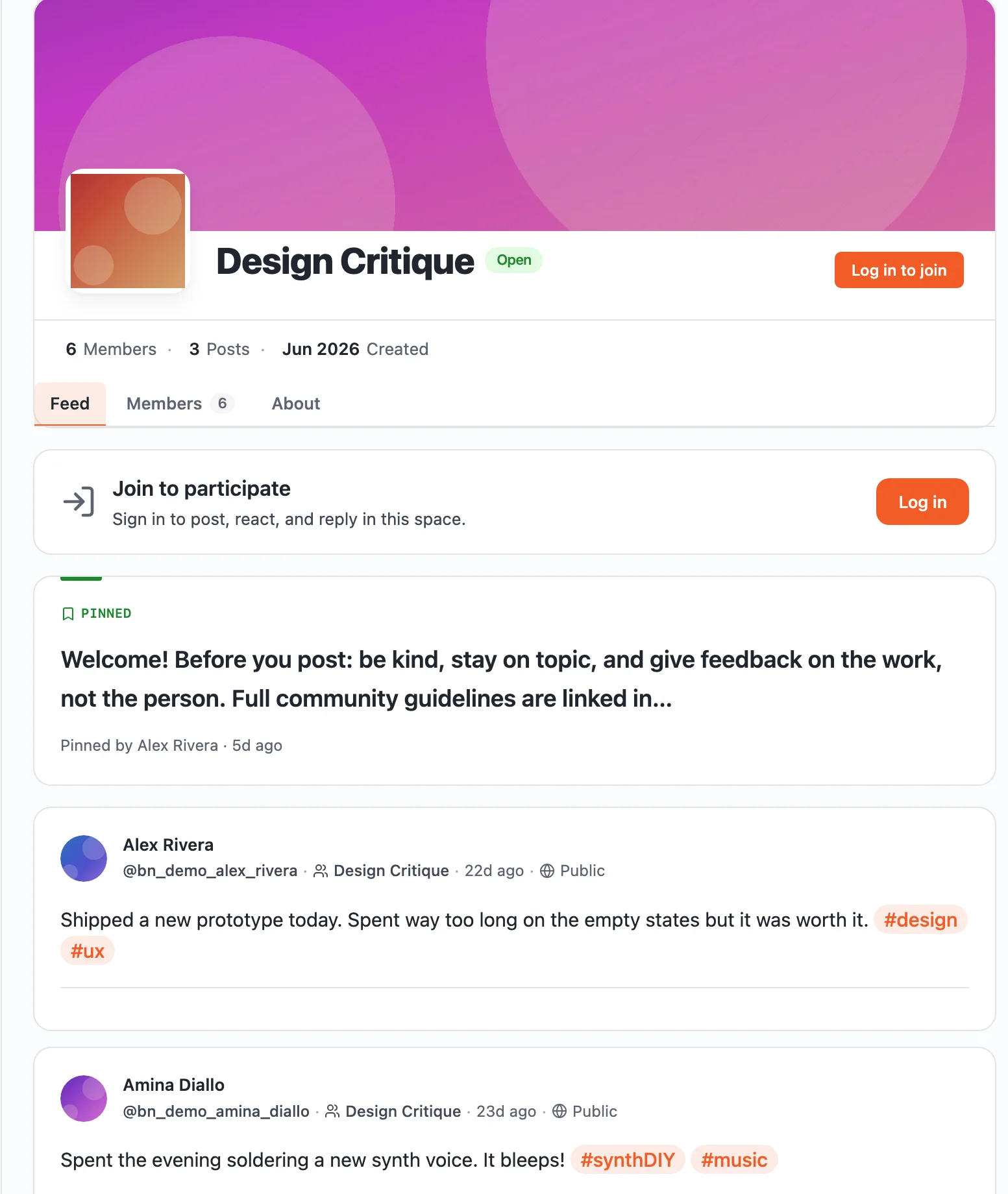
Real members, real posts, real answers, in a public space anyone can land on from a search or a shared link, no account required. Every substantive answer in a space like this is an invitation working around the clock, findable by the next person with the same question. That’s the invitation half of K, built as a structural feature rather than hoped for, and the conversion half is helped along by the fact that a real, named person is visibly behind each answer, not a faceless brand account.
The fix: make the answers public by default
The highest-leverage move on a brand community’s coefficient is the least glamorous one: default the good answers to public instead of private. Not every support interaction, some genuinely need to stay private, but the reusable ones, the questions many customers will hit, belong in a public, searchable space where they can do the invitation work a closed ticket never can.
This single change lifts the invitation half of K from near zero toward something real, and because K is a multiplication, it lifts the whole coefficient. It also costs almost nothing, since the answers are already being written, just in the wrong place. A brand community that moves its reusable answers from private to public isn’t adding work. It’s redirecting work that was already happening into a channel that actually compounds.
The pushback: “our answers are proprietary”
Sometimes genuinely true, security-sensitive configuration, account-specific troubleshooting, anything that reveals something about your systems you don’t want public. That’s a real, narrow category worth protecting, and it’s a much smaller list than the instinct to keep everything private suggests.
Most support answers aren’t proprietary. “How do I reset this setting” and “why is this error happening” are questions a competitor already knows the answer to, and keeping them private protects nothing except your own coefficient from ever climbing. The proprietary exception is real. It’s just far narrower than the default-everything-private habit most brands operate on, and that habit is precisely what’s holding K near zero.
Where this lives inside BuddyNext
If you’re running the community on BuddyNext, Spaces can default to public with real moderation handling the narrow cases that genuinely need privacy, so the reusable answers become the searchable invitations K depends on. Public member profiles mean the real person behind each answer is visible, which is exactly what lifts the conversion half. Both levers are there; the only thing left is the decision to stop sealing your best answers inside private threads.
Turning it into something you actually check
Monthly: of the reusable answers your team gave this month, how many landed in a public, searchable space versus a closed ticket. That ratio is the invitation half of your brand community’s K, made visible. And separately, how many new members or customers mention finding a specific public answer as how they arrived, that number is the coefficient actually converting, not just existing in theory.
A private answer helps one customer once. A public one, written by a real member and left where the next searcher can find it, is an invitation that keeps converting for as long as the answer stays accurate. That’s the difference between a brand community with a coefficient near zero and one that quietly grows itself.
Related reading