
5 min read
The Certificate Is An Invitation Students Are Proud To Send

A course community’s viral coefficient has one unusually clean invitation mechanism, and most creators leave it almost entirely unused. It’s the certificate. A student finishes, gets a credential, and if that credential is public, verifiable, and worth sharing, they post it somewhere their network can see it. Every share is an invitation, every person in that network who trusts it and enrolls is a conversion, and multiply the two and you get a K that a course business can actually move on purpose.
If you’ve read the piece on the viral coefficient for communities, this is the course-specific version, and its invitation mechanism is more concrete than almost any other niche gets.
In this pieceThe certificate as an invitation
Why students don’t share by default
Why a certificate converts better than an ad
A real, verifiable certificate, not a mockup
The fix: make the certificate worth sharing
The pushback: “our students won’t bother”
Where this lives inside Learnomy
Turning it into something you actually check
The certificate as an invitation
Most invitations in a community are low-stakes, a shared link, a casual mention. A course certificate is different: it’s an invitation the sender is proud to make, because it reflects well on them. Someone sharing a certificate isn’t doing the course a favor, they’re showcasing their own accomplishment, and the course gets the invitation as a byproduct of the student’s genuine pride. That alignment, where the member’s self-interest and the community’s growth point the same direction, is the strongest possible foundation for a viral coefficient.

This is why the certificate is the highest-leverage invitation mechanism a course business has. It converts a private accomplishment into a public artifact that a student wants to share for their own reasons, and every share reaches a network that trusts the sender specifically because they chose to share something that reflects on their own competence.
Why students don’t share by default
The invitation half of a course community’s K is usually weak for a simple reason: the certificate isn’t worth sharing. A plain PDF that nobody can verify, that looks like something anyone could fake in an afternoon, doesn’t get posted, because sharing it reflects poorly rather than well on the person. So the invitation never happens, not because students weren’t proud, but because the artifact wasn’t good enough to carry that pride in public.
The fix is upstream of any sharing prompt. It’s making the certificate itself into something a graduate is genuinely proud to attach to their name: verifiable, well-designed, one click from being posted to the place that matters. Get the artifact right and a meaningful share of graduates invite their network without being nagged. Get it wrong and no amount of “please share” copy will move the invitation half at all.
Why a certificate converts better than an ad
The conversion half of a course community’s K is where the certificate really earns its place. When someone in a graduate’s network sees that shared credential, the invitation arrives pre-trusted, filtered through a real person they know who just publicly vouched that this course was worth finishing. That’s a conversion advantage an ad can never buy, because an ad interrupts a stranger while a shared certificate reaches someone through a trusted human at exactly the moment they’re wondering whether they could do the same thing.
This is the compounding mechanism the growth loop piece on course certificates describes, quantified. The conversion rate on a certificate-driven invitation is high precisely because trust travels with it, which means even a modest number of shares can produce a coefficient worth having.
A real, verifiable certificate, not a mockup
Here’s what a shareable, converting certificate actually looks like, reachable without an account.
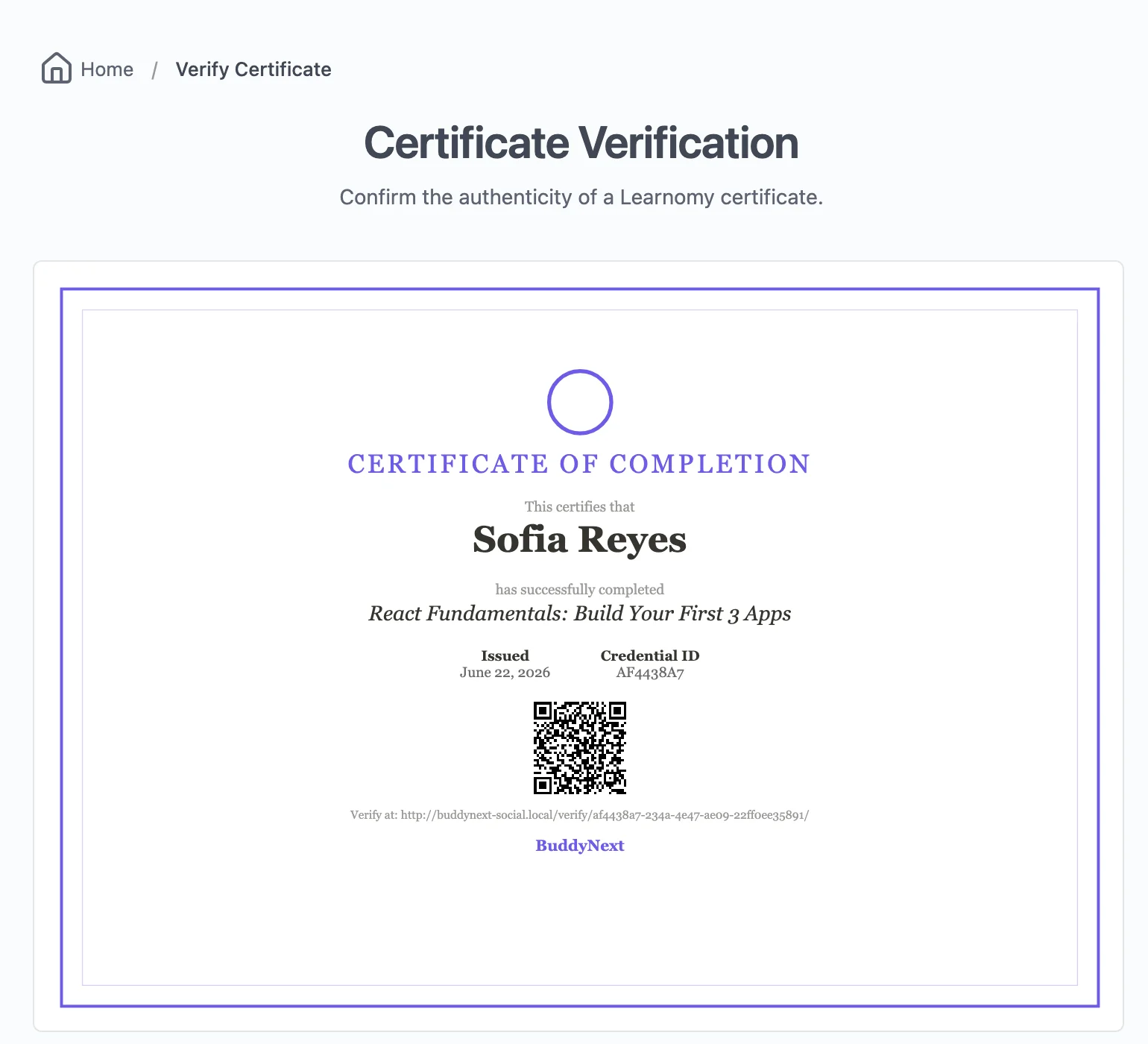
A real credential, publicly reachable at its own verify URL, with a QR code that resolves to that exact page and a genuine credential ID. Anyone in a graduate’s network who sees this and clicks lands on proof, not a promise, which is exactly what makes the conversion half of K work. The certificate is verifiable, so it’s worth sharing, so it generates invitations; and it lands the recipient on real proof, so those invitations convert. Both halves of the coefficient, riding on one artifact.
The fix: make the certificate worth sharing
The whole coefficient, for a course business, often comes down to a single question: is the certificate good enough that a proud graduate wants to post it. Three things make the difference, and all three lift the invitation half at once. It has to be verifiable, so it carries weight rather than looking fakeable. It has to look good enough to sit next to someone’s name. And sharing it has to be one click to the place that matters, usually a professional network, not a multi-step export.
Get those three right and the invitation half climbs on its own, because you’ve removed every reason a proud graduate wouldn’t share. The mistake most course creators make is trying to increase shares with prompts and reminders while the underlying artifact still isn’t worth sharing. Fix the certificate first; the invitations follow.
The pushback: “our students won’t bother”
Some won’t, and the coefficient doesn’t need everyone. It needs a meaningful minority who are proud enough of finishing something hard to post it, and a course with a real completion bar reliably produces exactly that feeling in a real slice of graduates. The viral coefficient was never going to be driven by everyone. It’s driven by the proud minority, and even a small share rate on a high-converting artifact produces a K worth having.
If shares are genuinely low, the honest diagnosis is almost never “our students don’t care.” It’s that the certificate wasn’t worth caring about, verifiable, well-designed, one-click, before assuming the students are the problem.
Where this lives inside Learnomy
If you’re running courses on Learnomy, the free tier already ships every piece this coefficient needs: signed certificates with a real QR code, a public verify page anyone can check without an account, and one-click sharing built in. That’s the invitation half handled and the conversion half handled, the artifact is worth sharing and it lands the recipient on real proof. Pair it with BuddyNext and the community the certificate points back to is a real, alive place rather than a dead landing page. For the actual certificate designer, the verification page, and how the signing works underneath it, see our full walkthrough of the certificate system.
Turning it into something you actually check
Weekly, not per-launch: of the certificates issued, how many actually got shared, not just issued. That ratio is the invitation half of your K. And how many new students mention a shared certificate or a graduate’s referral as how they found you, that’s the conversion half landing. If the first number is near zero, the fix is the artifact, not the marketing plan.
An ad stops converting the second you stop paying. A certificate a graduate is proud to share keeps generating invitations, each one pre-trusted, for as long as graduates keep finishing. That’s a viral coefficient a course business can actually build, one good certificate at a time.
Related reading