
9 min read
Progress Bars, Streaks, and the Course Nobody Wants to Restart

A student who is sixty percent through your course behaves differently from one who is five percent through, and the difference is not mostly about motivation. It is about what each of them stands to lose by stopping.
The one at five percent can walk away and lose almost nothing. The one at sixty percent would be abandoning something they built. That asymmetry is the most useful thing a course operator can understand about completion rates, and it is also the easiest thing to abuse.
This piece looks at how loss aversion shows up specifically in courses and social learning, where the accumulated thing is progress rather than status or reputation.
Progress is two different things wearing one label
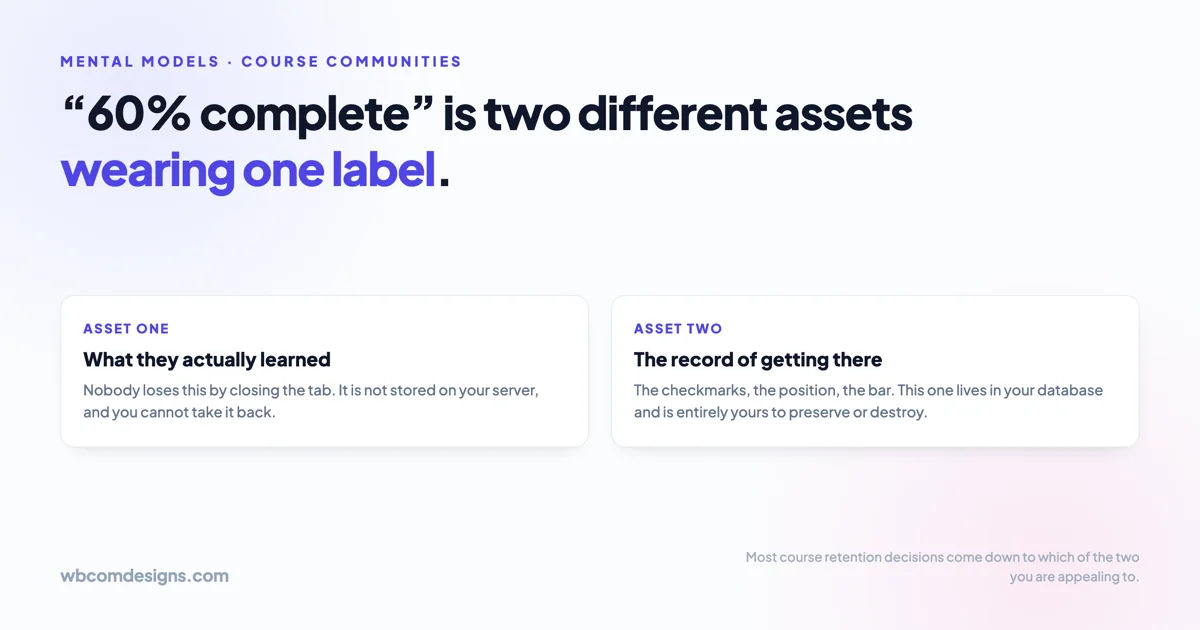
When a course platform shows a student they are sixty percent complete, that number is standing in for two very different assets.
The first is real: what the student actually learned and can now do. Nobody loses that by closing the tab. It is not stored on your server.
The second is the record. The completed checkmarks, the position in the sequence, the place the student would have to fight back to if they restarted. That one lives entirely in your database and is entirely yours to preserve or destroy.
Almost every retention decision in a course business comes down to which of those two you are actually appealing to. A student who returns because they remember the material was worth their time is returning to real value. A student who returns because they cannot stand the thought of the bar resetting to zero is responding to a record you control, and you should be honest with yourself about which one your product is leaning on.
Our piece on the forgetting curve makes the complementary point: the real asset decays without reinforcement, whether or not the record says complete. A finished progress bar and a retained skill are not the same achievement, and it is possible to optimise hard for one while quietly losing the other.
Expiring access to something already paid for
Course platforms routinely put an end date on access. A year of access, or six months, or access for the duration of a subscription. The commercial logic is clear enough and the psychological cost is usually underestimated.
A student who paid once and then loses access does not experience this as a licence expiring. They experience it as the course being taken away. That reading is not irrational. They paid a single amount for a thing, and now the thing is gone.
Whether that is fair depends almost entirely on what was said at the point of sale. Expiry disclosed clearly up front is a term of the deal. Expiry discovered afterward is a loss, and it produces the reaction that losses produce.
| Access model | How it reads to the student | What makes it defensible |
|---|---|---|
| Lifetime access, honoured | The course is theirs | Nothing to manage; the promise matches the product |
| Fixed term, stated at checkout | A rental they agreed to | The term is visible before payment, not in the terms page |
| Fixed term, discovered later | Something being confiscated | Very little; this is where refund requests come from |
| Subscription with access tied to payment | Reasonable while they understand it | Clear messaging that stopping payment ends access, said at signup and again before the first renewal |
| Cohort ends, materials remain | The live part ended, the substance stayed | Separating the scheduled experience from the permanent asset |
There is a quieter version of the same loss: what happens to progress when access ends and the student later comes back. If renewing means starting again from lesson one, you have turned a lapse into a punishment. Learnomy handles this the student-friendly way: when fixed-term access ends and the learner renews, the progress and completion they already earned are kept. Whatever platform you use, check what happens to a returning student’s record before you set an access term.
That last row of the table is the pattern we would point most cohort operators toward. The expensive, genuinely scarce part of a cohort course is the live teaching and the group. The recordings and materials are not scarce at all, and keeping them available after a cohort closes costs almost nothing while removing one of the sharpest losses in the whole format.
What happens when a cohort graduates
Cohort courses create a loss that has nothing to do with content. The group disperses.
For many students the cohort was the product. The discussions, the people at the same stage, the accountability of a shared schedule. When the course ends on the calendar, all of that ends at once, and the student loses something they were not told they were buying and did not expect to grieve.
The usual response is a graduation email and an invitation to buy the next thing. A better response is to give the cohort somewhere to continue existing. An alumni space that stays open after the course ends preserves the part of the value that had nothing to do with the syllabus, and it costs a fraction of what acquiring those students cost in the first place.
This is straightforward to run when the course and the community live on the same site. Learnomy, a free WordPress LMS with 0% transaction fees, sitting alongside BuddyNext, the free community platform for WordPress, means the cohort’s space does not have to close when the course does. The mechanism is ordinary. The decision to leave the room open is the part that matters.
Streaks in a learning context
Streaks work. That is exactly the problem with them.
A daily streak is one of the most reliable engagement mechanics available, because after a couple of weeks the streak itself becomes the thing the student is protecting. The trouble is that a streak measures attendance, not learning, and those come apart quickly. A student can keep a ninety-day streak by opening a lesson and closing it, and the number will look magnificent while nothing is happening.
Worse, a streak that resets to zero after one missed day punishes an absence far out of proportion to its cost. Missing Tuesday does not undo three months of study. Telling a student it does is a manufactured loss, in the sense our main piece describes: the thing they are afraid to lose is the counter, not anything they built.
The design fix is well established and cheap. Grace days, or streak freezes, let the counter survive an ordinary interruption. WB Gamification, a 100% free gamification plugin for WordPress, supports streaks with grace periods, so one missed day does not wipe out months of effort. Pair the counter with a view of activity over time, such as a calendar or heatmap of study days, which is a more honest representation than a single fragile number: it shows a pattern, where one gap is visibly just one gap.
The heatmap framing is worth adopting even if you never use that specific tool. A student looking at three months of mostly-filled squares sees the truth, which is that they have been consistent. A student looking at a streak counter reading 1 after ninety days sees a lie.
Refund windows and the moment of doubt
Every course has a point, usually early, where the student wonders whether this was a mistake. What happens next depends heavily on what they think they would be giving up.
A generous refund policy reduces the fear of loss at purchase, which is why it raises conversion. It also means the student’s decision to stay past the window is a real decision rather than a trapped one, and that turns out to matter for completion. Students who could have left and chose not to behave like people who chose. Students who missed a deadline behave like people who are stuck.
We would rather have the first group, even at the cost of some refunds, and we would say the same to any operator weighing a tighter window against a looser one. A cohort of people who stayed on purpose is worth more than a slightly larger cohort holding a receipt they regret.
Certificates: the record students most want to keep
Of everything a student accumulates in a course, the certificate is the piece that leaves your site. It goes onto a CV, a LinkedIn profile or a file at work, and it is the part of the record other people check. That makes it the clearest case of a real asset, and the one where taking it away does the most damage.
Two things protect it. First, the certificate should outlive access: a student whose year of access has ended still earned the credential, and a verification link that stops working when access ends makes the certificate worthless in the one moment it is needed. Second, anyone should be able to check it without logging in. In Learnomy every certificate gets its own public verification page and QR code, and is digitally signed, so an employer can confirm it is genuine years later without the student having to dig out a PDF.
If you ever change platforms, plan for certificates first. Courses can be rebuilt; a credential a student already shared cannot be quietly reissued under a different link.
A checklist before you ship a retention mechanic
Run each new idea for keeping students engaged through these questions. A mechanic that fails two or more is probably leaning on a manufactured loss.
- Is the access term stated before payment, on the checkout page itself, not only in the terms?
- Does a returning student keep their progress when they renew or come back after a break?
- Does a streak survive one ordinary missed day, through grace periods or freezes?
- Do certificates stay verifiable after access ends?
- Does the cohort have somewhere to go after the last live session?
- Could a student leave in the refund window without friction, so that staying is a real choice?
- Would you be comfortable explaining the mechanic to a student who asked why it works the way it does?
The test for course operators
Everything above reduces to one question, asked before shipping any mechanic that touches what a student has accumulated: is the thing they are afraid to lose something they actually built, or something you invented so they would be afraid?
Progress they earned is real. Materials they paid for are real. A cohort they became part of is real. A number that resets because of one missed Tuesday is not, and a countdown on an evergreen enrolment is not, and students eventually work out the difference. When they do, the mechanic stops working and takes some of your credibility with it.
The general version of this argument, including where the line sits between honest and manipulative design, is in our main piece on loss aversion in communities. For the closely related pull of an unfinished thing, see the Zeigarnik effect and unfinished courses.
Frequently asked questions
Do progress bars improve course completion?
They help most students keep going, because the further along they are, the more they feel they would lose by stopping. They work best when they reflect real learning and do not reset unfairly. A bar that measures clicks rather than progress, or that resets after a break, pushes behaviour without building skill.
Are streaks good for online courses?
Streaks build a study habit, but they measure attendance, not learning. Use them with grace periods so one missed day does not erase months of effort, and show activity over time rather than relying on a single counter.
Should course access expire?
It can, if the term is clear before payment and returning students keep their progress when they renew. Expiry that students discover afterwards feels like something being taken away, and that is where refund requests and bad reviews come from.
What should happen when a cohort course ends?
Keep the materials available and give the group somewhere to continue, such as an alumni space on the same site. The live sessions were scarce; the recordings and the relationships do not need to disappear with them.
Related reading