
5 min read
The Forgetting Curve: Why Finishing a Course Isn’t the Same as Remembering It


In 1885, Hermann Ebbinghaus memorized lists of nonsense syllables and tested himself on them at intervals, alone, with no course platform and no incentive but curiosity. What he found still holds up: freshly learned material doesn’t decay in a straight line. It falls off a cliff first, roughly half gone within a day, then keeps leaking away on a slower curve unless something brings it back. Every course creator building a linear lesson-after-lesson sequence is quietly building on top of that cliff and hoping it isn’t there.
Completed is not the same claim as remembered
A course platform’s dashboard shows completion. Lesson 4 of 12, checked. Quiz passed on the first try. Certificate issued. None of that measures what’s still in someone’s head three weeks later, and the honest answer for most students is: less than the completion checkmark implies.
This isn’t a teaching-quality problem. A genuinely well-taught lesson decays on roughly the same curve as a mediocre one, because the cliff is a property of unreinforced memory, not of instructional design. Someone can walk away from an excellent explanation and still lose most of it by the following week, through no fault of the explanation.
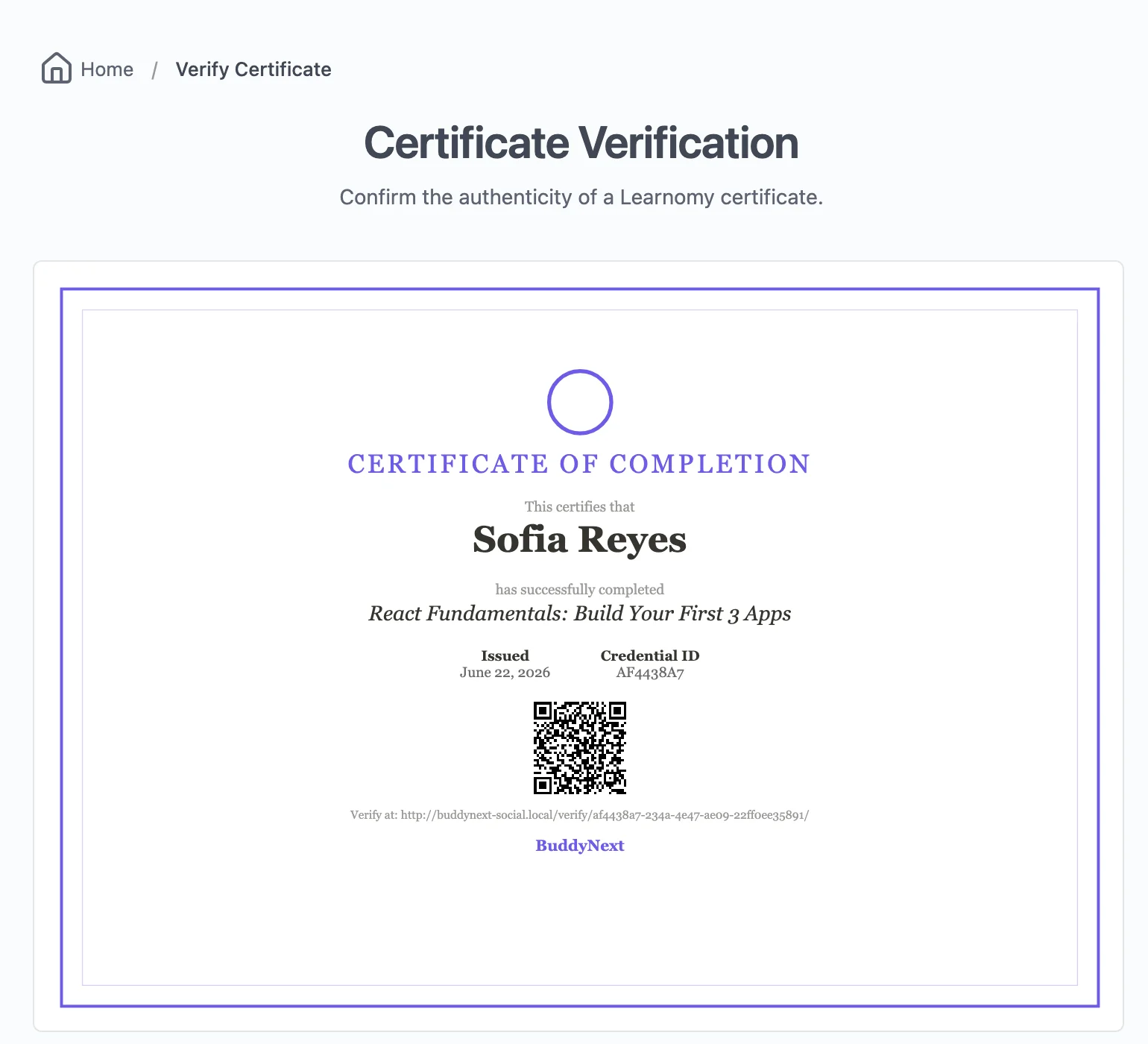
A certificate is real proof of something. It’s proof the material was covered and the assessment was passed on the day it was passed. It was never a claim about the following month, and treating it like one is where the mismatch starts.
The counter has a name, and almost nobody ships it
Spaced repetition, reviewing material at deliberately increasing intervals instead of once and done, is the proven answer to the forgetting curve. It’s the mechanism behind flashcard apps that outlast every other memorization method, and it works for the same reason the curve exists: a memory touched again just before it would have faded gets reinforced further out than it started, and the next touch can wait even longer.
Almost no course platform builds this in. The default shape is linear: lesson one, lesson two, lesson twelve, certificate, done. Nothing comes back to lesson two after lesson nine to see if it’s still there. The platform’s job, in most builders’ minds, ends at delivery. The forgetting curve doesn’t care that the job was considered finished.
The same shape, a different substrate
There’s a real parallel here worth naming instead of glossing over. A community’s member-retention curve and a course’s knowledge-retention curve are the same shape for a structurally similar reason: something was gained (a member, a fact) at a single moment, and without a reason to come back, it decays toward zero instead of staying at the level it was gained. A community that never gives someone a reason to return loses the member. A course that never gives someone a reason to revisit loses the material. Neither failure announces itself. The dashboard keeps showing the same completion number while the actual value quietly drains out from underneath it.
A first remembered action beats a first completed one
Activation Rate established that a defined first action, not the signup itself, is what predicts whether someone sticks. Course platforms usually pick “started lesson one” or “finished the course” as that action. Neither is quite right. A student who binges all twelve lessons in one sitting and forgets nine of them by Friday has completed the course and activated nothing durable.
The better first action is smaller and later: did they come back on their own, a week after finishing, to answer three review questions or reread one section, without being chased. That’s a first remembered action, not a first completed one, and it’s the honest version of the repeat-purchase test 1,000 True Fans uses for a different kind of return: someone who acts twice, unprompted, on their own initiative, is telling you something a single completion never can.
Sit with that for a minute
A course that produces excellent completion rates and terrible three-month recall isn’t succeeding at teaching. It’s succeeding at being finished. Those are different outcomes, and only one of them is the one anybody actually paid for.
The one feature that’s closer to the real thing than it gets credit for
There’s a feature already sitting in most quiz-based courses that’s closer to spaced repetition than anyone treats it as: a question bank large enough to generate a different quiz each time, paired with letting students retake it. Most creators built that for anti-cheating reasons, so someone can’t just memorize question order and pass without learning anything. But a retake pulling fresh questions from the same bank two weeks after the first attempt is, mechanically, a review touchpoint. It just happens to be one nobody scheduled on purpose.
The gap isn’t the mechanism. It’s that almost nobody prompts the retake. The quiz sits there, available, waiting for a student who already thinks they’re done to voluntarily go back and test themselves against a curve they don’t know exists. A single scheduled nudge, sent at the moment the forgetting curve predicts the material is half gone, is the difference between a passive feature and an active one.
What’s actually available to build with, honestly
Learnomy, a free WordPress LMS with 0% transaction fees, doesn’t have a dedicated spaced-repetition engine, and it would be dishonest to claim it does. What it has, free, is an announcements and email-template system a creator can point at a review cadence by hand: a message that goes out ten days after completion asking three questions from lesson two, another at thirty days pulling from lesson seven. That’s a manual version of the real thing, not an automated one, and it only works if the creator actually schedules it rather than assuming the platform handles it.
Content Drip, a Pro extension, controls the pacing of new material rather than resurfacing old material, so it solves an adjacent problem (binge-then-forget from releasing everything at once) without solving this one directly. The honest state of the tooling here, across course platforms generally, is that almost nobody has built the real thing yet. A creator willing to schedule the manual version is doing something most competitors aren’t.
What to actually do about it
Pick one course. Look at the completion rate first, then ask a harder question nobody tracks by default: of the people who completed it a month ago, how many could still explain the core idea from lesson three without looking. Nobody has that number, which is itself the finding. Then build one review touchpoint, a single email or announcement at the two-week mark, pulling one specific fact back into view. Not a summary of everything. One fact, revisited on purpose, before the cliff takes it.
There is a companion problem worth reading alongside this one. The forgetting curve is about what happens to the material after a lesson ends. The Zeigarnik effect is about what happens to the learner: finishing a course is also the moment the pull that kept them coming back switches off.
Related reading