
14 min read
Writing Content AI Search Engines Can Actually Cite

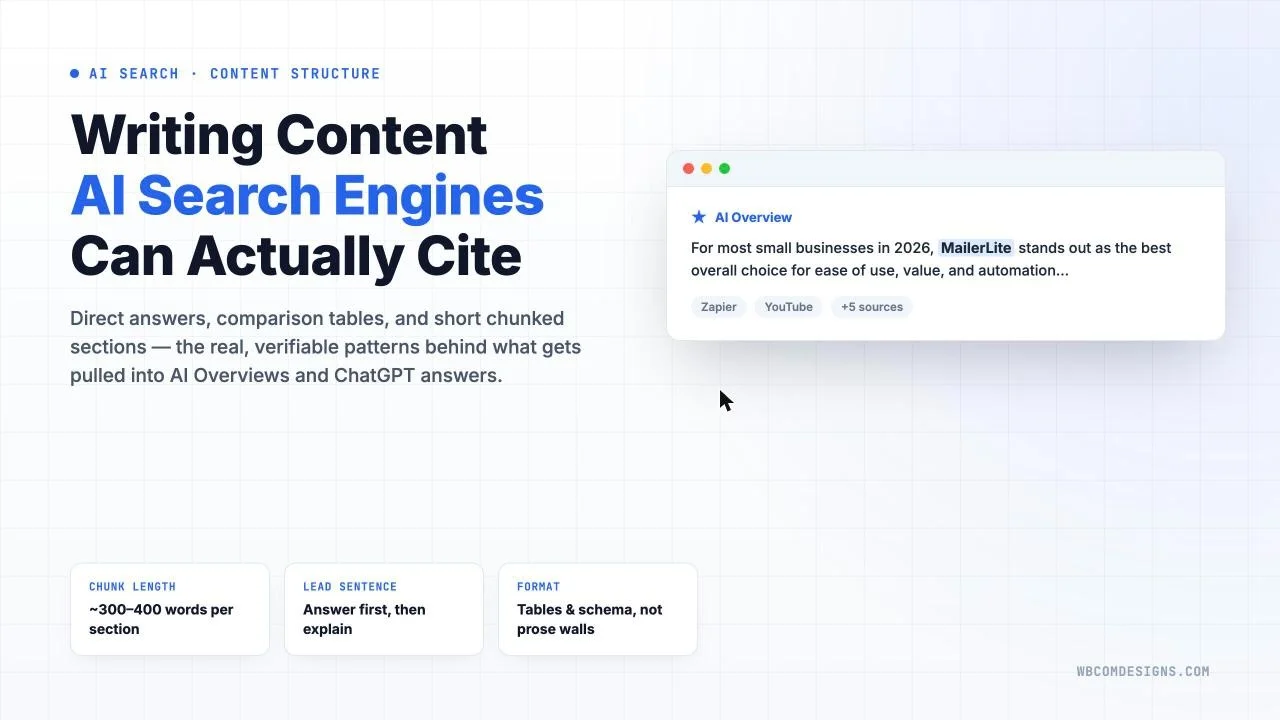
Type a comparison question into Google right now and there is a good chance you never reach a list of blue links. An AI Overview answers it directly, names two or three specific products in bold, and tucks small citation badges under each claim. The page those badges point to did not get picked by magic. It got picked because of how it was written and structured, and that structure is learnable.
This piece is the practical, page-level half of that story: what to actually put on a page so an AI system can lift a clean, self-contained answer out of it. If you want the measurement side instead, how to track mention rates, citation share, and AI-referred traffic over time, we cover that separately in our AEO guide to tracking and improving AI search visibility. This post does not repeat those citation-rate statistics; it is about the writing and formatting choices that make a page citable in the first place.
Everything below is demonstrated with real, live screenshots taken while writing this post, not mockups, so you can see the actual pattern instead of a described one.
In this post
- A live example: watching an AI Overview pick its sources
- How AI search retrieval actually works
- A naming correction worth making: there is no single “Discovery Engine”
- Chunking: why section length determines whether you get quoted
- Lead with the answer, not the throat-clearing
- Comparison tables: the format AI systems seem to prefer
- Name the entity every time, not just once
- Structured data: making the page machine-parseable, not just human-readable
- Freshness and why “updated” has to mean something
- A self-audit checklist you can run on any page today
- Frequently asked questions
A Live Example: Watching an AI Overview Pick Its Sources
Here is what actually happened when we searched “best email marketing software for small business 2026” while researching this piece. Google returned an AI Overview, and a source-analysis tool running alongside it surfaced exactly which pages it drew from and some real authority/traffic metrics for each one.
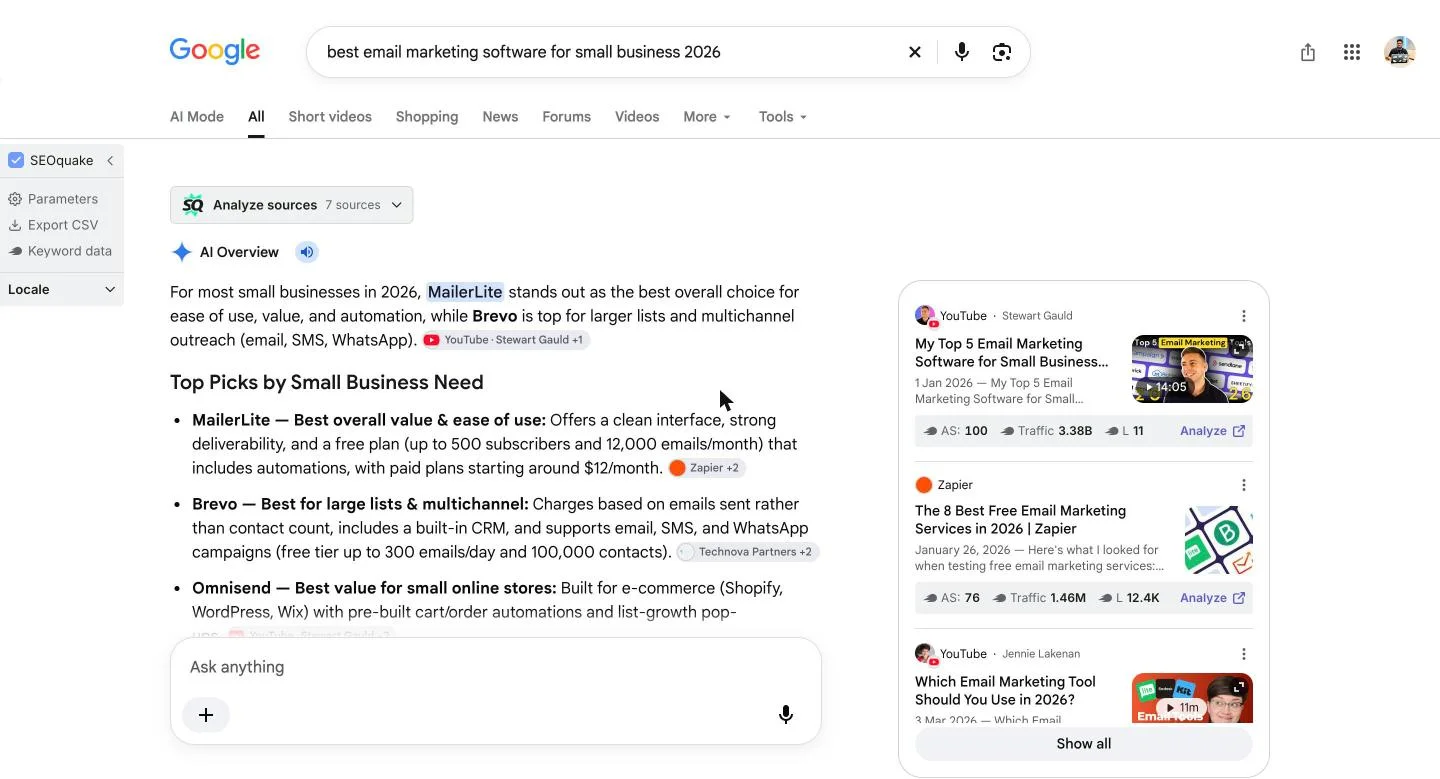
Look at the shape of the answer itself, not just that it exists. The first sentence names a winner and the runner-up by category (“best overall” vs. “best for large lists”) in a single direct sentence. Then a “Top Picks by Small Business Need” section follows, one bolded product name per bullet, each followed by a tight, specific description and a citation.
That is not a coincidence of formatting. It is a direct reflection of how the page it cited was written. Here is that cited page, Zapier’s own roundup of free email marketing tools:
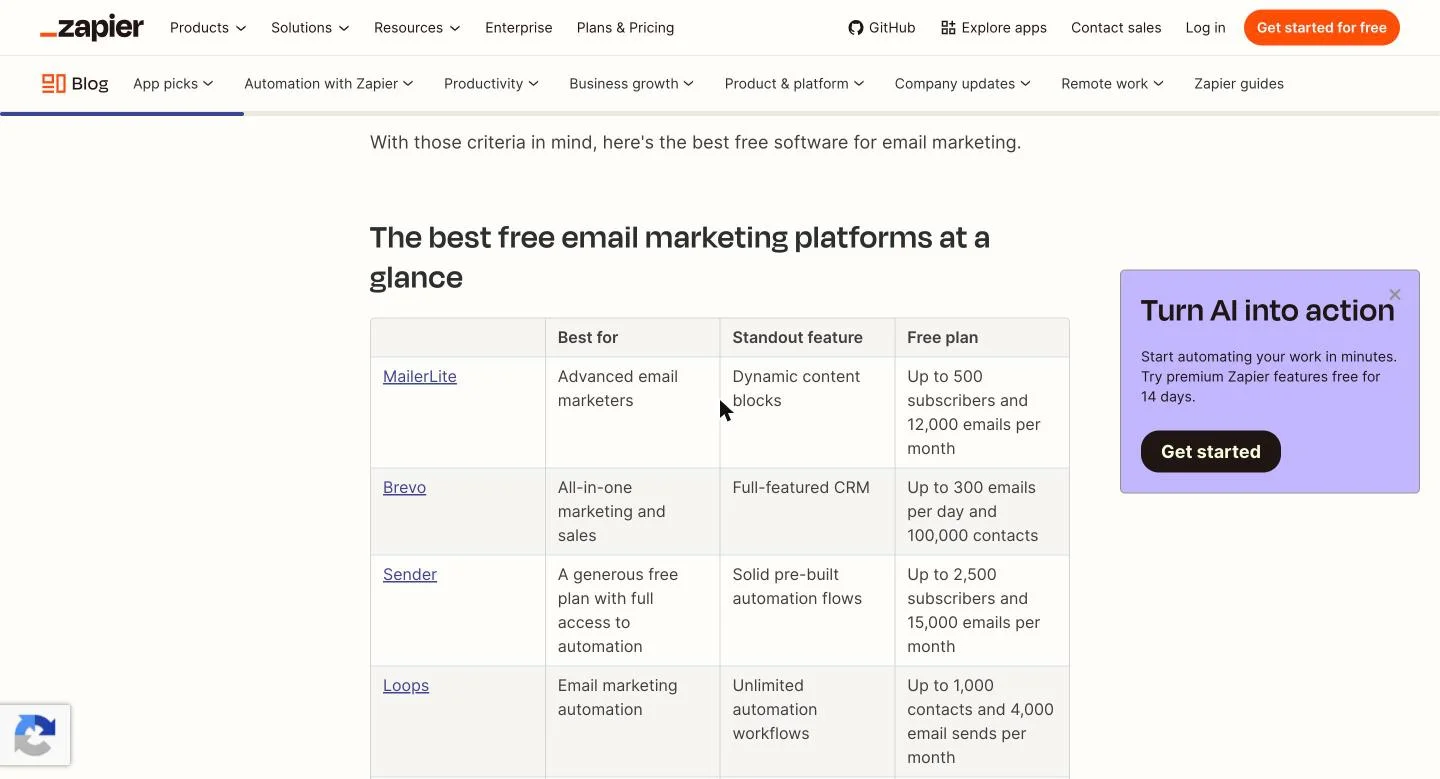
The AI Overview’s bolded-name-plus-one-line-verdict structure is a close match for this table’s own Tool / Best for / Standout feature columns.
The AI system did not invent a summary from scattered prose. It had a summary already built for it, in table form, and extracted from it directly.
That is the pattern worth internalizing for everything that follows in this post.
How AI Search Retrieval Actually Works
It helps to know, at a working level, what is actually happening between your query and that answer, because it explains why the formatting choices later in this post matter and are not just stylistic preference.
Modern AI search answers (Google’s AI Overviews and AI Mode, ChatGPT’s search feature, Perplexity, Copilot) are built on a pattern usually called retrieval-augmented generation. The system does not generate an answer purely from what a language model memorized during training.
It first retrieves a handful of real, current web pages relevant to the query, then generates a natural-language answer grounded in what those pages actually say, attaching citations back to them. Google has described AI Overviews this way publicly: the feature is built on Search’s core retrieval and ranking systems, with a generative layer that synthesizes and cites what Search already finds relevant, rather than a wholly separate ranking system running in parallel.
A concrete way to picture the semantic piece: a passage about “monthly send limits, subscriber caps, and free-tier automation rules” can match a query like “which email tool won’t charge me once my list grows” even though almost none of the words overlap. The retrieval step is comparing meaning, via vector embeddings, not just scanning for matching strings.
That is also why keyword stuffing has gotten less useful over time and clear, specific, concrete language has gotten more useful: a vague sentence produces a vague embedding that matches fewer queries well, while a specific one maps cleanly onto the specific question someone actually asked.
Four things materially affect which pages get retrieved and how much of them gets quoted:
| Signal | What it actually means for a page |
|---|---|
| Semantic relevance | Retrieval compares the meaning of your content to the meaning of the query via vector embeddings, not just matching words. A section can rank for a query that never uses its exact phrasing. |
| Keyword & entity matching | Semantic matching sits alongside keyword relevance, not instead of it. Name the actual entities a query is asking about, not just pronouns. |
| Freshness | Time-sensitive queries (pricing, year-specific “best of” lists) favor content with genuine, verifiable recency, not just a bumped timestamp. |
| Structured data & clean markup | Schema.org markup and a clean heading hierarchy make it mechanically easier to parse what a chunk of the page actually is, before language understanding even starts. |
None of these four are exotic or proprietary concepts. They are the same fundamentals that have underpinned modern information retrieval and search ranking for years; what has changed is that a generative layer now sits on top of them, picking short passages to quote rather than just ranking whole pages in a list.
A Naming Correction Worth Making
You may come across the claim that Google’s AI search ranking runs on something called the “Discovery Engine.” Worth being precise about this one, because it is a real product name being applied to the wrong thing.
Discovery Engine (now largely rebranded as part of Google Cloud’s Agent Search / Vertex AI Search line) is a real, documented Google Cloud product. Google’s own documentation describes it as letting businesses “build secure, Google-quality enterprise-grade generative AI applications for search and recommendations” on their own data: their own site search, their own internal knowledge base, their own product recommendations.
It is licensed enterprise infrastructure for other companies to build custom search experiences. It is not the system that decides what appears in Google.com’s consumer AI Overviews, and Google has not described it that way.
This matters practically, not just pedantically: if you are optimizing for AI Overviews and AI Mode, you are optimizing against Google’s public Search ranking and retrieval systems (the ones Search Central documents), not against a named enterprise product you could look up and reverse-engineer. The signals below are the real, verifiable ones to optimize for.
Chunking: Why Section Length Determines Whether You Get Quoted
Retrieval systems do not typically hand a whole 3,000-word page to a language model and ask it to find the good part. They work with smaller units, often called chunks, individual passages or sections that get evaluated for relevance somewhat independently. A chunk that mixes a direct answer with three paragraphs of unrelated throat-clearing is a worse retrieval candidate than a chunk that is only the direct answer.
In practice, that means the individual H2 or H3 section under a heading, not the page as a whole, is the real unit of competition. A common, practical guideline among people doing this work is to keep each individual section (the direct-answer portion specifically, before any supporting detail) to roughly 300 to 400 words. That is not a documented Google ranking rule with a precise cutoff; think of it as a practical ceiling rather than a line Google enforces.
A tight, self-contained section reads as a clean, extractable unit. A long section that wanders through several sub-ideas before reaching a point is harder to extract cleanly, even if the information in it is accurate. Look again at the Zapier table example above: each row is a handful of words. The detailed section for any one tool, further down that same real page, runs to a few tight paragraphs per product, not one sprawling comparison essay. That is chunking in practice, not in theory.
Lead With the Answer, Not the Throat-Clearing
The single highest-leverage sentence on any page is the first one under each heading. Compare these two openings for a section titled “Is MailerLite good for ecommerce?”:
| Weak opening | Strong opening |
|---|---|
| “When thinking about email marketing tools for an online store, there are a lot of factors to consider, and MailerLite is one option worth looking at among many others in the space.” | “MailerLite works for small ecommerce stores but lacks Omnisend’s dedicated cart-abandonment and product-recommendation blocks.” Then elaborate. |
The weak version is the kind of sentence that fills space without saying anything a retrieval system, or a human skimming, can act on. The strong version states a specific, checkable claim in the first clause and names the actual comparison point. If a system is only going to extract one sentence from your section, write the sentence you would want extracted, and put it first, not third.
Comparison Tables: The Format AI Systems Seem to Prefer
The screenshots earlier in this post are not a one-off. Comparison and “best of” queries are exactly the shape of query where AI Overviews most reliably appear, and tables are a format that happens to solve several problems at once: they force one clear claim per cell instead of a paragraph that hedges, they give every option the exact same fields to be judged on, and they are trivially easy for a retrieval system to parse into structured facts.
A practical table for this purpose needs, at minimum: the name of each option, one “best for” or positioning column, and one or two genuinely differentiating fact columns (price, a standout feature, a hard limit). Skip decorative columns that do not actually differ row to row; they add length without adding anything extractable.
Name the Entity Every Time, Not Just Once
This is a narrower, page-level cousin of the cross-platform “entity consistency” work covered in our AEO tracking guide: keeping your brand name and facts synced across LinkedIn, Crunchbase, and review sites. Inside a single piece of content, the equivalent discipline is simpler but just as often skipped: name the actual entity every time a claim is made about it, instead of leaning on “it,” “this tool,” or “the platform” after the first mention.
Writers do this for readability, since repeating a product name feels clunky in flowing prose. But a retrieval system evaluating one isolated chunk, remember, chunks get assessed somewhat independently, cannot always see the earlier paragraph where “it” was defined.
A sentence that says “It also includes a free CRM” is nearly useless as a standalone quotable fact. “Brevo also includes a free CRM” is immediately usable, in isolation, by a system that only retrieved that one sentence. The practical fix is not to mechanically repeat the name in every single sentence, that reads badly and triggers its own set of problems. It is to re-anchor the entity name at the start of each new section or each new bulleted point, specifically the places most likely to be chunked and retrieved on their own, even if the paragraph in between uses a pronoun naturally.
Structured Data: Making the Page Machine-Parseable
Structured data, schema.org markup embedded as JSON-LD, does not write your content for you and it does not guarantee a citation. What it does is remove ambiguity about what a given piece of content is, before any language understanding has to guess. A few that matter most for this kind of content:
- FAQPage for genuine question-and-answer sections, matched to real questions people actually ask, not invented ones stretched to fit the schema.
- Product and Review schema on comparison/roundup content, when you are actually making a factual claim about a real product’s price or rating.
- Article with accurate
datePublishedanddateModifiedfields, which ties directly into the freshness signal below, since an unmarked or inaccurate date is a freshness signal you are throwing away for free.
One caution worth stating plainly: do not run two SEO/schema plugins at once on the same WordPress install, and do not mark up content with a schema type it does not genuinely match. Duplicate or mismatched schema is a well-documented way to get a rich result suppressed rather than enhanced.
Freshness, and Why “Updated” Has to Mean Something
Freshness as a signal is frequently misunderstood as “bump the modified date.” Editing the timestamp on a page with unchanged, now-stale facts is a short-lived trick at best, and it actively backfires on exactly the kind of query this post is about: pricing, year-specific “best of” lists, and anything time-sensitive, because a retrieval system and a human reader both eventually notice the content does not match the date.
Genuine freshness means the actual facts changed: a price that moved, a product that got discontinued and should be removed from a comparison table, a new competitor that entered the category. Update the content first; let the date update be the honest byproduct of that, not the goal itself.
A Self-Audit Checklist You Can Run on Any Page Today
- Does the first sentence under each H2/H3 state a specific, checkable answer, not a lead-in?
- Is any single section’s direct-answer portion under roughly 300 - 400 words before it moves into supporting detail?
- Is there at least one comparison table with one clear positioning column and one or two genuinely differentiating fields?
- Does every product, tool, or entity get called by its actual name near its claims, re-anchored at the start of each section, not just “it” or “this option” throughout?
- Is FAQPage/Product/Article schema present, accurate, and not duplicated by a second plugin?
- Does the
dateModifiedfield match a real, substantive content change, not just a republish click? - If you read only the bolded terms and table rows on the page, top to bottom, does it still make sense as a standalone summary?
That last question is the fastest real test. If a skimmed version of your own page, just the headings, bold terms, and table rows, already reads like a coherent answer, you have built something a retrieval system can lift cleanly. If it reads like fragments without the connecting prose, a human skimmer and an AI retrieval system will struggle with it for the same reason.
Frequently Asked Questions
Is there an exact word count Google requires for a citable chunk?
No. Google has not published a precise chunk-size rule. The 300 - 400 word range described here is a practical, widely used guideline among people doing this work day to day, not a documented cutoff. Treat it as a ceiling to stay under for a single direct-answer passage, not a target to hit exactly.
Does “Discovery Engine” have anything to do with how my content gets cited?
Not directly. As covered above, Discovery Engine is Google Cloud’s enterprise product for businesses building their own custom search applications on their own data. The consumer AI Overviews you see in Google.com search results run on Google’s public Search ranking and retrieval systems, which are what the guidance in this post is actually written against.
Will adding a comparison table guarantee my page gets cited?
No single tactic guarantees a citation; selection is not fully transparent and depends on the whole query landscape, not just one page’s formatting. A well-built table materially raises your odds for comparison-shaped queries because it hands the retrieval system a pre-structured summary, which is a real, demonstrated pattern, not a guarantee.
Should I rewrite my whole site around this today?
Start with the pages already getting real search impressions for comparison or “best of” style queries; those are the ones where this formatting has the clearest, fastest payoff. Rewriting a page nobody is searching for will not produce a measurable result either way.
How does this relate to traditional SEO?
It extends it rather than replacing it. Clean headings, real keyword and entity relevance, and accurate structured data have been sound SEO practice for years. What is new is the added weight on self-contained, quotable chunks and tables, since those are the units a generative layer is actually lifting out, not just a ranking list a human then has to click through.
Does this formatting advice apply the same way to ChatGPT and Perplexity as it does to Google?
The core mechanics, chunked retrieval, semantic matching, citation back to a source, are broadly shared across Google’s AI Overviews, ChatGPT’s search feature, Perplexity, and Copilot, since all of them follow some version of the retrieve-then-generate pattern described above. The details differ: each engine crawls on its own schedule, weighs recency and authority somewhat differently, and draws from a different mix of indexed sources. Content built around clear, direct-answer chunks and genuine structured data tends to travel reasonably well across all of them, rather than requiring a completely separate version of a page per engine.
What is the single most common mistake on pages that never get cited?
Burying the actual answer. The most frequent pattern in content that AI systems skip over is a section that spends two or three sentences on context, history, or a rhetorical question before ever stating the fact the heading promised. A retrieval system evaluating that chunk against a direct query sees a lot of low-relevance filler surrounding one useful sentence, and a competing page that states the same fact as its very first sentence is simply the cleaner match.
For the tracking and measurement side of this, how to tell whether any of this is actually moving your citation rate, see our AEO guide to tracking and improving AI search visibility.
Interesting Reads:
Related reading