
6 min read
The Certificate That Recruits Your Next Student For Free

Course creators spend real money finding the next student, ads, affiliates, cold outreach to the same three Facebook groups every launch. Meanwhile the thing that could be doing that job for free is sitting quietly in every graduate’s inbox: the certificate.
Most course platforms treat completion certificates as a formality, a PDF nobody looks at twice. That’s a missed loop, not a small one. A public, verifiable, shareable certificate is one of the few pieces of content a student is genuinely proud enough to post somewhere strangers will see it. If you read the piece on why most communities have no growth loop at all, this is exactly the mechanism that piece was describing, an output that escapes the platform and becomes someone else’s input.
In this pieceWhy a certificate is a better growth channel than an ad
What makes a certificate actually shareable
A real one, not a mockup
What makes course certificates fail as a loop
The pushback: “our students won’t bother sharing”
Where this actually lives inside Learnomy
Why this isn’t the same as a LinkedIn skill badge
Turning it into something you actually check
Why a certificate is a better growth channel than an ad
An ad interrupts a stranger who wasn’t thinking about your course. A shared certificate reaches someone already inside that person’s actual network, filtered through a real human being who just told everyone watching that this specific course was worth finishing. That’s not a marketing channel you can buy at any price. It’s earned, once, by making the certificate good enough to want to post.
The economics are lopsided in the certificate’s favor. An ad costs money every single time it runs. A certificate costs nothing extra to issue, you were already generating it, and it keeps working every time a new graduate decides to share theirs, for as long as the course exists.
What makes a certificate actually shareable
Three things separate a certificate people post from one that sits in a downloads folder forever.
It has to be verifiable by a stranger, not just decorative. A public link anyone can check, proving the credential is real and not something the graduate typed up themselves in an afternoon, is what makes a hiring manager or a curious connection actually trust it enough to click.
It has to look good enough to want to post next to your name. Nobody shares an ugly PDF, no matter how legitimate it is. The visual design is doing real marketing work, not decoration.
And it has to be effortless to share to the one place that actually matters for most courses: a single click to LinkedIn, not a multi-step export-and-upload process that most graduates will simply never finish.
A real one, not a mockup
Here’s an actual example instead of a description of one.
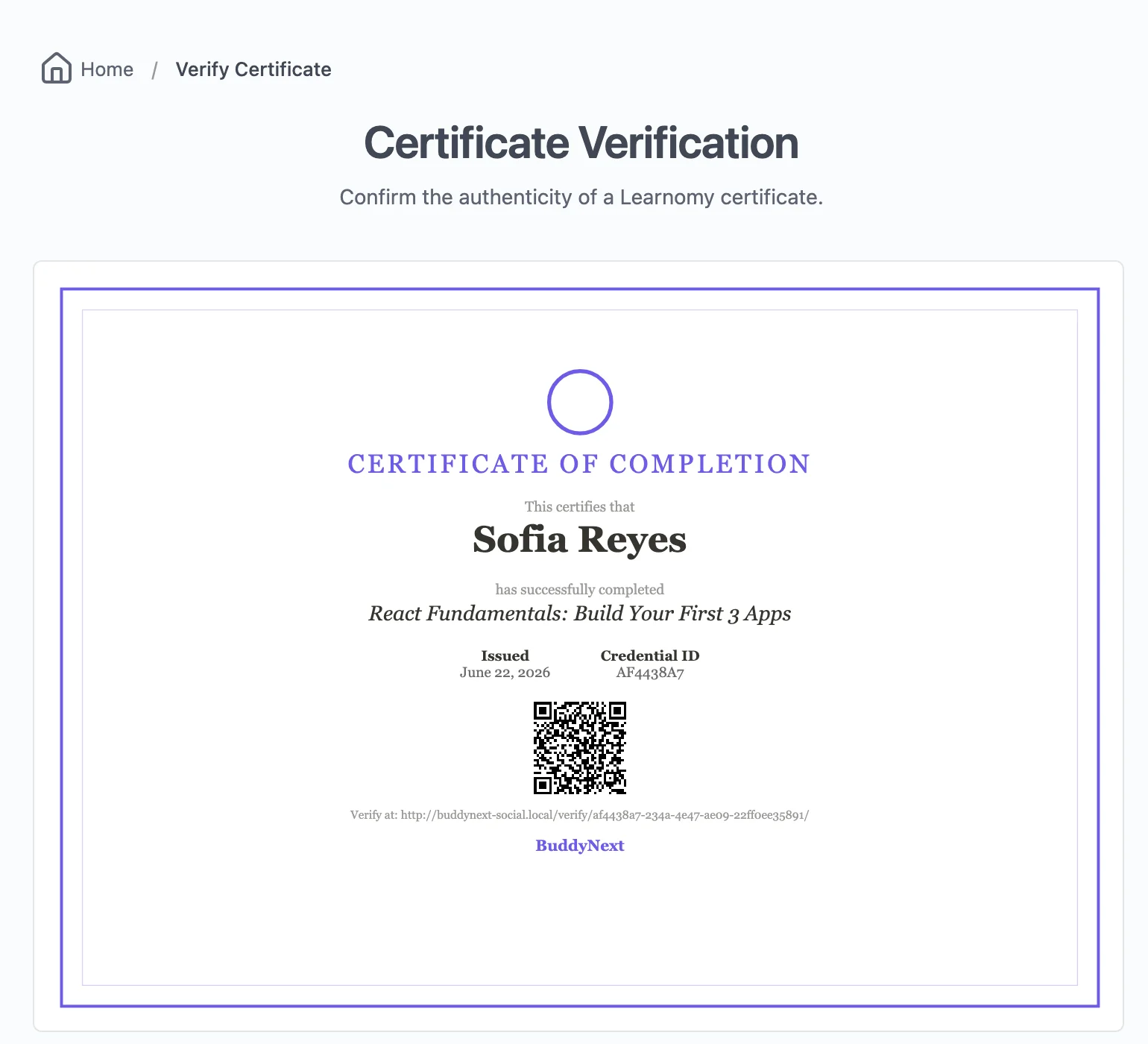
That’s a real, live credential, publicly reachable at its own verify URL, with a QR code that resolves to that exact page and a genuine credential ID, not a placeholder. Anyone who scans it or clicks the link lands on proof, not a promise. That’s the entire mechanical requirement for the loop to close, and it already exists the moment the course issues its first certificate.
What makes course certificates fail as a loop
The most common failure is making the certificate available but not verifiable. A downloadable image with no public check-page behind it can be faked by anyone in five minutes, and sophisticated viewers, the exact hiring managers and peers you want reached, know that and discount it accordingly.
The second is friction. If getting a shareable version requires downloading a file, then manually uploading it to LinkedIn as an image post, most graduates who would have shared it in one click simply won’t do the multi-step version.
The third is a certificate that only proves attendance, not competence. “Attended a webinar” doesn’t earn anyone confidence when they see it in a feed. A certificate tied to real assessment, quizzes actually passed, a real final project, carries weight a participation certificate never will, and that weight is what makes someone stop scrolling and actually click.
The pushback: “our students won’t bother sharing”
Some won’t, and that’s fine, the loop doesn’t need everyone. It needs a meaningful minority who are proud of finishing something hard, and course completion, especially anything with a real pass rate below a hundred percent, reliably produces exactly that feeling in a real slice of graduates.
The honest fix if share rates are low isn’t nagging people to post. It’s checking whether the certificate is actually good enough to be proud of, verifiable, well designed, one click to share, before assuming the concept doesn’t work for your course.
Where this actually lives inside Learnomy
If you’re running courses on Learnomy, the free tier already ships every piece this loop needs: signed certificates with a real QR code, a public verify page anyone can check without an account, and one-click LinkedIn sharing built in rather than bolted on. None of that is a Pro upgrade. It’s there the moment a student finishes the course. We’ve walked through the certificate designer and the verify page in detail, with real screenshots, in this dedicated breakdown.
If you’re pairing the course with a community layer like BuddyNext, the way the social learning piece in the North Star Metric series describes, the certificate loop and the community loop reinforce each other. A graduate who shares a certificate and gets a comment asking “how did you learn this” has an actual answer to give, your community, not just your course, and a real place to send the person who asked.
Why this isn’t the same as a LinkedIn skill badge
LinkedIn already lets anyone add a self-reported skill, endorsed by connections who mostly click the button without reading closely. It’s worth being honest about why a course certificate is a different, stronger thing, not just a fancier version of the same idea.
A self-reported skill has no verification behind it at all, anyone can add “Python” to their profile whether they’ve written a line of it or not. A verifiable certificate ties a specific claim to a specific, checkable credential, a real course, a real assessment, a real issue date. The gap between those two is exactly the gap between a claim and proof, and hiring managers who’ve been burned by the first one notice the difference.
It’s also a different kind of content in a feed. A skill endorsement is invisible, buried in a profile section nobody scrolls to. A shared certificate is an actual post, with a design, a moment, something worth a comment. One sits passively waiting to be noticed. The other actively shows up in front of the exact audience most likely to become your next student.
Turning it into something you actually check
Weekly, not per-launch. Track how many issued certificates actually get shared, not just issued, that ratio tells you whether the loop is real or theoretical. Track how many new students mention a shared certificate or a referral from a graduate as how they found you. And if that number is close to zero, the fix usually isn’t the marketing plan. It’s the three requirements above, verifiable, good-looking, one click, that the certificate itself hasn’t earned yet.
An ad campaign stops the moment you stop paying for it. A certificate a graduate is proud of keeps recruiting for you long after the course ended, for free, one share at a time.
Related reading