
5 min read
The Ringelmann Effect: Why a Bigger Community Answers Fewer Questions

In 1913, a French agricultural engineer named Max Ringelmann had people pull on a rope and measured how hard they pulled. Alone, someone pulled at close to their full capacity. Add a second person, and the combined force wasn’t quite double. Add six more, and the per-person contribution kept falling, until a group of eight was pulling at roughly half the force you’d expect if each person’s solo effort simply added up.
Nobody in the group was told to pull less. Most of them probably believed they were pulling just as hard as before.
What actually happens to a question in a big room
The rope experiment gets cited as “social loafing,” which makes it sound like laziness. That’s not quite what Ringelmann found, and it’s not the useful part for anyone running an online community. Some of the drop was coordination loss, people literally getting in each other’s way and out of sync. But a real share of it was motivational: as the group got bigger, each individual’s sense that their specific effort was necessary got smaller.
Post a question to five people and it feels personally addressed. Someone will answer, and everyone half-expects it to be them. Post the identical question to a Space with five thousand members and something quietly changes, not in the words, only in who reads them. Now the responsibility is distributed across five thousand people instead of five, which mathematically means each individual reader’s share of “should I be the one to answer this” is a thousand times smaller. Most of them assume, correctly, that someone else with more expertise or more time will get to it first. Multiply that assumption by five thousand people making it simultaneously and the honest answer, sometimes, is that nobody does.
This isn’t a character flaw in your members. It’s the same rope, digitized.
The numbers, with the honest caveats attached
The percentages usually quoted for Ringelmann’s original experiment go something like this: two people pulling together produced about 93% of the sum of their individual efforts, three people produced about 85%, and eight people produced somewhere around 49%. Worth being careful with those exact figures. Ringelmann’s original 1913 data was never fully published in a form later researchers could re-derive cleanly, later re-analyses have disputed the precise curve, and some of the drop at higher group sizes is coordination loss rather than motivation loss, which is a different mechanism wearing the same symptom.
What survived a century of replication, including studies specifically designed to separate coordination loss from motivation loss, is the direction and the rough shape: individual output per person declines as group size grows, and it declines even in tasks with no physical coordination problem at all, cheering, clapping, brainstorming, evaluating an idea. That’s the part worth trusting. The exact percentage at eight members is not the part worth building an argument on.
The mechanism underneath two things you’ve already read about
If Dunbar’s Number tells you the size at which a community outgrows any one person’s capacity to actually know its members, and the 90-9-1 Rule tells you what the resulting participation split actually looks like, Ringelmann is the piece that explains the mechanism connecting them. It’s not only that a 5,000-member community exceeds what any one brain can track. It’s that the moment a question’s visible audience crosses some threshold, each individual reader’s felt obligation to be the one who answers drops on a curve, not a cliff, and it drops for reasons that have nothing to do with whether they know the answer.
That matters because it points to a different fix than either of those two ideas implies on their own. Dunbar’s ceiling suggests you can’t know everyone past 150, which is true and mostly unfixable. Ringelmann suggests something you actually can fix: the size of the audience a specific question feels like it has, which is a design choice, not a population fact.
The fix nobody wants, and the one that works
The tempting fix is to shrink the community, keep it small enough that every member still feels personally on the hook. That works, and it also throws away everything a growing community is supposed to be for. It’s the wrong lever, and it contradicts the entire case for building Spaces and sub-spaces in the first place, which exist precisely so a community can grow in member count without every individual conversation inheriting that same size.
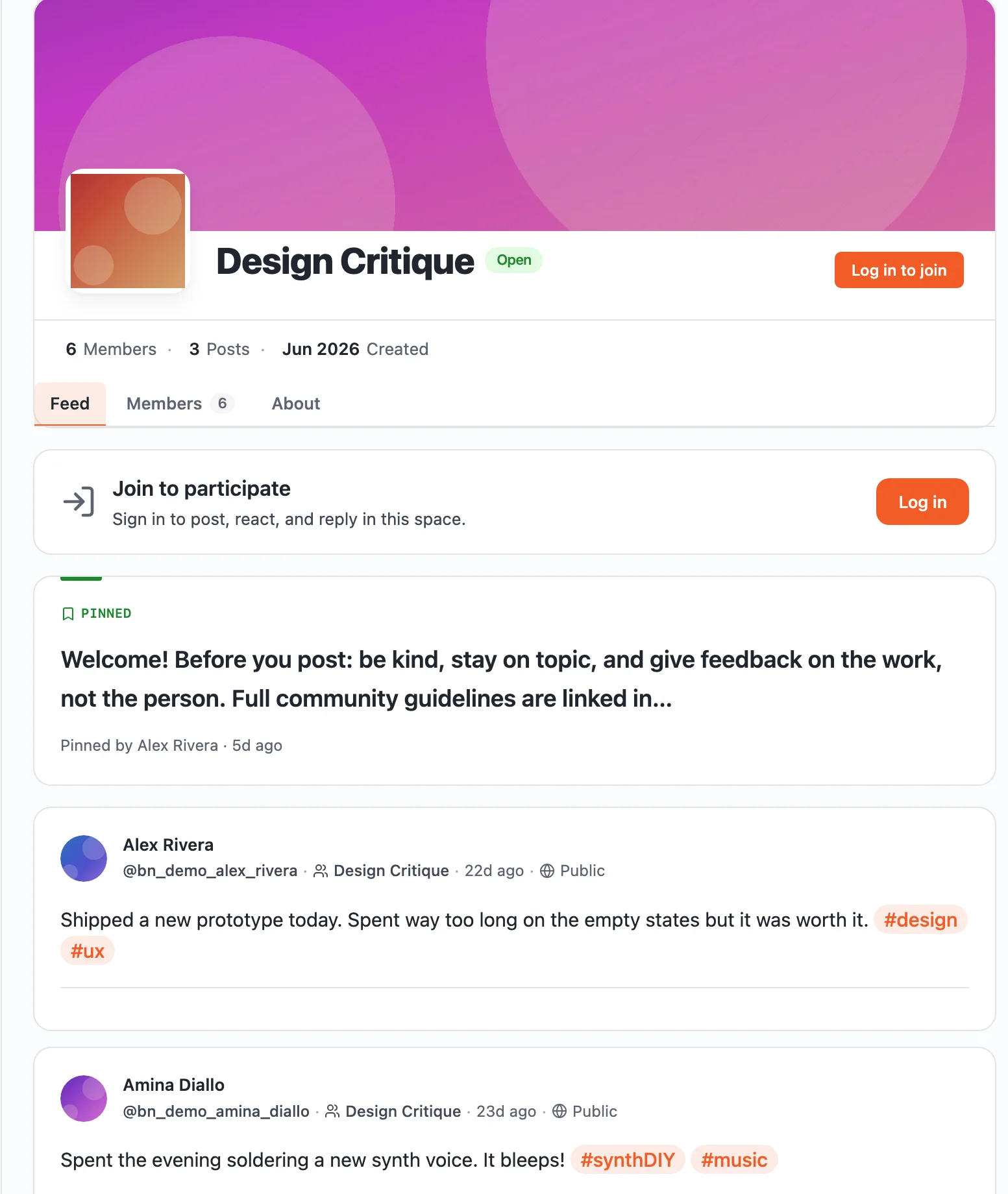
The fix that actually works is narrower: keep the visible audience for any specific ask honestly small, even inside a large community. A question dropped into a twelve-person Space carries the same per-person felt-responsibility it would carry among twelve friends, regardless of how many thousand people belong to the parent community around it. That’s a structural answer, not a motivational poster telling people to care more.
Two more things do real work here, both grounded in features that exist today rather than invented for this argument. A direct @-mention lands as a named request instead of a broadcast, which restores exactly the “this is addressed to me” signal a public post to a large feed dilutes away. And BuddyNext’s five-level threaded comments plus its per-type notification channels make one specific person’s silence visible in a way a flat activity feed never does, since a reply nested under a direct question shows up as a reply to that specific person, not as one more item in an undifferentiated stream everyone can quietly scroll past.
Where this goes wrong the other direction
Sit with that for a second before reaching for the obvious next move, which is assigning specific people to specific questions on a rotation, a kind of community answer-desk schedule. It sounds like the logical extension of “make the audience small and the ask personal.” It backfires for the same reason the 90-9-1 Rule’s most engaged 1% burn out when a community turns their voluntary contribution into a formal obligation: an @-mention that restores felt-responsibility is different in kind from a duty roster that manufactures it. One works because it reflects something real, that this particular person actually might know. The other imports the language of a job onto something people were doing because they wanted to.
The useful version of this fix is closer to routing than assigning. Point questions at the smallest honest audience, and at the person most likely to actually care, without converting anyone’s goodwill into a rota.
What to actually check
If your community has a channel or Space where questions routinely go unanswered, don’t start by asking whether the members there are disengaged. Count the visible audience for a typical question in that space, and compare it to the visible audience in a smaller Space where the same kind of question reliably gets answered. The gap between those two numbers is usually the entire explanation, and it’s the kind of gap a sub-space, a direct mention, or a threaded reply closes without anyone having to become a more conscientious person than they already are.
Related reading