
11 min read
Live Chat vs. Contact Forms: What the Response-Time Data Actually Says

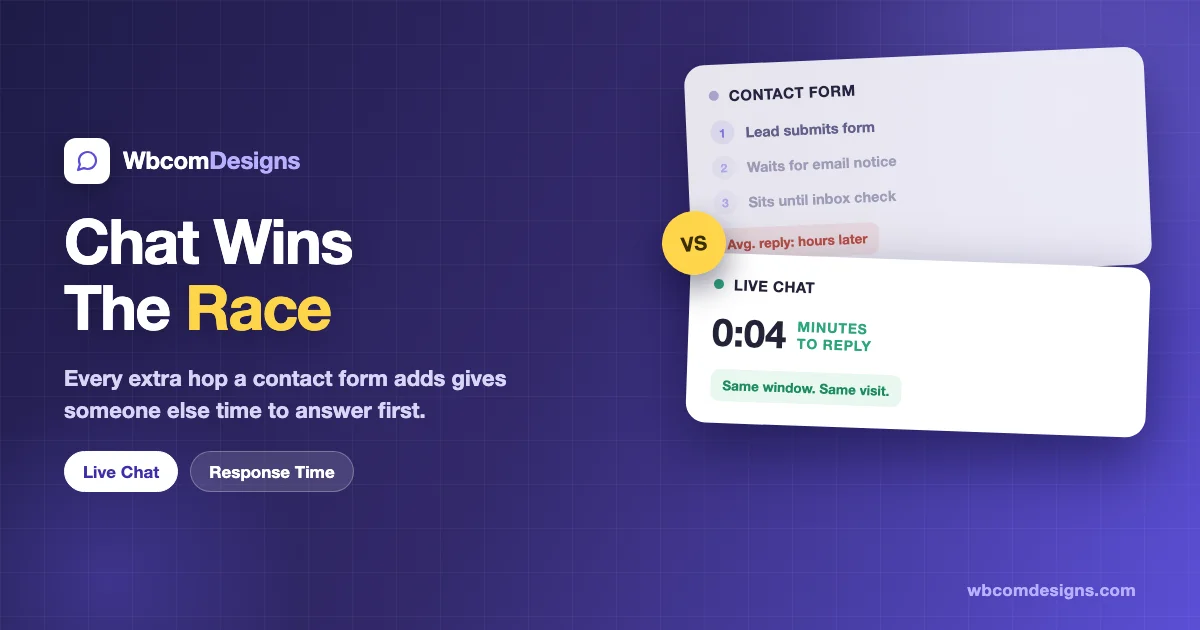
A prospect lands on your site, likes what they see, and reaches out. What happens in the next few minutes decides more about whether you win that deal than almost anything else in your sales process. Live chat vs contact forms is not a cosmetic choice: the format they used to reach out has more to do with that outcome than most service businesses give it credit for.
Our research post on lead response time walked through the data on how fast a reply needs to be to still count. This post narrows in on one specific question underneath that research: why does the format a lead comes in through, form or chat, change the odds so much? The honest answer has less to do with effort or headcount than most people assume. It comes down to how many hops sit between “someone reached out” and “someone replied.”
Live chat vs contact forms: why the form was never built for speed
A contact form feels instant to the person filling it out. Type a few lines, click submit, done in twenty seconds. But that is the last fast part of the interaction. Everything after the click depends on somebody else’s schedule, not the prospect’s.
The hops between “submitted” and “answered”
A single form submission typically passes through several separate delays before a human reply goes out, and each one adds time on its own:
- The form plugin fires a notification email, which can itself lag by a few minutes if the mail server queues outbound mail or a plugin batches notifications instead of sending immediately
- The notification lands in an inbox that is not being watched in real time. Most people check email in batches, a handful of times a day, not continuously between other work
- The message gets triaged against everything else already sitting in that inbox: invoices, existing client replies, calendar invites. A submission from a stranger does not always read as urgent next to those
- Someone finally opens it, decides it deserves a real reply rather than a canned “we got your message,” and starts composing a response from scratch
None of those hops is dramatic on its own. Stacked together, they routinely turn a twenty-second form submission into a reply that lands hours later. It is worth noticing that “we typically respond within 24 hours” has become a standard line on contact pages, a quiet industry-wide admission that forms do not produce same-window replies.
Some of the delay is even more mechanical than a full inbox. Plenty of form plugins batch their email notifications on a schedule rather than sending the moment a submission comes in, to keep server load down. Shared hosting environments throttle outbound transactional mail during traffic spikes, which adds a delay that has nothing to do with anyone’s attentiveness. And a notification email addressed to a generic “info@” or “contact@” alias, rather than a person, is more likely to land in a folder nobody checks daily. It may even get filtered out by a spam rule tuned for exactly that kind of automated-looking message.
This is a structural problem, not a work ethic problem
Nobody in that chain is being careless. Checking email a few times a day rather than sitting on it continuously is often the correct way to run a business that is not also a full-time intake desk. The issue is not that people are slow to respond. It is that a form separates the moment of interest from the moment of reply by at least one full email round trip, usually more. No version of “try harder” removes an architectural gap like that.
What live chat actually changes
Live chat does not win because it is chat. It wins because of the one structural thing it changes: a reply can happen inside the same browser session the prospect is already sitting in.
Three things are true the moment someone opens a chat widget that are not true of a form submission. The lead is already on the page, already reading your site. They already have intent, since opening a chat window is a more deliberate action than filling in three fields. And a reply, when it comes, arrives without an email round trip, without batching, and without getting triaged against unrelated messages in someone’s inbox.
Same window, not the next window
That is the entire mechanical advantage, and it is worth stating plainly because it often gets dressed up as something more complicated than it is. Instead of the prospect’s attention resetting to whatever they do next while they wait for an email, the answer arrives right away. They are still sitting there with the question in mind and the tab open. Removing the wait does not require removing effort from anyone’s day. It requires removing the hops.
The catch nobody mentions: an idle widget is worse than a form
Here is the part that gets left out of most “add live chat” advice: chat only produces that advantage if someone is actually watching it in real time. An installed-but-unmonitored widget is not a smaller version of the benefit. It can be worse than a form, for a specific reason. A form at minimum guarantees an email lands somewhere and gets checked eventually, even if that check happens in a batch three times a day. An unanswered chat bubble often has no equivalent fallback. There is no notification loop pulling anyone back to look at it. A visitor who opens a chat window that never responds tends to read that silence as a worse signal than a form that at least implies a reply is coming.
So the real comparison is not “chat versus form.” It is “actively monitored chat versus form.” An unmonitored chat widget loses to both. That is exactly why so many small business chat widgets sit dormant with zero conversations started: prospects have learned to distrust the ones that clearly are not staffed.
| Response pathway | Typical first-reply window | What it depends on |
|---|---|---|
| Unmonitored contact form | Hours, often a day or more | Whenever someone happens to check the inbox |
| Monitored contact form (dedicated inbox check) | Within the hour, on a good day | Someone deliberately watching that inbox on a schedule |
| Unmonitored chat widget | Rarely, if ever | Whether anyone happens to glance at a dashboard |
| Actively monitored live chat | Minutes, same session | Someone being reachable when the widget opens |
Read down that table and the pattern is clear: the format matters far less than whether a human is actually present on the other end of it. Chat only outperforms a form when that presence is real.
Why the format gap matters most for service businesses
For a high-volume retail site, a few hours of lag on a fraction of daily inquiries barely registers. If three out of five hundred leads a day wait an extra hour, the averages absorb it. Consultants, freelancers, and small agencies do not get that cushion. A one-person consultancy or a small studio might see five genuine inquiries in a week, and each one represents a meaningfully sized engagement rather than a small transaction. Losing one to a slow reply is not a rounding error. It is a lost contract, and often a lost relationship that would have led to referrals down the line.
Every lead is a named account, not a funnel stage
Service businesses also tend to know the specific person and the specific project by the second message, which is part of why the delay stings more than it would for a commodity purchase. The prospect is not comparing SKUs or checking a price table. They are deciding who to trust with a real piece of work. How quickly and thoughtfully you answer the first question is itself part of what they are evaluating, whether they say so out loud or not. It is the same signal buyers rely on when deciding who to hire for a project in the first place. The speed and quality of that first answer tells them most of what they need to know, often before any contract gets signed.
Forms make it easy to ask five people the same question at once
There is a second effect that is specific to forms, and it rarely gets named directly. A contact form has almost no switching cost. A prospect can fill one out, open a new tab, fill out the next agency’s form, and repeat that three or four times in under a minute. All of that happens before any of the replies come back. The form itself does nothing to discourage that behavior, since submitting it feels like progress even though nothing has actually been resolved. A live chat conversation works differently. Once a prospect is mid-conversation with someone who is actually answering their questions, there is a real cost to abandoning it and starting over somewhere else. They already have a person, a scoped answer, and momentum. That is not a minor detail. It means chat does more than respond faster. It also reduces how many competitors a lead is actively shopping in parallel while they wait.
What this actually looks like day to day
The lead is not judging your website nearly as much as they are judging how fast, and how well, you respond to the first thing they said.
A freelance designer gets asked whether they can work within an existing brand system. Answered inside the same conversation, with a couple of examples, that is a five-minute exchange that keeps momentum going. Answered the next day by email, the prospect has often already booked a call with someone else who replied sooner. A consultant fielding a discovery-call request can confirm availability on the spot instead of trading three emails to find a shared slot. An agency responding to an RFP-style question gets to demonstrate responsiveness as part of the pitch itself. How well and how fast you answer that first question is evidence of how you will run the engagement once it is signed.
It also changes how a small team handles more than one inquiry landing close together. With email, two form submissions arriving within an hour of each other usually get answered in whatever order someone happens to open them. That can mean the second, more promising lead waits behind a less serious one. A live conversation makes it obvious in real time which inquiry is warm and worth prioritizing, because you are actually talking to the person rather than guessing from a subject line.
None of that requires more hours in anyone’s day. It requires the reply happening in the window the prospect is actually paying attention, rather than the next one.
Closing the gap without turning someone into a full-time chat operator
The obvious objection to all of this is fair: nobody wants to hire a person to sit and stare at a chat window all day any more than they want someone babysitting an inbox. That is not the fix, and it is not what actually closes this gap for a small team. That tension is sharpest for solo consultants and small agency owners, who are usually also the person doing the billable work, a bind we dig into in how service businesses lose leads while “getting back to you”.
This is the specific problem our team built WP Sell Services to solve. It is real-time, one-to-one chat built specifically for businesses that sell service engagements, consultants, freelancers, agencies, and studios. That is different from the generic “how can I help you today” widget bolted onto an online shop. That distinction matters more than it sounds like it should. A service inquiry is not “where is my order.” It is “can you actually do the thing I need, and are you the right fit,” and that question needs a real, specific answer from the person who can give one, not a scripted reply from a support queue.
The responsiveness expectation does not end once the contract is signed, either. A client who converts fast and then waits days for an onboarding answer forms the same impression a slow lead response does, as we cover in our retention playbook on why customers actually cancel.
With it in place on a service site, you get a few concrete things:
- So you can answer a scoping question while the prospect is still reading your site, instead of after they have already moved on to a competitor
- So you can qualify budget, timeline, and scope inside the same conversation, rather than trading three separate emails to get there
- So you can route a live conversation to whoever is actually free right now, instead of leaving it to whoever happens to check their inbox first
- So you can show responsiveness as part of the sale itself, which for a service business is often half the pitch
We built it around one-to-one conversations on purpose, because selling a service is a consultative process, not a transactional one. The person reaching out generally wants to know they are talking to someone who understands their specific situation, not a rotating queue of agents reading from a script. If you are also thinking through how to structure that kind of offering more broadly, our guide on building a service marketplace on WordPress covers the setup side of the same product.
Where to start
You do not need to overhaul your entire sales process to act on this. Start by being honest about which of the four rows in that table above actually describes your current setup. Then ask whether a form sitting in an inbox is quietly costing you deals that a live, monitored conversation would have kept. The response-time research is consistent on the underlying point even if the exact multipliers vary study to study: speed compounds. The format that removes the most hops between question and answer tends to win the deal. Winning that first conversation is only half the timeline, though, see how it connects to what happens after the sale in chat for the first question, community for every question after.
If your leads are currently landing in an inbox and waiting for someone to notice, take a look at WP Sell Services and see what it takes to have that first conversation in the same window the prospect opened it in, instead of the next one.
Related reading