
11 min read
Lead Response Time: Stop the Costly Mistake of Slow Replies

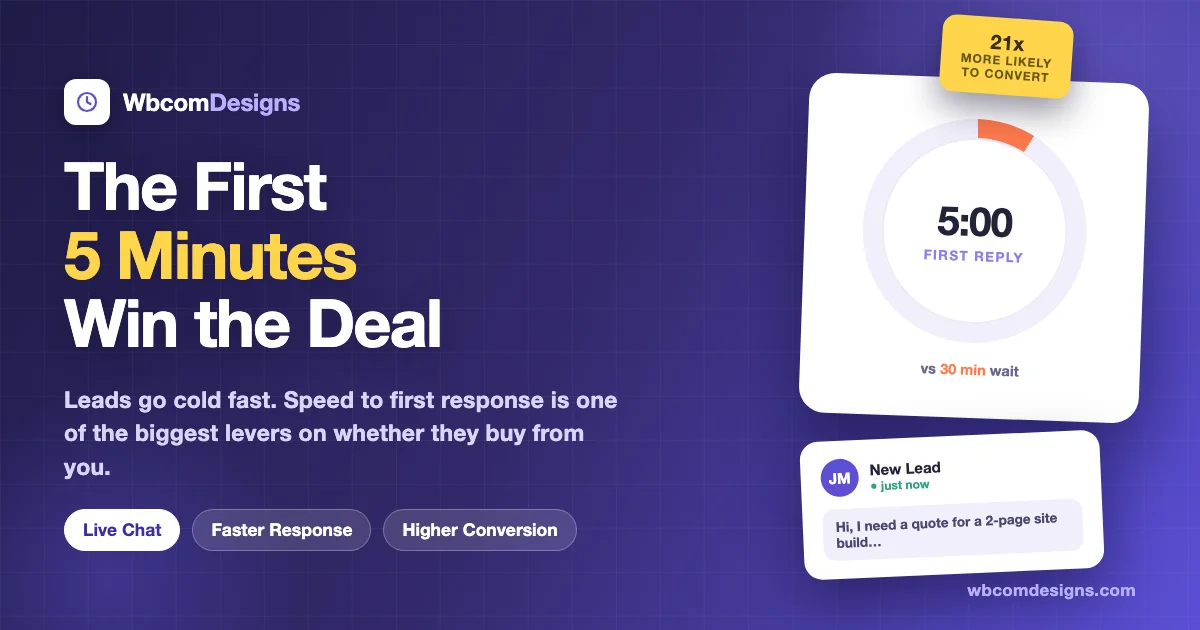
Lead response time, how fast you reply after someone reaches out, is often the real deciding factor in whether you win a deal. A lead fills out your contact form at 2:14 PM. They’re comparing three agencies. They’ve got a real problem, a rough budget, and the attention span of someone juggling four browser tabs. Whoever gets back to them first isn’t just first in line, they’re often the only one who gets a real conversation, because by the time the second and third replies land, the prospect has already picked a direction.
That’s the uncomfortable part of running a service business: the deal is frequently decided before anyone gets on a call. It’s decided in the gap between “they filled out the form” and “someone replied.” Lead response time, the gap between when someone reaches out and when a real person answers them, is measured in hours for most agencies, consultants, and freelancers, not minutes, and not because anyone is careless. It’s because nobody’s job is to sit and watch the inbox.
What the lead response time research actually says
The numbers on lead response time get thrown around a lot in sales blogs, usually stripped of context and rounded up for effect. It’s worth looking at where they actually come from, because the honest version is still compelling, it just needs the caveats attached.
The Harvard Business Review analysis
The most widely cited data point traces back to a study by James Oldroyd, published in Harvard Business Review in 2011, analyzing tens of thousands of sales leads from a group of B2B companies. The finding: reps who contacted a lead within an hour of it coming in were roughly seven times more likely to have a meaningful qualifying conversation than reps who waited even a few hours longer. The odds didn’t decline gently, they fell off a cliff, and kept falling the longer the lead sat untouched.
That study is over a decade old now, and buyer behavior has shifted plenty since 2011, more channels, more self-serve research, more competitors a click away. But the underlying mechanic hasn’t changed: a prospect’s interest is highest the moment they raise their hand, and it decays from there.
The five-minute number, with a caveat attached
The stat that gets repeated even more often, that responding within five minutes makes you roughly 21 times more likely to convert a lead than waiting thirty minutes, comes from a separate “Lead Response Management” study, also led by James Oldroyd, run in partnership with InsideSales.com. It’s worth flagging plainly: InsideSales.com sells speed-to-lead software. That doesn’t make the finding wrong, but it does mean it’s a vendor-funded study rather than an independently re-verified universal constant, and it deserves “research suggests” framing rather than “proven fact” framing. Directionally, it lines up with the HBR data and with plenty of sales teams’ lived experience. Treat the exact multiplier as illustrative, not gospel.
Why the two numbers don’t quite agree, and why that’s fine
If you’ve read both studies, you’ve probably noticed the headline multipliers don’t line up neatly: one says roughly 7x within an hour, the other says roughly 21x within five minutes. That’s not a contradiction, it’s two different studies measuring different windows with different methodologies and different lead pools. Trying to reconcile them into one precise formula misses the point. What both studies agree on, independently, is the shape of the lead response time curve: response speed matters a lot, the effect is front-loaded into the first few minutes to the first hour, and it keeps decaying after that. Use the numbers as evidence of a real pattern, not as an exact multiplier to plug into a forecast.
What slow response is estimated to cost
Industry reports from companies like Drift and Velocify-style analyses put the cost of slow lead response at tens of billions of dollars a year in lost revenue, extrapolated from average B2B response times, which in a lot of industries still run into hours or days, set against conversion-rate studies like the ones above. That’s a plausible order-of-magnitude estimate built from real inputs, not a precise measured figure anyone audited line by line. The exact number matters less than the shape of it: slow response is not a minor inefficiency, it’s a structural leak in the pipeline.
Speed is a top factor, with an honest confound
Multiple independent studies, using different methodologies and different industries, converge on the same broad conclusion: response speed is consistently one of the strongest predictors of who wins a competitive deal, in some cases outweighing price or even product fit, particularly in categories where multiple vendors look similar on paper. But there’s a confound worth naming honestly: businesses that respond fast usually also have better sales operations overall, a dedicated intake process, decent lead routing, a CRM that actually gets used. Some of the “speed effect” is really a “we have our act together” effect, and speed is the most visible symptom of that, not the only cause. Getting faster is genuinely valuable. It’s just not a silver bullet divorced from the rest of your process.
The lead is never more interested in talking to you than in the first few minutes after they reach out. Every hour after that, you’re competing against their own cooling attention, not just against other vendors.
What this means for how you actually respond
None of this is news to anyone who’s worked sales. The harder question for a small agency, a solo consultant, or a two-person studio is what to do about it, because “just respond faster” is easy advice and hard execution when you’re also the one doing the client work.
The math doesn’t care about your intentions
Nobody is deliberately ignoring leads for six hours. It happens because you’re mid-project, or in a client call, or it’s after 6 PM and the inquiry sits in an inbox until morning. The prospect doesn’t know that. They just know they asked a question and nobody answered it, so they moved on to the next name on their list, who might have answered in four minutes. It’s worth remembering the next time you’re the one doing the shopping around, too: our guide on hiring a WordPress developer without getting burned covers the same responsiveness signal from the buyer’s side of the table.
| Response window | What tends to happen |
|---|---|
| Under 5 minutes | Prospect is still in “actively looking” mode, highest odds of a real conversation |
| Within 1 hour | Still warm, but attention has started splitting across other options |
| Same day | Prospect has likely engaged with at least one competitor already |
| Next day or later | Often treated as a courtesy reply rather than a live opportunity |
That table is a simplification of a messy reality, not a formula, but it’s the shape of what the research above points to, and it matches what most people who run inbound pipelines will tell you anecdotally.
Why “just hire someone to answer faster” isn’t the real fix
The obvious answer, put a person on standby to catch every inquiry the moment it lands, doesn’t scale for a service business. You can’t staff a round-the-clock intake desk to shave minutes off response time for a trickle of leads, and hiring for it changes your cost structure before you’ve even confirmed the deal is worth closing. The gap isn’t a hiring problem. It’s a “the prospect has a question right now and no one is in the room” problem, and headcount is an expensive way to solve a timing problem.
What actually happens while a lead sits waiting
It helps to picture the wait from the prospect’s side, because that’s where the deal is actually being lost. Someone searching for a consultant or an agency rarely submits one form and stops. In the time it takes your team to notice a new inquiry, a typical prospect is doing some combination of the following:
- Opening two or three competitor sites in other tabs and filling out their forms too, just in case
- Re-reading their own message and starting to second-guess whether they described the problem clearly
- Getting pulled into something else, a meeting, a kid, a deadline, and mentally shelving the whole search
- Noticing who replies first and quietly treating that as a signal about how responsive the working relationship will be
None of that requires the prospect to be fickle or unserious. It’s just what happens to attention when nothing fills the silence. The fix isn’t convincing prospects to wait more patiently, it’s not leaving silence for them to fill in the first place.
Closing the lead response time gap without adding headcount
This is the part that actually matters for how service businesses operate day to day: you don’t need more people watching the inbox, you need the ability to have a real, live conversation the moment a prospect is ready for one, without it depending on someone being physically available to notice the form submission.
That’s the specific problem our team built WP Sell Services around. It’s real-time, one-to-one chat built for businesses that sell service engagements, consultants, freelancers, agencies, studios, not general storefront live chat bolted onto an online shop. The difference matters: a service inquiry isn’t “where’s my order,” it’s “can you actually do the thing I need, and are you the right fit,” and that conversation needs a human-feeling response, not a canned script. If you’re weighing how to structure that kind of offering in the first place, our walkthrough on building a Fiverr-style freelance service marketplace on WordPress covers the setup side of the same product.
With it in place, a prospect who lands on your site at 9 PM doesn’t hit a contact form that vanishes into a queue, they can start a conversation immediately, so you can:
- Cut response time from hours (or “whenever someone checks email”) down to minutes, without anyone sitting by the inbox
- Qualify a lead, budget, timeline, scope, while they’re still in the mindset that made them reach out, instead of re-warming them a day later
- Keep the conversation in one place, so nothing important gets buried three replies deep in an email thread
- Hand off a warm, already-scoped conversation to whoever’s actually available, instead of routing blind
Built for how service businesses actually sell
General live-chat tools are built around transactional e-commerce: track an order, answer a shipping question, escalate to a ticket. Selling a service is a different motion, it’s consultative, it’s often a back-and-forth before anyone commits, and the person asking usually wants to know they’re talking to someone who understands their specific situation, not a rotating support queue. WP Sell Services is built around that one-to-one dynamic on purpose, so the tool matches the way consultants and agencies actually close business: a real conversation with the person who can say yes, started the moment the prospect is paying attention.
In practice that looks different depending on who’s using it. A consultant fields a discovery-call request and can confirm availability on the spot instead of a three-email scheduling back-and-forth. A freelance designer gets asked “can you work with our brand guidelines” and answers directly, with examples, instead of the prospect waiting a day and moving on. An agency fielding an RFP-style question gets to show responsiveness as part of the pitch itself, because how fast and how well you answer the first question is itself evidence of how you’ll run the engagement.
The point isn’t “faster for the sake of faster.” It’s that the research above is fairly consistent on one thing: the leads that get a real response while their interest is still high convert at meaningfully better rates than the ones that wait, and closing that gap doesn’t have to mean adding a headcount line to your budget.
Speed only holds up if support keeps pace after the sale
There’s a second half to this that’s worth naming even briefly: winning the deal fast and then going quiet once the contract is signed just moves the churn point downstream. A client who converted in five minutes and then waits three days for a support answer during onboarding forms the same impression a slow lead response does, that nobody’s paying attention. It’s the same dynamic we walked through in our retention playbook on why customers actually cancel: value that doesn’t land fast enough gets punished either way, before the sale or after it.
That’s a topic worth its own deeper look, but the short version is that the same principle applies after the sale as before it: response speed at scale usually isn’t about hiring more support staff, it’s about giving clients a faster path to an answer, peer answers, a searchable history of past questions, a real community space instead of a ticket-by-ticket queue. We go deeper on exactly that in our follow-up on why forums and communities are faster support than you think, and it’s part of why we also build Jetonomy for support (see what makes it a modern WordPress forum plugin) and BuddyNext for community (see our library on building a WordPress community you own), the idea being that the speed advantage you build at the top of the funnel shouldn’t fall apart the moment someone becomes a paying client.
Where to start
You don’t need to rebuild your entire sales process to act on any of this. The research points at one lever that’s disproportionately effective: shrink the time between “a prospect raises their hand” and “a real person talks to them.” For a service business, that means being reachable for a live conversation at the moment someone’s actually looking, not routing them into a form that gets answered on your schedule instead of theirs.
If your leads are currently landing in an inbox and waiting for someone to notice, that’s the gap worth closing first. Take a look at WP Sell Services and see what it would take to have that first conversation in minutes instead of hours.
Related reading