
6 min read
Dunbar’s Number and the Community You’re About to Outgrow


In the 1990s, the anthropologist Robin Dunbar noticed something odd about primate brains. The size of a species’ neocortex predicted, with real precision, the size of the social group it could hold together. He ran the same regression on humans and got a number: about 150. Not the number of people you can recognize, that’s closer to 1,500. The number of people you can hold a real relationship with, the kind where you know how they’d react to something, is capped around 150.
Every community builder eventually meets this number, usually without knowing its name. You cross it quietly. The feed that used to feel like a room starts to feel like a crowd. Familiar names get outnumbered by strangers. Engagement dips, and it’s tempting to read that as content getting stale or momentum running out. It’s neither. It’s arithmetic.
The number is actually five numbers
Dunbar’s own research goes further than the headline figure, and the detail matters more than the round number does. He found a nested series: about 5 people in your intimate support circle, 15 in your close friend group, 50 in your meaningful-relationship layer, 150 in your stable-relationship layer, and out past that, 500 acquaintances and 1,500 recognizable faces.
Each layer takes a different amount of social effort to maintain, and effort is finite. Add someone to the 150 and, mathematically, someone else’s relationship with you thins out to make room. Nobody chooses this consciously. It just happens, the same way a phone’s battery drains faster the more apps you have open.
A community platform that only offers one room, one feed, one member list, one undifferentiated everything, is asking every member to hold the entire membership in that same flat layer. That works fine under 150. Past it, the platform is quietly asking for something human cognition doesn’t do.
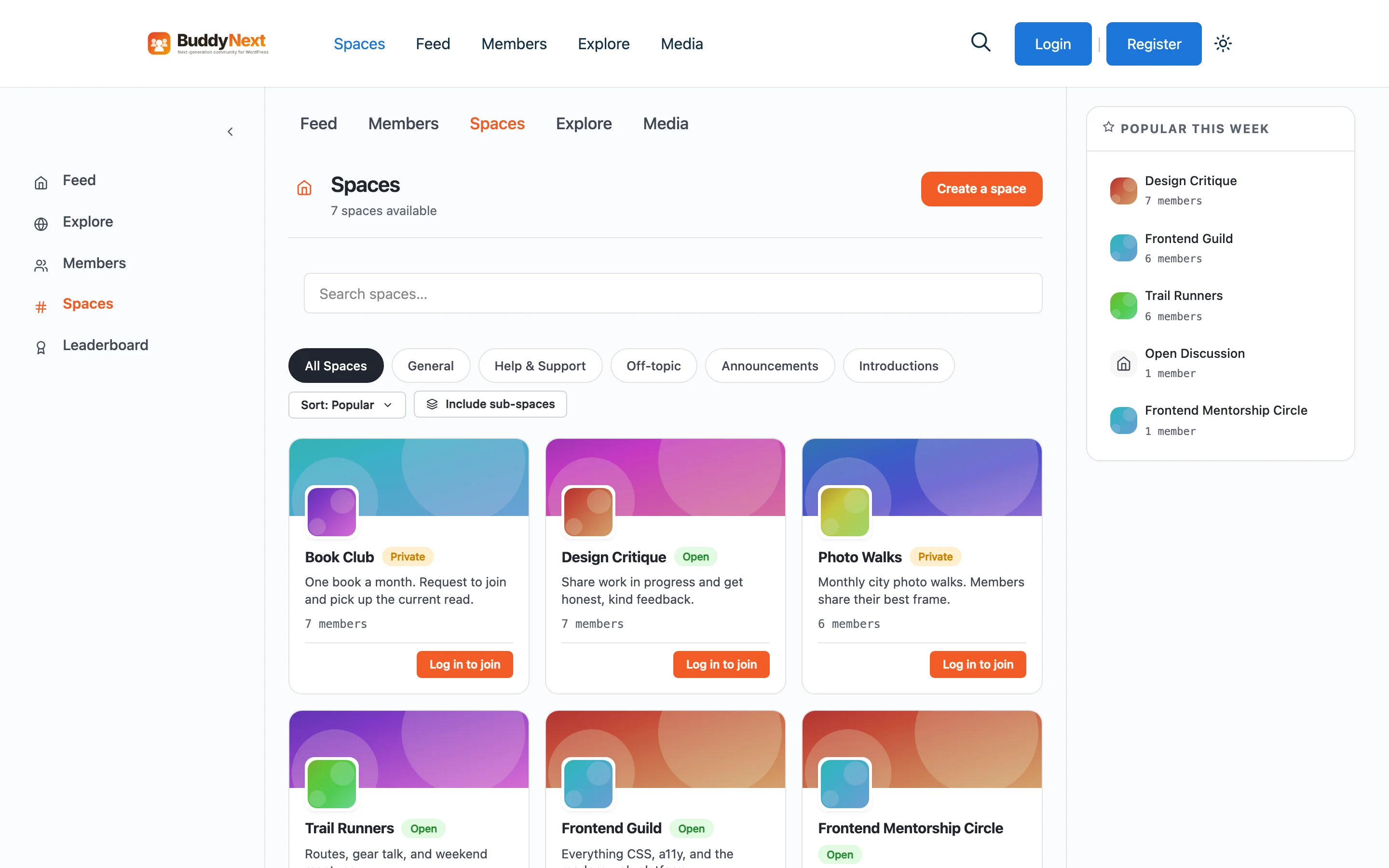
That screenshot is a real BuddyNext community’s Spaces directory, a set of smaller rooms living inside one larger membership. It’s the practical answer to Dunbar’s ceiling, and it’s worth being precise about why it works, because “just make groups” undersells what’s actually happening.
A crowd and a room are different things
Picture two versions of the same 400-person community. In the first, everyone posts into one feed. By the time you’ve scrolled past the first thirty posts, you’ve seen more strangers than familiar faces, and your brain, quite reasonably, starts treating the space the way it treats a train platform. You don’t perform intimacy in a crowd. You keep your head down.
In the second version, that same 400 people are split across a dozen Spaces of 15 to 40 members each, organized by whatever actually holds people together, a shared interest, a shared cohort, a shared discipline. Walk into any one Space and you’re back under Dunbar’s ceiling. You recognize names. You remember who asked what last week. It reads as a room again, because it is one.
The total membership didn’t shrink. What changed is that no single view asked anyone to socially process more than about 150 people at once, and inside most Spaces, far fewer than that.
Why people mistake this for decline
Community owners who don’t know this pattern tend to reach for the wrong fixes. More content. Different post times. A relaunch. None of it addresses the actual mechanism, because the mechanism isn’t about content quality, it’s about group size crossing a cognitive threshold that has nothing to do with what you’re posting. It’s a close cousin of the 90-9-1 rule, both are group-size effects that get mistaken for content or engagement problems.
You don’t lose intimacy by growing. You lose it by refusing to subdivide.

That’s the whole diagnosis, and it’s also the whole prescription. A community that plateaus at 150-ish active participants and then goes quiet as it grows past that isn’t failing. It’s telling you, in the only language group dynamics speak, that it’s time to build smaller rooms inside the bigger one.
What a Space actually needs to work
Not every subdivision works. A Space that’s just a smaller copy of the main feed, with no reason to exist beyond “fewer people see it,” doesn’t recreate intimacy, it just makes a quieter crowd. The Spaces that hold together share a few traits.
They form around something specific enough to be a real reason to gather, a shared course cohort, a shared discipline, a shared project, a shared level of experience, not a generic slice of the whole membership. They stay small enough that a regular participant can plausibly know most of the other regulars, which in practice means well under Dunbar’s 150, often closer to his 15-to-50 layer. And they have their own visible activity, their own feed, their own recent posts, their own sense of who showed up this week, rather than being a label applied to content that still mostly happens in the main space.
BuddyNext, the free Community OS for WordPress, builds Spaces as a core, no-plugin-required feature, open, private, or secret, each with its own roles, join flow, sub-spaces, and per-space moderation. A community doesn’t need a different product to solve this problem; it needs the one it already has configured around the actual shape of its membership instead of one flat room.
Dunbar’s own layers are a better model than his headline number
It’s worth going back to that nested structure from earlier, because most communities implement Spaces as a flat list, a dozen rooms sitting side by side, no relationship between them, when Dunbar’s own data suggests nesting works better than flattening.
His 5-15-50-150-500-1,500 progression isn’t six separate groups. It’s six concentric circles, each one containing the ones inside it. Your 5 intimate contacts are also part of your 15 close friends, who are also part of your 50 meaningful relationships, and so on outward. Nothing about that structure is flat.
BuddyNext’s Spaces support this directly through sub-spaces, a Space that contains smaller Spaces inside it, rather than every subdivision living at the same level. A 400-person “Running” Space can hold a “Trail Runners” sub-space and a “Marathon Training” sub-space inside it, each with its own smaller, tighter room, while the parent Space still exists as the wider circle everyone in either sub-space also belongs to.
That mirrors Dunbar’s actual structure much more closely than a flat list of unrelated Spaces does. Someone in the Trail Runners sub-space isn’t cut off from the broader Running Space, they’re just also part of a smaller, denser circle inside it, the same way your 15 close friends are still part of your 150 stable relationships, not a separate group entirely.
Practically, this matters most once a community has enough Spaces that the Spaces list itself starts to feel like its own crowd. A directory of forty flat, unrelated Spaces asks a new member to make forty decisions about where to go. A nested structure, a handful of broad parent Spaces, each holding a few focused sub-spaces, asks for one decision at a time, at whatever depth actually matches how specific the member’s interest is.
The ceiling looks different by niche
How this plays out depends heavily on what kind of community you’re running. A brand community’s 150-person wall shows up differently than a course community’s does, and a fitness community’s differently still. I’ve written a companion piece for each of four common shapes, because the fix is the same principle applied through four genuinely different lenses, not one generic answer copy-pasted four times:
Your Brand Community Has a 150-Person Ceiling, why your best customers go quiet, and how to split by product line or use case.
One Discussion Thread Doesn’t Scale Past Dunbar’s Number, why cohort Spaces beat one giant course thread.
Runners, Lifters, and Yogis Aren’t One Audience, why one general fitness feed stops working, and how to nest niche Spaces.
Growing Doesn’t Have to Mean One Bigger Room, why hobbyist communities can grow forever if they split by sub-interest.
The short version, if you only take one thing from this: your community’s headcount is not the number that matters. The number that matters is how many people any single member has to hold in mind at once when they open the app. Get that number back under 150, and the room feels like a room again, no matter how large the building around it has gotten.
Related reading