
4 min read
Runners, Lifters, and Yogis Aren’t One Audience


Fitness communities hit Dunbar’s ceiling in a specific, almost funny way: the people in them are training for completely different things, and one general feed papers over that until it can’t anymore.
Runners, lifters, and yogis are not one audience
A general fitness community that grows past a couple hundred members ends up hosting a runner’s PR announcement next to a lifter’s form-check question next to a yoga teacher’s class schedule, all in the same feed. Individually, none of it is bad content. Together, it means nobody sees enough of what they actually care about to bother scrolling, and the room stops feeling like it belongs to anyone specifically.
That’s a slightly different flavor of Dunbar’s problem than pure headcount. It’s not just that there are too many people to know, it’s that even the people you could know are training for different things, so the shared context that makes a room feel like a room never forms in the first place.
Niche Spaces recreate the small-gym feeling
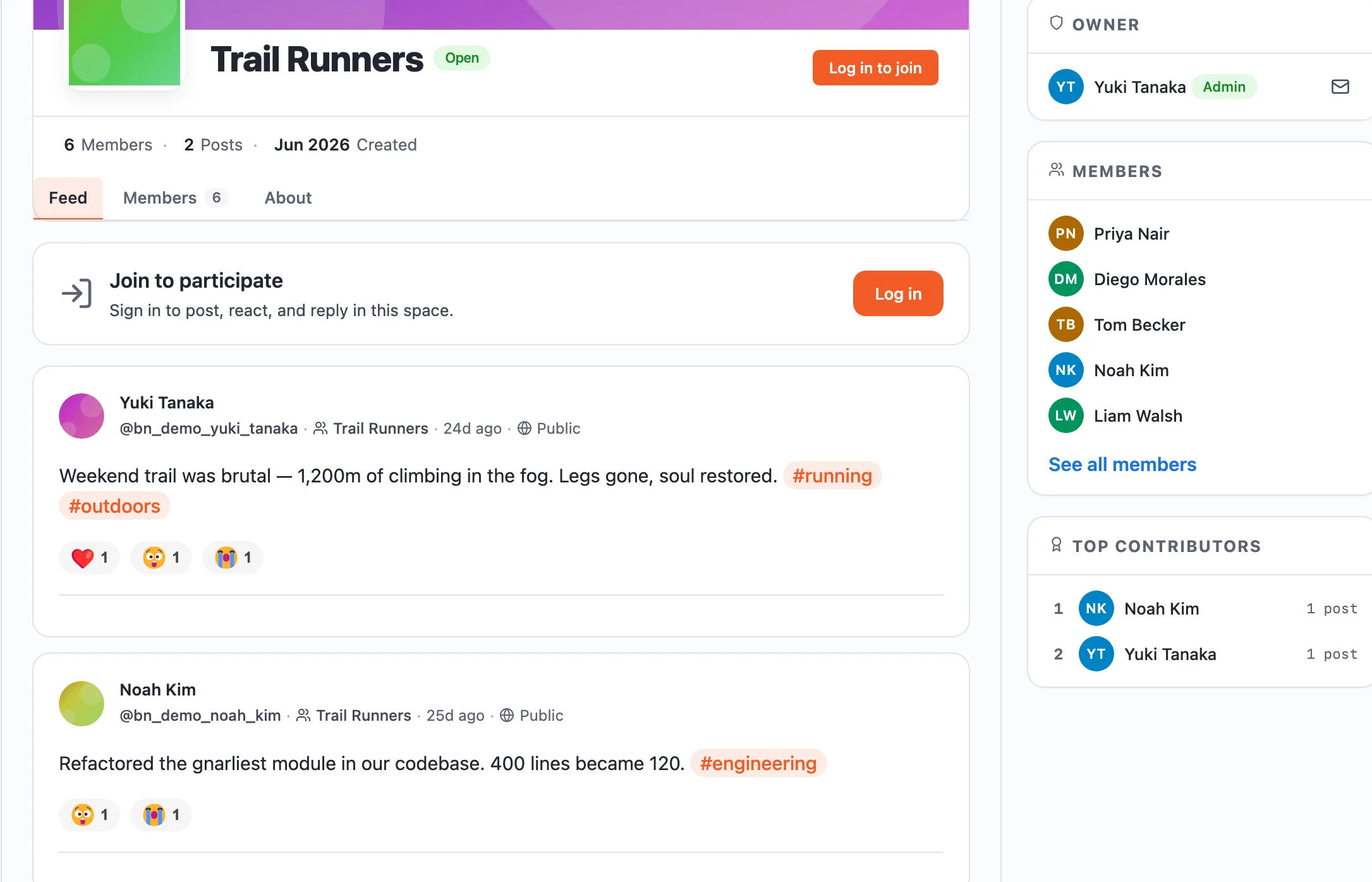
That screenshot is a real trail-running Space, a small group who all showed up for the same specific thing, with early posts from an identifiable founding handful. That’s the feeling a good local gym has that a 5,000-member general fitness app usually doesn’t: you know who’s going to be there, roughly what they’re working on, and what a normal week of activity from them looks like.

Splitting a large fitness community by activity, running, strength training, yoga, cycling, does more than sort content. It puts each member back in a group small enough that their training partners are actually recognizable people, not a scrolling wall of PRs from strangers.
Solo sports and group sports split the ratio differently
One wrinkle worth naming: not every fitness discipline wants the same group size. A lifting Space full of people doing solo programs at home can stay useful well past 150, because most of the value is one-way, seeing someone else’s progress photo, reading someone else’s form cue, and doesn’t require deep mutual familiarity to work. A running club planning actual group runs together hits the ceiling much faster, because coordinating a real Saturday-morning meetup needs people who genuinely know each other, which caps out far below 150.
The practical rule: Spaces built around content consumption can run larger; Spaces built around actual coordinated activity should stay small on purpose, closer to Dunbar’s 15-to-50 layer than his 150 ceiling.
Nesting a niche inside a discipline
The trail-running Space in that screenshot isn’t a standalone room floating on its own, it works better as a sub-space nested inside a broader “Running” Space. That structure matters more than it sounds like it should. A member who’s serious about trail running still probably cares about running in general, race announcements, general training theory, gear reviews that apply beyond any one sub-discipline, even while their daily, name-recognizing conversation happens in the smaller trail-specific room.
Flatten that into two unrelated Spaces instead of a nested pair, and you force a choice that shouldn’t have to be made: join the broad Space and lose the intimacy, or join the narrow one and lose the wider running conversation. Nesting lets a member get both, deep familiarity where they need it, broader reach where they don’t.
This scales past two levels when a discipline is big enough to need it. A “Strength Training” Space can hold a “Powerlifting” sub-space, which in turn could hold a “Raw Powerlifting” sub-space for a specific, small, genuinely tight-knit group, as long as each layer down stays small enough to actually know the people in it, which is Dunbar’s test applied recursively rather than once.
Not everyone quiet is disengaged
One honest caveat: some fitness journeys are private by nature. A member who never posts but reads every thread in their running Space isn’t a Dunbar’s-number casualty, they’re just someone who doesn’t want an audience for their 5k time, and that’s a legitimate way to use a fitness community. Splitting into smaller Spaces helps the people who want visibility find each other faster. It’s not a fix for people who never wanted visibility in the first place.
The members who do post their results are usually your best zero-cost marketing, and they’re far more likely to keep posting in a Space of forty training partners than a feed of four thousand strangers.
The coach has the same problem as the member
If your fitness community has coaches or trainers answering form-check questions and building programs, they run into their own version of Dunbar’s ceiling, the number of trainees a coach can give genuinely personalized attention to has a real cap, and it’s not that different in shape from the member-side number. A coach spread across a 400-person general feed ends up giving generic advice, because generic is all that’s cognitively available when you can’t hold four hundred people’s history in mind.
Scoped Spaces fix this on the coaching side too. A coach assigned to a 30-person strength-training Space can actually remember who’s recovering from what, whose form has been improving, and who needs a nudge this week, the same familiarity a small gym’s regulars get from a coach who knows their names, just delivered through structure instead of physical proximity.
Related reading