
4 min read
Growing Doesn’t Have to Mean One Bigger Room

Hobbyist communities have a strange relationship with Dunbar’s number, because unlike a brand community or a course, growth itself is often the explicit goal. More members finding the hobby, more people to talk to about the niche thing you love, nobody sets out to cap it. But the ceiling doesn’t care what the goal was.
The paradox of wanting to grow
A woodworking forum, a houseplant group, a vintage-synth community, these thrive on enthusiasm, and enthusiasm wants an audience. So the instinct when a hobbyist space starts feeling quiet is almost always “we need more members,” when the actual problem is frequently the opposite: there are already too many people in one undifferentiated feed for anyone to feel like they’re talking to people who share their specific corner of the hobby.
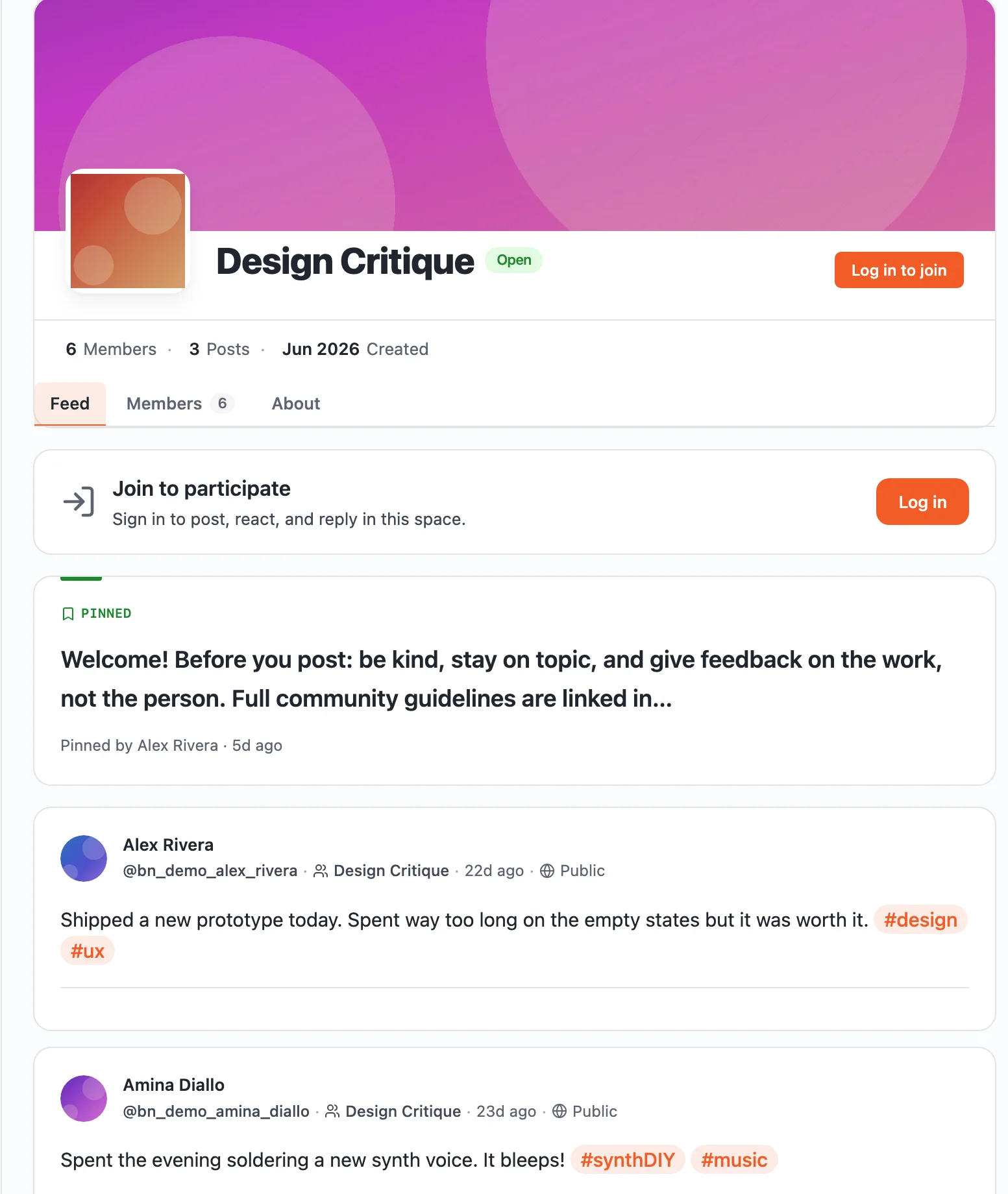
That’s a real design-feedback Space, a sub-interest inside a broader creative community, small enough that the pinned rules and the regular posters are actually visible, not buried under volume.
Split by sub-interest, not by size cap
A large woodworking community doesn’t need a Space that’s arbitrarily “the first 150 members” and another that’s “everyone else.” It needs Spaces built around the sub-interests that were always inside the broader hobby, hand tools versus power tools, furniture versus turning, beginners versus people restoring antiques. Each of those is naturally sized well under Dunbar’s ceiling, and each gives members a reason to be there beyond “I’m interested in woodworking generally,” which turns out to be too broad a shared identity to build real familiarity on at scale.
This is the one place where growth and intimacy aren’t actually in tension. The whole community can keep growing indefinitely as long as new sub-interest Spaces keep forming to absorb it, the growth just has to happen in the branches, not in one trunk feed that everyone’s forced through.
Beginners and experts don’t want the same room either
Sub-interest isn’t the only fault line worth splitting on. Skill level often matters just as much, and mixing it into one Space quietly discourages both ends of the range. A beginner asking “what wood should I start with” in the same feed as someone posting a hand-cut dovetail joint feels like they’re interrupting an expert conversation. The expert, in turn, often stops posting detailed technique breakdowns because the audience skews toward people who don’t yet have the vocabulary to engage with them.
Splitting a “Beginners” Space out from the general woodworking Space, or nesting it as a sub-space inside the broader one, gives new hobbyists a room where their question is the whole point, not a distraction, while letting the advanced conversation get more technical without constantly circling back to fundamentals. Both groups end up more active, not because either was doing anything wrong before, but because neither was actually in a room sized and pitched for them.
The real exception: a hobby that’s secretly a marketplace
One case doesn’t fit this pattern cleanly: a hobbyist Space that’s quietly become a two-sided marketplace, people buying and selling gear, commissioning work, trading services, rather than a pure discussion group. Marketplaces behave differently from social groups. They often benefit from more reach, not less, because a buyer wants access to the largest possible pool of sellers, and splitting that pool into smaller Spaces can actively hurt liquidity even if it would help pure conversation.
Worth checking honestly which one your hobbyist community actually is before subdividing. If people mostly transact, protect the reach. If people mostly talk, protect the room size.
A quiet hobbyist Space isn’t automatically a failing one, sometimes it’s just correctly sized for the kind of talking people actually came there to do.
A quick gut check before you split anything
Before creating a new sub-interest Space, it’s worth asking one honest question: is this split serving the members, or is it serving my own instinct to organize things neatly? A Space that exists because an admin likes tidy categories, but that nobody’s actually asking for, tends to sit empty, which then reads as failure and discourages further subdividing even where it’s genuinely needed elsewhere.
The signal worth trusting is the same one from the pillar piece: are people in the current Space already forming an identifiable sub-group within it, recognizable by the topics they keep returning to? If yes, giving that sub-group its own room usually works immediately, because the Space is just catching up to a split that already existed informally. If the sub-group only exists in an admin’s head, the Space will probably stay quiet no matter how logically it was carved out.
Growth doesn’t have to mean one bigger room
The instinct to chase a bigger single feed usually comes from mistaking “more members” for “more energy,” when the energy hobbyist communities actually run on is the feeling of belonging to a specific, knowable group of people who care about the exact same narrow thing you do. That feeling doesn’t get more available as the room gets bigger. It gets scarcer, right up until it disappears somewhere past Dunbar’s ceiling.
A hobbyist community that keeps adding well-scoped sub-interest Spaces as it grows can, in principle, keep growing indefinitely without ever losing that feeling for any individual member, because no member ever has to experience the whole membership at once. They only ever experience their Space, and their Space can stay exactly the size that feels like belonging, no matter how large the community around it gets.
Related reading