
5 min read
Community-Led Growth: The Loop, the K, and the 1% Were the Same Idea

Community-led growth gets defined wrong constantly, usually by companies that already got it wrong in practice. The definition on offer is almost always “a community for support” or “a community for engagement.” Neither one is community-led growth. Both are cost centers wearing growth language.
The real definition is narrower and less comfortable: community-led growth is when the community is the acquisition channel, not an accessory sitting next to one. Members recruit members. The product doesn’t grow because marketing pushed harder. It grows because the people already inside are doing work marketing used to do, and doing it better, because nobody trusts an ad the way they trust a person who already uses the thing.
That distinction sounds academic until you notice what it asks of a company. It asks the company’s job to change. Not “add a Slack channel and call it done” change. A real change: from broadcasting to a list, to enabling a small number of people to say true things to people who already trust them more than they trust you.
The pieces were never separate
If you’ve read this site’s other posts on growth, you’ve already met the mechanics of community-led growth without the name attached to them.
The growth loop is the shape of one cycle: a member takes an action, that action reaches someone outside the community, that person joins, the loop runs again. Community-led growth is what you get when that loop is the primary channel, not a curiosity running alongside paid acquisition while the real numbers come from ads.
The viral coefficient is the arithmetic underneath the loop: how many people an average member invites, multiplied by what fraction of those invites convert. Community-led growth doesn’t require that number to clear one. It requires the number to be real, meaning actual members are actually inviting actual people, not a slide deck assuming they might, someday, if the onboarding email is clever enough.
The 90-9-1 rule tells you who does the inviting. It’s the 1%. Community-led growth that quietly assumes the average member is the channel is building a strategy on a population that mostly isn’t going to show up for it. The company’s actual job is protecting and equipping that 1%, not designing a growth motion aimed at the median member, who was never going to recruit anyone and shouldn’t be made to feel like a failure for it.
And relationship marketing is the reason none of the above can be automated into existence. A drip sequence can look like a recommendation. It isn’t one. The 1% recruiting on your behalf are doing it because a real relationship exists, between them and the community, and between them and the specific person they’re inviting. Automate the appearance of that relationship and you get an unsubscribe rate, not a growth loop.
Put those four pieces together and community-led growth stops being a slogan on a slide. It’s a loop, the mechanism, run by a coefficient, the math, driven by a small population, the 1%, that only works because of something you cannot fake: real trust between two specific people.

The theater version
Most companies that claim community-led growth are doing something narrower. They built a Discord or a forum, they call it “our community,” and they wait. Waiting is not a growth motion. It’s a support motion wearing a nicer name, and the acquisition chart never moves because of it.
There’s one honest question that separates the two. If your community disappeared tomorrow, would your new-signup number move? If the real answer is “not really, that’s not actually where new users come from,” you don’t have community-led growth. You have a community. Those are different assets. Only one of them is a channel, and pretending otherwise is how a company ends up surprised, two years in, that the thing it called its growth engine never grew anything.
The test is cheap to run. Ask ten recently joined members, directly, not through a survey tool, how they found you. If the honest answer clusters around “a friend told me” or “I saw someone post about it,” the loop is real. If it clusters around a paid channel and the community only comes up after signup, you’re running acquisition and support as two separate systems that happen to share a login page.
What actually makes the loop real
The mechanism has to be technically possible, not just conceptually appealing on a roadmap slide. A member can’t recruit into a space that nobody outside the community can see. An explore and search surface reachable by an unauthenticated visitor, a real public feed instead of a walled garden that demands an invite before anyone can even tell there’s something worth joining, is the unglamorous plumbing the whole strategy depends on. BuddyNext, the free Community OS for WordPress, ships exactly that: a public Explore and unified search that works even with JavaScript off, so the door the 1% are pointing people toward is actually open when someone clicks through.
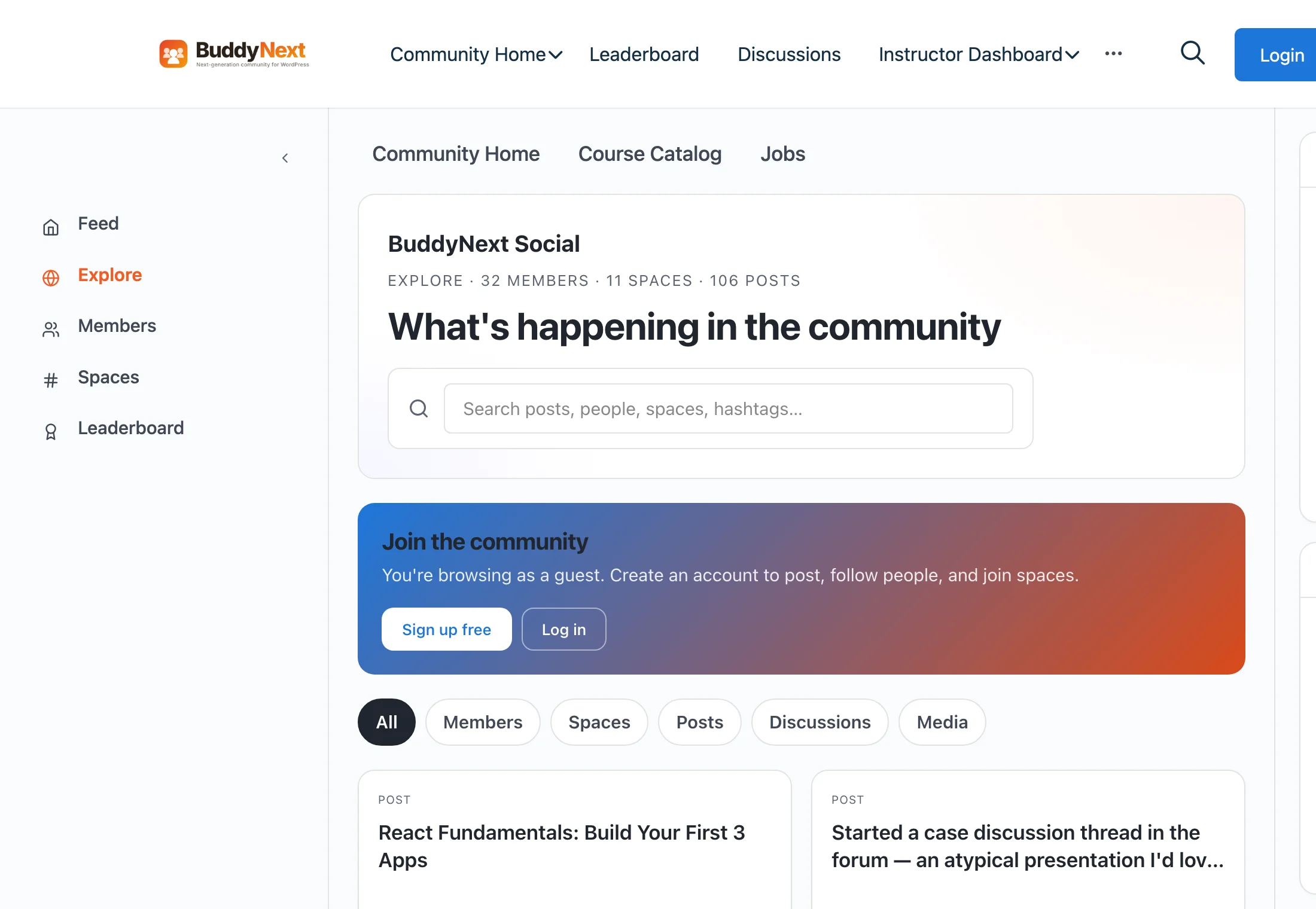
That’s a small requirement and it’s the one most self-declared community-led growth strategies skip, because a locked community feels safer to run, and a public one requires actually having something worth showing a stranger.
This isn’t a referral program with extra steps
It’s worth separating community-led growth from the thing it gets confused with most often: a referral program bolted onto a community forum. A referral program pays for an action. Invite five people, get a discount. The incentive is the reason the invite happened, and the moment the incentive stops, so does the behavior. That’s a real growth tactic. It just isn’t this one.
The 1% in a community-led motion aren’t inviting people for a discount. Most of them would tell you, if you asked, that they hadn’t thought about whether there was anything in it for them at all. They’re inviting people because someone they know would genuinely get something out of being there, and telling them so costs nothing and feels like a favor rather than a transaction. Layering a cash incentive on top of that motion doesn’t usually strengthen it. It can quietly poison it, by turning a recommendation into something that looks a little too much like an ad the moment the recipient notices there’s a referral code attached.
That doesn’t mean never reward the 1%. It means the reward should recognize what already happened, a badge, a public thank-you, early access to something real, rather than manufacture the behavior in the first place. If the behavior only exists because of the payment, it was a referral program the whole time, and it will stop the day the budget does.
Sit with that for a minute
None of this compounds because a company decided, in a strategy meeting, to be community-led. It compounds because a small number of real people decided the thing was worth telling someone else about, and the company built a place where that telling could actually travel somewhere.
That’s the whole strategy. The loop diagram, the coefficient, the 1% framework: all of it is instrumentation for something that was always going to be simpler and harder than a framework at the same time. Earn it. Then get out of the way.
Related reading