
19 min read
Best LMS for Entrepreneurs in 2026


This comparison is for a specific reader: you’re building a business that teaches, not a teacher building a business. Maybe education is a new revenue stream next to your consulting practice, your SaaS onboarding, your agency’s productized services, or a personal brand with an audience that keeps asking how you do what you do. You think in customer acquisition cost, lifetime value, funnels, and time-to-revenue, not in pedagogy, and you’ll judge a learning platform the way you’d judge any other piece of the business: what it costs to acquire a customer through it, what margin survives it, and how fast it gets a product into the market.
That lens changes the evaluation more than most LMS comparisons admit. It’s a different question from the craft-focused one a solo course creator asks (how good is the building and teaching experience) and different again from the ops-focused one a solopreneur asks (how little maintenance can I get away with). An entrepreneur’s three real constraints are time-to-first-sale (an unlaunched course is inventory, not an asset), unit economics (a platform fee on every sale compounds against LTV forever), and ownership of the customer relationship (whoever holds the checkout holds the list). We compared eight platforms against those three constraints specifically, rather than a generic feature checklist.
Table of Contents
- Quick comparison
- 1. Learnomy, the fastest path from idea to first sale
- 2. LearnDash, the proven engine with an ecosystem to grow into
- 3. Kajabi, the all-in-one hosted funnel machine
- 4. Thinkific, hosted simplicity without the funnel premium
- 5. Teachable, quick to launch, check the fee structure
- 6. Tutor LMS, a capable builder with tier gaps worth checking
- 7. MemberPress Courses, when recurring membership is the business model
- 8. Podia, the friendly low-cost storefront
- Time-to-first-sale: the only launch metric that matters
- Rent versus own: the balance-sheet view
- What actually matters most for an entrepreneur adding education revenue
- How we evaluated these eight platforms
- What a careless platform choice actually costs an entrepreneur
- Three entrepreneurs, three different right answers
- Common mistakes entrepreneurs make when adding a course line
- Questions worth asking before you commit
- FAQ
- Verdict
Quick comparison
| Platform | Time to first sale | Marketing/funnel tooling | Platform fee on sales | Entry Price |
|---|---|---|---|---|
| Learnomy | Days, AI drafting plus native checkout | Coupons, memberships, automatic pricing page | None | Free |
| LearnDash | 1 - 2 weeks with WooCommerce setup | Via WooCommerce and add-ons | None | $259/yr |
| Kajabi | Days, funnels included | Strongest native funnels, email, pipelines | None advertised, confirm per plan | $149/mo+ |
| Thinkific | Days | Moderate, plus integrations | None on paid plans | $109/mo+ |
| Teachable | Days | Upsells, order bumps | On some tiers, confirm current terms | $59/mo+ |
| Tutor LMS | About a week | Via WooCommerce and add-ons | None | $199/yr+ |
| MemberPress Courses | About a week | Membership funnels, coupons | None | $199.50/yr+ |
| Podia | Days | Simple email and storefront | Varies by plan, confirm | $39/mo+ |
1. Learnomy, the fastest path from idea to first sale
For an entrepreneur, the question isn’t “which LMS has the best features,” it’s “which platform gets a sellable product live fastest without giving away margin or the customer list.” Learnomy’s answer to the first half is its AI-assisted course and quiz generation, which compresses the production bottleneck that stalls most course launches: from a topic and a few inputs it drafts a structured curriculum and assessments you edit rather than write from a blank page, turning weeks of content production into days of editing. For a founder whose expertise is real but whose calendar is the constraint, that compression is the feature.
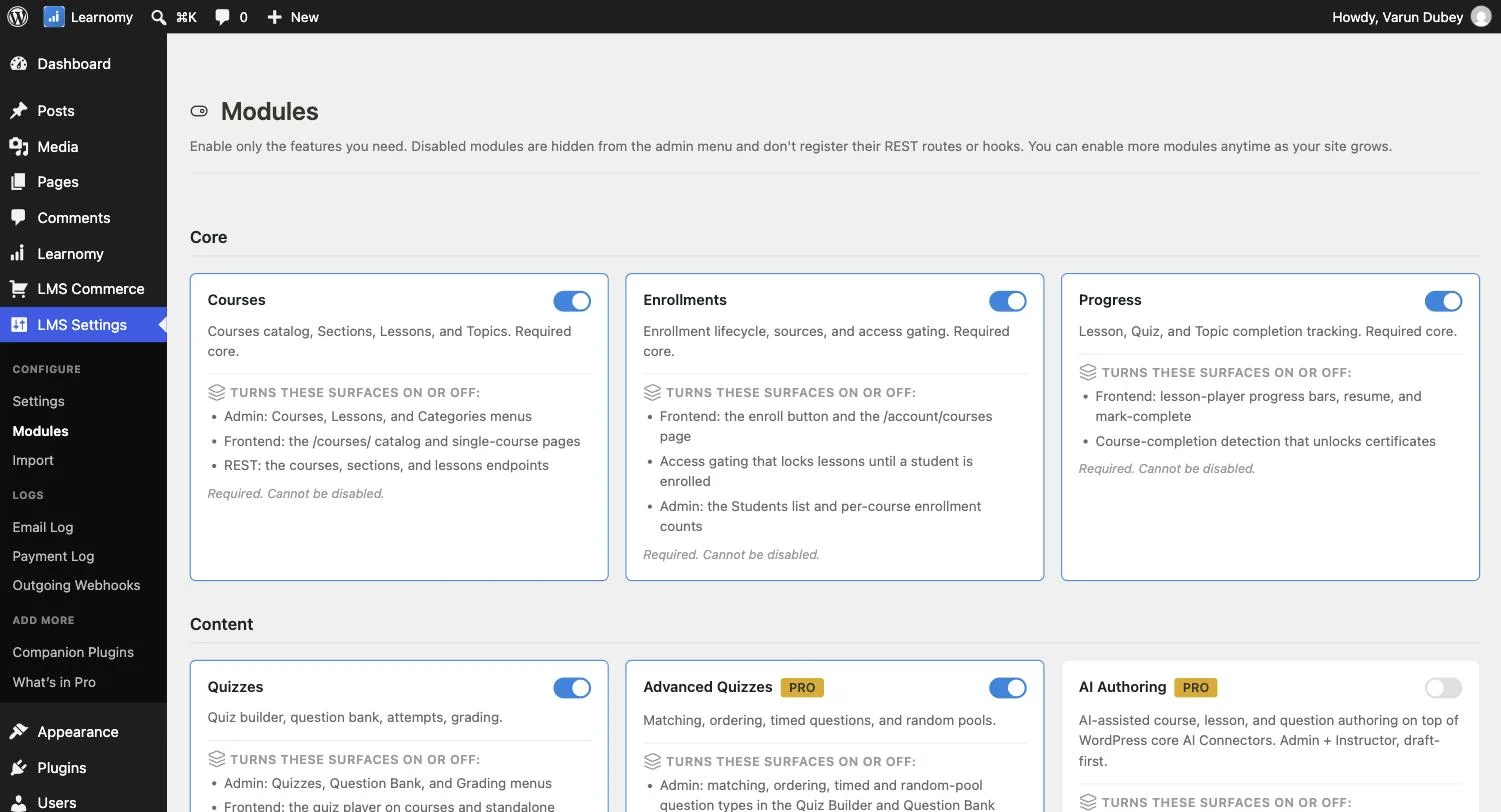
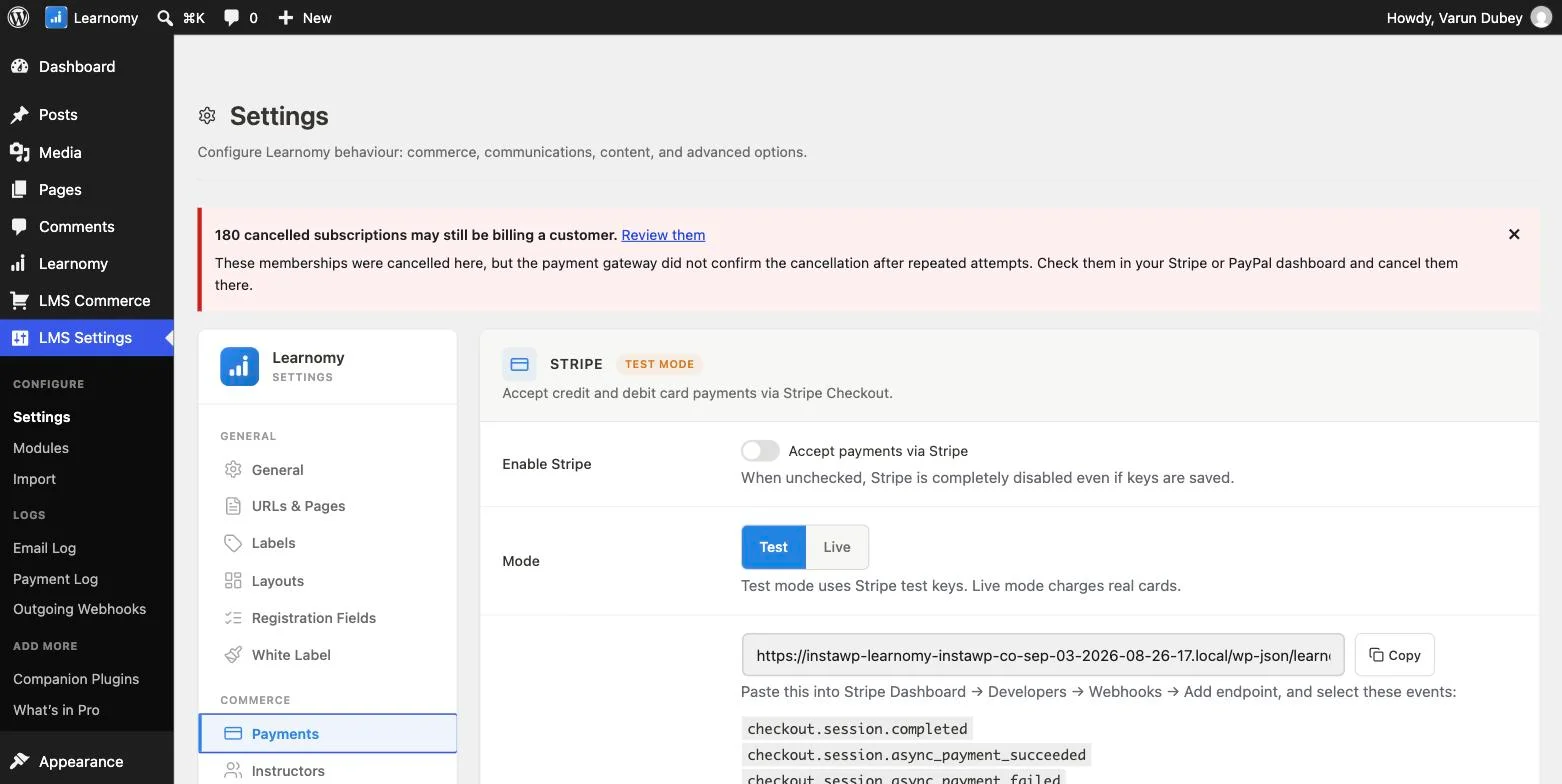
The second half of the answer is that the commercial machinery ships in the box. Native Stripe and PayPal checkout means no WooCommerce install standing between you and revenue, coupons handle launch promotions, memberships with trials support a recurring model out of the gate, and an automatic pricing page removes one more build task from the launch list. Critically for unit economics, there are no platform fees, what students pay is yours, minus only payment processing, so the margin math you model at launch is the margin math you keep at scale. On a hosted platform charging a monthly fee that rises with your tier, every incremental sale carries platform cost; here the marginal cost of a sale is effectively the Stripe fee.
The growth path matters to this reader too, because entrepreneurs don’t plan to stay solo. Learnomy scales into multi-instructor revenue sharing with Udemy-style splits, instructor applications and dashboards, so the business can grow from “founder teaches” to “team teaches” to a marketplace without a platform migration, and automated instructor payouts plus deeper revenue analytics exist at the platform’s upper capability tier as the operation grows into them. If the marketplace direction is live for you, our course marketplace comparison covers that path in depth. There’s also a practical hedge: a migration wizard from LearnDash, Tutor LMS, and LifterLMS means a wrong first choice elsewhere isn’t a life sentence.
The honest tradeoff: Learnomy is self-hosted WordPress, so you own hosting, updates, and backups, or pay a managed host roughly a coffee budget per month to own them for you. And its marketing tooling covers the commerce layer (checkout, coupons, pricing, memberships) rather than the full funnel automation a Kajabi ships; you’ll pair it with your existing email and analytics stack, which most entrepreneurs already run anyway. The free tier is genuinely usable for launching and validating, confirm current feature scope directly, since free-tier limits can change, which makes the validation-stage economics hard to argue with: your pre-revenue platform cost is zero.
2. LearnDash, the proven engine with an ecosystem to grow into
LearnDash is the most established name in WordPress LMS, and for an entrepreneur that maturity translates into de-risking: nearly any specific requirement you discover post-launch, a niche integration, an unusual quiz behavior, a specific CRM hookup, likely has an existing add-on. As a long-term asset, a LearnDash build on your own hosting is fully yours, with no platform fee on sales.
The tradeoff shows up in time-to-first-sale and total cost. Real payment processing typically routes through WooCommerce, which means a second system to install, configure, and test before revenue moves, and the add-on ecosystem that makes LearnDash flexible also means your actual launch stack costs meaningfully more than the $259/yr sticker, in both dollars and setup days. It’s the right choice when you already know you’ll need ecosystem depth; it’s a slower first dollar when you don’t.
3. Kajabi, the all-in-one hosted funnel machine
Kajabi deserves its reputation as the entrepreneur’s hosted platform, and the reason is that it isn’t really an LMS with marketing bolted on, it’s a marketing machine with courses inside. Funnels, email sequences, landing pages, pipelines, and offers are native and genuinely good, which means a founder who lives in funnel metrics can build the entire acquisition path, ad to landing page to email sequence to checkout to upsell, inside one product with no integration work. For speed from cold traffic to revenue with no stack assembly, it’s the strongest hosted option in this comparison, and we’d say that plainly.
The cost structure is the counterweight. At $149/mo and up, meaningfully more on higher tiers, Kajabi is a permanent four-figure annual operating cost before your first sale, and limits on products and contacts per tier mean growth raises the bill. That’s rational spend for a business already converting traffic, where the funnel tooling pays for itself; it’s expensive validation for a business still testing whether anyone buys. And as with every hosted platform, the students, the checkout, and the content live on Kajabi’s side of the fence, which is the ownership question the balance-sheet section below takes seriously.
4. Thinkific, hosted simplicity without the funnel premium
Thinkific is the hosted option for the entrepreneur who wants zero infrastructure responsibility but doesn’t want to pay Kajabi’s funnel premium. At $109/mo and up you get a solid no-code course builder, native checkout without platform fees on paid plans, and a clean integration surface for connecting the email and analytics tools you already use. Its total cost is also unusually transparent: the monthly fee is close to the real all-in number, since there’s no hosting or plugin stack underneath it.
The tradeoff is that its native marketing tooling sits well below Kajabi’s, so you’re assembling the funnel from external tools anyway, at which point a self-hosted platform doing the same assembly at a fraction of the recurring cost becomes a fair question. Thinkific fits best when the deciding factor is genuinely “I will not manage a website,” and the recurring fee is the price of that decision, paid monthly, forever.
5. Teachable, quick to launch, check the fee structure
Teachable’s pitch is speed and simplicity at a lower entry point, $59/mo and up, with a course builder anyone can use and commerce features like order bumps and upsells that show it understands its buyers think in average order value. For a fast, low-friction launch of a straightforward course, it delivers, and its checkout handles sales tax in ways that save real admin for founders selling internationally.
The line item to scrutinize is transaction fees: Teachable has historically charged a percentage on sales on its lower tiers, with the fee dropping away higher up, and its plan structure changes often enough that confirming current terms directly is the only safe move. For an entrepreneur, that’s the exact opposite of the margin structure you want, the cheapest tier taxing every sale means your platform cost scales with success, so model your realistic first-year revenue against each tier’s fees before assuming the $59 tier is the cheap option.
6. Tutor LMS, a capable builder with tier gaps worth checking
Tutor LMS pairs a genuinely well-regarded frontend course builder with a self-hosted cost structure an entrepreneur can respect: $199/yr and up, no platform fees, your data on your hosting. Its multi-instructor support also gives it a credible story if your course line grows into contributors, and its free tier is a reasonable validation sandbox.
The caution is tier gating: capabilities that a commercial launch actually needs, content dripping, certificates, some monetization features, sit in the paid tiers, and payments typically route through WooCommerce or add-ons, adding the same setup tax LearnDash carries. Map your launch requirements against the specific tier’s feature list before committing, the gap between “free tier exists” and “free tier launches my business” is where the surprise lives.
7. MemberPress Courses, when recurring membership is the business model
If your model is recurring revenue first, a paid community, a subscription library of trainings, an ongoing program rather than one-off course sales, MemberPress Courses inverts the usual architecture in your favor: it’s a mature membership and billing engine with course delivery built in, rather than an LMS with membership bolted on. Native payments, subscription management, dunning, and access rules are its home turf, and at $199.50/yr with no platform fees, the recurring-revenue math stays clean. For an entrepreneur whose spreadsheet says MRR, this is the specialist tool, and our small-business LMS comparison looks at it from an adjacent angle.
The mirror-image tradeoff: its course-building and assessment depth trails the dedicated LMS platforms in this list, so if the teaching product itself is complex, serious quizzing, certification, structured assessment, you’ll feel the ceiling. Pick it when membership is the business and courses are the content, not the reverse.
8. Podia, the friendly low-cost storefront
Podia is the gentlest on-ramp in this comparison: $39/mo and up for a hosted storefront that sells courses, digital downloads, and coaching side by side, with simple email marketing included. For an entrepreneur testing whether an audience will pay for anything, its breadth is the appeal, you can launch a download this month and a course next month from the same storefront without new infrastructure, and the low entry price keeps validation cheap by hosted-platform standards.
The tradeoff is depth on every axis: the course experience, assessment tooling, and funnel machinery are all lighter than the platforms above, and fee structures vary by plan, so confirm current terms. Podia is a storefront that teaches, not a school, which is exactly right for validation and exactly the thing you migrate away from if the education line becomes the business.
Time-to-first-sale: the only launch metric that matters
Before the first sale, everything about a course business is hypothesis: the topic, the price, the audience, the promise. Which means the platform decision at launch stage should be optimized for one number, days from decision to first completed transaction from a real stranger, because that transaction is the first actual data the business produces. Every week spent configuring a stack before that moment is a week of unpaid uncertainty, and momentum, for a founder juggling this next to another business, is a real resource that setup friction burns.
Walk the eight platforms against that clock. Learnomy compresses both halves of the timeline, AI-assisted generation shortens production, and native checkout with an automatic pricing page shortens commerce setup, with zero pre-revenue platform cost. Kajabi, Thinkific, Teachable, and Podia all get the commerce layer live within days too, at the price of a monthly fee that starts before revenue does. LearnDash and Tutor LMS typically add the WooCommerce assembly step, budget the extra week honestly if you choose them. The subtler point is what time-to-first-sale is a proxy for: a platform that gets you to market in days also lets you kill a failed hypothesis in weeks and relaunch the next one cheaply, and at the validation stage, iteration speed is worth more than any single feature. Our selling-focused LMS comparison pushes further into the commerce mechanics if that’s your bottleneck.
Rent versus own: the balance-sheet view
Strip the feature comparisons away and the hosted-versus-self-hosted question is a balance-sheet question. A hosted platform is perpetual opex: $59 to $149-plus per month, forever, rising with tiers as you grow, and when you stop paying, the school closes. A self-hosted build is closer to capex: modest recurring hosting, software you own the install of, and an asset, the site, the catalog, the student records, that sits on your side of the ledger. If you ever sell the business, a self-hosted school transfers like any other owned asset; a hosted account transfers as a subscription and a hope.
The deeper issue than price is the customer relationship. Whoever operates the checkout holds the student list, the purchase history, and the behavioral data, and on a hosted platform that’s the platform, with your access mediated by its export tools and terms. For a reader who thinks in LTV, this is the argument that should land hardest: your course buyers are your highest-intent customers for everything else you sell, consulting, software, the next product, and renting the relationship to a platform means your most valuable list lives in someone else’s database. Self-hosting puts the checkout, the records, and the list in infrastructure you control outright.
The honest other side: ownership has carrying costs, updates, backups, security, uptime, which either consume founder attention or a managed-hosting fee, and a founder whose time is worth hundreds an hour can rationally pay Kajabi to make the whole layer disappear. The argument here is not that renting is wrong; it’s that the choice is structural, not cosmetic, and should be made deliberately with the end-state in mind, because moving an established school across this line later is a real project. Choose rent for speed and hands-off operation, choose own for margin, data, and asset value, but choose on the balance sheet, not on the pricing page.
What actually matters most for an entrepreneur adding education revenue
Three tests sort every platform on this list. Margin structure: what percentage of each sale survives platform fees, tier fees, and required add-ons, at your realistic year-one volume and at ten times that, run both numbers, because some platforms get cheaper with scale and some get more expensive. Ownership: who holds the student list and whether you can walk away with your catalog, your customers, and your records intact. And integration with the business you already run: your CRM, your email tool, your analytics, because education revenue is rarely standalone, its real value is often the pipeline it feeds into everything else you sell. A platform can win a feature checklist and fail all three of these; nothing that fails all three deserves your catalog.
How we evaluated these eight platforms
Learnomy’s capabilities described here reflect its current documented feature set. The other seven platforms are compared on their publicly stated pricing, fee structures, and limitations. Where a competitor claim couldn’t be confirmed from public documentation, it’s flagged rather than asserted, and fee structures in particular change often enough on the hosted platforms that every number here should be reconfirmed on the platform’s own pricing page before a commitment. The weighting throughout is this post’s stated lens, time-to-revenue, unit economics, and ownership, so a platform that excels at institutional pedagogy but taxes every sale ranks lower here than it would in a different comparison, deliberately.
What a careless platform choice actually costs an entrepreneur
The failure modes are concrete. A founder who signs up for a hosted platform’s cheapest tier without reading the fee schedule discovers that a percentage of every sale is gone before margin math starts, and that the tier that removes the fee costs more than the projected profit of the first quarter. A founder who builds a six-figure course line on a rented platform, then wants to sell the business, discovers the education asset is a subscription account with limited transferability rather than property, and the valuation reflects it. A founder who ignores the export question learns it during a price increase: the moment you most want to leave a platform is the moment you discover what leaving actually costs in re-platforming, broken student access, and a checkout rebuilt from zero. None of these failures show up in a feature comparison, all of them show up in the P&L, and every one is avoidable by asking the ownership and fee questions before the catalog exists rather than after.
Three entrepreneurs, three different right answers
The validator, a consultant testing whether their expertise sells as a product, should minimize pre-revenue cost and maximize iteration speed: Learnomy’s free tier with AI-assisted drafting gets a real, sellable course live in days at zero platform cost, and Podia is the hosted alternative if touching WordPress is a dealbreaker. The wrong move at this stage is a $1,800-a-year hosted commitment to test a hypothesis a free tier could have tested.
The funnel operator, already spending on ads with a converting front end, should weight marketing machinery above all: Kajabi’s native funnel stack is the honest recommendation if the monthly cost is a rounding error against ad spend, while a Learnomy or LearnDash build integrated with a serious external email and funnel stack achieves similar outcomes with better unit economics for the operator willing to assemble it.
The empire builder, planning a team of instructors or a niche marketplace, should choose for the end-state: Learnomy’s native revenue-sharing, instructor dashboards, and payout capability mean the marketplace future is a settings change rather than a re-platforming, which is precisely the kind of two-years-out decision worth making on day one, because migrating an established student base later is the most expensive version of this choice.
Common mistakes entrepreneurs make when adding a course line
Optimizing the product before validating the demand. Founders who’d never build a SaaS feature without customer interviews will spend three months polishing a course nobody has paid for. Ship the smallest sellable version, one module, one price, one funnel, and let revenue justify the production budget.
Reading the entry price as the cost. The real number is entry price plus required add-ons plus per-sale fees at your projected volume, computed for year one and year three. Platforms differ far more on that number than on their pricing pages, and the divergence grows with success.
Letting the platform own the list. Every buyer email that lives only in a hosted platform’s CRM is pipeline you don’t control. Whatever you choose, sync buyers into your own email system from day one, the course is the product, but the list is the asset.
Ignoring the AI production advantage. Production time is the entrepreneur’s scarcest input, and AI-assisted course generation, where it’s real rather than a marketing phrase, changes the build economics materially. Our AI-features LMS comparison separates the platforms where it drafts genuinely usable curriculum from the ones where it renames a text box.
Questions worth asking before you commit
Get confirmed, current answers, from documentation or a direct support question, not a marketing page, to five questions. What is the total fee on a single $200 sale on the tier I’d actually start on, platform fee plus payment processing? Can I export my full student list, purchase history, and course content, in a format another system can import, at any time? What breaks when I outgrow this tier, and what does the next tier cost at my projected volume? If I add a second instructor or a revenue-share partner in year two, is that a setting or a migration? And how does support respond to exactly these questions, because a platform that answers fee and export questions vaguely before the sale is telling you something worth believing.
FAQ
What’s realistic for time-to-first-sale on any of these platforms? With existing expertise and material, days to a couple of weeks: content production is the long pole, which is why AI-assisted drafting matters, and the commerce setup ranges from under an hour (native checkout platforms) to a few evenings (WooCommerce-dependent stacks). The audience question, whether anyone who trusts you knows the course exists, matters more than any platform difference.
Do platform fees really matter at small volume? At ten sales a month the dollar amount is small; the reason to care early is that you’re choosing the margin structure you’ll scale into, and re-platforming later to escape a fee is far more expensive than choosing well now. Model year three, not month one.
Is Kajabi worth the price? For a business already converting paid traffic through funnels, genuinely yes, its native marketing stack replaces several tools and the monthly cost is small against working ad spend. For a business still validating demand, the same money is better spent on reaching an audience, with the course on a free or cheap platform.
Can I start hosted and move to self-hosted later? You can, but it’s a real project: content transfers imperfectly, student progress and purchase history often don’t, and the checkout and funnel layers rebuild from zero. If self-hosting is your probable end-state, starting there, or on a platform with a migration path in, costs less than moving an established school.
Do I need WordPress experience for the self-hosted options? Comfort with the WordPress dashboard is enough for Learnomy, which runs standalone with any theme and needs no page-builder or WooCommerce assembly; LearnDash and Tutor LMS stacks involve more moving parts. A managed WordPress host removes most of the infrastructure burden for a monthly fee well under any hosted LMS plan.
What about selling to companies rather than individuals? B2B is often the best-margin version of education revenue, and it changes the requirements: Learnomy’s team training support, where a company buys seats and manages its own roster, handles this natively, and it’s worth checking the equivalent capability on any platform you shortlist, because bolting B2B onto a B2C-only platform later is painful.
Which platform is best if the course is really a lead magnet for higher-ticket services? Then minimize cost and friction rather than maximizing LMS depth: a free or low-cost self-hosted setup with clean CRM integration does the job, and the ownership argument gets stronger, since the entire point is feeding your own pipeline, not a platform’s.
Verdict
For an entrepreneur adding education as a revenue stream, Learnomy is the strongest starting point in this comparison because it optimizes the three numbers this reader actually manages, time-to-first-sale compressed by AI-assisted production and native checkout, unit economics protected by zero platform fees, and ownership of the customer list and the asset, while leaving a native growth path to multi-instructor revenue if the business scales into a team. Kajabi is the safest alternative for the founder who lives in funnels and will happily pay a premium for the best hosted marketing machine. Thinkific and MemberPress Courses are both worth evaluating directly, the former if hands-off hosting is non-negotiable, the latter if recurring membership is the actual model, and the remaining platforms each fit a narrower situation honestly described above rather than deserving a blanket dismissal.
The fastest path from idea to first sale
AI-assisted course drafting, native Stripe checkout with no platform fees, and a migration wizard for a wrong first choice ship in Learnomy, on a site you own.
Related reading