
11 min read
Best Market Research Tools and Platforms in 2026

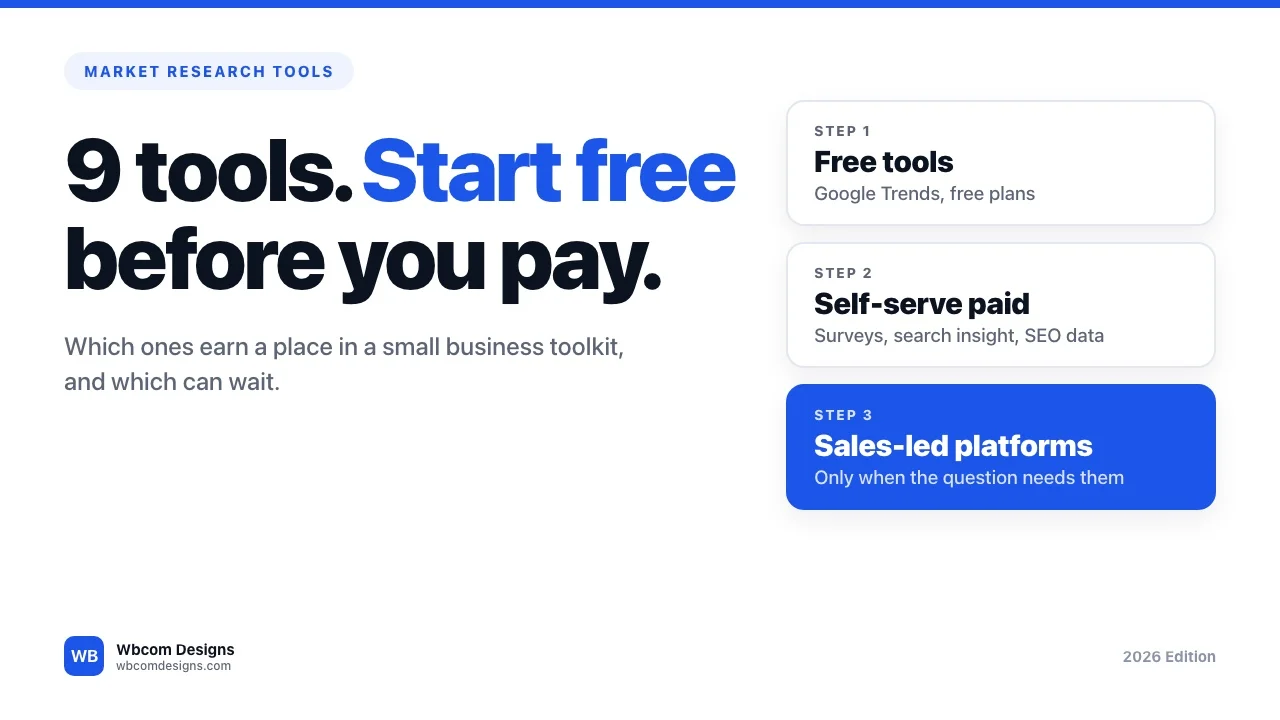
The best market research tools for a small business are Google Trends to check demand, SurveyMonkey to ask your customers directly, SparkToro to find where your audience spends time, and Semrush to see what competitors are doing online. Statista, Similarweb, Qualtrics and GWI earn their place later, when a specific question needs them. Start with the free ones. Most small teams never need to move past the second tier.
This ranking is built from each vendor’s public documentation and pricing pages, last verified in November 2026. We have not run hands-on tests of every tool, and where a vendor’s own pages disagree, we say so.
In this article
Quick comparison table
Prices below are what each vendor’s page showed in November 2026. Several pages localise prices by country, so treat any figure as a starting point and confirm it on the vendor site.
| Tool | Best for | Standout feature | Starting price | Free plan | Last verified |
|---|---|---|---|---|---|
| Google Trends | Checking demand | Compare search interest by term, place and time | Free | Yes | Nov 2026 |
| SurveyMonkey | Asking customers directly | Survey builder with a free Basic plan | Region-based, see vendor site | Yes, Basic | Nov 2026 |
| AnswerThePublic | Finding the questions people ask | Search-question research | US$20 a month, or US$120 billed yearly | Not stated on pricing page | Nov 2026 |
| SparkToro | Audience research | Shows where an audience spends time online | Sources disagree, see vendor site | Reported yes, limited searches | Nov 2026 |
| Semrush | Competitor and keyword data | Free plan with 10 reports a day | US$117.33 a month, billed yearly | Yes | Nov 2026 |
| Statista | Market size figures | Statistics database | See vendor site | Yes, Basic account | Nov 2026 |
| Similarweb | Competitor traffic and market share | Up to 37 months of history | Not listed | Free data sample and trial | Nov 2026 |
| Qualtrics | Large survey programmes | Market research offering built on one platform | Request pricing | Not mentioned | Nov 2026 |
| GWI | Consumer panel data | Priced per seat, plus custom research | Quote on request | Not mentioned | Nov 2026 |
How we picked these tools
Most roundups on this keyword come from software vendors, and vendors tend to rank their own product first. We tried to be less predictable. Five tests decided who made the list and in what order.
- Does it answer a real question? A tool had to map to a specific research job: demand, audience, customer opinion, market size or competitors.
- Can a small team start without a sales call? Tools with a free plan or public pricing ranked above tools that hide the price.
- Is the data collected or borrowed? We separated tools that let you ask people directly from tools that show you data someone else gathered.
- How honest are the limits? Sampled, relative or estimated data is fine if you know that going in.
- What does it cost to find out it is wrong for you? A free plan beats a twelve-month contract.
The order is a judgment call aimed at small businesses and agencies. An enterprise research team would reorder it.
Pick the question before the tool
The market research industry is large. ESOMAR’s Global Market Research 2023 report put global turnover for research, data and analytics at about US$130 billion in 2022, up 12% from US$118 billion the year before. Most of that money goes to teams who know what they are trying to learn before they buy anything.
That is the habit worth copying. Decide whether you need to know how big a market is, who is in it, what they want, or what your rivals are doing. Then choose the tool.
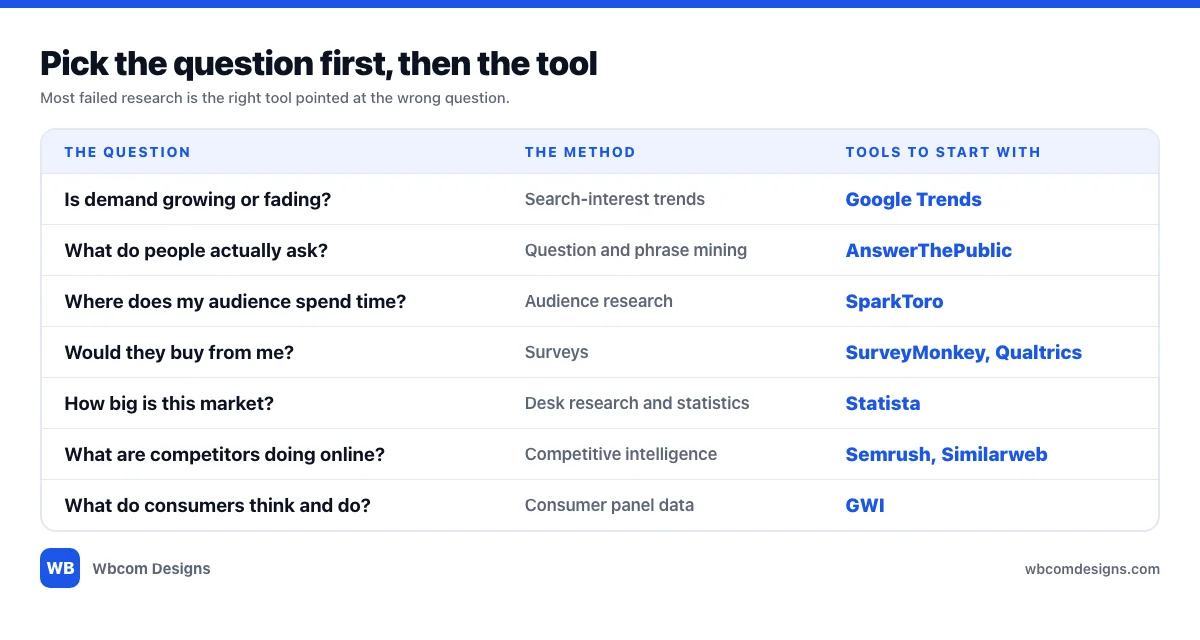
Most failed research is the right tool pointed at the wrong question. A survey tool cannot tell you market size. A statistics database cannot tell you whether your customers would pay.
The 9 best market research tools
1. Google Trends
Best for: checking whether demand for a topic is growing, flat or fading.
Key features: Google describes Trends as a largely unfiltered sample of real search requests. You can compare terms, narrow by location down to city level, and look across long date ranges.
Limits: The numbers are relative, not absolute. Google divides each figure by total searches for that place and period, then scales it from 0 to 100. Low-volume terms show as zero, noise is added for privacy, and searches made inside Google’s own AI Mode and AI Overviews are excluded. Read it for direction, never for raw volume. For raw volume you need a keyword tool such as Semrush.
Pricing: free.
Verdict: The first stop on every project. Compare your topic against two or three alternatives over five years and you will know in ten minutes whether the market is worth more of your time.
2. SurveyMonkey
Best for: asking your own customers or prospects a direct question.
Key features: A survey builder with a free Basic plan limited to one user and ten questions per survey. Paid team plans add unlimited surveys and questions, with response caps. The Team Advantage plan, for example, lists 50,000 responses a year.
Limits: The free plan hides how many responses you can view until you sign up. Overage is charged per response on team plans, so a viral survey can cost more than you planned. The tool collects answers. It does not tell you whether your sample represents your market.
Pricing: region-based. The page we read showed Indian rupees, with individual plans starting at ₹899 a month on Standard Monthly and Team Advantage at ₹1,550 per user a month billed yearly, three users minimum. Check your own region before you plan a budget.
Verdict: The default choice for primary research. Ten questions is enough for a sharp customer survey, which is the point.
3. AnswerThePublic
Best for: finding the exact questions and phrases people type about your topic.
Key features: It turns a search term into the questions, comparisons and prepositions people use around it. That language is useful for product pages, ads and content planning.
Limits: The pricing page we read now builds its plans around Composeo, an AI writing product, and does not list free search limits. If you only want the question research, check what your plan actually includes before you pay.
Pricing: Starter US$20 a month or US$120 billed yearly. Growth US$99 a month or US$594 yearly. Business US$199 a month or US$1,194 yearly. The page notes that pricing may be localised.
Verdict: Cheap and specific. Good for turning vague topic interest into the actual wording your buyers use.
4. SparkToro
Best for: learning where your audience spends its time online, so you know where to show up.
Key features: Audience research that points to the sites, channels and accounts a defined group pays attention to. Useful before you spend on ads or outreach.
Limits: We could not open SparkToro’s own pricing page, and the third-party listings we found conflicted on plan names and prices. SparkToro’s blog reportedly returns free accounts to five searches a month, but confirm that before relying on it. Results on free accounts are sampled.
Pricing: see the vendor site. We will not quote a number we could not verify.
Verdict: Worth a free-tier trial. If you sell to a niche, knowing which three podcasts or communities your buyers follow is worth more than a thousand-line keyword export.
5. Semrush
Best for: seeing what competitors rank for and where their traffic comes from.
Key features: Keyword and competitor data, plus a free plan that includes one demo project and 10 reports a day. Paid plans also track keywords daily and now include AI prompt tracking.
Limits: It is an SEO platform first. As a market research tool it shows online demand and competitor visibility, not why people buy. Plans are priced for marketing teams, not casual use.
Pricing: SEO plan US$117.33 a month billed yearly (list price US$139), Starter US$165.17 (US$199), Pro+ US$248.17 (US$299), and Advanced on request. There is a seven-day free trial.
Verdict: Use the free plan for a competitor snapshot. Pay only if search is a channel you will work every week. If AI search matters to you, our guide to tracking and improving AI search visibility covers what to measure.
6. Statista
Best for: quoting a market size, a growth rate or a consumer statistic in a plan or pitch.
Key features: A large statistics database. The free Basic account covers free statistics only. Premium statistics need a paid account.
Limits: Paid plans run on annual contracts. The paid prices we found conflicted by region and date, with older US pages showing figures near US$199 a month and a recent UK listing showing about £159 a month. Always check the original source behind a statistic before you quote it.
Pricing: free Basic account. Paid plans, see the vendor site.
Verdict: Good for the one slide that needs a market-size number. Poor value if you only need it once.
7. Similarweb
Best for: comparing competitor traffic and market share.
Key features: Competitive analysis, market research analysis, keyword and SEO data, ads intelligence and AI-traffic trends. The business packages cover up to 37 months of history and more than 100 countries.
Limits: No prices are published. Business and enterprise packages go through sales, and the free data on the public site is a limited sample without deeper drill-downs. Traffic figures are estimates.
Pricing: not listed. There is a free trial and a self-serve option for individuals and small teams.
Verdict: Strong if you work in a competitive category and need to see rivals side by side. Overbuilt for a first project.
8. Qualtrics
Best for: large or repeated survey programmes with several teams involved.
Key features: A platform with customer experience, employee experience and market research offerings under one roof.
Limits: Every plan on its pricing page says Request Pricing, and the cost is based on usage measures such as interactions or employee count. The page does not mention a free account or trial.
Pricing: on request.
Verdict: A tool for organisations with a research function. A small business will do better on SurveyMonkey.
9. GWI
Best for: consumer attitudes and behaviour backed by a large panel.
Key features: Platform access priced per seat, with Pro and Team seat types. Integrations are priced by consumption, and bespoke research is priced by project.
Limits: No public prices and no free trial mentioned on the page we read. It is aimed at agencies and brands with a research budget.
Pricing: quote on request.
Verdict: Right for an agency that sells audience insight to clients. Wrong for a first research project.
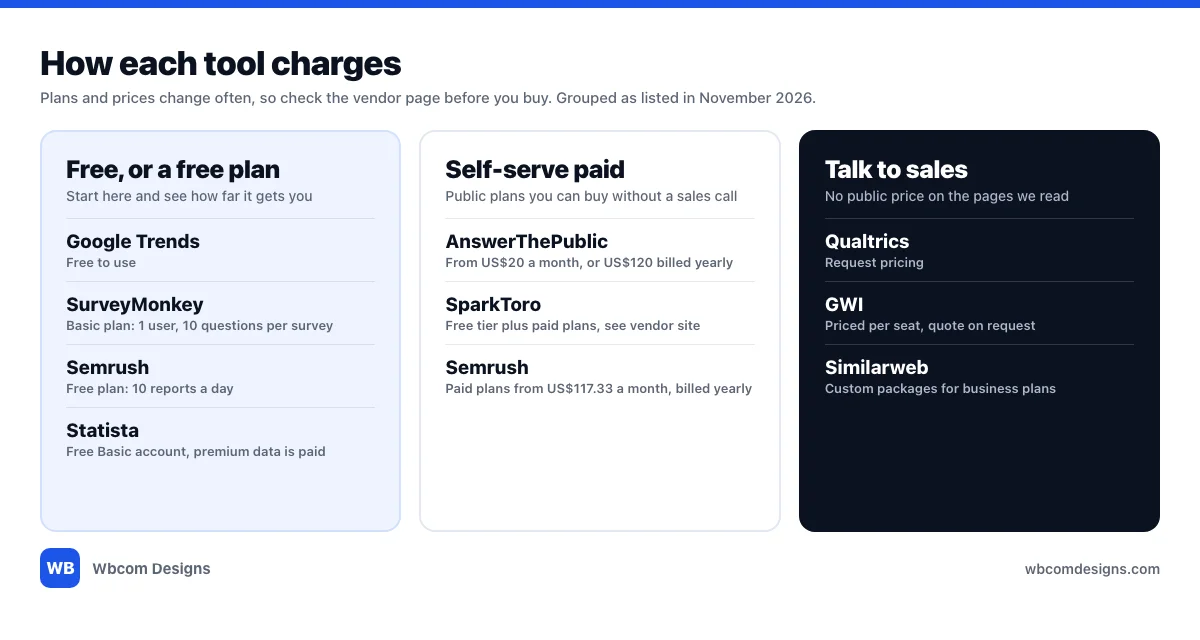
How these tools charge
Grouping the nine by pricing model makes the buying order obvious. Use up the free options first. Move to a self-serve plan only if you hit a real limit. Talk to a sales team last.
Pick by situation
Solo founder or startup. Google Trends, a free SurveyMonkey Basic survey and the Semrush free plan. Cost: nothing. That stack is enough to test an idea before you build anything.
Small or mid-size business. Add SparkToro for audience research and AnswerThePublic for customer language. Add a paid Semrush plan only if search drives your sales.
Agency. The small business stack, plus Similarweb for competitive work and GWI when a client pays for audience insight. Research findings also feed lead generation. Our AI lead generation system for service businesses shows where that research plugs in.
Enterprise. Qualtrics or GWI, plus Similarweb. At this size the question is governance and integration, not price.
A five-step research sprint
You do not need a six-week project. A small team can run this in a week, spending money only if the free steps leave a gap.
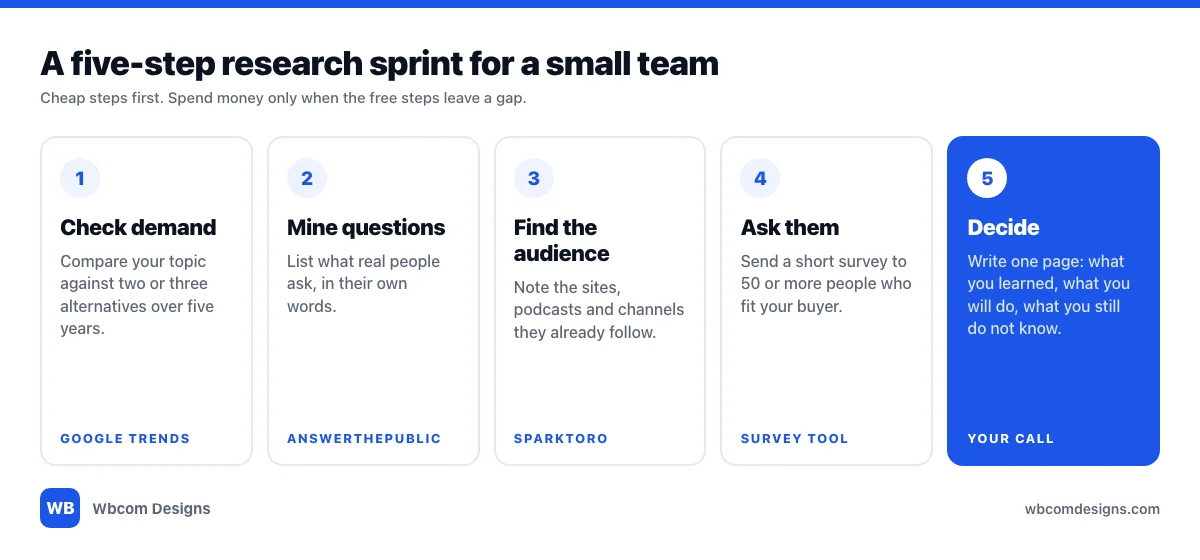
- Check demand. Compare your topic against alternatives in Google Trends.
- Mine questions. Write down what real people ask, in their own words.
- Find the audience. Note the sites, podcasts and channels they already follow.
- Ask them. Send a short survey to 50 or more people who fit your buyer. That shows direction, not proof.
- Decide. Write one page: what you learned, what you will do, what you still do not know.
If the decision involves your own positioning, our five-step marketing audit is a useful companion.
Mistakes that waste the budget
- Buying before asking. A paid platform will not fix an unclear question.
- Reading relative numbers as volumes. A Google Trends score of 80 does not mean 80 searches.
- Surveying people who already like you. Your email list will flatter you.
- Quoting a statistic without finding its source. Statistics databases summarise other people’s research. Open the original.
- Signing a twelve-month contract before a trial. Most of these tools offer a free plan, a free trial or both.
- Ending without a decision. Research that does not change what you do is a hobby.
Frequently asked questions
What are market research tools?
Software that helps you learn about a market, its customers and its competitors. Some collect new answers from people, such as survey tools. Others show data that already exists, such as search trends or traffic estimates.
What is the best free market research tool?
Google Trends, for checking demand. Pair it with the free Basic plan on SurveyMonkey for a customer survey and the Semrush free plan for competitor data.
What is the difference between primary and secondary research?
Primary research is data you collect yourself, for example a customer survey. Secondary research is data someone else already gathered, such as Statista figures or search trends. Start with secondary because it is cheaper, then run primary research to fill the gaps.
How much do market research tools cost?
From nothing to a custom enterprise contract. Among the tools above, AnswerThePublic starts at US$20 a month and Semrush at US$117.33 a month billed yearly, while Qualtrics, GWI and Similarweb’s business packages do not publish prices.
Does a small business need a paid research platform?
Usually not at first. A free stack covers demand, customer opinion and a competitor snapshot. Pay when you hit a specific limit, such as needing more survey responses or daily keyword tracking.
Can AI replace market research?
AI can summarise existing reports and speed up desk research. It cannot tell you what your own customers think, because it has not asked them. Treat AI output as a starting hypothesis and check it with real people.
How many survey responses do I need?
For a narrow audience, 50 to 100 well-chosen responses will show direction. They will not prove a result. The more varied your audience, the more responses you need.
How do I check what competitors are doing online?
Use Semrush for keyword and search visibility, and Similarweb for traffic and market share estimates. Both give estimates, so use them to compare yourself with rivals, not to predict revenue.
Need the findings turned into a site that converts?
Research only pays off when it reaches the page your customers see. If your results point to a new site, a rebuilt landing page or a stronger WordPress setup, talk to our WordPress team.
Related reading