
14 min read
Our New WordPress Plugin Series Is AI-Ready, and Here Is What That Lets You Do

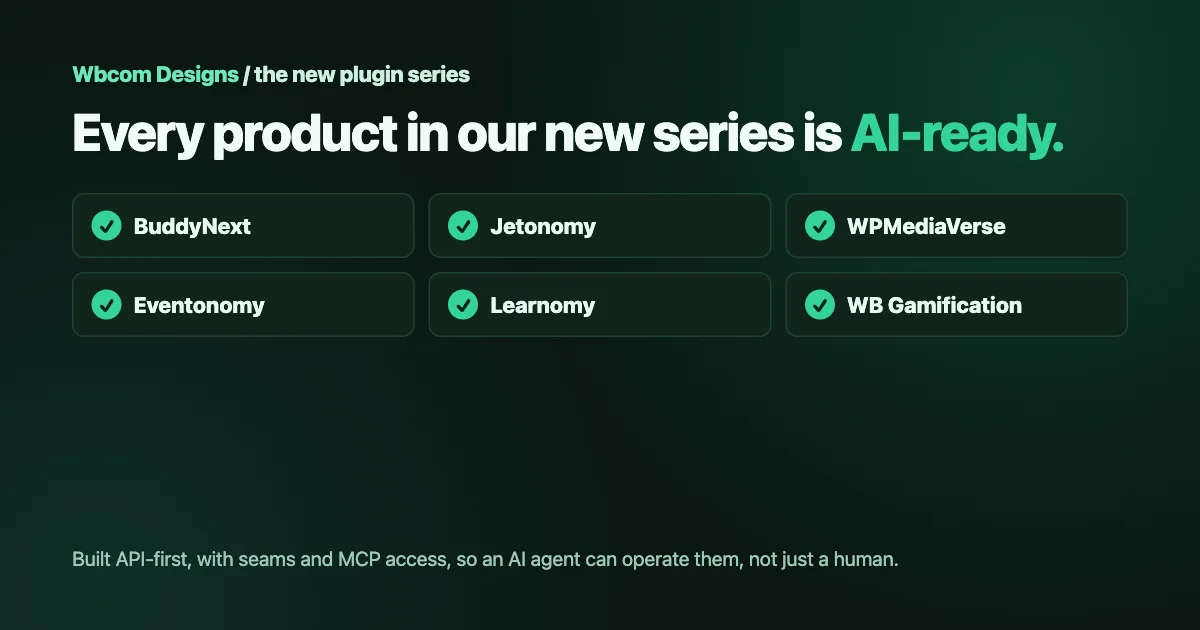
For twenty years, a WordPress plugin was built for one kind of user: a person clicking through the dashboard. You logged in, found the screen, filled in the fields, and saved. That assumption sat quietly under almost every plugin ever made, and it worked, because the one doing the work was always a human. That assumption is now breaking, and it is why we rebuilt our whole product line as AI-ready WordPress plugins: software that an AI agent can actually operate, not just a person with a mouse. Led by BuddyNext, every product in the new series is built this way, and this is a plain explanation of what that means and, more importantly, what it lets you do.
We will keep this useful for two readers at once. If you run a site, you care about what these plugins let you accomplish that ordinary ones cannot, and that is most of this piece. If you build on our products, there is a section near the end written for you, on the exact technical shape that makes this work. You can skip to it, or past it, without missing the point.
What AI-ready actually means
The phrase gets used loosely, so let us be precise. AI-ready does not mean we sprinkled a chatbot on top, or added one button that calls a model. Those are features, and features are the easy part. AI-ready means something structural: an AI agent can actually operate the product, read its data, take actions in it, and be trusted to do so, the same way a capable staff member could.
Think about what a human needs to run a plugin: a way to see the current state, a way to make a change, and guardrails so a mistake does not break everything. An AI agent needs the exact same three things, only through a clean interface rather than a screen. So a product is AI-ready when it exposes all of its functions through a proper interface an agent can use, when its data lives somewhere an agent can query, and when the actions an agent can take are defined and safe. That is the whole idea. It is not glamorous, and it is exactly the part most plugins skipped, because for twenty years nobody needed it.
AI-ready is not a chatbot bolted on top. It means an AI agent can see the state, take the action, and be trusted with it, the same way a good staff member could. That is a property of the architecture, not a feature on a menu.
What AI-ready is not
It is worth clearing away the common misreadings, because the term is being stretched to mean almost anything right now. AI-ready is not a chatbot widget in the corner of your site; that is a feature you could add to any plugin, and it says nothing about whether an agent can run the thing. It is not an AI content generator baked into the editor; that is handy, but it is the plugin using AI, not the plugin being operable by AI. And it is not a marketing badge that means the vendor has heard of ChatGPT.
Those confusions matter because they let a plugin claim to be modern while staying exactly as closed as it always was. A plugin can have three AI features and still be impossible for an agent to operate, because everything real still lives behind human-only screens. The test that cuts through all of it is simple: can something other than a human drive this product through a clean interface, safely? If yes, it is AI-ready. If no, the AI features are just decoration on the same old box.
Why most WordPress plugins are not ready for this
To see why this matters, look at how a typical plugin is built. Its features live inside admin screens, tied to buttons and forms. Its settings are often a pile of stored options with no clean way to read or set them from outside. Its data may be scattered in ways that made sense for displaying a page but are hard to query on their own. None of that is wrong for a human clicking around. All of it is a wall for an agent.
When a plugin only exposes itself through dashboard screens, an AI agent has nothing solid to hold. At best it has to pretend to be a human, clicking through pages and hoping the layout does not change, which is slow and fragile and exactly the kind of thing that breaks quietly. There is no clean way for the agent to ask what the current state is, and no safe, defined way for it to make a change. So the agent either cannot help at all, or it helps in a way you cannot trust. That is the position most of the plugin world is in right now, through no fault of its own. It was built for an era that is ending.
What makes our AI-ready WordPress plugins different
When we started the new series, we set one standard that every product in it has to meet, and it is the standard that makes them AI-ready. It comes down to a few things that sound technical but have a very practical payoff.
- A full interface for everything, not just screens. Every feature a person can use through the dashboard is also available through a proper programmatic interface. Nothing important is locked behind a button that only a human can press. An agent can reach all of it.
- Data that lives somewhere you can actually query. The new products keep their data in their own proper structures rather than scattering it, so an agent, a report, or another tool can ask real questions of it and get real answers.
- Defined actions with real seams. Every meaningful action has clear points where other code, or an agent, can hook in before and after it. That is what lets automation be added safely, and what lets an agent act without reaching into places it should not.
- Three ways in, on purpose. Every feature is reachable three ways: the frontend for your members, the admin for you, and the interface for tools and agents. A feature is not considered done until all three exist. That third door is the one that makes the product AI-ready.
Hold those together and the picture is simple. The new series was built so that a human, another piece of software, or an AI agent can all operate it through a clean, safe interface. Most plugins offer only the first. Ours offer all three, and the third is what the agent era runs on.
What this lets you actually do
All of that architecture is only worth anything because of what it makes possible for you, so here is the payoff in plain terms.
You can run more of your site by asking, instead of clicking. Because an assistant can operate these products through their interface, the busywork of managing a community, a store, a course platform, or an events calendar can increasingly be handed to an agent. Set up a new group, enroll a cohort, pull a report on who is active, tidy up spam, schedule a run of events: work that used to be a human clicking through screens becomes something you can ask for and check.
You can automate the parts that used to need a developer. Because every action has clean seams, the automations you always wanted, when this happens, do that, become reachable without a custom build for each one. And because the products are agent-operable, an AI assistant can wire much of that up with you rather than for a fee.
You can let AI help build and maintain the site itself. A site built on AI-ready WordPress plugins is one an agent can genuinely help you run, not just chat about. That is the difference between AI that talks about your site and AI that can actually do something on it, safely, and report back.
And you are buying something that is not about to age out. The direction of the whole field is toward more work being done by agents. A product that cannot be operated by an agent is going to feel more stuck every year. Building your community or store on a series that was made for this means you are not going to have to migrate off it the moment agents become how everyone works.
A day of running your site by asking
To make that concrete, picture how a week might go for someone running a community and a course on our stack once an assistant is connected to it. On Monday, instead of clicking through screens, you ask your assistant to show which members have gone quiet in the last month, and it queries the community data and hands you a list. You ask it to invite them back into a specific group, and because the group action is available through the interface, it does, and tells you what it did.
Midweek, a wave of spam signups hits. Rather than deleting them by hand, you ask the assistant to find and remove the accounts matching the pattern, and the moderation actions are defined and safe, so it clears them and reports the count. Before a launch, you ask it to enroll a new cohort into your course and schedule the week’s events, and it does both across the learning and events products because each one exposes those actions cleanly.
None of that required a developer, and none of it required you to trust the agent blindly, because you can see what it did at every step and the actions it can take are bounded. That is the daily texture of AI-ready WordPress plugins: the site becomes something you can operate by describing what you want, while still keeping a clear view of what actually happened. On a closed plugin, not one of those requests would have been possible.
Proof this is real, not a promise
It is easy to claim AI-ready. Here is where it is already true in the series, so you can see it is a standard we ship, not a slogan.
Jetonomy, our forum and discussion plugin, was built for the AI era from the start, with modern architecture, AI-assisted moderation, and, importantly, a working interface that lets an AI assistant operate it directly. We wrote about that in the first WordPress forum plugin built for the AI era, and it is the clearest single example of what the whole series is built to be. Our events plugin was built with a complete programmatic interface covering everything it does, so nothing is trapped behind an admin screen. The same pattern runs through the community, media, learning, and gamification products in the series. Different jobs, one shared standard: a clean interface, queryable data, safe actions, three doors in.
BuddyNext sits at the center of this as the flagship, the community engine the rest of the series plugs into, and it carries the same AI-ready design so the community at the heart of your site is as operable by an agent as everything around it. You can see how these pieces fit together in our overview of the self-hosted community and course plugins led by BuddyNext.
How to tell if a plugin is AI-ready before you build on it
Since the label is about to be everywhere, here is how to check a plugin for yourself before you trust it, whether it is one of ours or anyone else’s. These questions cut through the marketing quickly.
- Does it have a real, complete API? Not a couple of endpoints, but coverage of what the plugin actually does. If the features only exist as admin screens, an agent cannot drive it.
- Can you get its data out cleanly? If the answer involves scraping pages or digging through scattered storage, it is not ready. Proper data structures mean an agent can ask real questions.
- Are there defined hooks around its actions? Clean seams are what let automation and agents act safely instead of reaching into internals.
- Is there an agent path, such as an MCP server? The clearest sign a plugin was built for this is that an AI assistant can already connect to and operate it.
- Does every feature exist beyond the dashboard? If the frontend and the admin are the only doors, the third door an agent needs was never built.
Run those five questions against any plugin and you will know quickly whether AI-ready is real or a sticker. We built the new series to answer yes to all five, because we would want to be able to check the same way.
AI-ready does not mean AI-run
One worry worth answering head on: AI-ready does not mean your site is handed over to AI, or that you have to use agents at all. The interface that makes these products operable by an agent is the same interface that has always made good software extensible. If you never connect an assistant, the plugins work exactly as any well-built plugin would, through the dashboard, by hand, entirely under your control.
What AI-ready adds is a door, not a requirement. You decide whether to open it, how far, and for which tasks. You can let an agent handle spam cleanup but keep enrollment in your own hands. You can automate reports but approve every member invite yourself. Because the actions are defined and bounded, you are never choosing between total manual control and total automation; you are choosing, task by task, how much help you want. The human stays in charge at every step, and the agent only reaches what you allow.
That is the opposite of the fear people have about AI in their tools. It is not the software making decisions behind your back. It is the software finally being open enough that you, and any assistant you trust, can operate it cleanly, with you deciding where the line sits. AI-ready is about capability and choice, not surrender.
It also means you can grow into it. Start by running your site the way you always have, and the day you want to hand a repetitive job to an assistant, the capability is already there waiting, with no migration and no rebuild. You are not committing to a new way of working today; you are making sure the option exists when you want it. That is the quiet advantage of building on AI-ready WordPress plugins: the future is available whenever you are ready for it, and not a moment before.
For developers: the shape that makes this work
If you build on our products, here is the concrete version of everything above, and it is the part we are most proud of. Every product in the new series ships a full REST API that covers its entire feature set, not a token handful of endpoints, so anything a user can do, your code or an agent can do through the API. Data lives in proper custom tables with real access methods rather than in a sprawl of options and post meta, so it is queryable at scale and safe to read programmatically. Every meaningful operation fires before and after action hooks, giving you defined seams to extend behavior without patching core. And the products are built to be driven by the Model Context Protocol, the emerging standard for letting AI assistants operate software directly; Jetonomy already ships an MCP server, and it is the model the series follows.
The practical result for you is that building on these products does not mean fighting them. The seams you need are already there, the data is reachable, and the API is complete, so your custom work sits alongside the product instead of hacking into it. And because the same interface an agent uses is the one you use, anything you can automate, an assistant can help operate. That is the developer payoff of an AI-ready design: the product is a platform you build on, not a closed box you work around.
Why we made this the standard now
We could have kept building plugins the old way, and they would have sold fine for a while. We chose not to, because we think the way people run WordPress sites is genuinely changing, and building for the old assumption would have meant shipping products that felt more dated every year. The work of running a site is moving toward agents doing more of it, and the plugins that thrive in that world are the ones an agent can actually operate. We would rather build for where things are going than for where they have been.
That is the whole reason the new series exists in the shape it does. It is not that we added AI to our plugins. It is that we rebuilt how our plugins are made so that AI, and you, and your developers can all operate them cleanly. BuddyNext and everything in the series share that foundation, and it is the foundation the next decade of WordPress work is going to need.
Building for the agent era
If you are choosing what to build your community, store, courses, or events on, the question worth asking now is no longer only what this plugin does today. It is whether you will be able to operate it the way you will want to work tomorrow, with agents handling more of the load. Most plugins were not built with that in mind. Our new series was, from the data layer up.
So the invitation is simple. Build on a stack that is ready for the way work is heading, where a human, a developer, and an AI agent can all run your site through the same clean, safe interfaces. That is what AI-ready means for us, it is the standard behind BuddyNext and the whole new series, and it is the part that will still matter in five years. If you want to talk through what building your platform on that foundation looks like, that is exactly the conversation we are here for.
Related reading