
7 min read
Price a Course Like a Convertible Note

A convertible note is a strange piece of paper. It isn’t equity, and it isn’t quite debt either. It’s a promise: give me money now, before anyone can agree on what this is worth, and I’ll pay you back in ownership later, at a price set once the world has actually decided. Nobody prices the deal at the moment of trust. They price it at the moment of proof.
Course creators run this exact instrument constantly, they just never call it that. Every time you take money for a course that isn’t finished, or price early access below what the finished thing will eventually cost, you’ve written a convertible note. The mechanics are the same: a discount for going first, a ceiling that protects the early buyer from your own success, and a trigger event where the discount becomes the real thing.
In this pieceThe instrument, stripped down
Selling before it exists is the same bet
The discount: paid to go first
The cap: protection from your own success
The trigger event, where the discount becomes real
A real course, a real price, before the ceiling
Why the discount has to be real
Where this lives inside Learnomy
The test, if you want one
The instrument, stripped down
Strip a convertible note down to its parts and there are only three that matter. A discount, the early investor’s money converts to equity at a lower price than whoever invests in the next round. A cap, a ceiling on that conversion price, so if the company gets wildly more valuable before the next round, the early money still converts at something close to what it paid, not at the new inflated number. And a trigger, the note doesn’t convert whenever anyone feels like it, it converts when a specific priming event happens, usually the next round where an outside party actually sets a real price.
The reason this instrument exists at all is that pricing something too early is dishonest in both directions. Charge the early backer the full, proven price and you’re charging them for certainty that doesn’t exist yet. Charge them nothing and you’re not compensating the actual risk they’re taking. A convertible note resolves this by deferring the pricing decision to the moment enough information exists to make it honestly, while still rewarding the people who moved before that moment arrived.
Selling before it exists is the same bet
A course you’re pre-selling has exactly the same pricing problem, for exactly the same reason. You don’t yet know what the finished course is worth, because worth is proven by outcomes, and outcomes take a cohort actually going through the material. Price it at what you hope it’ll be worth and you’re asking buyers to trust a number you can’t back up yet. Give it away to build an audience and you’re failing to compensate the people taking a real risk on something unfinished.
The honest move, the one a convertible note formalizes for startups and course creators do instinctively when they get it right, is to defer the real price and compensate the early risk with a rate that’s better than anyone will ever get again. Not a permanent discount, a temporary one, tied to a moment when the real price gets set. That’s not a marketing gimmick if you build it properly. It’s just honest pricing under uncertainty, which is what a convertible note actually is.
The discount: paid to go first
The discount side of this is the part every course creator already understands, even if they’ve never connected it to financing. Early-bird pricing, founding-member rates, charter-cohort pricing, these all exist because the first buyers are taking a risk nobody after them will take: buying a thing that has no reviews, no completion data, no proof it delivers what it claims. That risk deserves compensation, and the compensation is a price below what the course will eventually settle at once it’s proven.
Where creators get this wrong is treating the discount as a permanent feature of the funnel instead of a reward for a specific, real risk. If everyone gets the early-bird price forever, it was never a discount for going first, it was just your price, badly disguised. The discount only means something, and only works the way a convertible note’s discount works, if it’s genuinely temporary and genuinely tied to a moment when things change.
The cap: protection from your own success
The cap is the part course creators almost never build in, and it’s the part that makes the whole arrangement fair rather than merely generous. A cap says: whatever this thing eventually becomes worth, your early price is protected up to a ceiling, you don’t lose the deal just because the course turned out better than anyone expected. Without a cap, an early buyer’s good deal is only good by accident, dependent on you not raising the price too aggressively later.
For a course, the cap can be as simple as a stated promise: founding members lock in this price for as long as they’re enrolled, no matter what the course grows into or what the price becomes for everyone who joins after. That’s not charity, it’s the exact mechanism that makes convertible-note pricing trustworthy. The buyer isn’t betting that you’ll be fair later. The cap makes fairness a term of the deal, not a hope.
The trigger event, where the discount becomes real
A convertible note doesn’t sit unconverted forever, it converts when something specific happens, usually the next funding round, because that’s the first moment an outside party actually sets a real price. A course needs the same defined trigger, otherwise the early price never resolves into anything, it just quietly becomes the permanent price by default, which erases the whole point of having offered it.
The trigger for a course is usually obvious if you look for it: the course reaches full launch, a cohort actually completes it and the completion data exists, the price moves to what the market will actually bear once reviews and outcomes are real. Before that moment, you were selling a promise at a discount. After it, you’re selling a proven thing at its real price, and the people who bought before the trigger got the better deal they were promised, because the promise had a defined edge.
A real course, a real price, before the ceiling
Here’s what an actual course price looks like, reachable without an account.
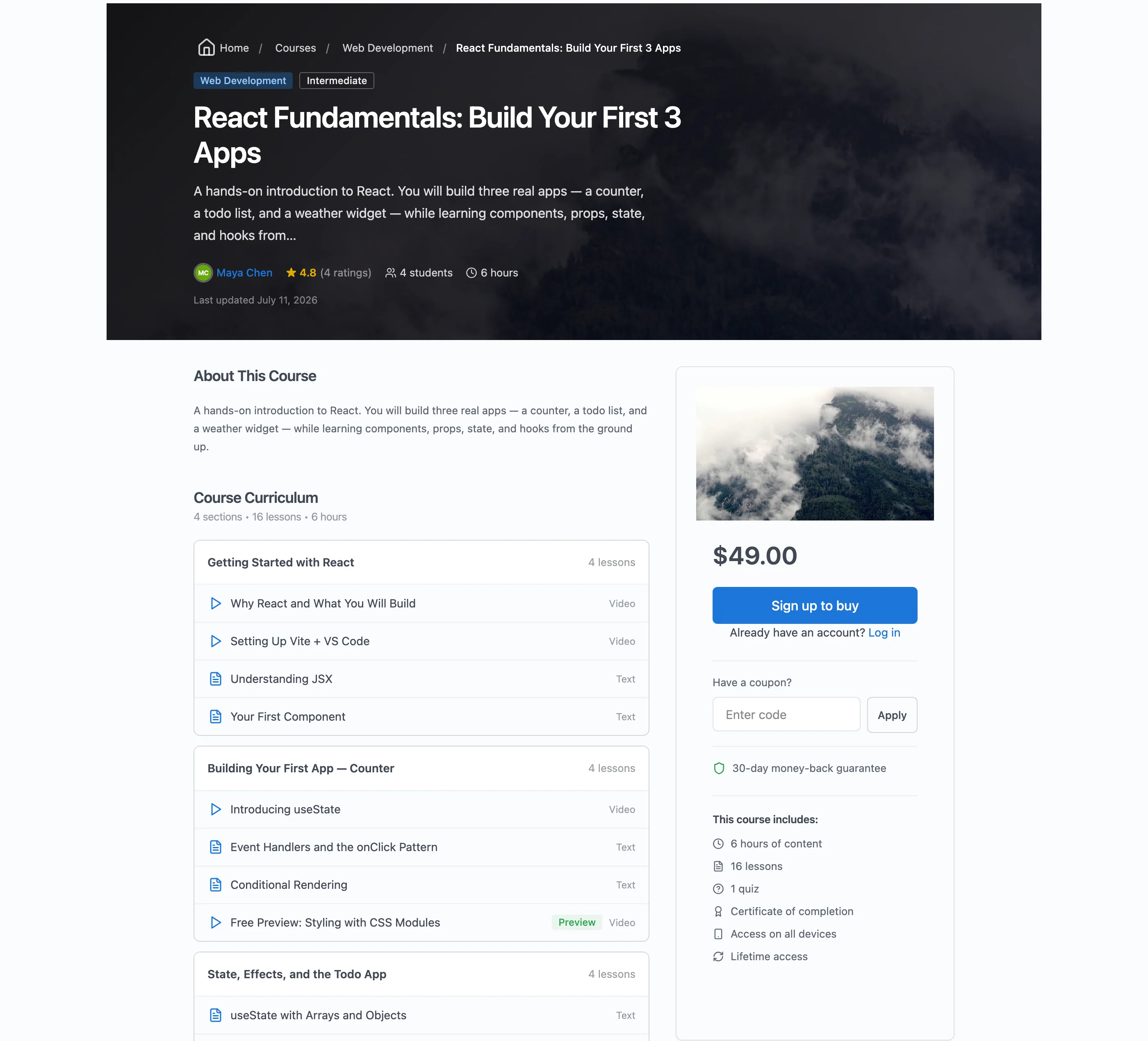
A single, real number, not a placeholder. This is what a trigger event resolves toward, the price the market will actually bear once the course has proof behind it: enrollments, outcomes, reviews. An early rate offered before this number existed only means something in relation to it, it’s the discount, the cap only protects against, the thing the whole arrangement was deferring judgment on. Without a real number like this one to eventually land on, an early price is just a lower price, not a convertible-note-shaped deal.
Why the discount has to be real
The entire arrangement collapses the moment the discount is fake, and fake is easy to slide into. If the early-bird price is available whenever anyone asks, or the price never actually rises after the trigger, or the cap is quietly ignored for existing members when a permanent price hike happens, the whole thing was theater dressed up as an investor-grade instrument. Buyers can tell, even when they can’t articulate why the offer felt hollow.
A real convertible-note-style offer costs you something. It means genuinely raising the price at the trigger, genuinely honoring the cap for people who bought early even when it costs you revenue you could otherwise capture, genuinely closing the discount window instead of quietly extending it because a launch didn’t hit its number. The discount only functions as compensation for risk if the risk was real and the reward was real, and both of those require you to actually follow through on the terms once the trigger arrives.
Where this lives inside Learnomy
None of this needs special financing infrastructure to run, it’s a pricing decision you make and then honor. If you’re building a course on Learnomy, the price field on a course is just a price field, nothing stops you from setting an early rate before the course is finished and raising it at a defined trigger once it’s proven. The instrument isn’t a feature you install, it’s a promise you keep, the platform just needs to let the price change when the moment comes, which it does.
Pairing this with a real completion signal, actual student outcomes, actual reviews, actual certificates once a community layer lets students show their work, gives you an honest, external reason to say the trigger has arrived. The price doesn’t rise because you decided to charge more. It rises because the course now has proof it didn’t have before, which is the entire justification a convertible note runs on.
The test, if you want one
Before you offer an early price on anything unfinished, write down the three parts out loud. What’s the discount, and is it actually temporary. What’s the cap, the promise that protects early buyers from your own future success. And what’s the trigger, the specific, real event where the discount resolves into the actual price. If you can’t name a real trigger, you don’t have an early-bird offer, you have a permanent low price wearing a launch-week costume.
Priced this way, an early buyer isn’t getting a marketing discount, they’re getting compensated for taking a real risk on something unproven, on terms that were honest about the uncertainty from the start. That’s the whole idea a convertible note formalizes for startups, and it’s available to anyone selling something before it’s finished, without needing a single legal document to make it real.
Related reading