
5 min read
Why Certification Courses Need More Runway Than They Look Like

A certification course needs more runway than a consumer course of similar size, and most creators who cross over from consumer courses into this space underestimate that by a wide margin. The reason isn’t that certification content costs more to produce, it often doesn’t. It’s that the sales cycle is longer, the buyer is frequently institutional rather than individual, and the verification infrastructure the entire business depends on has to be built and paid for before the first real sale closes, not incrementally alongside it.
If you’ve read the piece on burn rate for course businesses, this is the variant where the runway math looks the least like a typical consumer course, because almost every assumption underneath it is different.
In this pieceWhy the sales cycle is structurally longer here
The infrastructure cost that has to exist before day one
A real, verifiable certificate, and what it took to make it real
Why the runway math needs a longer horizon
The pushback: “one enterprise deal will fix the runway”
Where this actually lives inside Learnomy
Turning it into something you actually check
Why the sales cycle is structurally longer here
An individual buying a consumer course makes a fast, personal decision, often within minutes of landing on the page. An institutional buyer, an employer purchasing compliance training or a professional body evaluating a continuing-education partner, moves through procurement, budget approval, and often a security or compliance review before any money changes hands. That process routinely takes months, not minutes, and it’s a structural feature of institutional buying, not a sign anything’s being done wrong.
A creator whose runway math assumes consumer-course sales velocity, revenue arriving within days or weeks of outreach, will badly misjudge how much cash is actually needed to survive the real sales cycle this specific buyer requires.
The infrastructure cost that has to exist before day one
Unlike a consumer course, where the certificate can reasonably be an afterthought added later, a certification business’s entire value proposition depends on the verification infrastructure existing and being trustworthy from the very first sale. A real, working, publicly checkable verify page isn’t a nice-to-have feature to build once revenue justifies it, it’s the actual product an institutional buyer is paying for, and it has to be real and functional before the first serious sales conversation, not after.
That’s real, front-loaded burn that has no consumer-course equivalent, spent on infrastructure before the sales cycle described above has even produced its first dollar of revenue, compounding the runway problem from both directions at once.
A real, verifiable certificate, and what it took to make it real
Here’s what that infrastructure actually looks like once it’s built, reachable without an account.
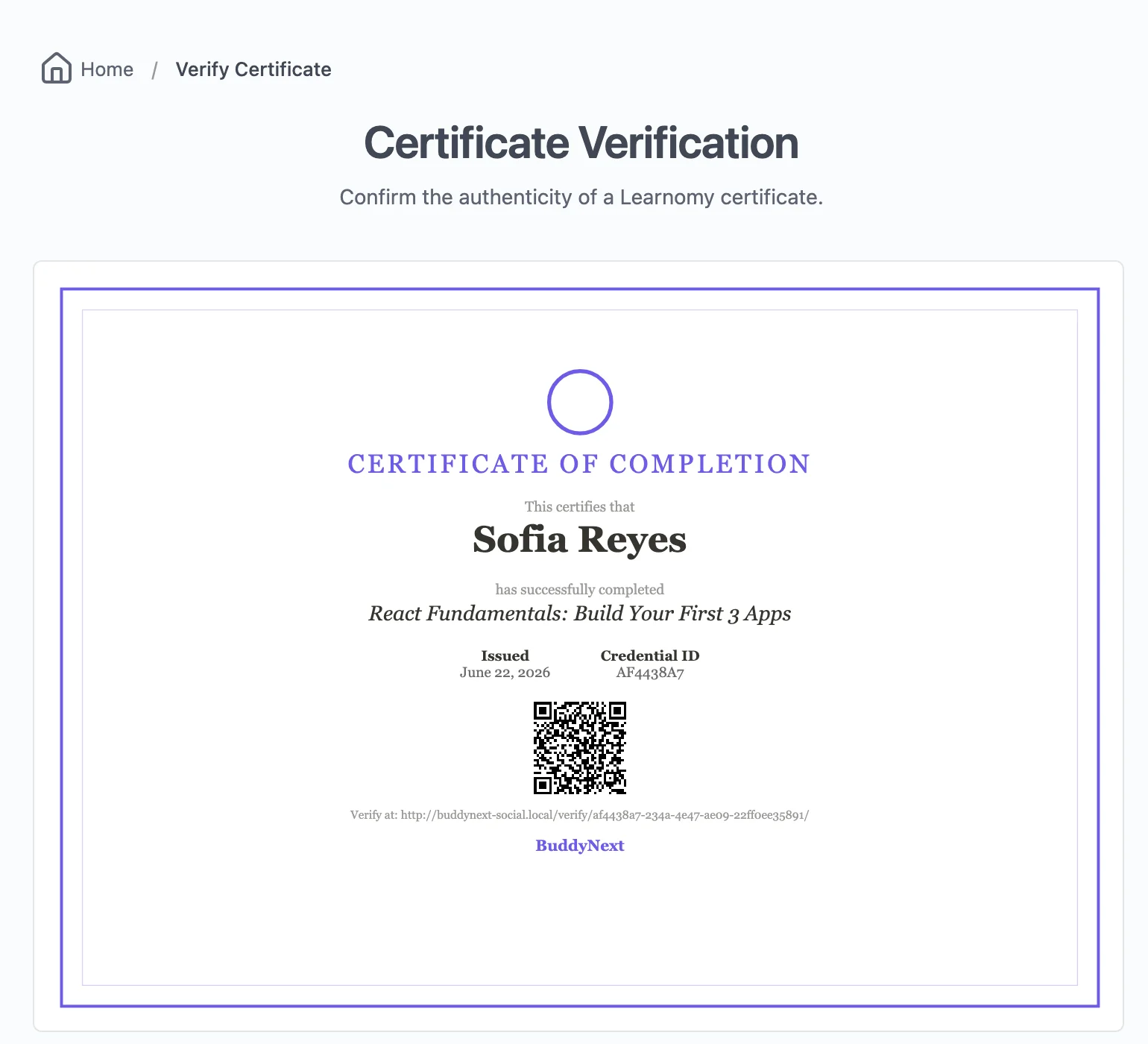
A real credential ID, a real QR code, a live public verification page. None of this is negotiable for a serious institutional buyer, and building it, or paying for a platform that already has it built, is a real cost that has to be absorbed before this business model can credibly sell to anyone at all. Skipping it to save early cash doesn’t reduce burn, it just delays the cost to a moment when a buyer’s procurement team discovers the certificate can’t actually be verified, at which point the entire sale, and the runway spent pursuing it, is lost.
Why the runway math needs a longer horizon
Combine the longer sales cycle with the upfront infrastructure cost and the runway requirement for a certification business looks nothing like a consumer course’s. Where a consumer course creator might reasonably plan for a matter of weeks between launch and meaningful revenue, a certification business often needs to plan in quarters, sometimes multiple quarters, before the first institutional deal actually closes and pays.
Underestimating this horizon is the single most common way certification-course creators run out of cash despite a genuinely strong product and real institutional interest already in the pipeline. The interest was real. The cash simply ran out one or two months before the deal that would have justified it actually closed.
The pushback: “one enterprise deal will fix the runway”
Often true, and also a dangerous way to plan runway, because it treats an uncertain future event as a load-bearing assumption in a cash survival calculation. Institutional deals do close, and when they do, they’re often large enough to meaningfully change the business’s trajectory. They’re also genuinely uncertain in timing, procurement delays are common and rarely explained in advance, and a runway plan that assumes a specific deal closes by a specific date is a plan with no real margin for the ordinary uncertainty institutional sales carries.
The safer version is planning runway as if the deal takes longer than expected, then treating an early close as a welcome surprise rather than a baseline assumption the business’s survival actually depends on.
Where this actually lives inside Learnomy
If you’re building certification or compliance courses on Learnomy, the free tier already includes the verification infrastructure described above, Ed25519-signed certificates, a real credential ID, a public verify page, and a QR code that resolves directly to it. That removes the upfront infrastructure-build cost from the runway calculation entirely, since it’s there from the first certificate issued rather than something that has to be separately funded and built before a single institutional conversation can credibly begin.
Turning it into something you actually check
Before pursuing this model at all: real cash on hand against a realistic, multi-quarter horizon, not a best-case one, for the first meaningful institutional revenue to arrive. And ongoing, per prospective deal: where it actually sits in procurement, tracked honestly, rather than treated as effectively closed the moment a promising conversation happens.
The margin advantage of certification and compliance courses is real, and it’s covered in more depth in the piece on the Rule of 40 for this model. That advantage only gets realized by a business that survives long enough to collect it, and surviving long enough is entirely a function of runway planned honestly against how this specific kind of buyer actually moves.
Related reading