
7 min read
How Big Can Your Community Actually Get? TAM, SAM, SOM


Ask a community owner how big their community could get and you’ll usually get one of two useless answers: a wildly optimistic one (“everyone interested in this topic!”) or a shrug. Both are wrong in the same way, they collapse three completely different numbers into one. There’s the total number of people who could theoretically care, the smaller number you can actually reach and serve, and the smaller-still number you’ll realistically capture. Startups have names for these three: TAM, SAM, and SOM. Communities almost never calculate them, and it costs them either way, through fantasy expectations or through aiming too low to bother.
Getting these three numbers roughly right is what separates a community owner who sets sane goals and picks the right niche from one who either burns out chasing an impossible audience or quits because a genuinely healthy community felt small next to an imaginary one.
In this pieceThe three numbers, in community terms
TAM: everyone who could theoretically care
SAM: the slice you can actually reach and serve
SOM: the slice you’ll realistically capture
Why founders overestimate all three
The reframe: a small SOM beats a huge TAM
A real reachable audience, not a fantasy one
Where this lives inside BuddyNext
How the three numbers shift by niche
The test, if you want one
The three numbers, in community terms
TAM, SAM, and SOM come from market sizing, where a startup estimates the total market, the part it can serve, and the part it can realistically win. The exact same three-layer logic applies to a community, just measured in people who might join rather than dollars. TAM is everyone on earth who could conceivably care about your topic. SAM is the subset you can actually reach and serve given your language, format, platform, and focus. SOM is the subset you’ll realistically capture given competition, your effort, and the plain fact that most people who could join never will.
The value isn’t in any single number. It’s in the gaps between them, because each gap is a different problem. The gap between TAM and SAM is a reachability problem. The gap between SAM and SOM is a capture problem. Confusing the two, or ignoring both, is how community goals end up either delusional or timid.
TAM: everyone who could theoretically care
Your total addressable market is the widest honest circle: every person who, in principle, cares about the thing your community is about. Every runner, if you’re building a running community. Every user of a product, if you’re building a brand community. It’s a big, satisfying number, and it’s almost entirely useless on its own, because you will never reach most of it and couldn’t serve it if you did.
TAM is worth estimating for exactly one reason: to know whether the ceiling is high enough to bother. A topic with a genuinely tiny TAM, a hyper-specific niche with only a few thousand people on earth who care, has a hard cap no amount of effort escapes, and that’s worth knowing before you start. But a big TAM is not a plan. It’s just permission for the ceiling to be high, nothing more, and treating it as a target is the single most common community-sizing mistake there is.
SAM: the slice you can actually reach and serve
Your serviceable addressable market is where the number starts to mean something. It’s the part of the TAM you can actually reach with the community you’re actually building. If your community is in English, non-English speakers fall out. If it’s built around a specific sub-topic, everyone interested in the broader topic but not that slice falls out. If it lives on a platform or in a format that only suits certain people, the rest fall out. What’s left is who you could genuinely serve, and it’s always dramatically smaller than TAM.
The gap between TAM and SAM is a reachability problem, and it’s mostly a set of choices you already made: language, focus, format, platform. Narrowing SAM deliberately, choosing a tighter, more serviceable slice, is usually a strength rather than a limitation, because a community that serves a well-defined SAM extremely well beats one spread thin across a TAM it can’t actually reach. This is the same logic behind picking a narrow starting niche in the piece on bootstrapping a community.
SOM: the slice you’ll realistically capture
Your serviceable obtainable market is the honest one, the number most community owners never let themselves calculate because it’s the smallest and least flattering. It’s the share of your SAM you’ll actually capture, given that other communities exist, given how much effort you can realistically sustain, and given the plain reality that most people who could join any given community simply won’t. SOM is SAM minus everyone you’ll lose to competitors, inertia, and the ordinary friction of getting anyone to do anything.
SOM is the number your actual goals should be built on. A community that captures a real, healthy share of its SAM is thriving, even if that number looks small next to the TAM fantasy. The gap between SAM and SOM is a capture problem, competition, effort, friction, and it’s the gap you actually work on day to day, not the imaginary distance to the total addressable market.
Why founders overestimate all three
The overestimation is emotional, not analytical. A big TAM feels like validation, so founders quote it as if it were reachable. SAM gets inflated because admitting how many people your specific format and focus exclude feels like admitting the idea is small. And SOM gets skipped entirely, because calculating the number you’ll actually capture means confronting competition and friction that the excitement of starting would rather ignore.
The result is a community owner operating on a number three or four steps too big, setting goals against a TAM they’ll never touch, and then experiencing a genuinely healthy SOM as a disappointment. The fix isn’t pessimism. It’s just doing the honest subtraction, so the community you actually build gets measured against the audience you can actually capture, not the one you could theoretically dream about.

The reframe: a small SOM beats a huge TAM
Here’s the reframe that matters. A community that completely dominates a small, well-defined SOM is worth far more than one that has a rounding-error presence in a giant TAM. The narrow community that becomes the obvious home for its specific slice has real density, real engagement, and real word-of-mouth, all the things that actually make a community work. The broad community chasing a huge TAM has none of them, because it’s spread too thin across an audience it can’t serve.
This is why “our TAM is huge” is often a warning sign rather than good news. The huge TAM tempts you to stay broad, which keeps your SOM near zero, when the winning move is almost always to pick a serviceable slice small enough that you can actually own it. Dominate a small obtainable market first. The larger market is reachable later, from a position of strength, not from a standing start against everyone at once.

A real reachable audience, not a fantasy one
Here’s what a real, reachable audience actually looks like, reachable without an account.
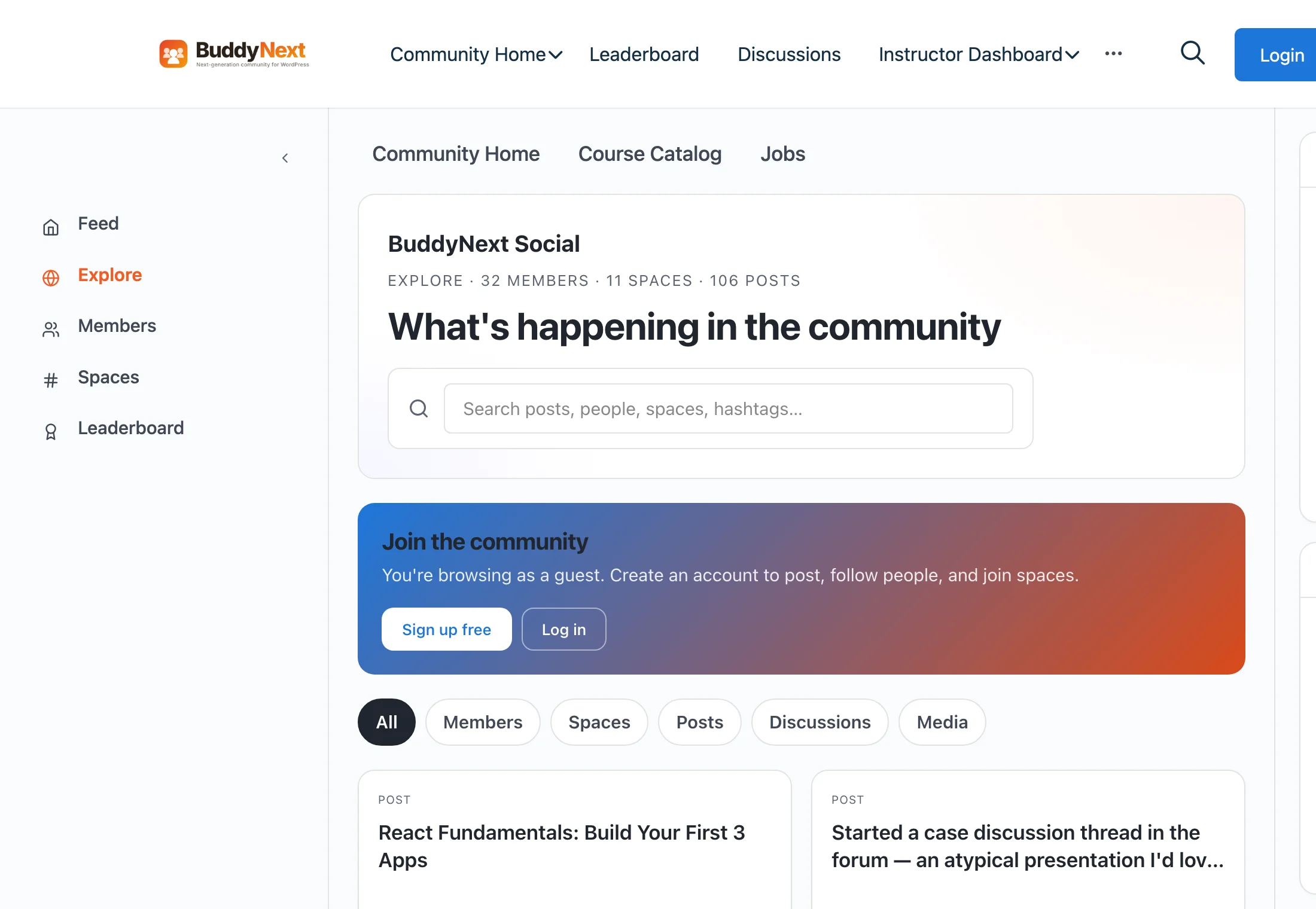
This is a real, public discovery surface, the place a reachable person actually lands and decides whether to join. It’s not the whole TAM, nobody’s whole TAM ever shows up anywhere. It’s the serviceable slice, the people who found their way here through search or a shared link and are close enough to the community’s focus to actually convert. A page like this is where SAM turns into SOM, one real, reachable person at a time, which is the only place community growth actually happens, not in the fantasy total-market number.
Where this lives inside BuddyNext
If you’re running the community on BuddyNext, the public Explore and search surface is literally your SAM-to-SOM conversion machine, the place reachable people become captured members. And the narrow-niche Spaces structure covered in the bootstrapping piece is exactly how you deliberately shrink your SAM to a slice you can actually dominate, rather than spreading thin across a TAM you can’t. The platform doesn’t change your three numbers. It just gives you real levers on the gaps between them.
How the three numbers shift by niche
The shape of TAM, SAM, and SOM changes by what you’re building. A brand community’s SAM is capped by its customer base in a way most niches aren’t, which changes the whole calculation. A course community’s obtainable market is tied to who actually completes and shares, not who enrolls. A fitness community’s SAM is often powerfully local even when the TAM is global. A hobbyist community’s TAM can be tiny while its SOM is unusually high, because the few people who care, really care. Same three-layer logic, four very different shapes.
The test, if you want one
Write down three numbers, honestly. Roughly how many people on earth could care about your topic at all. Roughly how many of those you can actually reach and serve with the specific community you’re building. And roughly how many of those you’ll realistically capture, given competition and the ordinary friction of getting anyone to join anything. If you’ve only ever thought about the first number, that’s the finding.
Then set your goals against the third number, not the first. A community that captures a real share of its obtainable market is succeeding, no matter how small that looks next to the total. The total was never yours to win. The obtainable slice is, and owning it completely is worth more than a token presence in a market you were never going to reach.
Related reading