
23 min read
The Cold Start Problem Every Online Community Has

Every community that now looks obviously worth joining once had a day when it had four members and nothing happening in it. Nobody remembers that day, because it doesn’t show up in the case study, the screenshot, or the “how we grew to 10,000 members” thread. But it happened, to every single one of them, and it’s the part almost nobody actually explains, because by the time someone’s writing about their community, they’ve forgotten how close it came to staying empty.
This is the piece about that day. Not growth, not retention, not the funnel, all of which assume you already have something worth optimizing. This is about the phase before any of that exists, when the only real problem is that nobody wants to be the first person talking in a room where nobody’s talking.
In this pieceWhat the cold start problem actually is
Why an empty room kills itself
The core mistake: launching wide before launching deep
A real empty room, not a hypothetical
Why “everyone welcome” is the enemy, not the strategy
Choosing your narrow starting niche on purpose
The founder-as-first-member problem
Why you shouldn’t try to do this entirely alone
What “doing things that don’t scale” actually looks like
Concrete seeding tactics, not just the theory
Where the founding cohort actually comes from
The line between seeding and faking
A real founding cohort, not a hypothetical
The invited founding cohort playbook
What the actual outreach message should say
How many people you actually need before organic kicks in
How long bootstrapping actually takes
The three phases: seed, invite, open
The harder version: two-sided cold starts
Common bootstrapping failure modes
The psychological cost nobody warns you about
Where this actually lives inside BuddyNext
A weekly rhythm worth actually keeping
What to do if it’s still not working after two months
How the cold start problem changes by niche
The test, if you want one
What the cold start problem actually is
The cold start problem is simple to state and genuinely hard to feel the weight of until you’re inside it: a community’s value to any given person depends almost entirely on who else is already in it, and nobody wants to be the first one there. A support space is worth joining because other people are asking and answering real questions. A discussion space is worth joining because there’s already a discussion. A fitness space is worth joining because other people are actually posting their runs. Strip out the other people, and what’s left is a login form pointed at an empty room.
This is structurally different from almost every other problem a new product faces. A tool can be useful to exactly one person on day one, a note-taking app doesn’t need other users to be worth opening. A community cannot. Its entire value proposition is other people, which means the earliest members are being asked to pay the full cost of joining, the time, the profile setup, the social risk of posting into silence, for a product that, by definition, doesn’t yet deliver the value it’s promising.
Why an empty room kills itself
Here’s the mechanism, and it’s worth being precise about it because the failure is completely predictable once you see the shape of it. A new visitor arrives, looks around, sees a handful of members and no recent activity, and makes an entirely reasonable inference: nothing is happening here, and posting into it would be posting into a void. So they leave without posting. The next visitor arrives an hour, a day, a week later, sees the exact same emptiness, plus one more silent visit nobody can see, and makes the identical reasonable inference. Leaves. Repeat.
Nothing about this requires anyone to be lazy, uninterested, or wrong. Every individual decision to not be the first one posting is a rational response to what they’re actually looking at. The community doesn’t fail because the idea was bad. It fails because the empty-room signal is self-reinforcing, and nothing about simply existing and waiting breaks that loop. Somebody has to break it on purpose, repeatedly, before the loop breaks on its own.
The core mistake: launching wide before launching deep
The single most common bootstrapping mistake is treating launch day like the finish line instead of the actual starting gun. A founder spends weeks on branding, a logo, a clever tagline, a broad “everyone in this industry, welcome” positioning, then announces it everywhere at once, a newsletter blast, a few social posts, maybe a press mention if they’re lucky. Hundreds of people click through in the first 48 hours. Almost none of them post anything, because they arrived at exactly the empty room described above, at the worst possible moment, when the room had the least density it will ever have again.
That launch-day traffic spike is usually the community’s best shot at critical mass, and it gets spent on an empty room instead of a warm one. The visitors who would have become founding members, if they’d arrived to genuine activity, instead arrive to silence, conclude correctly that nothing’s happening yet, and never come back to check again. The community doesn’t get a second launch day. It gets a slow, permanent trickle afterward, from people who found it through search or a stale link, arriving to the same thin activity level indefinitely.
A real empty room, not a hypothetical
This is easier to see with something concrete than with an abstract description of a failure mode, so here’s a real one.
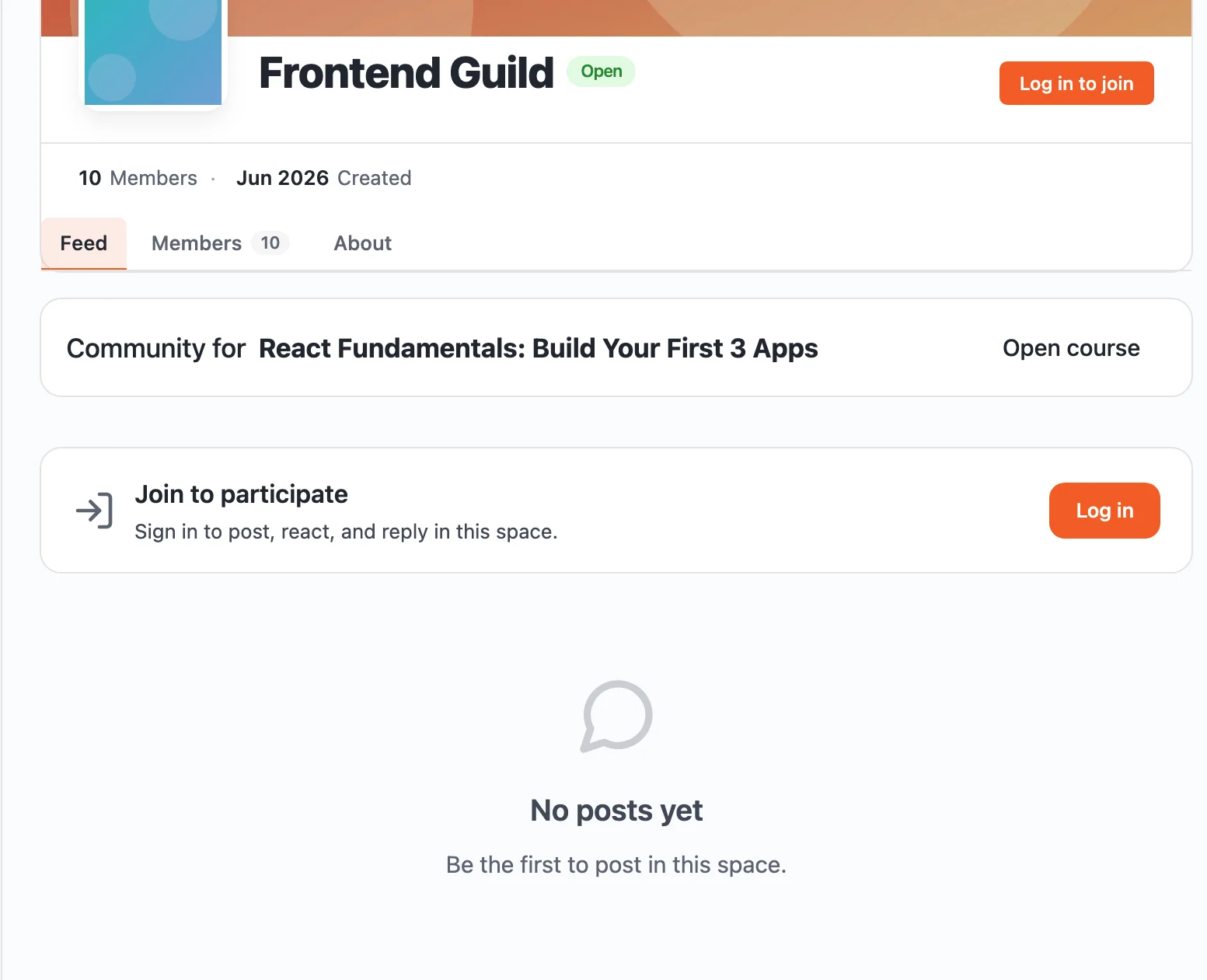
Ten real members joined this space. Zero posts. “Be the first to post in this space,” sitting there as an open invitation nobody has taken. This isn’t a mockup built to illustrate a point, it’s what the cold start problem actually looks like from the outside, the exact moment described above, frozen. Every one of those ten people saw this same empty feed when they visited. Every one of them made the same reasonable decision not to be the first voice in it. That’s not a failure of the ten members. It’s a structural gap nobody filled before opening the door.
Why “everyone welcome” is the enemy, not the strategy
Broad positioning feels like the safe choice, why exclude anyone, why narrow the addressable audience before you’ve even started. It’s exactly backwards for the bootstrapping phase specifically, even though it’s often the right instinct later. A community that welcomes “anyone interested in fitness” has to seed content that’s relevant to runners, lifters, yogis, and swimmers simultaneously, with a founder who has finite time and expertise, spread across all of it. A community that welcomes “trail runners training for their first fifty-kilometer race” can seed genuinely specific, genuinely useful content with a fraction of the effort, because the audience is narrow enough that one founder’s real knowledge covers most of what the first hundred people actually want to talk about.
The broader community isn’t more valuable during bootstrapping, it’s less. Diffuse relevance produces diffuse activity, which looks and feels exactly like the empty room above, just with slightly more profile photos in the member list. Narrow relevance produces concentrated activity, which is the only thing that actually breaks the cold start loop.
Choosing your narrow starting niche on purpose
The niche worth starting with isn’t necessarily the biggest addressable market, it’s the one where a founder can personally generate enough genuine, specific content and conversation to make the first fifty visitors feel like they walked into something real. That usually means picking the sub-segment the founder already knows best, not the sub-segment with the largest theoretical audience.
This feels like leaving opportunity on the table, and in a narrow sense it is, on purpose. The community can and usually should broaden later, once it has real density and its own momentum. Trying to serve the broad audience from day one just means the founder’s limited early effort gets spread too thin to make any single corner of the room feel alive, which is the one thing that actually matters before member number fifty.
The founder-as-first-member problem
Here’s the part that feels uncomfortable and is nonetheless the actual job: for the first several weeks, the founder isn’t running the community, they’re playing the majority of the roles in it. Posting the first update. Asking the first question. Replying to the third member’s post within the hour, not the next morning. Reacting to nearly everything, because a single reaction on a new member’s first post is the difference between “someone saw this” and the silence that made the empty room above what it is.
This is uncomfortable specifically because it feels like manufacturing enthusiasm that isn’t organically there yet, and there’s a real, honest version of this discomfort worth sitting with, rather than either dismissing it outright or pushing past it without ever actually thinking it through. The distinction that actually matters, covered in more depth further down, is between a founder generating real content and real responses under their own name, which is legitimate and necessary, and a founder pretending to be multiple different people, which is not. The first is the actual job of bootstrapping. The second is the thing that destroys trust the moment it’s discovered.
Why you shouldn’t try to do this entirely alone
Everything above describes a founder carrying most of the early load, and that’s realistic for the first stretch, but it’s worth being deliberate about recruiting a small co-seeding team rather than treating it as a one-person show indefinitely. Two or three people who care enough to post regularly under their real identities produce something a solo founder can’t fake: multiple distinct voices, multiple posting times, multiple areas of genuine expertise, all of which make the space read as a real, populated place rather than one person’s monologue with an audience of onlookers.
This doesn’t need to be a formal team or a paid role. A co-founder, an early employee, a genuinely enthusiastic first customer who’s willing to show up regularly, any of these work, as long as they’re posting as themselves, not as a favor performed once and forgotten. The single biggest tell of a founder-only space, even an honestly-seeded one, is that every substantive post traces back to one identity. A visitor doesn’t need to consciously notice this to feel it. It reads as thin even when nothing about it is dishonest.
What “doing things that don’t scale” actually looks like
Paul Graham’s line about startups doing things that don’t scale applies to community bootstrapping with almost no translation needed. Personally messaging the first twenty people who show interest, instead of waiting for them to find their own way in. Manually welcoming every single new member by name in their first week, instead of an automated welcome email nobody reads. Writing the first real answer to a question yourself, at length, instead of hoping someone else in an empty room will get there first.
None of that scales past a few hundred members, and it isn’t supposed to. It’s specifically, deliberately, temporarily disproportionate effort aimed at breaking the empty-room loop during the exact window when nothing else will break it. The founders who skip this phase because it feels inefficient are usually the ones whose community never gets past the empty-room stage at all, because they were optimizing for scale before they had anything worth scaling.
Concrete seeding tactics, not just the theory
Specific tactics worth having ready before the first outside visitor ever arrives, rather than improvised after the fact. Answer the five questions a newcomer to this niche always asks, written out in real depth, before anyone’s asked them yet, so a first visitor immediately finds substantive content instead of a blank feed. Post genuine behind-the-scenes progress, what’s being built and why, which requires no special expertise to write and reliably invites the first few comments because people like being let in early. Cross-post a founder’s own existing writing or work from wherever it already lives, a blog, a newsletter, a portfolio, into the new space, so the space isn’t starting from a literal blank page on day one.
Curating, not just creating, is equally legitimate and often faster: if a founder has genuine permission to share a useful resource, a helpful thread from elsewhere, a relevant piece of research, posting it with real added commentary gives a newcomer something substantive to react to without requiring original content for every single post. The throughline across all of these is that a newcomer arriving in week two should find several real, specific things to read, not a founder’s isolated “welcome, more coming soon” post sitting alone.
Where the founding cohort actually comes from
The invited founding cohort described later in this piece has to come from somewhere real, and the honest answer is almost always an existing relationship, not a cold audience. Past coworkers or collaborators who’d recognize the founder’s name and trust the ask. Commenters or repliers on a founder’s existing content elsewhere, people who’ve already demonstrated real interest in the specific topic, not just a general audience. Attendees from a relevant event or meetup, where a real conversation already happened before the invitation. A small, engaged slice of an email list or customer base, invited individually rather than blasted collectively.
What all of these have in common is that the invitee already has some reason to trust the founder’s judgment before they arrive, which is exactly the trust an anonymous public link can’t carry. A founding cohort assembled this way shows up warm. A founding cohort assembled by advertising to strangers shows up cold, and cold invitees walk straight into the empty-room problem the whole cohort strategy exists to avoid.
The line between seeding and faking
This is the part worth being genuinely careful about, because the tactics above can slide into something corrosive if the line isn’t held deliberately. Seeding a community honestly means real people, usually the founder and a small invited circle, posting real content under their real identities, doing more of the early work than will be needed later, but never pretending to be someone they’re not.
Faking a community means bot accounts, purchased engagement, sock puppet profiles posing as unrelated members, or a founder posting under invented personas to simulate a crowd that doesn’t exist. The practical difference matters less than the discovery risk, and discovery is close to inevitable, because real members eventually notice when “Sarah” and “Mike” and “Jordan” all reply within four minutes of each other with suspiciously similar phrasing, or when a supposedly organic community turns out to have been talking to itself. When that’s discovered, and it usually is, it doesn’t just fail to help, it retroactively poisons every real interaction that happened before the discovery. A slow, honestly-seeded community beats a fast, dishonestly-seeded one that collapses the day someone screenshots the pattern.
A real founding cohort, not a hypothetical
Here’s what the honest version of this actually looks like once it’s working, reachable without an account.
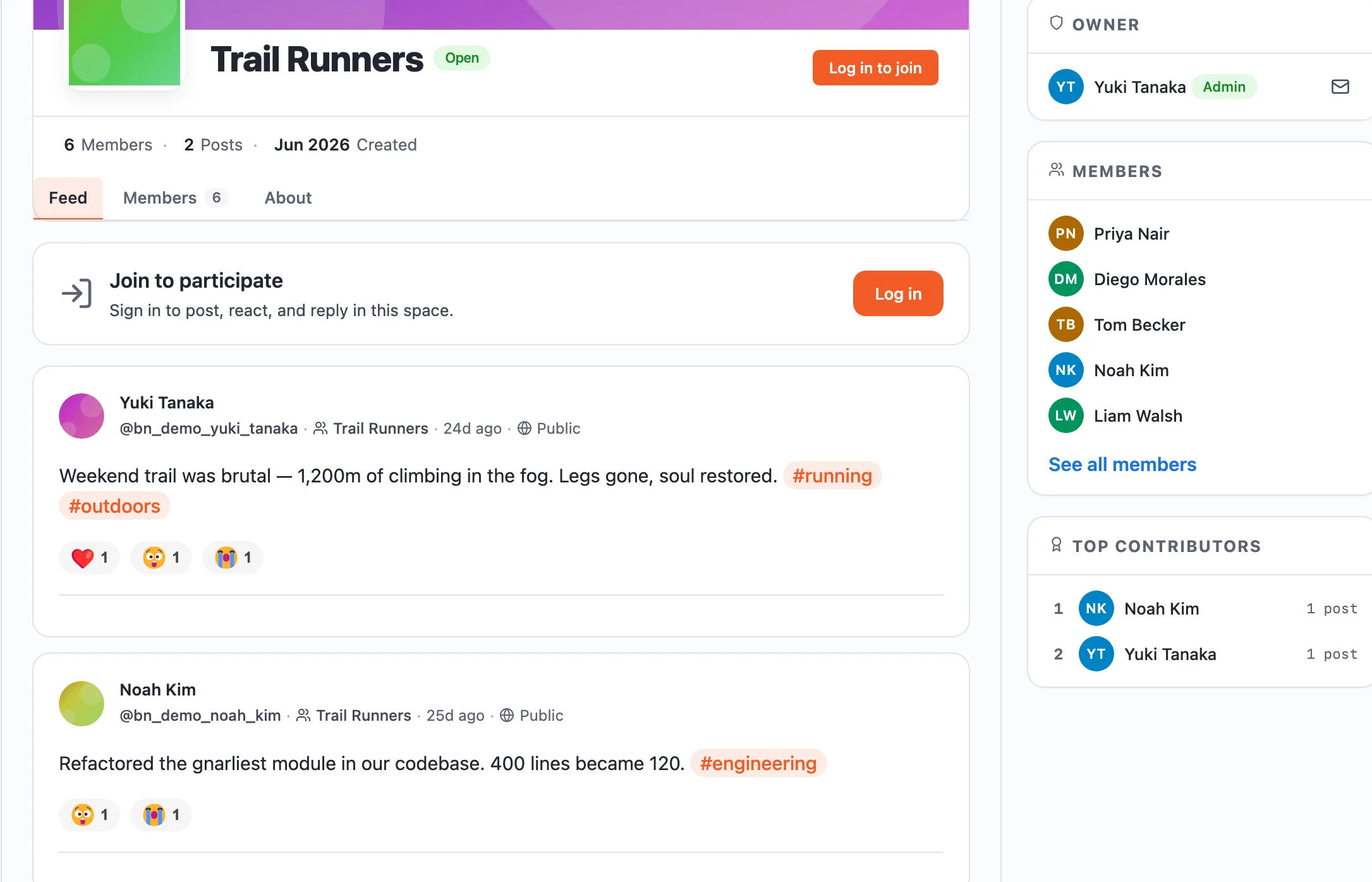
Six real members. Two real posts, from two different named people, each with genuine, specific detail, a brutal 1,200-meter climb in the fog, a codebase refactor from four hundred lines to a hundred twenty, not generic filler copy written to look active. Real reactions from other named members. This is what a community looks like a few weeks into honest bootstrapping, still small, still nowhere near self-sustaining, but no longer empty. A new visitor arriving here sees actual people, doing actual things, talking about them specifically. That’s an entirely different signal than the empty room above, even though the member count, six versus ten, is actually smaller.
The invited founding cohort playbook
The single highest-leverage move available before public launch is assembling a small, personally invited founding cohort, somewhere between ten and thirty people, before anyone else ever sees the space. Not a mass invite blast. Individual outreach, ideally to people the founder already has some real relationship with, existing customers, people met at an event, an engaged corner of an email list, explicitly framed as “I’m building this, I want your honest feedback and I’d love you to be one of the first people in it.”
That framing matters more than it sounds like it should. People who are asked to be early, named contributors to something show up differently than people who stumble onto a public link. They post more, because they were specifically asked to. They’re more forgiving of rough edges, because they know it’s early. And critically, by the time the space opens more broadly, it already has the density problem solved, because this cohort has been active in it for weeks already.
What the actual outreach message should say
The message that works is specific, personal, and honest about the ask, and it’s worth being explicit about what that means because vague versions of this outreach get ignored the same way a mass invite does. Naming the actual reason this particular person was asked, not a generic “I thought you’d be interested,” is the single biggest lever: “you mentioned struggling with X at the last event, and I’m building a space specifically for people dealing with that” reads completely differently than “check out my new community.”
The second component worth including deliberately is naming the size honestly. “You’d be one of the first fifteen people in this” is a more compelling invitation than it sounds, because it flatters the recipient without lying to them, and it sets accurate expectations about what they’ll find when they arrive, a small, early, real space, not a polished, populated one. Overselling the current state at this stage backfires immediately, the gap between the pitch and the empty room they actually land in is exactly the trust-breaking moment worth avoiding entirely.
How many people you actually need before organic kicks in
There’s no universal magic number, but the practical threshold is lower than most founders assume, and it has more to do with activity density than raw headcount. A space with fifteen genuinely active people, several posts a week, real replies within hours, feels alive to a new visitor in a way a space with two hundred silent members never will. The number that actually matters is something closer to “how long would a new visitor have to scroll before finding a real post from the last few days,” not total membership.
As a rough, non-scientific benchmark worth treating as a starting estimate rather than a rule: once a space consistently has new, real activity at least every day or two, without the founder personally generating all of it, the cold start phase is functionally over. Below that threshold, the founder is still doing the majority of the load-bearing work, whether or not the member count looks respectable on a dashboard.
How long bootstrapping actually takes
Longer than most founders plan for, and the honest range is worth stating plainly instead of implying it happens in a fast, tidy sprint. A genuinely niche, well-seeded community with a founder doing real disproportionate work can reach the “daily real activity without founder-generated content” threshold somewhere between six and twelve weeks. A broader or less clearly-defined niche routinely takes longer, sometimes considerably longer, not because the tactics are different, but because diffuse relevance means each individual post reaches fewer people who genuinely care.
The timeline matters less than the expectation it sets. A founder who expects this to take two weeks burns out at week four, right when the compounding is starting to happen but before it’s visible yet. A founder who goes in expecting two to three months of real, sustained effort is far more likely to still be showing up when the space actually turns the corner, because they haven’t already decided, emotionally, that it isn’t working.
The three phases: seed, invite, open
Breaking bootstrapping into three deliberate phases, rather than one blurry ramp-up, makes the founder-heavy work feel less indefinite and gives a real signal for when to move to the next stage. Phase one, seed: the founder alone, or with one or two collaborators, populates the space with genuinely useful starting content before anyone else is invited, so the room is never shown to anyone in a fully empty state. Phase two, invite: the personally-invited founding cohort described above, activity now coming from multiple real, named people, not just the founder. Phase three, open: public visibility and discovery, Explore, search, shared links, now pointed at a space that already has real density instead of an empty one.
The mistake that produces the empty room above is skipping straight to phase three, treating discovery and public launch as the first move instead of the last one. Each phase’s entire job is making the next phase’s cold start less cold.
The harder version: two-sided cold starts
Some communities have to solve the cold start problem twice at once, which is worth naming explicitly because the standard playbook above only fully covers the single-sided version. A marketplace-adjacent community, one side asking questions and a different side answering them professionally, for instance, needs both a critical mass of askers and a critical mass of qualified answerers, and neither side shows up for an audience that doesn’t yet include the other.
The practical fix is sequencing, not simultaneity: seed one side first, usually the side that’s cheaper or faster to recruit, using the founder-as-first-member tactics above to simulate enough of the other side’s function that the first side doesn’t leave. A founder personally answering the first questions well enough that askers stick around, while professional answerers are recruited in parallel, is a legitimate, honest version of this, distinct from faking answers under invented names. The moment real, qualified answerers exist in sufficient number, the founder steps back out of that role entirely.
Common bootstrapping failure modes
A handful of specific ways this goes wrong, repeatedly, across otherwise different communities. Going fully public before the seed and invite phases are done, spending the best traffic spike on an empty room, covered above. Spreading founder effort across too broad a niche, producing thin, generic activity that reads as inauthentic even when every post is genuine. Founder burnout, where the disproportionate early effort is sustainable for two weeks and abandoned by week six, right as the founding cohort needed one more push of visible momentum to become self-sustaining. And the dishonest-seeding trap covered above, reaching for fake density instead of doing the slower, harder work of genuine outreach.
The quieter failure mode, easy to miss because it doesn’t look like a failure at first, is stopping the founder-heavy effort the moment the space stops looking embarrassingly empty, well before it’s actually self-sustaining. A space with fifteen members and occasional activity still needs the founder showing up daily. Pulling back at that exact point, because it finally feels like enough people are around to carry it, is usually premature by several weeks, and the space quietly slides back toward silence.
The psychological cost nobody warns you about
Worth naming plainly, because it’s real and it’s a large part of why founders quit at exactly the wrong moment: posting into a space that only you and a handful of others are populating, week after week, without the validation of a large audience responding, is genuinely draining in a way that’s hard to anticipate until it’s happening. Every post feels slightly exposed. The absence of response, even when expected, still registers as a small rejection each time. This compounds, quietly, over the exact weeks when the disproportionate effort described throughout this piece needs to keep happening.
The founders who make it through this phase tend to do one or both of two things deliberately. They recruit the co-seeding team described earlier specifically so the emotional load isn’t carried by one person alone. And they set concrete, small milestones, ten real posts from people who aren’t the founder, five days in a row with genuine activity, rather than vague ones, so progress is visible on a timescale shorter than the multi-month arc the whole process actually takes. Neither trick makes the work less real. Both make it more survivable long enough to reach the point where it stops being necessary.
Where this actually lives inside BuddyNext
If you’re running the community on BuddyNext, Spaces support exactly the three-phase structure above natively: a space can be created as secret or private during the seed and invite phases, genuinely invisible to anyone outside the founding cohort, and switched to open once there’s real density worth showing a wider audience. That’s not a workaround, it’s the intended lifecycle, private first, open later, rather than public from the first post.
Personal invites, rather than a single shareable public link, keep the founding cohort intentional instead of accidental. And once a space does open up, the same Explore and public search mechanism covered in the growth loop piece means the density built during phases one and two is what a new, cold visitor actually sees first, not an empty shell waiting to be discovered before it’s ready.
A weekly rhythm worth actually keeping
Vague intentions to “post more” rarely survive contact with a busy week, which is why the founders who get through bootstrapping tend to have converted the effort into something closer to a routine than a mood. A simple version worth adapting rather than copying exactly: one substantive, specific post from the founder at the start of each week, real content, not a check-in. A personal reply, not just a reaction, to every new member’s first post, within a day, for as long as that’s still humanly possible to keep up with. One piece of individual outreach a week during the invite phase, a single real person, personally asked, rather than batching invitations into an occasional larger push. And a short honest look, weekly, at whether the last seven days had real activity from someone other than the founder, the actual signal that matters more than any vanity number on a dashboard.
None of this needs to be rigid or formalized into a tool. It needs to survive being deprioritized during a genuinely busy week, which is exactly when it’s most tempting to skip and most costly to actually skip, because a quiet week during the fragile early phase reads to any visitor as exactly the empty room this whole piece has been describing.
What to do if it’s still not working after two months
Two months of genuinely disproportionate founder effort with a space that’s still mostly silent is a real signal worth diagnosing honestly rather than pushing through with more of the same. Three questions worth asking in order, before concluding the whole idea was wrong. Is the niche actually narrow enough, or does “trail runners” quietly mean five different sub-audiences with different needs, diluting relevance the same way a too-broad niche does from the start. Is the invited founding cohort actually receiving personal, specific outreach, or did it drift into a slightly-larger group blast that stopped feeling individually addressed. And is the founder’s posted content actually specific and useful, or has it drifted into generic “welcome, how’s everyone doing” filler that doesn’t give anyone something real to respond to.
Most stalled bootstrapping traces back to one of those three, quietly, rather than to the underlying idea being unwanted. Narrowing further, re-personalizing the outreach, or raising the bar on what actually gets posted usually restarts the momentum. If all three are genuinely solid and two months of real effort still hasn’t produced any organic response at all, that’s a legitimately useful, if painful, signal that the idea itself may not have a real audience, worth learning at month two rather than month eight.
How the cold start problem changes by niche
Everything above is the general shape of the problem, true regardless of what kind of community is being bootstrapped. But the actual starting conditions, how much of a warm audience already exists, what the founding content should look like, where the founding cohort is likely to come from, differ enough by niche that a single generic playbook underserves all four of the niches this site keeps coming back to. The specific mechanics of bootstrapping shift by what’s actually being started. A brand or customer community usually isn’t starting from zero at all, the mistake there is treating an existing customer base like a cold audience instead of a warm one. A course-selling community gets its founding cohort for free, in the form of the first paying students, if the creator treats them as members to retain from day one instead of customers to deliver content to. A fitness community has to solve a translation problem, turning real in-person energy, local runs, gym relationships, into something that survives being posted online. A hobbyist community usually isn’t creating an audience from scratch either, the people already exist, scattered across a subreddit or a Discord server, and the actual job is giving them a specific reason to move, not conjuring interest that doesn’t yet exist anywhere.
The test, if you want one
Before opening any community to the public, or honestly evaluating one that’s already open and quiet, ask the single question that actually matters: if a stranger with zero context landed on this space right now, would they see real, recent, specific activity from real people, or would they see the same silence the frontend guild example above shows. If it’s the second one, that’s not a marketing problem, and it’s not a “we need more members” problem. It’s a seeding problem, and the fix is disproportionate, unglamorous, personal effort from whoever’s actually building it, not a bigger launch.
The community that looks effortless from the outside, the one that seems to have simply worked, almost never did. Somebody was the first voice, over and over, for longer than felt comfortable, until it stopped being necessary. That’s not a shortcut anyone’s found a way around. It’s just the actual first job, and it ends, reliably, for everyone who keeps doing it long enough for the room to stop being empty.
Related reading