
6 min read
Fitness Has A Giant Market. Thats The Trap.

A fitness community’s total addressable market is enormous, nearly everyone wants to be fitter, and that huge TAM is precisely what leads fitness community founders astray. They see a global market and build for it, when the reality of fitness is that its serviceable market is often powerfully local, defined by a shared gym, a shared trail, a shared city, in a way most niches aren’t. The gap between fitness’s global TAM and its local SAM is bigger and more counterintuitive than almost any other kind of community, and getting it wrong is the classic fitness-community mistake.
If you’ve read the piece on TAM, SAM, and SOM for communities, this is the fitness-specific version, where a giant TAM hides a local SAM.
In this pieceThe giant-TAM trap in fitness
TAM: nearly everyone wants to be fitter
SAM: often smaller and more local than it looks
SOM: who’ll actually show up and stay
Why local is the fitness advantage
A real local fitness community, not a global fantasy
Where this lives inside BuddyNext
The test, if you want one
The giant-TAM trap in fitness
Fitness has one of the largest total addressable markets of any community topic, which sounds like an advantage and usually functions as a trap. The huge TAM tempts founders to build a broad, global fitness community for everyone, and broad global fitness communities are brutally hard to make work, because “fitness” is too diffuse to create the density and shared context a community actually runs on. The giant TAM is real. It’s just almost entirely unserviceable as a single community.
The founders who succeed in fitness almost always do the opposite of what the huge TAM suggests: they go narrow, and often local. They build for trail runners in one city, or one gym’s members, or one specific training style, and let the density of a well-defined slice do the work the sprawling global market never could. The TAM misleads; the serviceable slice is where fitness communities are actually built.

TAM: nearly everyone wants to be fitter
The total addressable market for fitness is close to everyone, which is exactly why it’s useless as a target. A number that big tells you the ceiling is high, and nothing else. It certainly doesn’t tell you who to build for, because “people who want to be fitter” share almost nothing else, not a goal, not a method, not a level, not a place, none of the things a community needs its members to have in common.
A TAM this large is a special kind of trap, because it feels like it should make growth easy and instead makes focus hard. The breadth that looks like opportunity is the exact thing preventing density. In fitness more than anywhere, the total market is a distraction, and treating it as your audience is a direct path to a community too broad to cohere.
SAM: often smaller and more local than it looks
Fitness’s serviceable market is frequently defined by something physical and local: a shared training location, a shared city, a shared real-world context that lets the community actually function. This is the counterintuitive part, a topic with a global TAM often has a serviceable market bounded by geography, because so much of what makes a fitness community work, in-person sessions, local meetups, real shared experience, depends on people being close enough to share it.
Even fitness communities that end up global usually start local and stay local-flavored, because the local slice is where the density and real energy live. Deliberately treating your SAM as local, or at least tightly defined, rather than global is often the single best decision a fitness community founder makes. It shrinks the number and dramatically raises the odds of actually capturing it, the same narrow-first logic the piece on bootstrapping a fitness community describes.
SOM: who’ll actually show up and stay
The obtainable market is the people who’ll actually participate and, crucially, keep participating, because fitness has a retention problem baked into it. The honest SOM isn’t everyone in your local SAM who joins, it’s the smaller slice who stay past the week-two drop-off that the fitness industry has never solved. A fitness community’s obtainable market is defined as much by retention as by acquisition, which makes it smaller and more demanding than the join count suggests.
This is the number to build on. A local fitness community that captures and retains a real, active core of its serviceable slice is thriving, even though that number is a rounding error against the global TAM. Sizing on the global market, or even on total joins rather than retained members, is how a genuinely healthy local fitness community gets experienced as too small, when it’s actually exactly the right size.
Why local is the fitness advantage
The local SAM feels like a limit and is actually fitness’s greatest structural advantage. A local fitness community can do the one thing no global topic community can: create real, in-person shared experience, the runs, the sessions, the meetups that produce the energy and retention a screen-only community struggles for. That in-person dimension is exactly why the local slice retains better and grows through real word-of-mouth, the physical version of a referral no online-only community can match.
Founders who resent the local cap and chase the global TAM throw away this advantage, trading a dense, retaining, real community for a thin, churning, global one. Accept the local SAM, own it completely, build the real-world energy only a local community can, and the fitness community becomes something a global competitor genuinely cannot replicate. The cap isn’t the ceiling on your ambition. It’s the foundation of your only real edge.
A real local fitness community, not a global fantasy
Here’s what a real, tightly-defined fitness community actually looks like, reachable without an account.
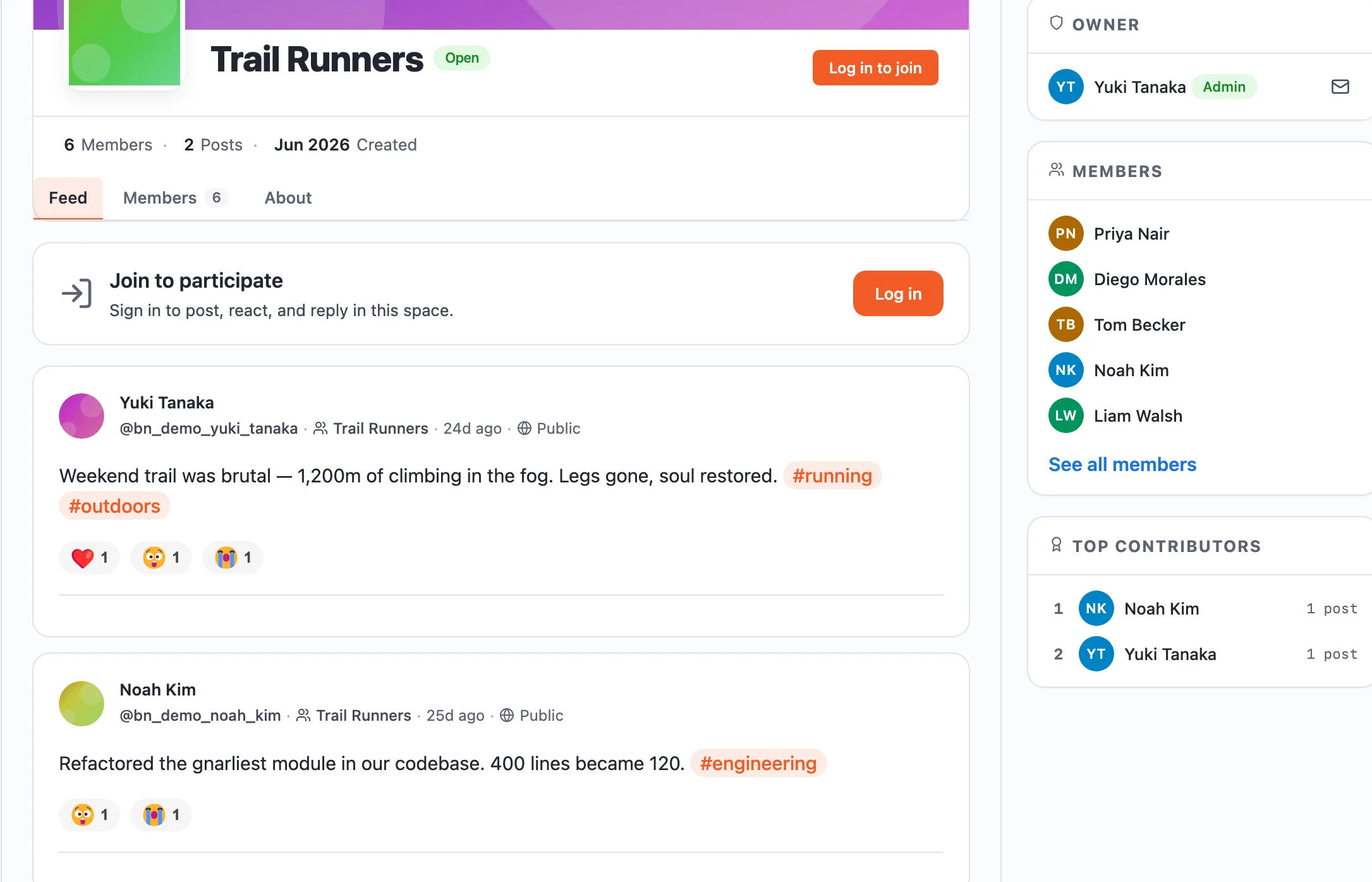
A small, defined group, real members, real posts about real runs. This is what a captured serviceable slice looks like, not a global fitness audience but a specific, tight community with genuine shared context. A space like this, dense and real, is worth far more than a token presence in the enormous global fitness TAM, because the density is exactly what makes it retain, engage, and grow. The small, defined slice is the win; the global market was never the point.
Where this lives inside BuddyNext
If you’re running the community on BuddyNext, narrow, well-defined Spaces let you build for a tight serviceable slice rather than the sprawling global TAM, which is exactly what a fitness community needs. Pairing it with WB Gamification adds the streaks and retention mechanics that grow the obtainable market from the retention side, capturing more of your local SAM by keeping people past the week-two drop. The platform can’t shrink fitness’s giant TAM for you; it just makes owning a real local slice of it genuinely doable.
The test, if you want one
Three numbers. Everyone who wants to be fitter, your enormous, mostly-useless TAM. The tightly-defined, often-local slice you can actually serve with real shared context, your SAM. And the retained, active core who’ll actually show up and stay, your SOM. If you’ve been building for the first number, that’s the mistake, fitness’s giant TAM is the single most misleading number in community market-sizing.
Build for the local, serviceable slice, and measure success by retained members, not global potential or total joins. A dense local fitness community that keeps its people is worth more than any thin presence in the global market, and the local cap you were tempted to resent is the exact thing that makes it real.
Related reading