
5 min read
Your Brand Communitys Market Is Capped. Thats A Gift.

A brand community has a market-sizing quirk no other niche shares: its serviceable market is capped by the business itself. Your community can’t realistically be bigger than the set of people who use, or might use, your product. That sounds like a limitation, and in one narrow sense it is. But it’s also the reason a brand community’s three numbers are more knowable, and more actionable, than almost any other kind, because the audience isn’t a vague global topic. It’s a customer list you largely already have.
If you’ve read the piece on TAM, SAM, and SOM for communities, this is the brand-specific version, where the SAM cap changes the entire calculation.
In this pieceWhy your SAM is capped by the business
TAM: everyone with the problem you solve
SAM: your customers and reachable prospects
SOM: the customers who’ll actually engage
Why the cap is a gift, not a limit
A real, engaged brand-community slice
Where this lives inside BuddyNext
The test, if you want one
Why your SAM is capped by the business
For most communities, the serviceable market is a slice of a broad topic. For a brand community, it’s bounded by something concrete: the people who have a real relationship with your product. You’re not building a community for everyone interested in your category, you’re building one for the people who use your specific thing, and that set has an edge to it, defined by your actual and potential customer base.
This changes the sizing exercise from guesswork to something closer to arithmetic. You don’t have to estimate a fuzzy global topic. You have to look at who your customers actually are, which you largely already know, and reason from there. The cap is real, but it makes every number below it far more knowable than a topic-based community ever gets.

TAM: everyone with the problem you solve
A brand community’s total addressable market isn’t your customers, it’s everyone who has the problem your product solves, whether they’ve heard of you or not. It’s the whole market your product competes in. This number matters for the same single reason it does anywhere: to know whether the ceiling is high enough. A product in a genuinely large market has a high community ceiling; a product in a tiny one has a hard cap, and that’s worth knowing.
But TAM is even less actionable for a brand community than usual, because most of it will never be your customers, let alone your community members. The problem-having population is interesting context. It is not the audience you’re building for, and quoting it as your community’s potential is the brand version of the total-market fantasy.
SAM: your customers and reachable prospects
The serviceable market is where a brand community gets its real advantage. It’s your existing customers plus the prospects you can genuinely reach, the people who already have a relationship with the product or are close enough to one to be worth inviting. This is a knowable, largely-owned audience, sitting in your CRM, your support history, your email list, exactly the warm founding cohort the piece on bootstrapping a brand community describes.
No topic-based community gets this. A running community has to reach strangers who happen to run. A brand community starts with a list of people who already paid for the thing, which means its SAM isn’t a slice it has to go find, it’s a slice it largely already possesses. That’s the whole reason the SAM cap is worth accepting: below the cap, the audience is warm and reachable in a way an uncapped topic never is.
SOM: the customers who’ll actually engage
The obtainable market is the honest, smaller number: the customers who’ll actually participate in a community, not just the ones who exist. Most customers, even happy ones, will never post, never join, never engage, and no community changes that. The SOM is the genuinely engaged slice, the ones who have questions, opinions, or a reason to talk to other users, and it’s always a fraction of the total customer base.
This is the number to build goals on. A brand community that captures a real share of its genuinely-engageable customers is thriving, even though that number is small next to total customers and tiny next to TAM. Expecting most customers to become community members is the brand version of chasing the total market, and it turns a healthy engaged core into a perceived failure.
Why the cap is a gift, not a limit
The SAM cap feels like a ceiling, and it is one, but it’s the good kind. A capped, knowable, warm market is far easier to actually capture than an uncapped, vague, cold one. You know roughly how many people you’re serving, you largely already have their contact, and they already trust the product enough to have paid for it. That’s a dramatically better starting position than a topic community staring at a huge TAM full of strangers.
The mistake is resenting the cap and trying to build a community for the whole problem-having market instead of the customer base. That dilutes the one real advantage a brand community has, a warm, known, reachable SAM, in pursuit of a TAM that was never going to convert. Accept the cap, own the engaged slice beneath it completely, and the brand community becomes an asset a topic community can’t match.
A real, engaged brand-community slice
Here’s what the engaged slice actually looks like, reachable without an account.
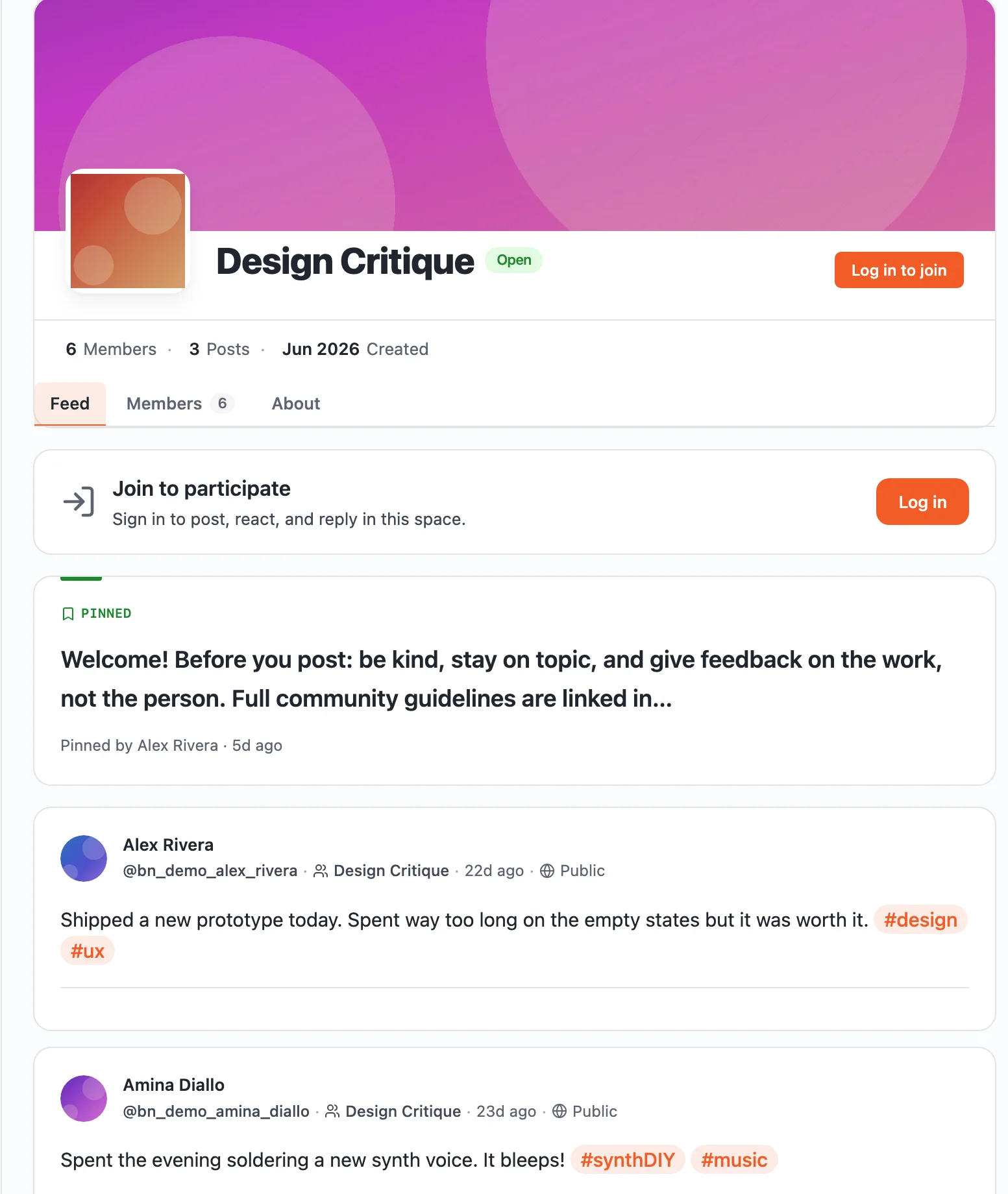
Real members, real posts, real engagement in a real space. This isn’t the whole customer base and it certainly isn’t the whole market, it’s the SOM, the genuinely-engaged slice that actually shows up and participates. A space like this working well, with a real, active core, is what a captured obtainable market looks like. The thousands of customers who never post aren’t a failure; they were never part of the realistic SOM. The engaged core is the win.
Where this lives inside BuddyNext
If you’re running the community on BuddyNext, the warm SAM you already possess, your customers, can be invited directly rather than reached cold, which is the entire structural advantage a brand community has. Public Spaces then convert the engageable slice of that SAM into an active SOM, a real community core, without needing the whole customer base to show up. The cap is fixed by your business; what BuddyNext gives you is a clean way to capture the engaged slice beneath it.
The test, if you want one
Three numbers, honestly. The size of the market your product competes in, everyone with the problem, your TAM. Your actual plus reachable customer base, your SAM. And the realistic fraction of those customers who’ll genuinely engage in a community, your SOM. The gap between the second and third is the one you actually work on.
Set goals against the engaged slice, not the customer count and certainly not the market. A brand community that owns its genuinely-engageable customers has captured the only market that was ever really obtainable, and that engaged core is worth more than a passive presence across a customer base that was never going to show up.
Related reading