
11 min read
10 Best Server Certificate Courses for IT Careers


Servers run everything from company email to online stores, so employers pay for people who can set them up, secure them and keep them running. A server certificate course gives you a structured route into IT security, networking and server management, whether you are an aspiring system administrator or a working professional adding a credential.
This post compares ten server certification paths, with exam codes, prices and validity checked against each vendor’s own page on 6 November 2026. A note on the name: here “server certificate course” means a professional certification for people who manage servers, not an SSL/TLS certificate for a website.
Last updated: 6 November 2026
Quick answer
The best server certificate course depends on your path. Pick CompTIA Server+ for hardware-focused server administration, RHCSA or LPIC-1 for Linux, AWS Solutions Architect Associate or Google Associate Cloud Engineer for cloud, Azure Fundamentals as a first step, CKA for Kubernetes, CCNA for networking and CISSP for security.
Before you pay for anything, look at the job market. The US Bureau of Labor Statistics puts the 2025 median pay for network and computer systems administrators at $99,130, but projects employment to fall 4% from 2025 to 2035 (about 13,200 fewer jobs from 323,600). Over the same period it projects information security analyst jobs to grow 21%, with a $129,180 median. Traditional server administration is shrinking while cloud, container and security skills are where the growth is, which is why this list leans that way.

Server Certifications Compared
All figures come from the vendor pages linked in each entry below. A dash means the vendor page did not list the figure.
| Certification | Exam code | Exam fee | Length and format | Valid for | Best for |
|---|---|---|---|---|---|
| CompTIA Server+ | SK0-005 | - | 90 minutes, max 90 questions | - | Server hardware and administration |
| Azure Fundamentals | AZ-900 | Varies by country | 45 minutes, proctored | - | First cloud credential |
| RHCSA | EX200 (RHEL 10) | - | Hands-on practical exam | - | Linux server administration |
| AWS Solutions Architect Associate | SAA-C03 | $150 | 130 minutes, 65 questions | 3 years | AWS architecture |
| Cisco CCNA | 200-301 v1.1 | $300 | 120 minutes | 3 years | Networking |
| CISSP | - | - | 8 domains, 5 years of experience required | - | Security leadership |
| Google Associate Cloud Engineer | - | $125 | 2 hours, 50-60 questions | 3 years | Google Cloud operations |
| CKA | - | $445 | 2 hours, hands-on | 2 years | Kubernetes clusters |
| VCP-DCV | 2V0-21.23 (vSphere 8) | - | - | - | VMware virtualization (see note) |
| LPIC-1 | 101-500 and 102-500 | - | Two exams, version 5.0 | 5 years | Vendor-neutral Linux |
How to Choose the Right Server Certificate Courses
Identify Your Career Goals - Determine what you want to achieve in your IT career, whether it’s focusing on cloud services, server administration, or cybersecurity.
Assess Skill Level - Consider your current skills and experience. Choose a certification that matches your knowledge level - beginner, intermediate, or advanced.
Understand Course Content - Look for certifications that cover the specific skills and technologies you want to master, such as networking, Linux, Windows servers, or cloud platforms like AWS, Azure, or Google Cloud.
Choose Vendor or Vendor-Neutral - Decide whether you want a certification that’s specific to a certain technology provider (e.g., Microsoft, Cisco) or a more general, vendor-neutral certification.
Consider the Format - Decide if you prefer an online or in-person class, and whether a self-paced course or live training session works best for you.
Cost and Value - Compare costs against the benefits and career opportunities offered by the certification. Is the price justified by potential earnings or job prospects?
Look for Industry Recognition - Make sure the certification is respected and recognized by employers in the field you’re targeting.
Review Requirements and Prerequisites - Check if there are any prerequisites or experience requirements for the certification, and whether you’re ready for them.
Top Server Certificate Courses
1. CompTIA Server+ (SK0-005)
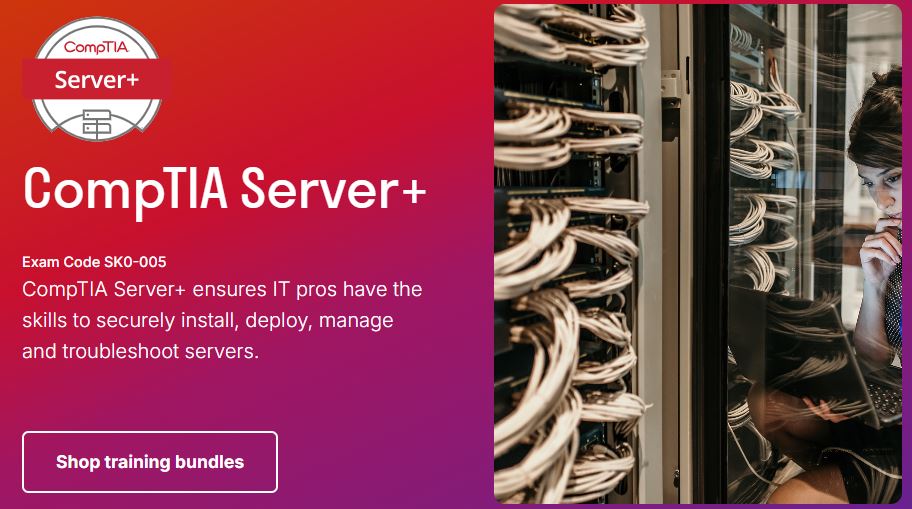
The CompTIA Server+ certification is designed for professionals who want to validate their skills in server management and administration. This certification covers a wide range of topics, from hardware and storage to security and troubleshooting.
Key Features:
- Server architecture and administration
- Data management and security
- Cloud and virtualization technologies
- Troubleshooting server hardware
Why It’s Worth It:
CompTIA Server+ is well-known in the IT industry and recognized by major employers. It’s ideal for individuals looking to work in server administration and maintenance roles.
Exam facts: the CompTIA Server+ page lists exam SK0-005 (launched 18 May 2021), up to 90 questions in 90 minutes, mixing multiple choice and performance-based items, with a passing score of 750 on a 100-900 scale. CompTIA lists no retirement date for it, and we found no successor exam, but check the page before you book.
Pros:
- Vendor-neutral certification
- Comprehensive curriculum
- Industry recognition
Cons:
- Requires significant study time
- Focuses more on hardware than software
2. Microsoft Certified: Azure Fundamentals
The Microsoft Certified: Azure Fundamentals course is perfect for those who want to learn the basics of cloud computing and Azure services. This certification covers cloud concepts, core services, pricing, and support models.
Key Features:
- Introduction to cloud concepts
- Azure services and solutions
- Pricing and support models
- Managing Azure subscriptions
Why It’s Worth It:
If you’re interested in cloud computing and server management, this course offers a great introduction to Azure. It’s ideal for those who want to get started with cloud-based server environments.
Exam facts: Microsoft’s Azure Fundamentals page (updated 20 July 2026) covers exam AZ-900 in 45 minutes, proctored, in 13 languages. It assesses cloud concepts, Azure architecture and services, and management and governance. Price depends on the country where you sit it.
Pros:
- Entry-level course
- Great for beginners in cloud computing
- In-demand certification for cloud-based roles
Cons:
- Limited depth for advanced professionals
- Focuses on Microsoft Azure rather than other cloud platforms
3. Red Hat Certified System Administrator (RHCSA)
The RHCSA is a certification that demonstrates proficiency in managing Red Hat Enterprise Linux (RHEL) servers. It’s ideal for system administrators working with Linux-based servers.
Key Features:
- Installing and configuring Red Hat Enterprise Linux
- Configuring network services
- Managing user permissions and storage
- Troubleshooting Linux server issues
Why It’s Worth It:
Red Hat is one of the most widely used Linux distributions in enterprise environments. The RHCSA course is perfect for those looking to specialize in Linux server management.
Exam facts: Red Hat lists exam EX200 as a hands-on, practical exam based on Red Hat Enterprise Linux 10. There is no internet access and you cannot bring notes, though the documentation shipped with the software is available on most exams.
Pros:
- In-depth focus on Linux systems
- Recognized in enterprise environments
- Hands-on learning approach
Cons:
- Requires a basic understanding of Linux
- Can be challenging for beginners
4. AWS Certified Solutions Architect - Associate
The AWS Certified Solutions Architect - Associate course is perfect for those who want to specialize in Amazon Web Services (AWS) cloud platforms. This certification validates your ability to design and deploy scalable systems on AWS.
Key Features:
- Designing and deploying scalable systems
- Cloud security and best practices
- AWS architecture and services
- Cost estimation and optimization
Why It’s Worth It:
With the growth of AWS, this certification is in high demand. It’s ideal for anyone who wants to work in cloud server management and architecture.
Exam facts: the AWS certification page shows a $150 exam fee, 130 minutes, 65 multiple-choice or multiple-response questions (exam SAA-C03), and a 3-year validity. You can recertify by passing the latest version or the Professional-level exam.
Pros:
- High-demand certification in the cloud industry
- Broad coverage of AWS services
- Recognized by top employers worldwide
Cons:
- Requires prior knowledge of cloud computing
- Advanced-level content for beginners
Also Read: Best Microsoft Excel Courses for Students and Career Fields Where Excel Skills Shine
5. Cisco Certified Network Associate (CCNA)
The CCNA certification by Cisco is one of the most well-known networking certifications in the world. While it’s more focused on networking, the course covers server networking, security, and management, making it an essential course for server administrators.
Key Features:
- IP addressing and networking fundamentals
- Server and router configuration
- Network security basics
- Troubleshooting networking issues
Why It’s Worth It:
The CCNA is perfect for professionals who want to manage both servers and networking equipment in an organization.
Exam facts: Cisco lists exam 200-301 CCNA v1.1 at $300, 120 minutes, valid for 3 years. Topics are network fundamentals, network access, IP connectivity, IP services, security fundamentals, and automation and programmability.
Pros:
- Recognized globally by networking professionals
- Hands-on practice with networking hardware
- Covers both networking and server fundamentals
Cons:
- Primarily focused on networking rather than server management
- Requires additional courses for deeper server expertise
6. Certified Information Systems Security Professional (CISSP)

The CISSP certification is ideal for those looking to specialize in cybersecurity. It covers a broad range of topics related to information security, including server security and encryption.
Key Features:
- Security and risk management
- Asset security and cloud security
- Cryptography and network security
- Security operations and incident response
Why It’s Worth It:
CISSP is one of the most respected cybersecurity certifications and is ideal for server administrators who want to build strong security practices.
Exam facts: ISC2 states that CISSP needs 5 years of work experience and covers 8 domains. A new exam outline takes effect on 15 April 2027, so candidates studying now should check which outline their exam date falls under.
Pros:
- Highly respected in the cybersecurity field
- Extensive coverage of security topics
- Ideal for those in senior security roles
Cons:
- Requires significant experience in security
- More advanced than beginner-level courses
7. Google Cloud Certified - Associate Cloud Engineer
The Google Cloud Certified - Associate Cloud Engineer certification is aimed at individuals who want to manage Google Cloud Platform (GCP) services, including server management, network configuration, and security.
Key Features:
- GCP platform and services
- Virtual machines and networking
- Cloud security and identity management
- Automation and monitoring on GCP
Why It’s Worth It:
Google Cloud is becoming increasingly popular in enterprise environments, and this certification provides solid knowledge in managing cloud-based servers.
Exam facts: Google Cloud lists a $125 fee, a 2-hour exam with 50-60 questions, no prerequisites and 3 years of validity. A shorter renewal exam (1 hour, 20 questions, $75) is available within 180 days of expiry. Google recommends 6+ months of hands-on experience.
Pros:
- Industry recognition in cloud environments
- Focus on Google Cloud services
- In-demand skills in cloud engineering
Cons:
- Focuses primarily on Google Cloud
- May require prior cloud experience
8. Certified Kubernetes Administrator (CKA)
The Certified Kubernetes Administrator course is designed for professionals who want to manage Kubernetes clusters, which are essential for containerized server environments.
Key Features:
- Kubernetes architecture and components
- Cluster configuration and management
- Networking and storage in Kubernetes
- Security and troubleshooting
Why It’s Worth It:
Kubernetes is a crucial technology for modern server management, especially in containerized environments. This course is perfect for IT professionals working with Kubernetes.
Exam facts: the Linux Foundation lists the exam at $445 (or $625 bundled with a THRIVE-ONE annual subscription), 2 hours, performance-based on a live command-line environment, valid for 2 years, with one retake included within 12 months. Troubleshooting carries the biggest weight at 30%, followed by cluster architecture, installation and configuration at 25%.
Pros:
- High demand for Kubernetes skills
- Comprehensive coverage of Kubernetes topics
- Great for containerized server environments
Cons:
- Advanced-level course
- Requires some background in DevOps and containers
9. VMware Certified Professional - Data Center Virtualization (VCP-DCV)
The VCP-DCV certification focuses on managing VMware environments, specifically data center and virtualized server setups.
Key Features:
- VMware vSphere architecture
- Virtual machine configuration and management
- Storage and networking in VMware
- Troubleshooting virtual environments
Why It’s Worth It:
With the rise of virtualized environments, VMware expertise is in high demand. This certification is ideal for those managing virtualized servers.
Note: Broadcom has been moving its VMware certification lineup towards VMware Cloud Foundation. Training provider Global Knowledge lists the VCP-VCF Administrator (exam 2V0-17.25) as a current VCP route, and the vSphere 8 VCP-DCV (2V0-21.23) is described by several training sites as a legacy credential. We could not confirm VCP-DCV’s status on Broadcom’s own page, so check it before committing.
Pros:
- Industry-leading virtualization technology
- Hands-on experience with VMware products
- Recognized in data center environments
Cons:
- Focuses only on VMware products
- Requires prior knowledge of virtualization concepts
10. Linux Professional Institute Certification (LPIC-1)

The LPIC-1 is the entry-level certification for Linux professionals. This course covers essential Linux server management skills, including installation, configuration, and maintenance.
Key Features:
- Basic Linux administration and command line
- Server setup and configuration
- Networking and security in Linux
- Managing Linux services and processes
Why It’s Worth It:
Linux is a critical component of many server environments, and the LPIC-1 certification is an excellent starting point for those wanting to specialize in Linux server management.
Exam facts: the LPI page lists two exams, 101-500 and 102-500, under version 5.0, with a 5-year validity period. Pricing varies by country.
Pros:
- Highly respected certification for Linux professionals
- Solid foundation for advanced Linux certifications
- Vendor-neutral certification
Cons:
- Focused only on Linux, not cross-platform
- Requires hands-on practice

Frequently Asked Questions
What is a server certificate course?
It is a training and exam route that proves you can install, configure, secure and troubleshoot servers. It is not the same as an SSL/TLS certificate for a website, which is a file that enables HTTPS.
Which server certification is best for beginners?
Azure Fundamentals (AZ-900) is the lightest entry point, at 45 minutes, and CompTIA Server+ or LPIC-1 suit people who want hands-on server and Linux basics. Start with the vendor your target employers use.
How much do server certifications cost?
Exam fees on the vendors’ own pages range from $125 for Google Associate Cloud Engineer and $150 for AWS Solutions Architect Associate to $300 for CCNA and $445 for CKA. Training courses, practice tests and retakes cost extra.
Do server certifications expire?
Most do. AWS, Cisco and Google Cloud certifications are valid for 3 years, CKA for 2 years and LPIC-1 for 5 years. You renew by passing a newer exam or, with Google, a shorter renewal exam.
Is server administration still a good career?
The US Bureau of Labor Statistics projects a 4% decline in network and computer systems administrator jobs from 2025 to 2035, but 21% growth for information security analysts. Pairing server skills with cloud, Kubernetes or security work is the safer bet.
Which certification should I take for Linux servers?
RHCSA is the standard hands-on credential for Red Hat Enterprise Linux 10 environments, while LPIC-1 is vendor-neutral and valid for 5 years. If you run a WordPress site on your own server, our guide to the best lifetime hosting companies shows where those skills get used.
Final Thoughts on Server Certificate Courses
Choosing the right server certificate courses depends on your career goals, expertise level, and the technologies you want to specialize in. Whether you’re focusing on cloud platforms, cybersecurity, or Linux server management, these courses offer a wide range of certifications to help you advance your IT career. The pay is real: BLS reports $99,130 for systems administrators and $129,180 for information security analysts. The direction matters too, so lean towards cloud, containers and security if you want a credential that keeps its value.
Interesting Reads:
Best Recording Software for Digital Course
Related reading