
14 min read
How to Get Your WordPress Site Cited by AI Search (2026)

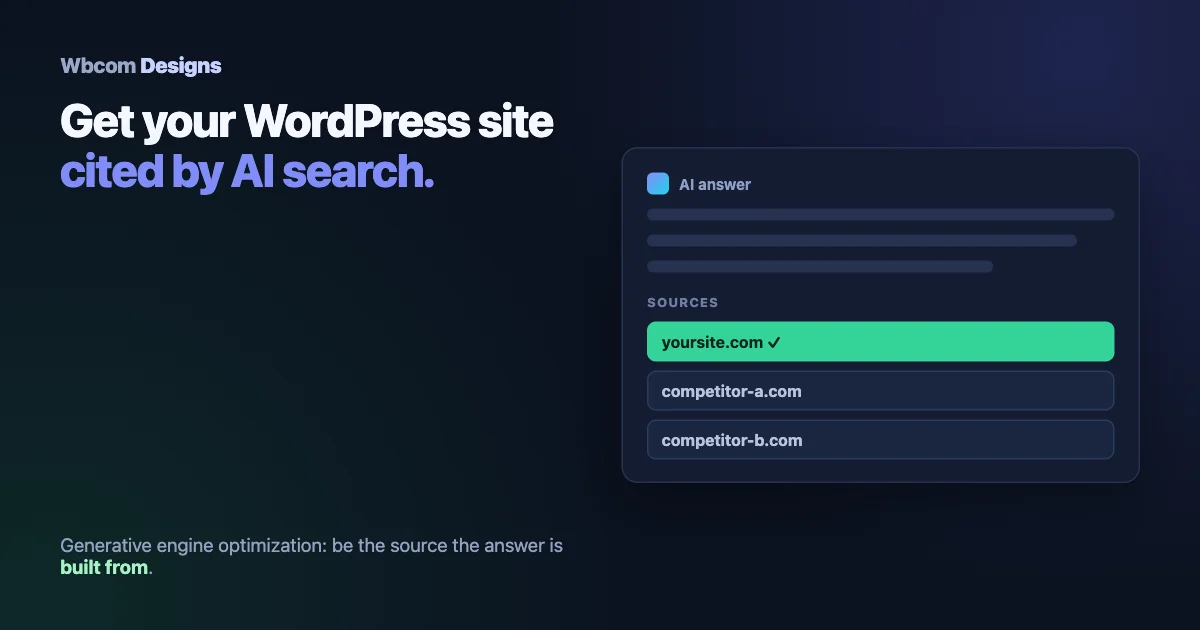
More of your future customers are asking an AI assistant instead of typing into a search box, and getting cited by AI search, the discipline known as generative engine optimization, is how your WordPress site stays visible to them. When someone asks ChatGPT, Gemini, Perplexity, or Google’s AI answers a question in your field, the assistant does not show ten blue links. It gives one composed answer and names a few sources. If your site is not one of those named sources, you are invisible to that customer, no matter how well you rank in the old results.
This guide is a practical walkthrough of how to earn those citations on a WordPress site, written for site owners and marketers first, with the technical detail marked clearly for developers near the end. It is the same approach our team uses when a client asks why their traffic is flat even though their rankings are fine. The answer, more and more, is that the click is being intercepted by an AI answer, and the fix is to become the source that answer is built from.
What getting cited by AI search actually means
Generative engine optimization, often shortened to GEO, is the work of getting your content selected, trusted, and cited by AI answer engines. It sits next to traditional search engine optimization rather than replacing it. Classic SEO tries to rank a page in a list. Getting cited by AI search tries to get your page pulled into the answer that an AI writes on top of that list, and named as a source the reader can click.
The distinction matters because the two goals reward slightly different things. Ranking rewards keywords, links, and page authority. Getting quoted by an AI rewards clarity, structure, and trustworthiness, because the model is not matching a keyword, it is deciding which passage best and most safely answers the question it was asked. A page can rank on page one and still never get quoted, and a page can get quoted often while sitting lower in the traditional list. If you want the wider marketing view of this shift, we covered it in our piece on generative engine optimization as a marketing strategy, and its effect on the bottom line in how GEO increases conversion rates. This guide is the hands-on WordPress companion to both.
Traditional search sends people a list of doors to try. AI search hands them one answer and mentions who it came from. The whole game now is becoming the site it mentions.
Why this matters for your business right now
This is not a far-off shift. AI answers already sit at the top of a large share of searches, and assistants like ChatGPT and Perplexity are where a growing number of people start their research. For a business, three things follow from that, and none of them are comfortable if you ignore them.
First, the click you used to earn from a good ranking can now be absorbed by the AI answer above it, so your traffic can fall while your rankings hold steady. Second, being named as a source in an AI answer is becoming its own kind of visibility, one that builds trust faster than a link in a list, because the assistant is effectively vouching for you. Third, the sites that get cited early tend to keep getting cited, because models and their training data reward established, consistent sources. Getting into that set now is easier than breaking in later.
We have watched this play out with clients whose organic numbers looked fine on paper while real inquiries slowed down. The traffic was being answered before it ever reached the site. Fixing that meant treating AI visibility as its own goal, with its own checklist, which is what the rest of this guide gives you.
How AI engines decide what to cite
To earn citations, it helps to understand, in plain terms, how an AI answer gets built. Most assistants do not answer purely from memory. They retrieve current pages related to your question, read them, and compose an answer from the passages they trust most, citing the strongest ones. That retrieval-and-compose process is where your opportunity lives.
A few factors decide whether your page makes the cut. The engine has to be able to reach and read your page, so technical access matters. It has to find a passage that answers the question directly and cleanly, so structure and clarity matter. It has to judge the source as trustworthy, so authority and consistency matter. And it favors content that is specific and current over vague and stale. None of that is mysterious. It rewards exactly the kind of clear, honest, well-built page that good publishers were already trying to make, and it punishes thin or confusing pages harder than old search did.
The playbook to get cited by AI search on WordPress
Here is the practical part. These are the moves that get a WordPress site cited by AI answers, ordered roughly from most to least impactful. You do not need all of them on day one, but the more you cover, the more often you show up in answers.
Answer the question in the first two sentences
AI engines quote passages that answer a question directly and early. The old habit of a long warm-up before you get to the point works against you here. Open each section with a clear, complete answer to the question that section is about, then expand. If someone asked your heading as a question, the sentence right under it should stand on its own as the answer. This single habit does more for citation than any plugin.
Structure content so a machine can lift it cleanly
Use real headings that read like questions or clear topics, short paragraphs, and lists where a list fits. A page built as one long wall of text is hard for an engine to pull a clean passage from. A page with clear sections, each answering one thing, is easy to quote. Question-and-answer sections are especially effective, because they match the shape of what people ask an assistant.
Add structured data so the meaning is explicit
Schema markup tells engines what your content means, not just what it says. FAQ, article, how-to, product, and organization schema all help an engine understand and trust your page. The vocabulary is defined at schema.org, and Google’s own guide to structured data is the clearest reference for getting it right. On WordPress this is mostly handled by your SEO plugin, and getting it accurate is part of building a page that both Google and AI engines can read with confidence. We covered the broader picture of building for this new bar in our piece on how we build fast, AI-native websites.
Make sure AI crawlers can actually reach you
None of this matters if the engines cannot read your pages. AI crawlers are separate from the traditional search crawler, and your site can accidentally block them at the robots file or the server. Decide deliberately which AI crawlers you allow, make sure your important pages are reachable, and keep your site fast, because slow pages get read less often and less completely. This is a real technical audit, not a checkbox, and it is the first thing our team checks when a site is not showing up in answers.
Build authority and get mentioned elsewhere
Engines trust sources that other trustworthy places mention. Being referenced on reputable sites, having a consistent presence across the web, and being clear about who you are and why you are credible all raise the odds of citation. This is the slow, compounding part of the work, and it is why sites that start now pull ahead. It is also why thin, anonymous content struggles: the engine has no reason to trust it.
Be specific, be current, and show your evidence
Vague, undated, generic content rarely gets cited. Specific numbers, clear dates, named examples, and honest detail get quoted because they are safe for the engine to repeat. Keep your important pages current, add the specifics only you know, and say plainly where your information comes from. Content that reads like it was written to fill space is exactly what these engines skip.
Setting this up on WordPress, step by step
Turning that playbook into action on a real WordPress site is straightforward if you take it in order. Here is the sequence we follow.
- Audit access first. Confirm AI crawlers are not blocked, your sitemap is clean, and your pages load fast. Fix this before anything else, because visibility work is wasted if the engine cannot read the page.
- Rewrite your key pages answer-first. Take your most important pages and make sure each section opens with a direct answer. Add clear headings phrased the way people actually ask.
- Add or fix schema. Make sure article, FAQ, and organization schema are in place and accurate through your SEO plugin, so engines understand your content and who stands behind it.
- Add real question-and-answer sections. Where a page answers common questions, format them as clear question headings with direct answers underneath. This matches how people query assistants.
- Strengthen internal links. Link related pages together with clear anchor text so an engine can follow your topic and see the depth of your coverage. Depth on a topic is a trust signal.
- Keep it current. Revisit your important pages on a schedule, update the specifics, and refresh dates and examples so your content stays quotable.
Most of this is content and configuration work, not a new plugin to install. The sites that win at getting cited by AI search are not the ones with the most tools; they are the ones whose pages are clear, fast, trustworthy, and genuinely useful, which is a standard worth meeting regardless of AI.
Where to start if you only have a week
The full program takes time, but you do not have to wait for all of it to see movement. If you can give this one focused week, here is the order that returns the most for the least effort, based on how we sequence it for clients who want a quick first win.
On day one, check access. Confirm the AI crawlers can reach your site and that your key pages load fast, because every later step depends on the engine being able to read the page. On the next two days, take your five most important pages, the ones tied to real revenue, and rewrite each section to answer its question in the first two sentences. This is the highest-return content change you can make. Spend a day on schema, making sure article, FAQ, and organization markup are present and accurate through your SEO plugin. Use the last day to add clear question-and-answer sections to those same five pages and link them together so the engine sees a connected topic rather than five stray articles.
That is a realistic week, and it targets the two things that block most sites: pages the engine cannot read, and pages with no clean answer to quote. Everything else, authority building and ongoing freshness, compounds from there, but this first week is what gets you into the running.
What AI visibility does for the rest of your marketing
The work of getting cited by AI search pays off well beyond the AI answer itself, which is part of why we think it is worth doing even if you are skeptical about how big AI search will get. Almost every change on the list makes your site better for humans too.
Answer-first writing helps every visitor, not just the engines, because people also want the answer before the preamble. Faster pages lift conversion and traditional rankings at the same time. Accurate schema improves how your pages appear in normal search results, with richer listings. Clear topic clusters keep readers on your site longer and make your expertise obvious to a human skimming as much as to a model parsing. Being named as a source by an assistant also carries a trust signal you can point to, a form of social proof that an assistant chose you, which strengthens the rest of your marketing story. None of this work is wasted if AI search grows slower than expected, because it is the same work that makes a site genuinely good. That is the reassuring part: you are not betting on a single channel, you are raising the quality of the whole site.
What this looked like for one client
To make this concrete, here is a pattern we have seen more than once, described without naming the client. A business came to us worried: their Google rankings were steady, even improving, but inquiries had been sliding for months and nobody could say why. Their analytics showed traffic down slightly, not enough to explain the drop in leads.
The audit found two problems. First, their server was quietly returning errors to a couple of AI crawlers, so the assistants could not read their pages at all. Second, their best pages buried the actual answer four paragraphs deep under a marketing introduction, so even where an engine could read them, there was no clean passage to quote. We opened crawler access at the server, rewrote the top pages to answer the core question in the first two sentences, and added proper FAQ and organization schema. Within a few weeks they started showing up as a named source when we asked the assistants the questions their customers ask, and the inquiry slide levelled off. Nothing exotic happened. The engines could finally read the pages, and the pages finally gave them something worth quoting.
How to tell if it is working
You cannot manage what you do not measure, and AI visibility needs its own measurement because your normal analytics will not show it directly. There are a few honest ways to check.
The simplest is to ask the assistants themselves. Regularly ask ChatGPT, Gemini, Perplexity, and Google’s AI answers the questions your customers ask, and see whether you are named as a source. Track that over time. Beyond that, watch for referral traffic from AI assistants in your analytics, which is a growing and trackable channel, and watch for the pattern of steady or rising rankings paired with softening clicks, which is the signature of answers being absorbed above you. A handful of tools now track AI citations specifically, and they are worth adding once the basics are in place. The point is to treat being cited as a metric you own, not a mystery you hope about.
Common mistakes we see
When a site is not getting cited, the reasons rhyme. These are the ones we run into most, and all of them are fixable.
- Burying the answer. Long introductions before the point mean the engine never finds a clean passage to quote. Lead with the answer.
- Accidentally blocking AI crawlers. A robots rule or a security setting quietly keeps the engines out, and no amount of content fixes that until it is corrected.
- Thin, generic pages. Content written to fill a keyword gap, with no specifics, gives an engine nothing safe to cite.
- No structured data. Without schema, the engine has to guess what your page means and who wrote it, and it trusts guesses less.
- Treating it as one-and-done. AI visibility rewards freshness and consistency. A page updated once and forgotten slowly stops being quoted.
- Chasing tools before fixing content. The tracking software is useful, but it does not create citations. Clear, fast, trustworthy pages do.
Questions we get about getting cited by AI search
Is traditional SEO dead now? No, and anyone who tells you so is selling something. The same fundamentals, reachable pages, clear content, real authority, feed both goals. What has changed is that ranking in the list is no longer the finish line. Getting cited by AI search is a second goal you add next to ranking, not a replacement for it.
How long before we start getting cited? The technical fixes, crawler access and structure, can change things within weeks, because the engines re-read your pages regularly. The authority part is slower and compounds over months. Most sites see the quick wins first, then a gradual climb as trust builds.
Do we need a special plugin for this? Mostly no. Your existing SEO plugin handles schema, and the rest is content structure, crawler configuration, and site speed. The tracking tools that monitor AI citations are useful once your basics are solid, but they measure the work, they do not do it.
Does this work for a local business? Yes, and often faster, because local questions have fewer strong sources competing to be the answer. Clear location and service information, accurate organization schema, and answer-first pages about what you do and where make a local site easy for an assistant to recommend.
Will AI just copy our content without sending traffic? Sometimes the answer is consumed without a click, which is exactly why the citation matters: being named as the source builds recognition and trust even when the visit does not happen immediately, and the people who do click through are further along and more likely to become customers.
Where this is heading
AI search is not a passing phase, and the share of research that starts with an assistant is going up, not down. The sites that treat getting cited by AI search as a real discipline now, auditing access, writing answer-first, marking up their meaning, and building genuine authority, are the ones that will be quoted when a customer asks an assistant about your field. The ones that wait will find the set of trusted sources already filled by the people who started earlier.
None of this asks you to abandon traditional SEO. It asks you to add a second goal next to it, becoming the source an AI answer is built from, and to build your WordPress site so it earns both. That is exactly the kind of work our team does, from the technical audit through the content and the ongoing measurement, so your brand shows up whether a customer searches the old way or simply asks. If you want to know whether your site is being cited today, and what it would take to change that, that is a conversation worth having now rather than after the answer set has closed.
Related reading