
6 min read
Relationship Marketing Over Automation: The Organic Growth Playbook

There’s a documented case study of a WordPress product that grew its audience from 165 followers to around six thousand, roughly thirty-six times, without spending a dollar on paid promotion. Profile visits per post climbed more than twentyfold. A quarter of a million impressions, all organic. The interesting part isn’t the numbers. It’s that when you actually look at what they did, there’s no growth hack in it at all. Just three habits, held consistently, that most brands and creators skip because none of them scale the way a scheduled-posting tool promises to.
Those three habits are the whole playbook, and they translate almost perfectly from “grow a social audience” to “grow a community” or “sell more courses.” They are: relationship marketing instead of automation, educational storytelling instead of promotion, and high-efficiency engagement instead of high-volume posting. This piece is about why all three work, and why they keep getting skipped.
In this pieceThe shortcut that isn’t one
Relationship marketing over automation
Educational storytelling over promotion
High-efficiency engagement over volume
Why the three compound instead of competing
What this actually looks like in a real space
Where this lives inside BuddyNext
How it splits by who you are
The test, if you want one
The shortcut that isn’t one
Every few months a new tool promises to automate the part of audience-building that feels like work: auto-replies, scheduled threads, DM sequences that fire the moment someone follows. The pitch is always the same, that you can get the outcome of genuine attention without spending the attention. And it never quite delivers, because the outcome was never the posting. It was the trust, and trust is specifically the thing automation can’t manufacture.
The case study that opened this piece is a quiet argument for exactly that. The results looked like something you’d expect from a big ad budget. The method was closer to what a single thoughtful person does when they actually care about the people they’re talking to. That gap, between how impressive the results look and how unglamorous the method is, is the entire lesson.
Relationship marketing over automation
The first habit is the hardest to fake: replying like a real person, in real time, to real people. Not a bot that thanks everyone for following. Not a canned response to every question. Actual conversation, the kind that builds what the case study called high-trust brand authority, because the person on the other end can tell the difference between being processed and being answered.
This matters more in a community or a course than it ever did on social media, because the stakes for the member are higher. Someone who follows a brand on a whim has risked nothing. Someone who joins your community, or pays for your course, has spent real social or financial capital, and the first genuine, human reply they get is what confirms they made a good decision. An automated welcome message confirms the opposite, that they’ve joined a machine, not a room with people in it.
Educational storytelling over promotion
The second habit is publishing content that teaches instead of content that sells. In the case study, that meant a handful of genuinely useful, search-optimized articles every month, each one turning a common customer question into something worth reading. Not a product announcement. Not a discount. An answer to a question a real person was already asking.
The mechanism here is patience. Promotional content asks for something now. Educational content gives something now and asks for nothing, which is exactly why it earns the right to ask later. A community that publishes real answers, or a course creator who teaches openly before anyone has paid, is making a deposit of goodwill that promotional content spends without ever making. Do it consistently and you become the place people go to understand the thing, which is a far more durable position than being the place that keeps interrupting them to buy the thing.
High-efficiency engagement over volume
The third habit is the one that gives everyone permission to relax a little: it isn’t about posting more. The case study’s engagement strategy was explicitly about quality of interaction over frequency of posting, high impact even with less output, because a few genuinely good exchanges do more than a flood of shallow ones.
This is the direct opposite of the “post five times a day or the algorithm forgets you” advice that burns people out. It also happens to be the only sustainable version of the first two habits, because relationship marketing and educational storytelling are both expensive in attention, and you cannot do them well at high volume. The efficiency isn’t a compromise forced by limited time. It’s the thing that makes the other two possible at all, which is why it burns founder energy far slower than the alternative.
Why the three compound instead of competing
What makes this a playbook and not just three nice ideas is that each habit makes the other two work better. Real relationships give you the real questions that educational content should answer. Educational content gives people a reason to start the conversations that become relationships. And keeping the volume low is what leaves enough attention to do either one properly. Pull any single thread and the other two loosen.
Automation breaks the whole weave at once. Automate the replies and you lose the relationships. Automate the content into promotion and you lose the reason anyone would engage. Push the volume up to feed an algorithm and you lose the attention that both of the other habits require. The three only work together, and they only work slowly, which is precisely why the results look surprising when they finally arrive.
What this actually looks like in a real space
Here’s a real, public community space, reachable without an account, that shows all three habits in one frame.
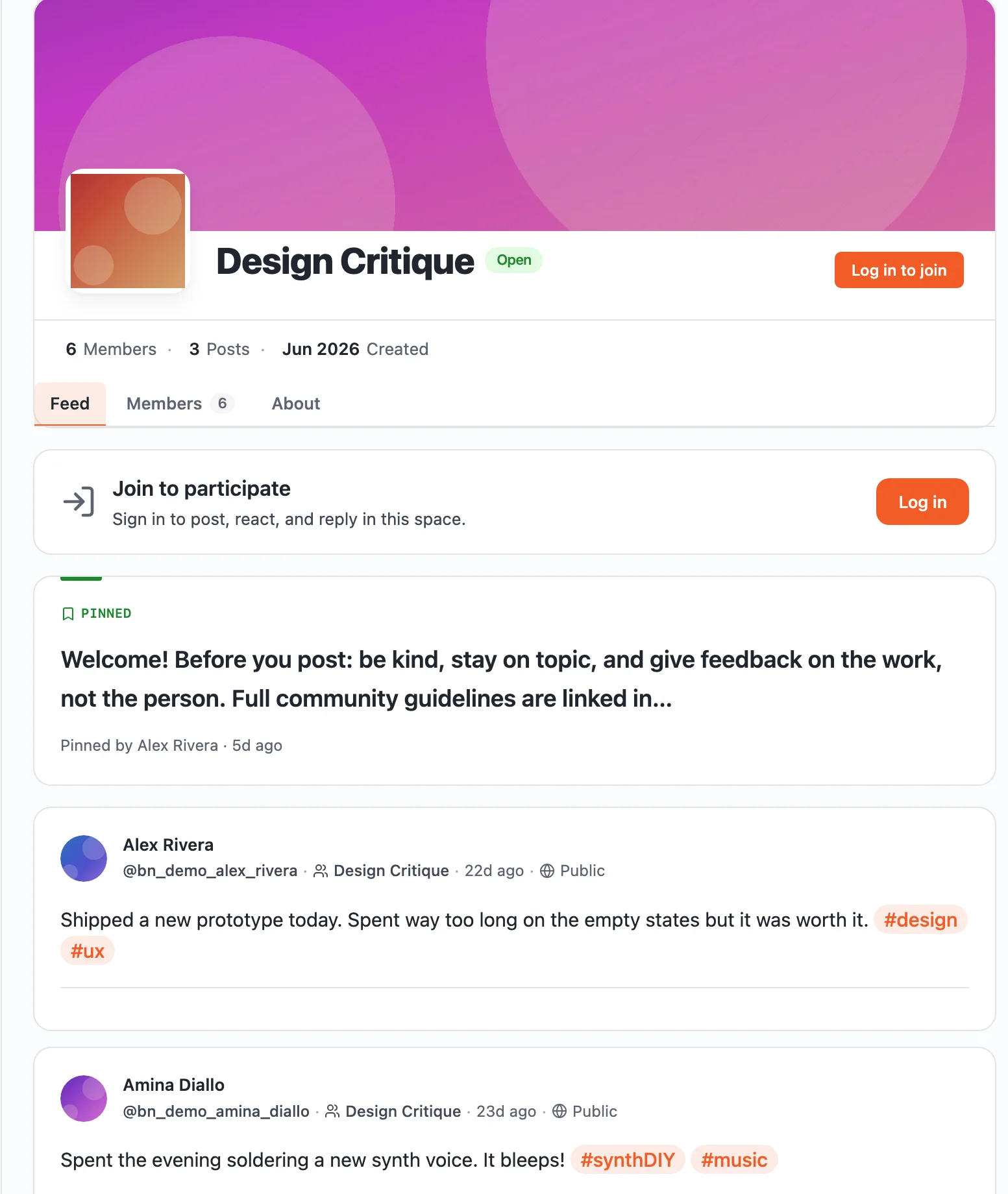
Look at what’s actually happening. Pinned ground rules set by a real, named moderator, asking people to be kind and give feedback on the work, not the person, that’s relationship marketing, a human setting a human tone. Real posts from real members sharing genuine work, that’s educational storytelling, people teaching each other by showing what they made. And reactions and replies on that work rather than a firehose of new posts, that’s high-efficiency engagement. None of it is automated. All of it is the playbook, running in a room instead of a feed.
Where this lives inside BuddyNext
If you’re running the community on BuddyNext, the platform is deliberately built to make the human version easy and the automated version unnecessary. Real Spaces with real moderators, not a bot managing a channel. A public Explore and search surface so educational content is actually findable, the same mechanism the growth loop piece covers. And notifications tuned so a founder can do high-efficiency engagement, showing up exactly where they’re needed, without drowning in every space at once, the specific runway-saver the founder-energy piece describes.
How it splits by who you are
The three habits are universal, but what you do with them depends on what you’re actually trying to build. A brand building a community uses them to turn customers into a trust-driven asset that markets the product better than any campaign could. A course creator trying to sell more and build a name uses them to become the trusted teacher in a space long before asking anyone to buy, which is what makes the eventual sale feel like a natural next step rather than a pitch. Same playbook, two different goals, both reachable without a single automated shortcut.
The test, if you want one
Look at the last ten interactions your brand or your course had with a real person. How many were genuinely human, written to that specific person in that specific moment, versus automated, templated, or broadcast at everyone at once. If most were the second kind, you’re running the method that produces forgettable results, no matter how much volume is behind it.
The case study that grew thirty-six times did the opposite, fewer interactions, each one real. That’s not a slower version of a growth hack. It’s the actual thing the growth hacks are a hollow imitation of, and it’s available to anyone willing to trade the illusion of scale for the reality of trust.
Related reading