
6 min read
Building a Thriving Medical School Alumni Community Website

Medical alumni need more than a directory, they need continuing education credit, a fellowship board, and a place to get a second opinion from someone who trained the same way they did. A free platform built on BuddyNext, the free Community OS for WordPress, Learnomy, a free WordPress LMS with 0% transaction fees, WP Career Board, a free block-first WordPress job board plugin, and Jetonomy covers all four without a per-member SaaS bill.
Why Medical Alumni Need Their Own Platform
Physicians need continuing medical education credit every year, whichever specialty they’re in. Most schools handle this through email blasts and a separate CME vendor portal that has nothing to do with the alumni community.
Fold CME into the same platform where alumni already find classmates and fellowship openings, and you remove a login, a vendor contract, and a reason for graduates to drift away from the school’s ecosystem entirely.
Why Alumni Engagement Actually Matters to a Medical School
Medical schools depend on alumni in ways most undergraduate programs don’t. Clinical rotation sites, residency letters of recommendation, guest lecturers, research collaborators, and a meaningful share of philanthropic giving all run through the same pool of graduates, and that pool only stays reachable if the school gives it somewhere to stay reachable.
Physicians disperse geographically faster and further than most alumni populations, scattered across residency programs the moment they graduate, then again after fellowship. A network that only exists as an annual mailing list loses touch with exactly the people who’d be most useful to current students: recent grads who remember what the transition to residency actually felt like.
The schools that keep this working don’t treat it as a once-a-year reunion event. They give alumni a reason to check in more often than that, a CME credit, a fellowship lead, a case worth a second opinion, and the byproduct is a stronger giving relationship and a deeper mentorship pipeline for current students, not because anyone asked for it directly, but because people who stay engaged for practical reasons tend to give back too.
What Makes Medical Alumni Networks Fail
Three patterns show up repeatedly in alumni associations that never gain traction.
Nothing to do besides browse. A directory with no forum, no job board, and no course library gives someone a reason to sign up once and never come back. Static content doesn’t generate return visits, ongoing utility does.
Communication that’s all outbound. Newsletters and event invitations are one-directional. Alumni who can’t post, ask, or reply have no reason to consider the platform “theirs” rather than the school’s marketing channel.
Launching to everyone at once. A platform that opens to 30 years of graduates simultaneously, with no seed content and no early activity, reads as empty even with a large member count. The ones that work start with one class or one committee and let real activity accumulate before opening wider.
What This Needs to Do
- Directory, find classmates by specialty, graduation year, and location (BuddyNext)
- CME credit, alumni-only courses and webinars, 0% platform fees (Learnomy)
- Fellowship board, filterable by specialty and program type (WP Career Board)
- Case discussion, a real forum for second opinions, not a comment thread (Jetonomy)
How to Build It
1. BuddyNext for the directory
Custom profile fields for specialty, residency program, and current practice location. Free forever, 31 capabilities including member directory and native moderation.
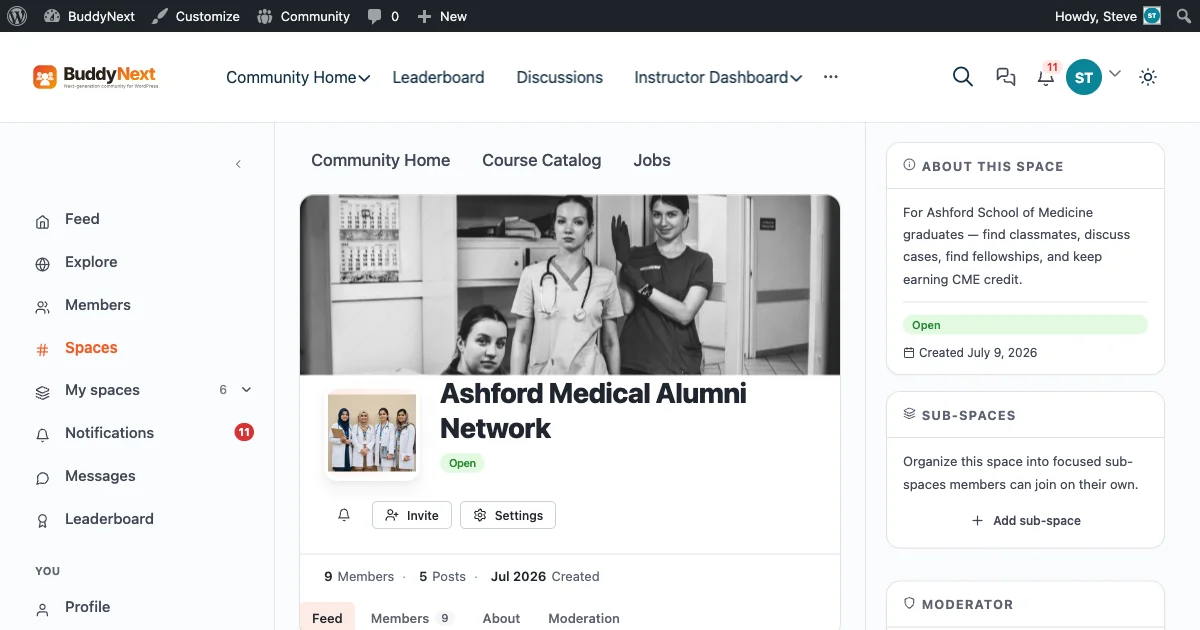
Here’s a working example we built, Ashford Medical Alumni Network, a real BuddyNext Space:
2. Learnomy for CME credit
Alumni-only continuing education, run on 0% platform transaction fees, if a course carries a fee, the school keeps what it charges. We seeded a real course to show it working:
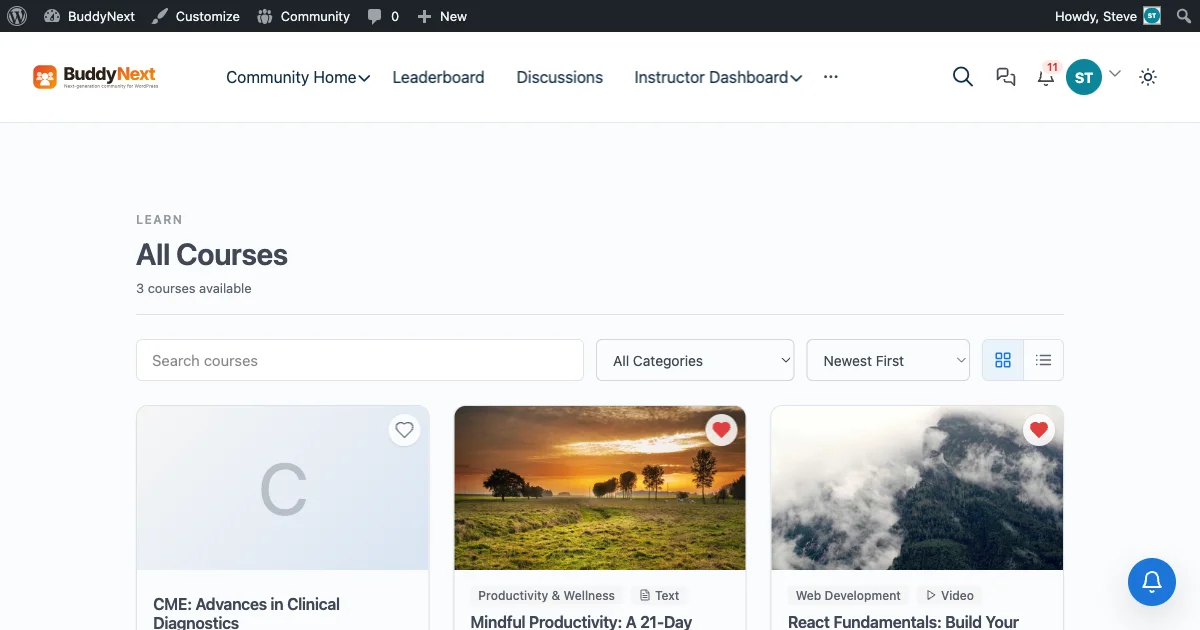
This is the single feature that makes a medical alumni platform worth logging into more than once a year. Nobody re-visits a directory for its own sake; people come back for CME credit.
3. WP Career Board for fellowships
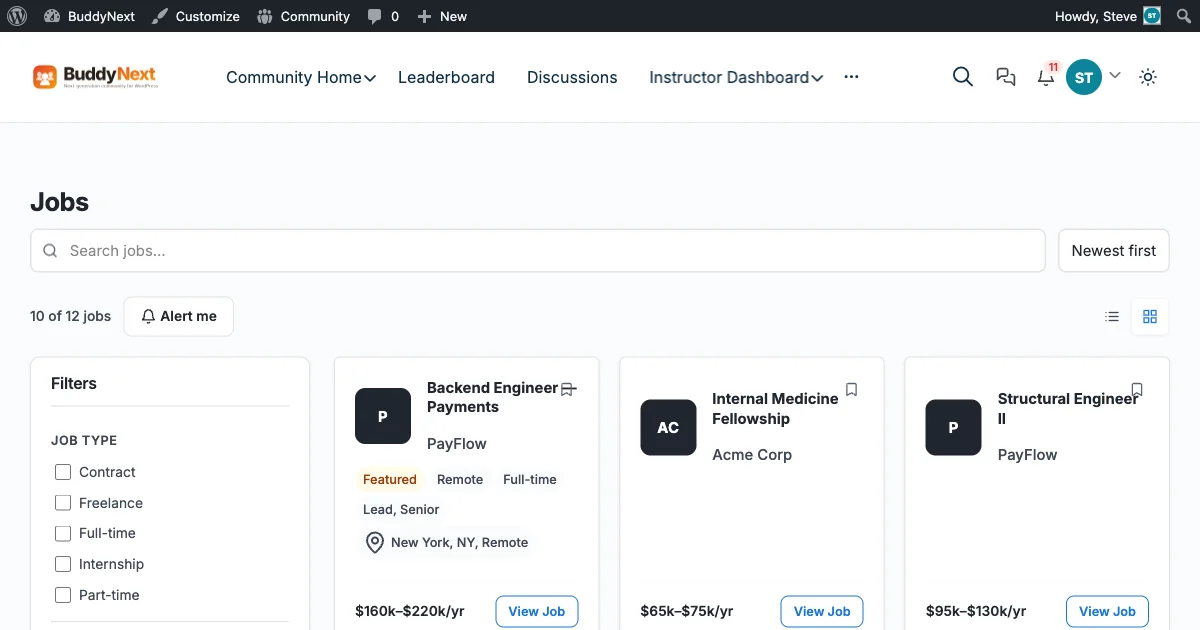
Filterable by specialty, program type, and location, with Google-Jobs-ready schema on every listing. Frontend submissions go through a moderation queue.
4. Jetonomy for case discussion
When BuddyNext and Jetonomy are both active, they integrate automatically, no configuration. The forum is where a genuinely useful second opinion happens: an atypical presentation, a treatment question, a “has anyone seen this” that a feed would bury in an hour.
What Changed: The Old Approach vs. This Stack
Older advice on this, including ours, pointed toward WordPress with Wbcom’s theme stack as “the ultimate solution” without naming what actually ran the CME, the forum, or the job board. That framing sold a platform without the parts.
| Generic “WordPress + Wbcom” pitch | BuddyNext + Learnomy + WP Career Board + Jetonomy | |
|---|---|---|
| CME courses | Not specified, separate vendor typically needed | Learnomy, 0% fees, built in |
| Fellowship board | Not specified | WP Career Board, built for this |
| Case discussion | Not specified | Jetonomy, auto-integrates |
| Cost to start | Vague | $0 across all four |
If you already have a working system for CME and fellowships elsewhere, keep it, there’s no need to consolidate everything at once. If you’re starting from scratch, naming the actual four products beats a vague “we’ll build you a platform” pitch.
What It Costs
| Product | Free | Pro (1 site) |
|---|---|---|
| BuddyNext | $0, full platform | $149/yr or $399 lifetime |
| Learnomy | $0, full LMS + payments | $104/yr (EarlyBird) |
| WP Career Board | $0, full job board | $48.30/yr (EarlyBird) |
| Jetonomy | $0, full forum | $48.30/yr (EarlyBird) |
All Pro tiers carry a 30-day money-back guarantee. Run the entire stack free indefinitely, CME courses, fellowship board, and forum included.
Frequently Asked Questions
Does Learnomy actually issue CME credit, or just host the course?
Learnomy hosts the course, tracks completion, and issues a verifiable certificate with a public verify page, the accrediting body relationship for CME credit itself still sits with your institution, same as any LMS. Learnomy handles delivery and record-keeping, not accreditation.
Can alumni post fellowship openings themselves?
Yes. WP Career Board’s frontend submission lets any logged-in alumnus post a listing, which goes through a moderation queue before it’s public.
Is patient information safe to discuss in the forum?
Treat the forum like any professional discussion channel, de-identify cases the same way you would in a journal club or grand rounds presentation. Jetonomy’s moderation tools (reports, banned words, space-scoped moderators) help enforce whatever policy your institution sets, but the policy itself is yours to define.
Is BuddyNext really free, or does it expire?
Free means permanent, not a trial. Pro ($149/yr) adds Stripe membership tiers and analytics; the free tier is a complete platform on its own.
Building This for Your School
We can configure the directory fields, CME course structure, and fellowship board categories for your program. Talk to us, or start with BuddyNext, Learnomy, and WP Career Board.
See how BuddyNext compares to Facebook Groups as a home for a professional medical network, or read our broader guide to building a niche community website on WordPress.
Building for a different program? See our guides for school alumni, MBA alumni, university alumni networks, or engineering alumni.
Related reading
- How to Create University Alumni Network Website
- How to Create an Mba Alumni Community Website
- Wbcom Designs Updates September 29 October 16 2026
- Wbcom Designs Updates September 22 28 2026
- Create an Engineering Alumni Network Website
- Buddynext Jetonomy And Learnomy Why Three Products All Have Spaces And How to Run Them Together