
6 min read
Best LMS for Creators in 2026


Content creators, YouTubers, newsletter writers, podcasters, and social media educators, approach course platforms from a different starting point than a traditional course entrepreneur: an existing, engaged audience already trusts them, and the platform’s job is converting that trust into a course purchase as frictionlessly as possible, ideally without redirecting followers off-platform in ways that feel disconnected from the creator’s existing brand. We compared eight WordPress LMS platforms specifically through this creator-monetization lens.
Table of Contents
- Quick comparison
- 1. Learnomy, full brand control with native, low-friction payments
- 2. LearnDash, Tutor LMS, LifterLMS, Sensei, WP Courseware, and MemberPress Courses, all offer genuine brand control
- 3. Thinkific, polished templates, less brand continuity
- Why brand continuity matters more for creators than for other course sellers
- Why a self-hosted course platform beats a generic “link in bio” tool for creators serious about courses
- Turning an audience spike into course revenue: launch mechanics that actually matter
- FAQ
- Verdict
Quick comparison
| Platform | Sales Page Customization | Native Payments (Low Friction) | Embeddable/Brand-Matched Checkout | Entry Price |
|---|---|---|---|---|
| Learnomy | Full control via WordPress page builder | Yes, Stripe + PayPal native | Yes, fully brand-matched (self-hosted) | Free |
| LearnDash | Full control via WordPress | Via WooCommerce/add-ons | Yes, brand-matched | $259/yr |
| Tutor LMS | Full control via WordPress | Via WooCommerce/add-ons | Yes, brand-matched | $199/yr+ |
| LifterLMS | Full control via WordPress | Via WooCommerce | Yes, brand-matched | $149 - $749/yr |
| Sensei LMS | Full control via WordPress | Via WooCommerce | Yes, brand-matched | Free / $179/yr |
| WP Courseware | Full control via WordPress | Via WooCommerce | Yes, brand-matched | $129 - $199/yr |
| MemberPress Courses | Full control via WordPress | Native | Yes, brand-matched | $199.50/yr+ |
| Thinkific | Thinkific-hosted templates | Native (hosted) | Limited, Thinkific-hosted checkout | $109/mo+ |
1. Learnomy, full brand control with native, low-friction payments
For a creator whose entire business is built on personal brand and audience trust, sending followers to a checkout page that looks and feels like a completely different, generic product breaks the continuity that trust depends on. Learnomy, running on self-hosted WordPress, lets a creator build a fully brand-matched sales page and checkout flow using the same page builder and design system as the rest of their site, with native Stripe and PayPal processing meaning no jarring redirect to a third-party checkout domain. This continuity, same look, same domain, same brand voice throughout, reduces the friction that causes an engaged follower to abandon a purchase partway through.
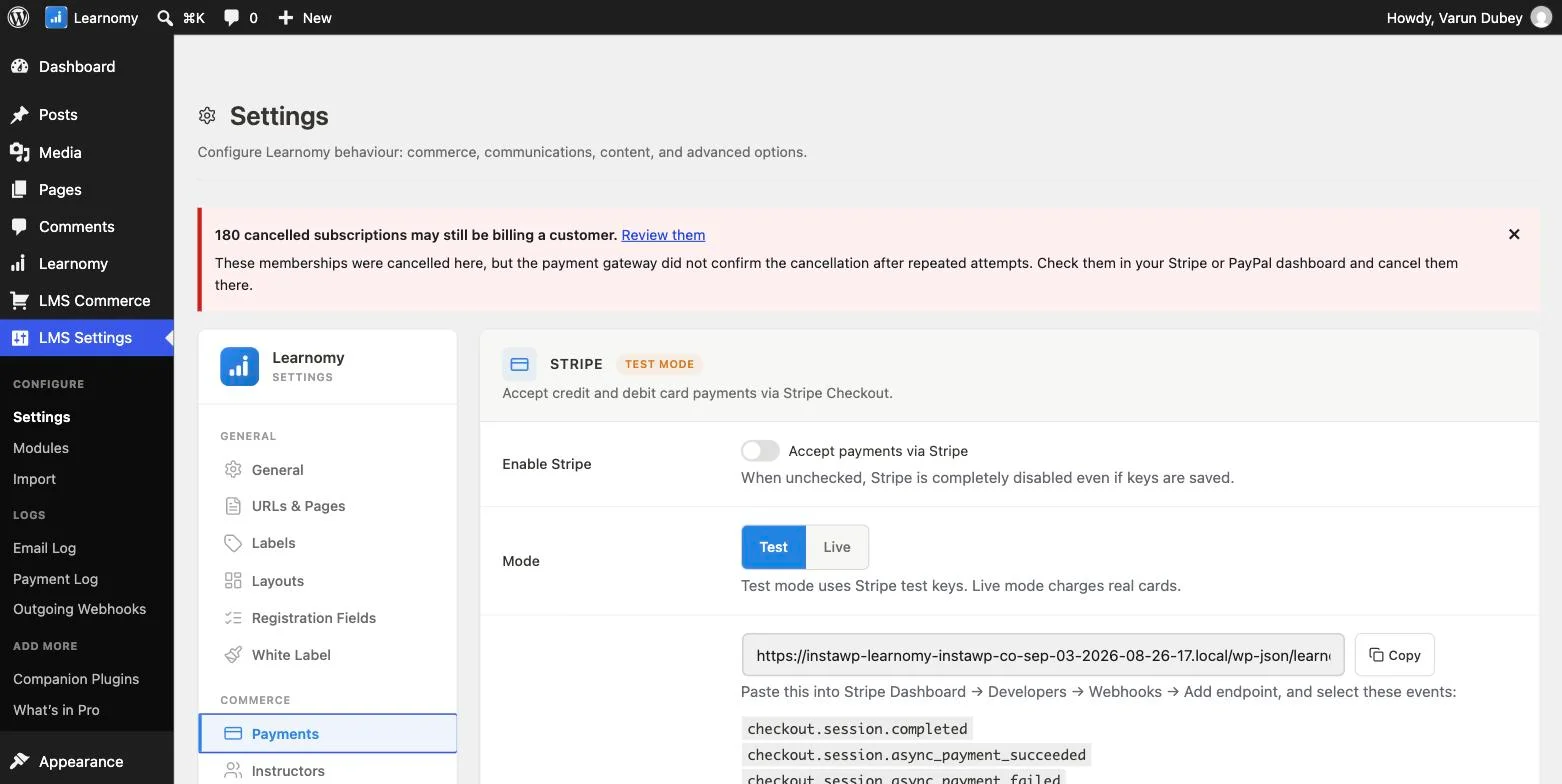
Beyond the sales experience, Learnomy’s AI-assisted course generation helps a creator who has deep subject expertise but limited time turn that expertise into structured course content faster, and its coupon system supports the kind of limited-time launch promotions creators commonly run to convert an audience spike (a viral video, a newsletter feature) into course sales.
Go deeper: You Don’t Have to Teach Everything Yourself covers the builder and AI-assisted content tools directly.
2. LearnDash, Tutor LMS, LifterLMS, Sensei, WP Courseware, and MemberPress Courses, all offer genuine brand control
Every self-hosted WordPress platform in this comparison shares Learnomy’s core advantage for creators, full design control and no forced redirect to a third-party checkout domain, since they all run on the same underlying WordPress foundation. The differentiation among them comes down to the same feature-depth considerations covered throughout this comparison series (payment friction, content-creation tools, analytics) rather than a fundamentally different creator-specific capability.
3. Thinkific, polished templates, less brand continuity
Thinkific’s hosted platform offers genuinely polished, professional-looking course templates with minimal setup effort, a real advantage for a creator prioritizing speed to launch. The tradeoff for a creator specifically is reduced brand continuity, students may notice the transition to a distinctly Thinkific-branded or Thinkific-hosted checkout experience, which matters more for a personal-brand-driven creator business than for a more anonymous or corporate course brand.
Why brand continuity matters more for creators than for other course sellers
A creator’s entire business model often depends on parasocial trust, an audience that feels a genuine connection to the creator specifically, not just interest in the subject matter. Any point where the buying experience feels disconnected from that established relationship (a generic checkout page, an unfamiliar domain, a different visual style) introduces doubt at exactly the moment a purchase decision is being made. This is a genuinely different psychological consideration than a B2B training buyer evaluating a corporate training platform on feature checklists alone, and it’s why self-hosted, fully brand-matched platforms carry outsized value specifically for creator-led businesses.
Why a self-hosted course platform beats a generic “link in bio” tool for creators serious about courses
Many creators start monetizing with a lightweight link-in-bio or digital-product tool, which is genuinely fine for a simple downloadable PDF or a single low-touch product. Once a creator is building a genuine structured course, multiple lessons, progress tracking, quizzes, certificates, those lightweight tools quickly show their limits, since they weren’t built for actual course delivery. A dedicated LMS platform is worth the additional setup specifically once your product has grown from “here’s a file” to “here’s a structured learning experience,” which is the point where student outcomes (not just the initial sale) start determining whether your course business has genuine repeat-purchase and referral potential.
Turning an audience spike into course revenue: launch mechanics that actually matter
Creators often experience sharp, short-lived audience spikes, a viral post, a feature, a well-timed collaboration, that create a narrow window to convert attention into course sales before it fades. The platform capabilities that matter most in this specific scenario: a checkout flow with no friction or unnecessary steps (every additional click during a traffic spike costs real conversions), a coupon or launch-pricing system that can create genuine urgency (a real, honestly time-limited discount rather than a fake countdown), and analytics good enough to tell you in real time whether the spike is actually converting so you can adjust your messaging or follow-up while the moment is still live. Confirm your platform’s real-time reporting responsiveness specifically for this use case, since a reporting dashboard that only updates daily is much less useful during a fast-moving launch window than one reflecting near-real-time activity.
FAQ
Can I sell a course directly through my existing website without redirecting to a separate platform? Yes, on any of the seven self-hosted platforms compared here, the entire purchase flow can happen on your own domain with your own branding throughout, unlike platforms that redirect to a separate checkout subdomain.
Do I need a large existing audience before this makes sense, or can I start small? Course monetization can work at any audience size, the platform choice matters less than having genuine, engaged trust with your audience, which several thousand highly engaged followers can convert as well as (sometimes better than) a much larger but less engaged audience.
How do I handle launch promotions and limited-time discounts for a course launch tied to a content moment? Learnomy’s and most competitors’ native coupon systems support time-limited and percentage/fixed-amount discount codes, confirm the specific scheduling and automatic-expiration capability against your platform before relying on it for a time-sensitive launch promotion.
Verdict
For creators wanting full brand continuity from content to checkout with native, low-friction payments, Learnomy’s self-hosted architecture and native Stripe/PayPal processing make it the strongest starting point in this comparison. The remaining self-hosted platforms (LearnDash, Tutor LMS, LifterLMS, Sensei, WP Courseware, MemberPress Courses) all share this core brand-continuity advantage, differentiated mainly by the feature depth covered throughout this comparison series. Thinkific offers a fast, polished launch experience at the cost of some brand continuity during checkout.
Full brand control, no jarring redirect
A brand-matched sales page and checkout on your own site, native Stripe and PayPal processing, and AI-assisted content tools all ship in Learnomy, on a site you own.
Related reading