
14 min read
In-Person Energy Doesnt Transfer Online For Free

A real trail run with five real friends, sweat, mud, a genuine shared struggle up a hill nobody enjoyed in the moment and everybody talks about afterward, produces enormous, real energy. Post that same experience online, in a new community space nobody’s populated yet, and watch how much of that energy actually survives the trip from trailhead to screen. Usually, not much. The mistake isn’t that fitness people don’t want community online. It’s assuming the in-person energy transfers automatically, when it’s actually a translation problem that has to be solved on purpose, deliberately, by someone, every single time it happens, not just once at launch.
If you’ve read the piece on the cold start problem, this is the fitness-specific version of it, and it’s a genuinely different challenge than a from-scratch topic community, because the energy already exists somewhere real. The job is moving it, not manufacturing it.
In this pieceThe translation problem, stated plainly
Why in-person energy doesn’t transfer for free
A real, small fitness founding cohort, not a hypothetical
Starting with the people you actually train with
The designated documenter, not a group requirement
The post-workout window, and why timing matters more here
What to seed with when the content is inherently physical
Why starting hyper-local beats starting broad
Why beginners bootstrap a fitness space better than veterans
Using a shared challenge to force early density
Fitness-specific failure modes
Bootstrapping without an existing in-person group at all
The pushback: “my training partners aren’t online people”
Where this actually lives inside BuddyNext
Why this is different from launching with a leaderboard
Turning it into something you actually check
The translation problem, stated plainly
Fitness energy is real, physical, and immediate, the kind of thing that shows up in a raised heart rate, a shared post-run silence, a group high-five nobody had to plan. Online community energy is asynchronous, text or photo-based, and requires someone to sit down afterward and deliberately choose to document something that already happened and is already fading from immediate memory. Those are two different kinds of energy, and assuming the first automatically becomes the second is where most fitness communities quietly fail to launch.
The translation has to be done on purpose, by someone, in the actual minutes and hours after the real activity happens, not days later when the moment has cooled into something that feels like homework to write up.
Why in-person energy doesn’t transfer for free
Three specific reasons this gap exists, worth naming rather than treating as a vague, unexplained phenomenon. First, friction: posting requires opening an app, finding the right space, writing something, all while the runner is tired, sweaty, and more interested in water than a keyboard. Second, audience uncertainty: a runner who’d happily tell five training partners about their race in person has no idea whether posting the same thing into a new, mostly-empty online space will land anywhere at all, the exact empty-room hesitation from the general bootstrapping piece. Third, and specific to fitness, the achievement itself often feels self-evidently obvious to the person who just did it, “I ran my normal route,” which undersells, to the person who did it, how genuinely interesting that content is to someone who wasn’t there.
Every one of those three frictions is solvable, but none of them dissolves on its own just because the underlying real-world energy was genuine. A useful mental check for anyone trying to seed a fitness space: after any real session this week, would a stranger reading the space have any idea it happened at all, or would the entire real, physical event have left no trace anywhere a newcomer could actually find it. If the honest answer is no, the energy existed and simply never got translated, which is a solvable, tactical problem, not a sign the community idea itself was wrong.
A real, small fitness founding cohort, not a hypothetical
Here’s what a properly translated version of this actually looks like, reachable without an account.
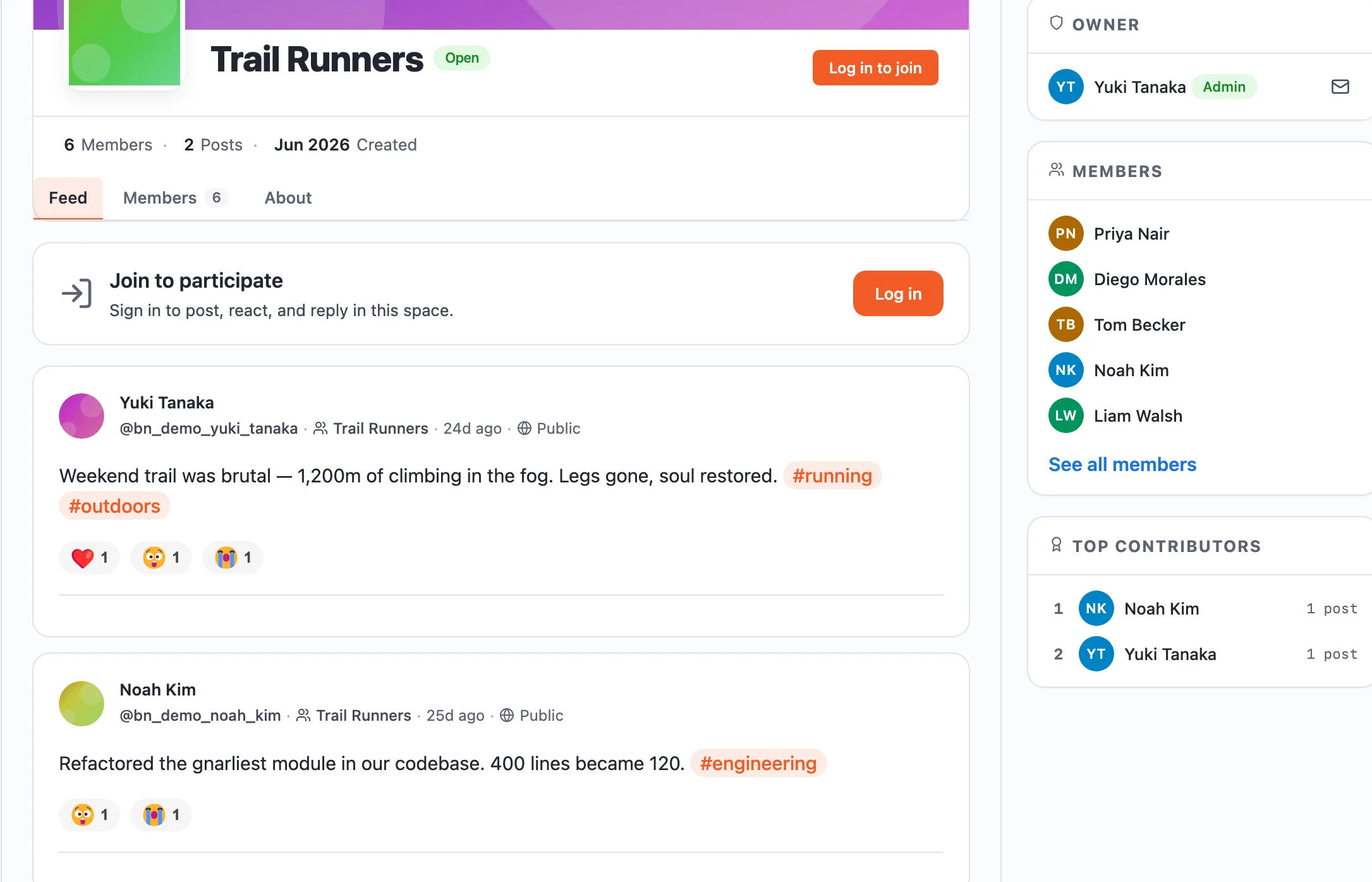
Six real members. A real post about a genuinely brutal, specific run, 1,200 meters of climbing in the fog, not a generic “great workout today,” specific enough that another runner reading it can picture exactly what happened. Real reactions from other named members who clearly know this person and this route. This is the translation problem solved, not through more members, but through one real, specific, well-written post that captures what the run actually felt like, posted close enough to the actual event that the energy hadn’t faded yet.
Starting with the people you actually train with
The founding cohort for a fitness community doesn’t need to be recruited from strangers online, and trying to do so first is usually a mistake. The people already training together in person, a real running group, a gym class, a small circle of workout partners, are the single warmest, most obvious founding cohort available, for the same reason an existing customer base is the warmest founding cohort for a brand community: the relationship and the shared activity already exist, and the community space is just giving it a second home online.
The invitation here is almost embarrassingly simple compared to the cold outreach a from-scratch community needs: “let’s start posting our runs in this space instead of just talking about them at the trailhead,” asked of people who are already showing up in person every week. That’s a founding cohort with close to zero recruitment cost.
The designated documenter, not a group requirement
A tactic worth borrowing directly from how a lot of real-world groups already handle photos without anyone formally deciding to: designate one or two people, explicitly, as the ones responsible for capturing and posting during the seed phase, rather than hoping the whole group spontaneously develops the habit at once. This mirrors the co-seeding team from the general bootstrapping piece, applied to the specific, physical constraints of a fitness context where posting requires a phone in hand at exactly the wrong moment for most of the group.
This isn’t about excluding anyone from participating, it’s about making sure the translation work described throughout this piece actually gets done by someone, reliably, instead of remaining everyone’s vague, shared responsibility, which in practice means nobody’s. Once the space has real, visible momentum, other members typically start posting on their own, having seen what a good post looks like from the designated documenter’s early examples.
The post-workout window, and why timing matters more here
The single highest-leverage tactical fix for the translation problem is timing: capturing the post-workout window, the twenty or thirty minutes right after a real session, when the shared experience is still fresh and the group is often still physically together. A photo taken at the trailhead, posted to the space before everyone disperses, captures real energy that the identical photo posted that evening, alone, at home, simply won’t carry the same way.
This is worth making a literal, explicit habit for the founding cohort during the seeding phase: whoever’s organizing the run or the session makes posting to the space part of the actual routine, the same way stretching or checking a watch is part of the routine, rather than an afterthought that competes with a dozen other things once everyone’s gone home.
What to seed with when the content is inherently physical
Fitness content has a real advantage the general bootstrapping piece’s seeding tactics can build on directly: it’s inherently visual and specific in a way that’s easy to make compelling without requiring much writing skill. A single honest sentence next to a real photo, a finish line, a route map, a personal record on a whiteboard, does more work than a long, polished paragraph would. The founding cohort doesn’t need to be good writers. They need to be prompted to post the specific, physical evidence of what they just did, with enough real detail that it reads as genuine rather than generic.
Worth preparing before the first real session after the space launches: a simple, repeatable prompt, “what was the hardest part of today,” works better than a blank composer and an unstated expectation, because it gives even a hesitant first-time poster an obvious, low-effort way to contribute something real. A small rotating set of two or three prompts, used consistently across the first several weeks, works better than a new, cleverer prompt every time, because familiarity lowers the effort required to answer, and the founding cohort starts recognizing the format as a normal, expected part of the routine rather than a fresh creative task each time.
Why starting hyper-local beats starting broad
The “narrow niche” principle from the general bootstrapping piece applies unusually literally in fitness: a space for “trail runners in this specific city or region” bootstraps far faster than a space for “trail runners” broadly, because the narrower version can actually host in-person events, the exact mechanism that produces the real energy this whole piece is about translating. A geographically broad fitness space has no natural in-person moment to translate from, and ends up relying entirely on the harder, colder, from-scratch bootstrapping tactics with none of fitness’s natural advantage.
Starting hyper-local, even uncomfortably small, a single city, a single gym, a single regular group run, gives the space something a broader version can’t manufacture: a real, recurring, in-person reason for the founding cohort to already be together, which is most of the bootstrapping problem solved before the space even opens.
Why beginners bootstrap a fitness space better than veterans
Counterintuitively, a founding cohort weighted toward relative beginners often produces better early content than one weighted toward the most experienced, accomplished members of a training group. A ten-year veteran’s routine long run is, to them, unremarkable, rarely worth a post. A beginner’s first five-kilometer run, first time completing a specific climb, first week of a new habit, is genuinely exciting to the person living it, and that genuine excitement is exactly the raw material honest seeding needs.
This doesn’t mean excluding experienced members, their expertise matters for answering questions and setting a credible tone. It means not assuming they’ll be the natural early posters, and specifically encouraging newer members of the training group, whose current milestones are still emotionally significant to them, to be part of the founding cohort rather than treating the space as something that opens once “real” veterans anchor it.
Using a shared challenge to force early density
A time-boxed, shared challenge, a thirty-day running streak, a specific distance goal over a month, a shared training block toward a real event, is a genuinely effective forcing function during the seed and invite phases specifically. It gives every founding member the same reason to post around the same time, manufacturing exactly the density a brand-new space otherwise takes weeks to accumulate organically.
This works because it turns an open-ended, vague invitation, “post about your training,” into a specific, bounded one, “post your day 4 of 30,” which lowers the activation energy for a hesitant first-time poster considerably. It also gives the space a natural, visible finish line, a moment worth a real celebratory post from everyone at once, which is exactly the kind of concentrated activity spike that convinces a new visitor the space is genuinely alive.
Fitness-specific failure modes
Beyond the general bootstrapping failure modes, a few specific to fitness. Posting only the highlight-reel achievements, personal records and race finishes, while skipping the ordinary training days, which makes the space feel like a highlight reel nobody can relate to on an average Tuesday, rather than a real, ongoing practice. Letting the online space become disconnected from the actual training calendar, so posting happens sporadically instead of being tied to real, recurring sessions. And over-relying on gamified streaks or badges as a substitute for the real post-workout translation work, which produces activity that looks real on a dashboard but reads as hollow to an actual visitor, the same as the empty room, just dressed up with more UI around it.
Bootstrapping without an existing in-person group at all
Not every fitness community starts from an existing training group, some genuinely start from a solo athlete or a small handful of people who don’t yet train together in person at all, coordinating remotely around a shared goal instead. This is a harder version of the problem, closer to the general cold-start piece’s from-scratch scenario than to the warm-start advantage described throughout the rest of this piece, and it’s worth being honest about that difference rather than assuming the same tactics apply identically.
The practical adjustment is leaning harder on the shared-challenge tactic described above, since there’s no natural in-person moment to translate from, a structured, time-boxed goal becomes the primary forcing function rather than a supplementary one. It also means the founder or organizer has to do more of the founder-as-first-member work from the general piece, personally, consistently, for longer, since there’s no existing group energy to lean on in the meantime. Slower, but not impossible, and the same honest-seeding principles apply exactly as they do everywhere else in this series. Online-first fitness communities that succeed almost always do so by eventually creating the in-person moment they lacked at the start, a first meetup, a regional challenge, a real event, at which point they inherit the exact translation advantage described throughout this piece, just arriving at it from the opposite direction, real activity built first, online later, rather than the other way around.
The pushback: “my training partners aren’t online people”
A genuinely common and fair concern, not every real-world training group has members who are naturally inclined to post online, regardless of how good the space or the prompts are. Forcing reluctant members to perform enthusiasm they don’t feel produces exactly the thin, inauthentic content this piece has been arguing against.
The realistic fix is accepting that the founding cohort doesn’t need to be the entire training group, it needs two or three genuinely willing posters, not all of them. A fitness space seeded by the two most naturally expressive members of a five-person group, consistently, over several weeks, produces more real density than one waiting for unanimous, reluctant participation that may never arrive. The reluctant members often start posting eventually anyway, once the space has enough real activity that contributing feels like joining something already alive rather than performing enthusiasm into a void, the exact empty-room hesitation this entire piece has been describing, solved quietly, by the two people willing to go first.
Where this actually lives inside BuddyNext
If you’re running the community on BuddyNext paired with WB Gamification, a real, mobile-friendly posting flow matters more here than in almost any other niche, since the post-workout window described above is short and often happens somewhere without easy desktop access. Streaks and shared challenges give the forcing-function tactic above a concrete, built-in mechanism rather than something that has to be manually tracked by the founding cohort’s organizer.
Why this is different from launching with a leaderboard
A natural instinct when bootstrapping a fitness space is to lead with competitive mechanics, a leaderboard, ranked streaks, from day one, on the theory that competition will drive engagement. It’s worth being skeptical of that instinct specifically during the founding-cohort phase. A leaderboard ranks people against each other, which requires enough participants for a ranking to feel meaningful rather than arbitrary, and it can actively discourage a hesitant beginner from posting at all if their first real contribution is immediately measured against a veteran’s much longer streak.
Competitive mechanics work well later, once the space has enough density that ranking feels like a real signal rather than a small, slightly awkward number next to five other small, slightly awkward numbers. During the seed and invite phases specifically, the priority is getting genuine, specific content posted at all, not optimizing who’s currently winning. Introducing the leaderboard once the space already has real density, rather than as the reason for posting from day one, tends to produce a healthier, more durable dynamic.
Turning it into something you actually check
Weekly, during the seed and invite phases: what percentage of the group’s actual real-world sessions this week produced a post in the space, not what percentage of members posted something at some point. That ratio, sessions-translated versus sessions-that-happened, is the real signal for whether the translation problem is actually being solved, rather than a vague sense that “people are posting sometimes.”
Worth checking alongside it: how many posts in a given week come from someone other than the designated documenter. Zero, for the first two or three weeks, is completely normal, the documenter is doing exactly the job described earlier in this piece. Zero, still, by week eight, with an otherwise consistently posting space, usually means the rest of the founding cohort has quietly settled into treating the space as one person’s diary rather than a shared one, worth addressing directly by asking specific other members for their own version of a recent session, by name, rather than waiting for it to happen unprompted.
The energy was never the missing ingredient. It exists every single time this group laces up and heads out together. The only question worth asking is whether anyone’s actually carrying a meaningful piece of it back to the space before it fades, the way the two names on that trail runners founding post did, specifically, honestly, close enough to the actual run that it still felt real.
That’s the entire job, repeated every week, for long enough that it stops being a deliberate effort and starts being simply what this group does after every session, without anyone needing to remember to ask, the way stretching afterward eventually stops being a conscious decision too. Fitness communities have a real advantage almost no other niche gets, a recurring, real-world reason for the founding cohort to be together in the first place. The only way to waste that advantage is assuming it does the online part of the work by itself, instead of treating the translation as the actual job it is.
Related reading