
14 min read
Why Youre Not Starting From Zero: Bootstrapping A Brand Community

Most brand communities that fail to get off the ground don’t fail because nobody wanted them. They fail because the team building them treated a warm, existing customer base like a cold audience, applying stranger-outreach tactics to people who already trust the company, already have real problems worth discussing, and already, in most cases, would have said yes to a personal invitation nobody thought to send.
If you’ve read the piece on the cold start problem, this is the specific version of it that shows up in brand and customer communities, and it has a different fix than the general playbook, because the actual problem here isn’t the absence of an audience. It’s the failure to recognize the audience that’s already there.
In this pieceWhy you’re not actually starting from zero
Why the cold-audience mistake happens anyway
What “warm” actually means here, specifically
The founding cohort hiding in your support inbox
How to prioritize which twenty to invite first
Recruiting support and success agents as co-seeders
A real, small, warm founding space, not a hypothetical
Direct outreach to your most engaged existing customers
What to seed with: turning resolved tickets into content
The failure mode: blasting the entire customer list at once
What the first two weeks should actually look like
Handling the customer who complains publicly
The pushback: “we don’t want to bother our best customers”
Where this actually lives inside BuddyNext
Why this is different from an NPS or advisory panel
Turning it into something you actually check
Why you’re not actually starting from zero
A brand or customer community almost always launches with a real, if invisible, running start: an email list, a support ticket history, a base of paying customers who’ve already decided the company is worth trusting with money. That’s not nothing. That’s most of the hard work a cold-start community has to do from scratch, already done, sitting in a CRM or a helpdesk, unused.
The mistake is building the community as if none of that exists, launching a shiny new space and waiting for organic sign-ups the way a founder with no existing audience would have to. That approach throws away the single biggest advantage a brand community has over every other kind, and produces the exact empty room described in the general bootstrapping piece, except this time it was avoidable.
Why the cold-audience mistake happens anyway
It happens for a boring, structural reason: the team building the community is often not the same team that owns the support inbox or the customer data, and “let’s launch a community” gets treated as a marketing or product initiative, announced the way a new feature gets announced, rather than as an extension of an existing relationship. Nobody’s being careless on purpose. The community effort simply isn’t wired into the systems that already know who the warmest, most engaged customers are.
The fix isn’t complicated, but it does require treating the community launch as a cross-functional project from day one, pulling in whoever owns support, sales, or customer success long enough to get a real list of the twenty or thirty customers worth personally inviting first, instead of a generic “we’re launching a community, stay tuned” email to everyone at once.
What “warm” actually means here, specifically
Not every customer is equally warm, and it’s worth being precise about who actually belongs in a founding cohort versus who should wait for a later, broader invitation. The customers who’ve filed multiple support tickets and clearly know the product in depth. The ones who’ve left detailed, thoughtful feedback unprompted, the kind of customer who emails a paragraph instead of clicking a star rating. Power users who’ve built workarounds, integrations, or genuinely creative uses of the product nobody on the team anticipated. Anyone who’s referred another customer, because they’ve already demonstrated willingness to advocate.
These are the people who have both the standing and the motivation to be the first voices in a new space, not because they’re being used, but because a real community actually benefits from their depth of experience from day one, in a way a random slice of the customer list wouldn’t.
The founding cohort hiding in your support inbox
The support ticket queue is, unglamorously, one of the best founding-cohort sourcing tools available, and almost nobody uses it that way. Every customer who’s asked a detailed, specific question, especially one that took real back-and-forth to resolve, has already demonstrated exactly the kind of engagement a founding cohort needs. They cared enough to write in. They likely have opinions about how the product could be better. And they’re precisely the people who’d get real value from a space where they could ask that same kind of question publicly and get an answer that helps the next person too.
Pulling twenty names from the last three months of genuinely substantive tickets, people who asked something specific and stuck with it through a real resolution, produces a far warmer, more relevant founding list than any generic segment a marketing tool would generate.
How to prioritize which twenty to invite first
Not every warm customer deserves an equal spot in the first invitation wave, and being deliberate about ordering matters more than it might seem. Recency counts for more than most teams assume, someone who filed a detailed ticket last month is more likely to still be actively using the product and thinking about it than someone whose last real engagement was a year ago, even if the older interaction was equally substantive at the time.
Diversity of use case matters almost as much as depth of engagement. A founding cohort made entirely of customers using the product the exact same way produces a space that feels narrow and repetitive within the first two weeks, the same content, the same angle, over and over. Deliberately including a few customers who use the product differently, a different plan tier, a different industry, a different primary use case, gives the space enough range that a wider set of future visitors can find something relevant when it eventually opens up.
And weight genuine advocates over merely satisfied customers. Someone who’s referred a friend or written an unprompted testimonial has already shown they’re willing to publicly associate themselves with the brand, which is close to a prerequisite for being an effective early, visible voice in a new space.
Recruiting support and success agents as co-seeders
The founder or community manager doesn’t have to carry the seeding workload alone, and for a brand community specifically, the support and customer success team is sitting on an underused advantage: they already have the product knowledge and the relationships. Inviting two or three support agents to actively post in the new space, under their real names, answering the kinds of questions they already answer privately every day, does the same work the general bootstrapping piece’s co-seeding team does, multiple real voices instead of one, except these particular co-seeders come pre-loaded with exactly the expertise a brand community needs.
This requires actual buy-in, not a passive mention in a team meeting, ideally framed as a real part of their role for the first several weeks rather than an unpaid extra. A support agent who spends thirty minutes a day answering questions publicly instead of only privately is doing genuinely valuable, visible work, and treating it that way, including telling their manager it’s sanctioned time, is what actually gets it to happen consistently instead of trailing off after the first week.
It’s also worth being honest with the co-seeding agents about why this matters to them specifically, not just to the company. A support agent whose helpful public answers are visible, attributed, and searchable is building a real professional reputation in a way that private ticket replies never allow, the same reputation mechanic covered in the growth loop piece on brand communities. Framing it that way tends to produce more genuine enthusiasm than framing it purely as an assigned task.
A real, small, warm founding space, not a hypothetical
Here’s what this actually looks like once it’s running, reachable without an account.
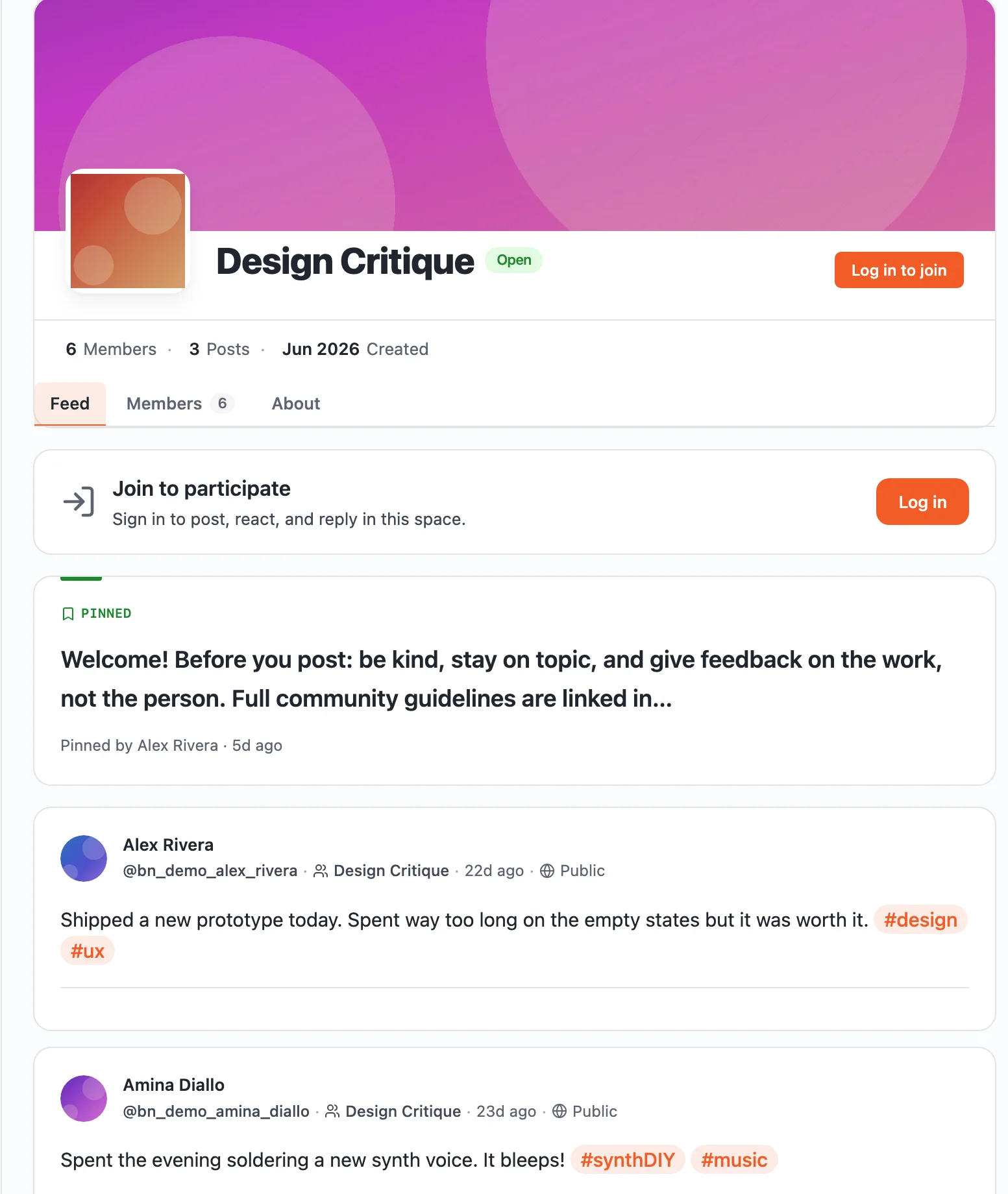
Pinned ground rules set once, by a real, named moderator, genuine posts from real members, reactions on real content. This is what a properly seeded brand-adjacent space looks like a few weeks in, small, real, already useful to the people in it, nothing about it manufactured. A support-ticket-sourced founding cohort, invited personally and given real ground rules to organize around, produces exactly this kind of density, far faster than a public launch to a cold audience would.
Direct outreach to your most engaged existing customers
The invitation itself should say the true thing plainly: “you’ve been one of our most engaged customers, and we’re building a space where people like you can talk to each other, not just to our support team, we’d love you to be one of the first people in it.” That’s not flattery, if the segment described above was pulled honestly, it’s an accurate description of why this specific person was chosen, and accurate, specific invitations get a dramatically higher response than generic ones.
Personal outreach at this scale, twenty or thirty individual messages rather than one blast, is genuinely more work than a mail-merge campaign. It’s also the entire reason a brand community can skip most of the cold-start pain a from-scratch community has to grind through, because the trust and relevance were already established through every prior support interaction.
What to seed with: turning resolved tickets into content
The single richest source of founding content a brand community has, and almost never uses deliberately, is the support team’s own resolved-ticket history. Every genuinely useful answer that’s already been given privately, once, to one customer, can be rewritten as a real, standalone post in the new space, the exact same value, now reachable by everyone instead of the one person who happened to ask.
This does double duty: it means the space never opens in a fully blank state, there’s real, useful content in it from the first day, and it demonstrates to the founding cohort exactly what kind of content belongs there, which makes their own first posts easier to write because they now have a template to follow.
Beyond resolved tickets specifically, a handful of other genuinely useful seed content types are worth preparing in advance. A short roadmap preview, real and specific rather than vague, gives the founding cohort something concrete to react to and often produces the first real comment thread, because customers who’ve invested in a product have real opinions about where it’s headed. A “how we built this” post about a recent feature invites the kind of behind-the-scenes curiosity that doesn’t require the reader to have a problem to ask about, useful for filling out the space’s early content beyond pure troubleshooting. And a direct, open question, “what’s the one thing you wish this product did that it doesn’t,” posted by the founder or a co-seeding agent, gives even the most hesitant founding member a low-effort way to make their first post a simple reply rather than an original piece of content.
The failure mode: blasting the entire customer list at once
The most common way this goes wrong is skipping the small, personal founding cohort entirely and announcing the new space to the full customer list in one email, the brand-community version of the general bootstrapping piece’s launch-day mistake. Thousands of customers click through simultaneously, arrive at a space with three founder posts and no other activity, correctly conclude nothing’s happening yet, and never return to check again.
The fix is sequencing exactly as described above: a small, personally invited founding cohort first, real density established over several weeks, and only then a broader announcement to the full list, now pointed at a space that already has genuine activity worth discovering instead of an empty one.
What the first two weeks should actually look like
Concretely, rather than abstractly: day one, the space opens with several resolved-ticket-turned-posts already in it, never a blank feed, plus the founder or community lead’s own first post explaining plainly what this space is for and why these particular twenty or thirty people were invited. Days two through five, personal outreach continues in small batches rather than all at once, giving the community lead time to personally welcome each new arrival’s first post with a real, specific reply, not a canned one.
By the end of week one, the goal is a handful of genuine posts from people who aren’t the founder or the co-seeding support agents, even if it’s only three or four. Week two is about consistency, not growth, making sure those first few external posters get a real response and a reason to come back, while continuing to invite the remaining names on the founding list in small, personal waves rather than a single push.
Handling the customer who complains publicly
Worth planning for explicitly rather than being caught off guard by it: at some point during the founding phase, an invited customer will use their first post to air a genuine grievance instead of the kind of constructive content the space was hoping to seed with. This is not a disaster, and treating it like one, deleting it or responding defensively, does far more damage than the original complaint would have.
The right response is the same one a good support interaction already uses: acknowledge the specific issue honestly, respond with real information or a real next step, and let the exchange stay visible. A newcomer who later finds this thread doesn’t see a company hiding problems, they see a company that responds to a real complaint in public, which is a stronger trust signal than an all-positive feed would have been. The founding cohort was chosen partly for candor. Occasionally getting candor that isn’t flattering is the actual, unavoidable cost of that, and it’s a cost worth paying.
The pushback: “we don’t want to bother our best customers”
A fair concern, and worth taking seriously rather than dismissing as overcaution. Some of the most engaged customers are genuinely busy, and an unwanted invitation can read as one more demand on their time from a company that’s already asking a lot of them.
The honest fix is framing the invitation as an opportunity, not an obligation, explicit that there’s no expectation of ongoing participation, and genuinely meaning it. Most customers who fit the “warm” description above are flattered by being asked, not burdened, precisely because it’s framed as recognition of their existing engagement rather than a new task. The ones who decline simply decline, and the ask cost them thirty seconds, not an ongoing commitment, and nothing about a polite decline changes the relationship with a customer who was already engaged enough to be considered in the first place.
Where this actually lives inside BuddyNext
If you’re running the community on BuddyNext, Spaces can start private or invite-only during exactly this founding-cohort phase, keeping the space genuinely small and warm until it’s ready for a broader audience, the same lifecycle covered in the general cold start piece. Once real density exists, the same public Explore and search mechanism that powers the growth loop for brand communities means the broader customer base, and eventually new customers entirely, discover a space that’s already alive, not one waiting to be filled.
Why this is different from an NPS or advisory panel
A fair question, since the founding cohort described here sounds similar to a customer advisory board or an NPS follow-up panel many companies already run. The overlap in who gets invited is real, often the exact same twenty or thirty names. The purpose is different in a way that matters: an advisory panel exists to extract feedback for the company. A founding community cohort exists to talk to each other, with the company mostly listening and occasionally participating, not running the conversation.
That distinction shapes what gets seeded and how success gets measured. An advisory panel succeeds when the company learns something. A founding cohort succeeds when members start replying to each other without the company prompting it, the actual signal that a space has stopped being a research exercise and started being a real community. Confusing the two produces a space that feels like a focus group, polite, responsive to the company, but never quite alive on its own, which is precisely the empty-room problem in a different costume.
Turning it into something you actually check
Weekly, during the founding-cohort phase specifically: how many of the personally invited customers have actually posted, not just joined, and how many resolved-ticket-turned-post pieces of content exist for a newcomer to find. Both numbers should be climbing steadily during the first six to eight weeks. If invited customers are joining but not posting, the invitation or the space’s initial content likely needs to be more specific, not more numerous.
Worth tracking separately, and easy to skip: how many replies are happening between two customers, with no company account involved in the thread at all. That number starting at zero and staying there for the first month is normal. That number staying at zero past week eight, with a founding cohort that’s otherwise posting regularly, usually means the space still reads as company-to-customer rather than customer-to-customer, and the fix is less founder posting, not more, to make visible room for members to talk to each other instead of only replying to the company.
The customers worth building this community around were never actually strangers. They already trusted the company enough to buy from it and engage with it. The only real mistake left to make is forgetting that, and starting the invitation from zero instead of from everything the support inbox already knows. Every one of those past interactions was, without anyone planning it that way, already the first draft of a founding cohort list, sitting in a ticket queue, waiting for someone to actually read back through it with that purpose in mind.
Related reading