
9 min read
Off-Page SEO for WordPress: Budgeting and Strategies

Off-page SEO is everything that happens away from your WordPress site that affects how it ranks: links from other sites, mentions of your brand, reviews, and the signals that tell Google you are a real entity people trust. Most WordPress owners either ignore it or waste money on link packages that do nothing (or worse). This guide covers what actually moves rankings in 2026, how to budget for it at three different spending levels, and how to do the on-site prep so the links you earn are not wasted.
What off-page SEO means after Google’s spam updates
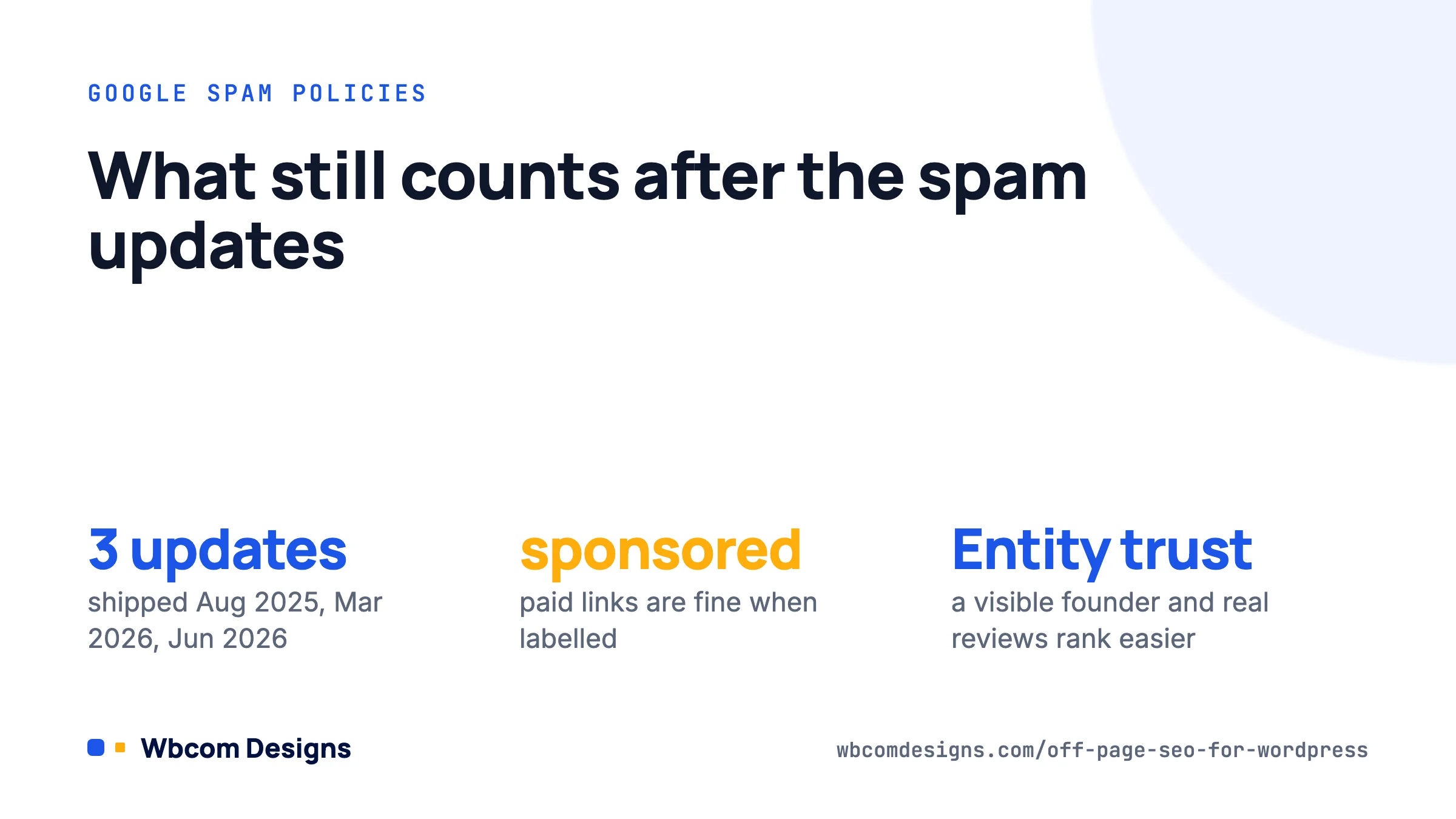
Google’s spam policies have not changed in spirit since the 2012 Penguin update: links you earn count, links you buy to pass ranking credit do not. What has changed is enforcement. Google shipped spam updates in August 2025, March 2026 and June 2026, each one faster than the last, and SpamBrain now catches manipulative link patterns that used to slide through for years. In May 2026 Google also rewrote its spam policy definitions to cover AI Overviews and AI Mode, so manipulating AI answers is explicitly spam too.
The current spam policies list these link practices as violations:
- Buying or selling links that pass ranking credit (money, products or services in exchange for a link).
- Excessive link exchanges (“link to me and I’ll link to you”) done mainly for cross-linking.
- Automated link building with programs or services.
- Requiring a link as part of a contract or terms of service without letting the other party add a
relattribute. - Advertorials and paid guest posts where the links pass credit.
- Low-quality directory and bookmark submissions, widget links, and footer or signature links with optimized anchor text.
Notice what is not on the list: paid placements that use rel="sponsored" or rel="nofollow". Google says plainly that buying and selling links is a normal part of the economy. The violation is pretending a paid link is an editorial one. Keep that distinction in mind because it is the difference between a sponsorship budget that helps your brand and one that gets your WordPress site a manual action.
Beyond links, off-page SEO in 2026 includes brand mentions without a link, reviews on Google Business Profile and third-party platforms, and citations in AI search answers. Google’s own documentation on how it evaluates quality leans heavily on reputation research about the entity behind a site. A WordPress business with a visible founder, consistent mentions on industry sites, and real reviews is easier to rank than an anonymous one with more backlinks.
Get the on-site foundation right before spending a cent
Links point at pages. If the pages are thin, slow, or confusing, the authority you earn leaks away. Before any outreach, do these four things on your WordPress site.
- Fix your SEO plugin setup. Yoast SEO, Rank Math, or SEOPress: pick one, set canonical URLs, submit the XML sitemap in Search Console, and make sure category and tag archives you do not want indexed are set to noindex. We went through the details in our WordPress SEO best practices guide.
- Build linkable pages first. Nobody links to a services page. They link to original data, a free tool, a definitive guide, or a strong opinion. Create two or three of these before outreach, so you have something worth pointing to.
- Internal linking. When a link lands on your guide, internal links pass that authority to the pages you want to rank. A simple rule: every new post links to at least three older relevant posts and gets linked from at least two.
- Speed and Core Web Vitals. Journalists and bloggers check the page before linking. An LCP over 2.5 seconds or INP over 200 ms on mobile makes a poor first impression and hurts the conversions the traffic brings.
Link building tactics that work in 2026
Digital PR and expert commentary
The highest-value links are from news and industry publications, and the most reliable way to earn them is by answering journalist requests. HARO (Help A Reporter Out) shut down as Connectively in December 2024, then came back in April 2025 under Featured.com as a free email service. Alongside it, Qwoted, Source of Sources (built by HARO’s original founder, free), and the #journorequest feeds on X and Bluesky are the working stack. Expect to answer 20 to 30 requests to land 2 or 3 placements; the hit rate goes up sharply when you respond inside the first hour with a specific quote, a one-line credential, and no sales pitch.
Original data and small studies
If you have a WordPress site with any data at all (a community, a store, a course platform), you have a study waiting to be written. “We analyzed 4,000 member signups and here is when people churn” will earn more links than any guest post. Tools like WB Polls or a short survey to your email list produce publishable numbers in a week.
Guest posting, done narrowly
Guest posts still work when the site is real, the audience overlaps with yours, and the post is something you would publish on your own blog. They stop working (and start hurting) when you pay for placement on “write for us” content farms. Rough signals of a safe host: real authors with bios, traffic you can see in Ahrefs or Semrush, comments or social shares, and editorial standards that reject weak pitches.
Unlinked mentions and broken links
Set up Google Alerts and a Brand24 or Mention trial for your brand and product names. When someone mentions you without linking, a polite one-line email converts 20 to 30% of the time. For broken link building, Ahrefs’ “Best by links” report filtered to 404 pages in your niche shows which dead resources still have links; build the replacement and email the linkers.
Community and partner links
For WordPress product businesses specifically, plugin and theme directories, integration partner pages, and case studies with customers are steady sources. If a partner lists integrations, make sure yours is there with a link. If you run a community site on BuddyPress or similar, member-created content and profiles can attract links, but set external profile links to rel="nofollow ugc" so you are not the one passing credit to spam.
Budgeting: three levels that match how much time and money you have
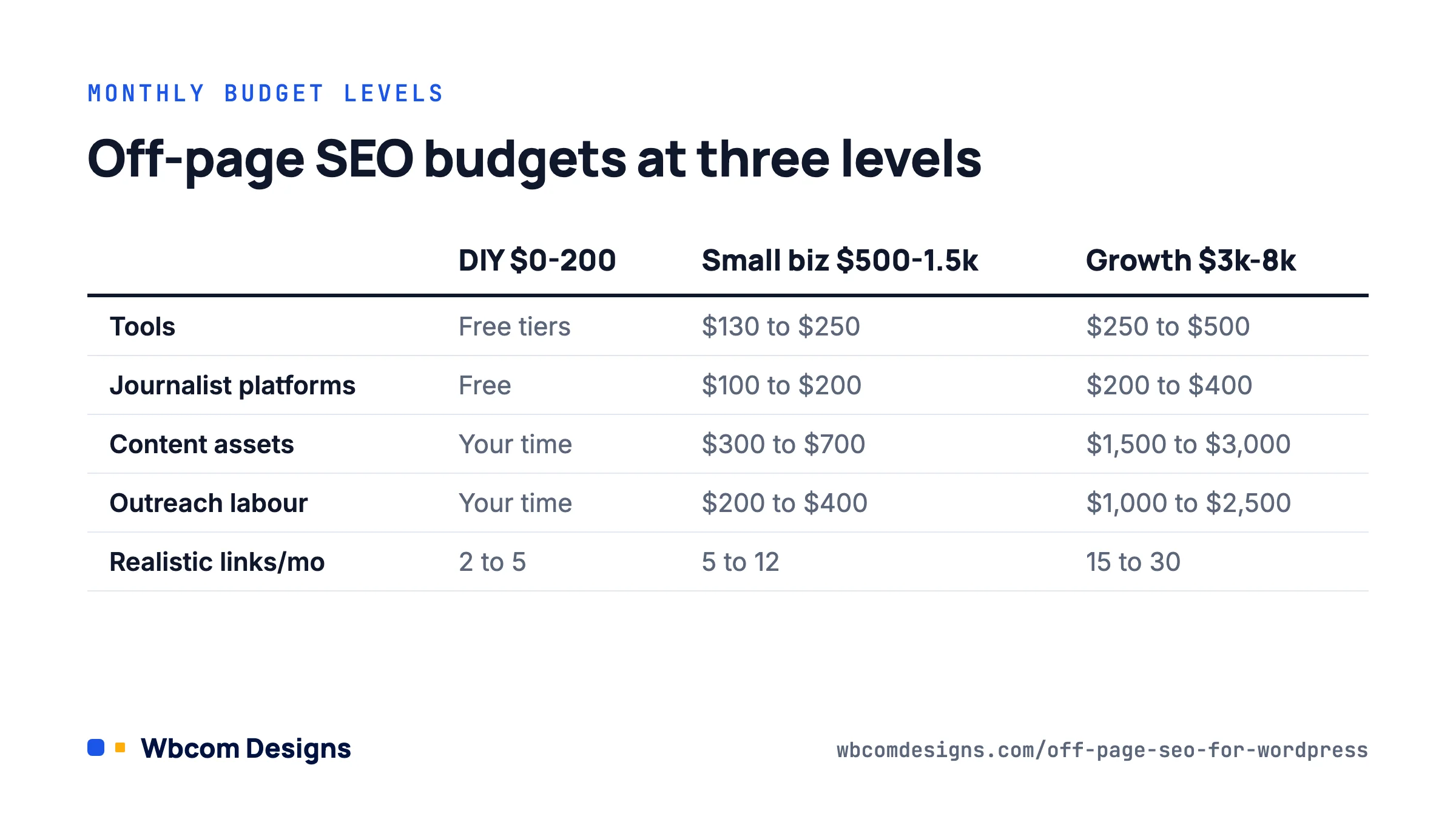
Off-page SEO is either your time or your money. Here is how we would split a monthly budget at three levels.
| Line item | DIY ($0 to $200/mo) | Small business ($500 to $1,500/mo) | Growth ($3,000 to $8,000/mo) |
|---|---|---|---|
| Tools (Ahrefs/Semrush, monitoring) | Free tiers, Search Console, Google Alerts | $130 to $250 | $250 to $500 |
| Journalist request platforms | Free (SOS, HARO, X) | $100 to $200 (Qwoted / Featured paid tiers) | $200 to $400 |
| Content assets (guides, data, tools) | Your time, 8 hrs/mo | $300 to $700 for one strong asset | $1,500 to $3,000 for two to three assets |
| Outreach labour | Your time, 6 hrs/mo | $200 to $400 freelancer | $1,000 to $2,500 specialist or agency |
| Sponsored placements (with rel=sponsored) | None | $0 to $200 | $500 to $1,500 |
| Realistic outcome | 2 to 5 links/mo, slow compounding | 5 to 12 quality links/mo | 15 to 30 links/mo plus brand coverage |
Some notes on those numbers. Single-page “DR 50+ links for $80” offers are almost always PBN or link-farm placements and belong in no budget. Agency link building in English-speaking markets runs $300 to $1,000 per editorial link when done properly, which is why content assets that attract links on their own give the best return at every level. And the outcome column assumes the on-site foundation is in place; without it, double the timeline.
One more allocation decision: time horizon. Off-page work compounds slowly. Budget for at least six months before judging results, and measure leading indicators (referring domains, branded search volume, mentions) rather than rankings alone in the first quarter.
Social media, reviews and brand signals
Social links are nofollowed and do not pass ranking credit directly, so “social signals” as a ranking factor is a myth. What social does is distribution: a study shared by the right 50 people in your niche earns the editorial links that do count. Treat social as the delivery mechanism for your linkable assets, not as off-page SEO by itself.
Reviews are a different story. For any WordPress site with a local or service component, Google Business Profile reviews affect local pack rankings directly. For product and SaaS sites, reviews on G2, Capterra, Trustpilot and WordPress.org build the reputation signals Google’s quality raters look for and feed the AI answer engines that increasingly summarize “best X” queries. A steady 3 to 5 genuine reviews a month, asked for at the moment a customer is happiest, beats a one-off campaign.
Branded search is the metric we watch most. If more people are typing your name into Google each month, the off-page work is doing its job regardless of what any individual link does.
A 90-day plan for a WordPress site starting from zero
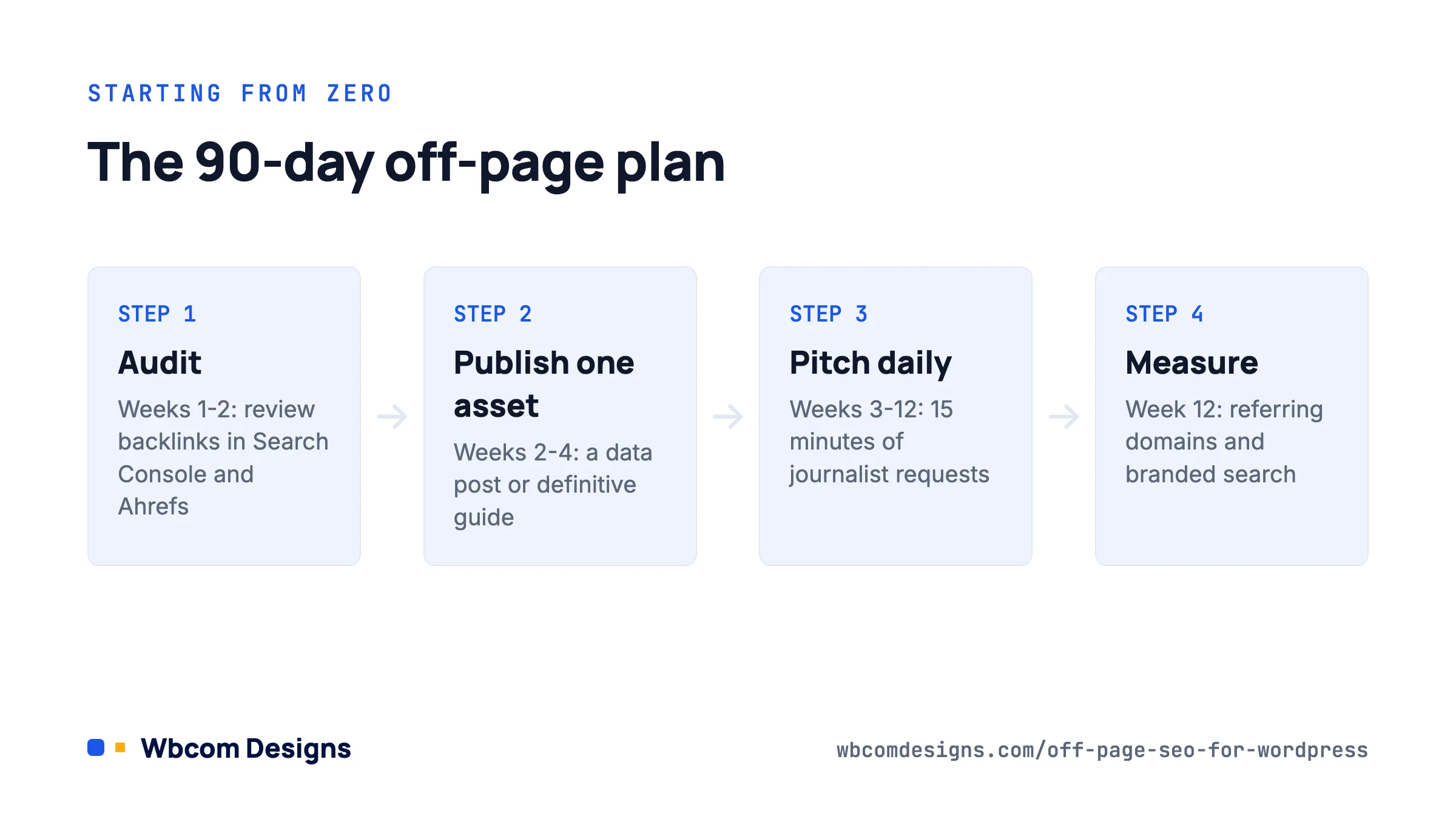
- Weeks 1 to 2: audit your existing backlinks in Search Console (Links report) and Ahrefs’ free Webmaster Tools. Note any obviously toxic patterns. Do not rush to disavow; Google ignores most spam links now and disavow is only for manual actions or clear negative SEO.
- Weeks 2 to 4: publish one linkable asset. A data post from your own numbers is ideal; a 3,000-word definitive guide with original diagrams is the fallback.
- Weeks 3 to 12: answer journalist requests daily, 15 minutes, first thing. Track pitches and placements in a spreadsheet.
- Weeks 4 to 8: email 30 sites that linked to similar (or dead) resources. Expect 3 to 5 links.
- Weeks 6 to 12: set up review requests in your post-purchase or post-support email flow. Claim and complete every relevant directory and partner listing.
- Week 12: measure referring domains, branded search impressions in Search Console, and rankings for your five target pages. Decide what to double down on.
If you are building a product company, this is roughly the plan we ran for our own plugin sites, and the content assets are still earning links years later. If you would rather hand it off, the services team handles the on-site groundwork that makes outreach pay.
Frequently asked questions
Do I need a disavow file?
Almost never. Google has said since 2020 that it ignores most spam links algorithmically. Use disavow only if you have a manual action for unnatural links or a clear negative SEO attack with thousands of new toxic links in a short period.
Is buying a sponsored post a waste if it is nofollowed?
Not if the site sends real readers. A sponsored post on a relevant publication brings traffic, brand awareness, and often natural follow-on links from people who read it. It just will not pass credit itself, and should not be bought for that reason.
How many links do I need to rank?
It depends entirely on who already ranks. Look at the top five results for your target query in Ahrefs or Semrush and check referring domains to the page (not the domain). If they average 40 and you have 3, you know the gap. If they average 5, your problem is probably content or intent, not links.
Does off-page SEO matter for AI search?
Yes, arguably more. AI Overviews, ChatGPT and Perplexity cite sources that are mentioned and linked widely across the web. Brand mentions on trusted sites, consistent entity information, and reviews are the same signals that drive citations.
What we’d do first
Spend the first month on one strong asset and a daily journalist-request habit. Both are free apart from your time, and together they produce the kind of links that no budget can buy cleanly. Add paid tools and outreach help once you can see which assets earn links on their own. And keep every paid placement marked as sponsored; the short-term gain from doing otherwise is not worth a manual action on a site you have spent years building.
Related reading
- Undelete a Wordpress Category
- Key Factors to Consider in an Seo Proposal Top 5 Essentials
- How to Safeguard Your Site Visitors Privacy With Vpn Security
- Identify Undervalued High Quality Link Opportunities in Any Niche
- Smart ux is a Retention Strategy That Can Scale Your Business if You Use it Well
- Community Content That Sells