
7 min read
BuddyPress User Surveys: What the Community Asked For


Every couple of years the BuddyPress core team has asked its users what to build next. The 2018 survey, which this post originally announced, was one of those rounds: 35 questions, open from December 2017 to January 2018, asking what BuddyPress should focus on that year. The answers from that survey and the ones around it shaped the template pack, the REST API and the direction the project took in 2023. If you run a BuddyPress site, knowing what other site owners asked for (and got) tells you a lot about where the plugin is strong, where it is thin, and how to get your own needs heard.
What the surveys were, briefly
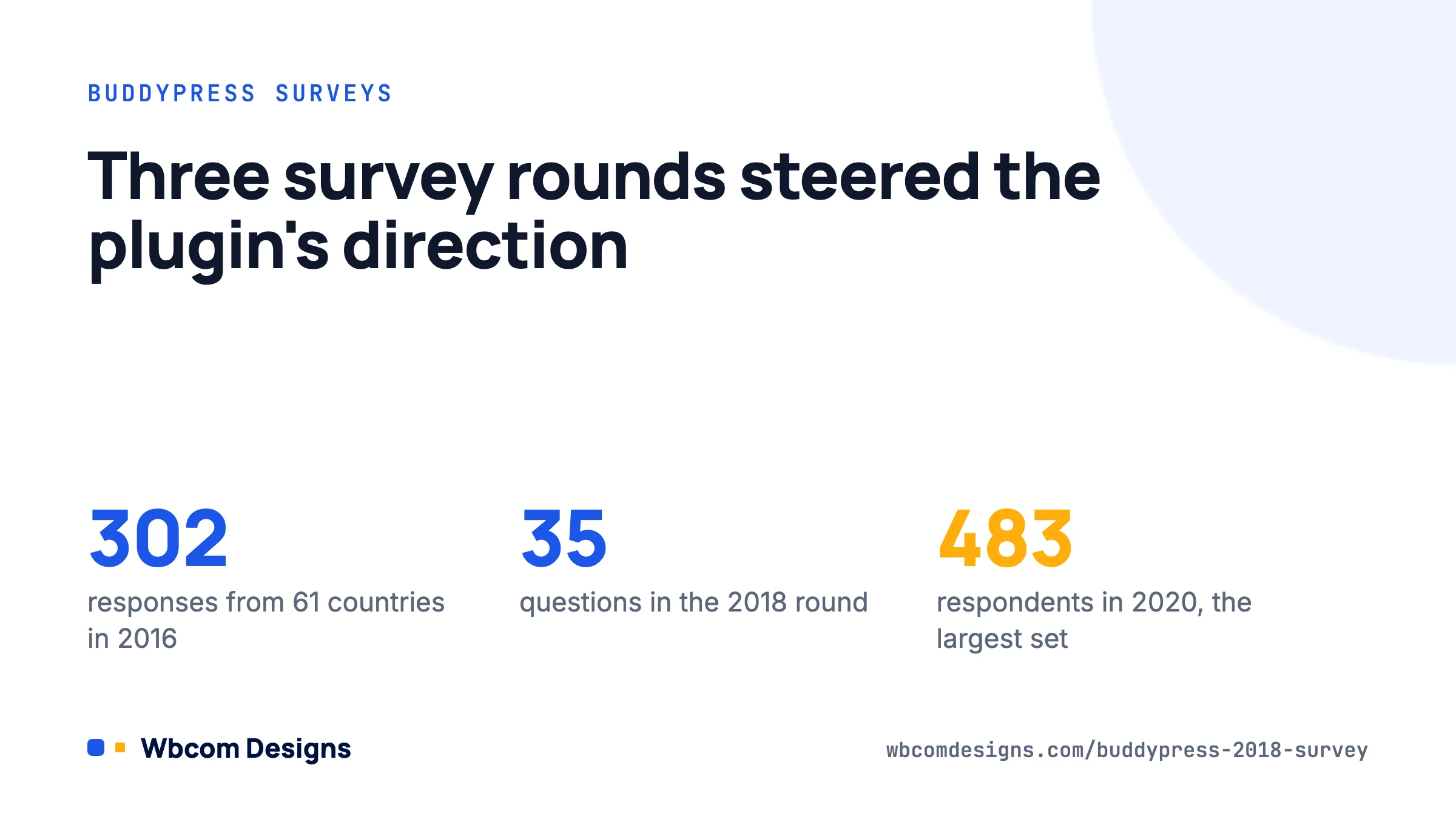
BuddyPress is maintained by volunteers, so surveys are how the team decides where limited hours go. The 2016 survey collected 302 responses from 61 countries. The 2018 survey ran next, and its raw results were folded into the comparison published with the 2020 survey results, which drew 483 respondents, the largest set so far. There has been no comparable public survey since 2020; from 2023 onward the team has set direction through a published roadmap series on buddypress.org and discussion on Trac and Slack.
Each round asked roughly the same things: who you are (site owner, developer, agency), what you build, which components you use, which theme, where you host, and what you want next. That consistency is what makes the results useful to compare.
What people build with BuddyPress
The site-type breakdown has been stable across every survey. In 2016 the top categories were generic communities (33 percent), academic (29 percent), sports (16 percent), artistic (15 percent) and gaming (12 percent). In 2020 academic communities led at 33.5 percent, with artistic at 18.3 percent and gaming at 14.2 percent, plus a long tail of health communities, recipe sites, intranets, nonprofits, marketplaces and dating sites.
Two things stand out. First, education is consistently the biggest single use, which is why LMS integrations (LearnDash, Tutor LMS, LifterLMS) matter so much to the ecosystem and why we build LearnDash add-ons that talk to BuddyPress groups. Second, nearly half of respondents in 2016 (45 percent) had been using BuddyPress for a year or less, and 62 percent were building for themselves rather than clients. BuddyPress is, and has stayed, a tool that people pick up to build their own thing.
Which components people actually use
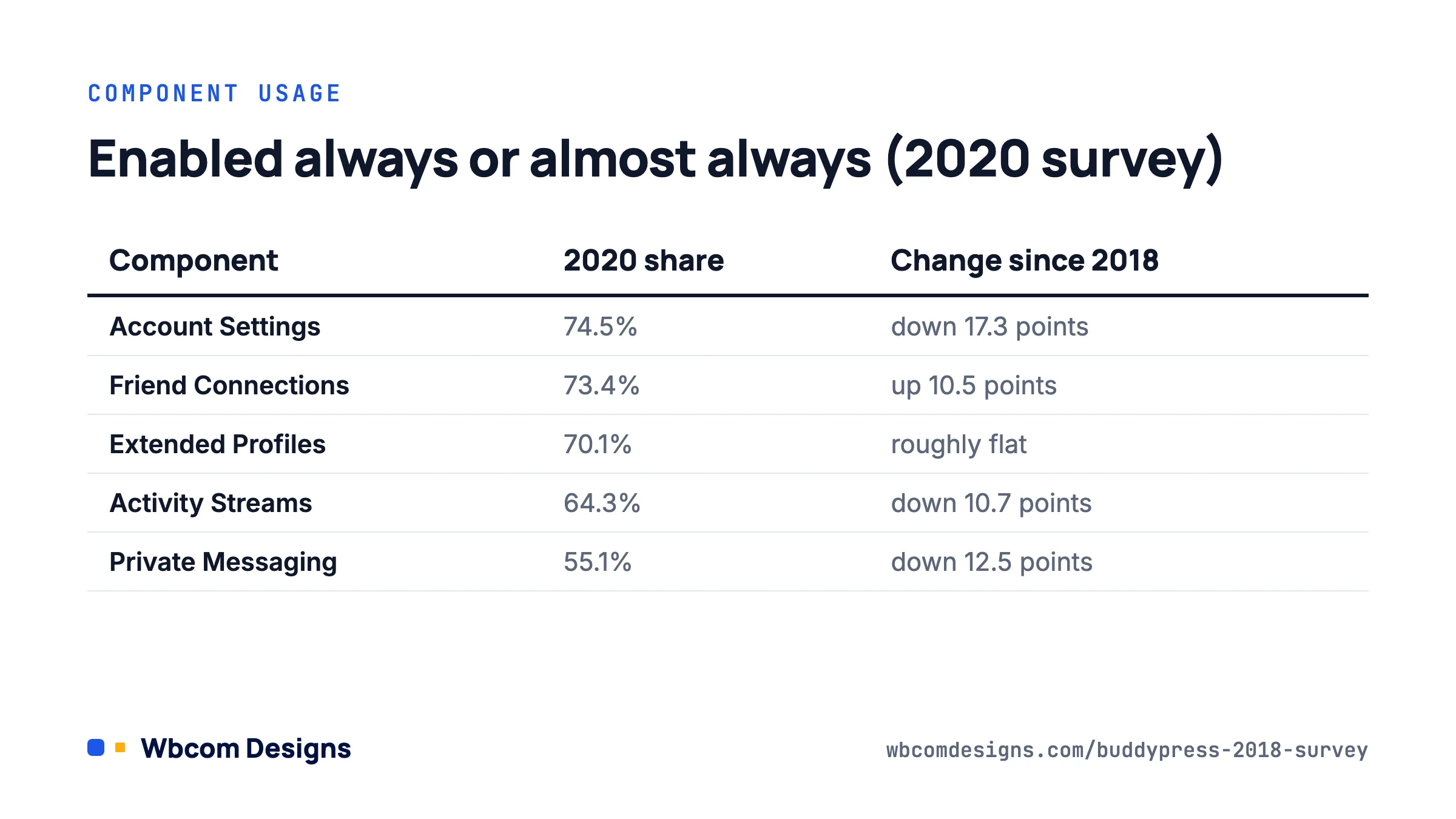
The 2020 results give the clearest picture of component usage, measured as the share of respondents who “always or almost always” enable each one:
| Component | Always or almost always enabled (2020) | Change since 2018 |
|---|---|---|
| Account Settings | 74.5% | down 17.3 points |
| Friend Connections | 73.4% | up 10.5 points |
| Extended Profiles | 70.1% | roughly flat |
| Activity Streams | 64.3% | down 10.7 points |
| User Groups | 55.4% | roughly flat |
| Private Messaging | 55.1% | down 12.5 points |
The drop in Activity Streams and Messaging between 2018 and 2020 surprised the core team. Our reading, from the sites we support, is that by 2020 a meaningful slice of BuddyPress users were running forums-first or courses-first communities where the activity stream is secondary, and some had moved messaging to external tools. The rise in Friend Connections fits the same story: profiles and connections are the durable core, the feed is optional.
For a site owner the practical lesson is to start with Profiles, Members and Groups enabled and add Activity and Messaging only when you have a reason. Fewer components means fewer settings to explain, fewer empty screens for new members and less to moderate.
What people asked for, and what happened
In 2016 the headline requests fed directly into two projects: the BP Nouveau template pack (shipped in BuddyPress 3.0, 2018) and the BP REST API (merged into core in BuddyPress 5.0, 2019). By 2020 Nouveau was the template pack on 63.3 percent of surveyed sites.
The 2020 feature requests were different in kind. “More customisation options” topped the list at 85.5 percent, followed by better bbPress compatibility (51.1 percent) and WooCommerce integration (44.7 percent). Asked whether BuddyPress should be split into modular plugins, 43.2 percent wanted it kept as one package and 35.6 percent preferred modules.
What came next is visible in the 2023 roadmap posts. The team restated the project’s purpose as “Get together safely, in your own way, in WordPress” and committed to a rewritten member and group URL system (BuddyPress 12.0, late 2023, which also moved legacy URL handling into the BP Classic plugin), blocks for community content (BuddyPress 14.x ships 15 blocks), and leaning on the REST API so themes and apps can build their own front ends. Customisation, in other words, came in the form of blocks and an API rather than more settings screens. The bbPress and WooCommerce asks were left to the ecosystem, which is where plugins like ours and themes like Reign, which bundles the WooCommerce and marketplace styling most people were asking for, come in.
Theme and hosting trends worth knowing
In 2020, 37.7 percent of respondents ran a free theme and 35.9 percent a commercial one, with the rest on custom builds. Managed WordPress hosting grew 8.3 points between 2018 and 2020. Both numbers point the same way: BuddyPress users increasingly want something that works out of the box and is maintained by someone else.
That is consistent with the support requests we see. The most common pre-sale question for BuddyX is not “can I customise it” but “does it already do X”. If you are choosing a theme for a new community, weight “maintained and tested against current BuddyPress” far above “has the most options”. A theme that lags BuddyPress releases by a year is the single most common cause of broken layouts we are asked to fix.
How to influence BuddyPress today
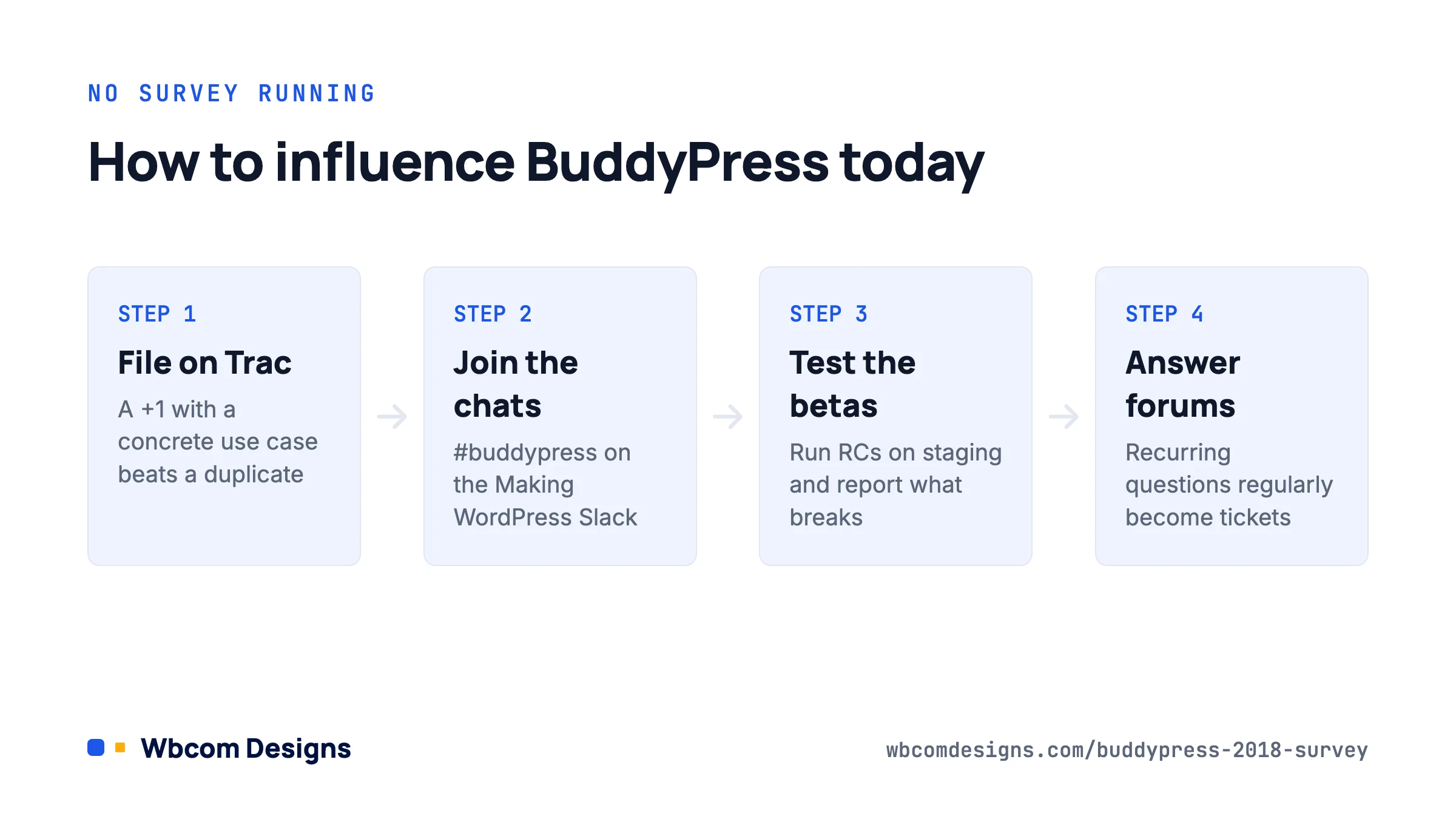
With no annual survey running, feedback goes through the project’s working channels. None of them require you to write code.
- Trac at buddypress.trac.wordpress.org is where features and bugs are tracked. Search before filing; a “+1” with a concrete use case on an existing ticket carries more weight than a duplicate. Attach screenshots and the BuddyPress, WordPress and PHP versions.
- GitHub mirrors core at github.com/buddypress/buddypress and accepts pull requests. If you have a patch, open it there and link it from the Trac ticket.
- Slack: the #buddypress channel on the Making WordPress Slack (wordpress.slack.com) is where dev chats and release planning happen. Watch buddypress.org for the current dev chat schedule, which changes with the release cycle.
- Support forums at buddypress.org/support. Core contributors read these, and recurring questions regularly turn into tickets.
- Testing betas and release candidates. Every minor and major release has a beta period announced on buddypress.org. Running the RC on a staging copy of your site and reporting what breaks is the highest-value contribution a non-developer can make.
- Translation via translate.wordpress.org if you run a non-English community.
The 14.5.0 security and maintenance release (July 2026) is a good example of this working: the REST API messages fix it shipped came from a responsible disclosure, and the Nouveau and Groups fixes came from forum and Trac reports.
Run your own survey before you build
The core team’s surveys are a model worth copying on your own community. Before you spend money on a feature, ask members. We run a short poll on every community we build at about the three-month mark, and it has killed more bad ideas than any amount of analytics.
- Keep it under ten questions. The BuddyPress surveys had 35 and the team noted drop-off; the 2020 respondent count of 483 was the highest for any single question, meaning many people quit partway.
- Ask about behaviour (“which of these did you use last month”) before preference (“which would you like”). Usage numbers are more honest.
- Offer one open text field at the end. The 2016 and 2020 write-in comments are where the template pack and REST API requests actually came from.
- Publish the results back to the community, as the core team does. It is the cheapest trust you will ever buy.
For the mechanics, WB Polls lets you post a poll straight into the activity stream or a group, which gets far more responses than an external form link. For anything longer, a survey form embedded on a members-only page works fine.
Frequently asked questions
Is the 2018 survey still open?
No. It closed on 31 January 2018 and the Polldaddy link in the original announcement no longer accepts responses. Its findings were published as part of the 2020 comparison.
Will there be another BuddyPress survey?
The team has not announced one since 2020. Direction is currently set through roadmap posts and Trac. If one is announced it will appear on buddypress.org and in the WordPress admin for sites with BuddyPress active.
Which BuddyPress version should I be on?
14.5.x as of August 2026, which requires WordPress 6.1 or later. The 12.7 and 11.6 branches received the same security fixes in July 2026, but only the current major gets new features and compatibility work.
Does the survey data say anything about BuddyBoss?
The core surveys did not separate BuddyBoss Platform users, and BuddyBoss forked from BuddyPress in 2019, between the 2018 and 2020 rounds. Treat the component usage numbers as BuddyPress-only.
Where to start
Read the 2020 results post once; it is the best single snapshot of who uses BuddyPress and why. Then audit your own site against it: are you running components nobody uses, on a theme that lags releases, without ever having asked members what they want? Fix those three things and you will have done more for engagement than any new feature. And when the next beta lands, install it on staging and file what breaks. That is how the project has always been steered.
Related reading