
9 min read
13 Best Uptime Monitoring Tools


An uptime monitoring tool checks your website at set intervals to confirm it is working. When a check fails, it alerts you by channels such as email, SMS, voice call or Slack, so you can bring the site back quickly. Most hosting providers include some monitoring, but they rarely cover every alert channel or check type you need.
Quick answer: The best uptime monitoring tool for most WordPress sites is UptimeRobot, whose free plan covers 50 monitors with 5-minute checks. Choose Uptrends or Pingdom for deeper synthetic and user monitoring, Site24x7 or Uptime.com for 1-minute checks from about $9 a month, and Jetpack Monitor if you only want a free downtime alert by email.
Last updated: 6 November 2026
Why do we need an Uptime Monitoring tool?
- It helps keep your service running by showing you when it stops.
- It checks your website around the clock and sends downtime alerts instantly.
- Confirmation from several locations cuts false alerts.
- Without monitoring, a site can stay down for a long time, which hurts customer experience and your reputation.
The internet is a complex system of regional lines, DNS systems that vary from ISP to ISP and layers of caching. A site can load for you and fail for a visitor in another country, so good tools check from several locations around the world.
How Much Downtime Does Each Uptime Level Allow?
| Uptime target | Downtime per year | Downtime per month (30 days) |
|---|---|---|
| 99% | About 3.65 days | About 7.2 hours |
| 99.9% | About 8.76 hours | About 43 minutes |
| 99.99% | About 52.6 minutes | About 4.3 minutes |
These figures are straight arithmetic on a 365-day year. They show why the check interval matters: a tool that checks every 5 minutes can take up to five minutes to notice an outage, while a 1-minute check cuts that to about one.
Uptime Monitoring Tools at a Glance
| Tool | Free option | Entry paid plan (USD, as shown 6 Nov 2026) |
|---|---|---|
| UptimeRobot | Yes: 50 monitors, 5-minute checks | Solo $10/month ($9 annual), 60-second checks |
| Uptrends | 30-day trial | Core from $46/month ($42 annual), 2-minute checks |
| Pingdom (SolarWinds) | Free trial (length not stated) | Not shown on the pricing page |
| Site24x7 | Free plan for up to 50 resources; 30-day trial | Web Uptime $10/month ($9 annual), 1-minute checks |
| StatusCake | Yes: 10 uptime monitors, 5-minute checks | Superior $24.49/month ($20.41 annual) |
| Uptime.com | No trial; 30-day money-back guarantee | Website Monitoring from $9/month, 1-minute checks |
| Host-Tracker | 30-day trial; limited free plan | Complete $9/month billed annually, 1-minute checks |
| ServiceUptime | Free account; 14-day trial | Start $5.95/month ($4.95 annual), 5-minute checks |
| SiteUptime | Yes: 1 monitor, 30-minute checks | Standard $10/month, 2-minute checks |
| Dotcom-Monitor | 30-day trial | Not shown on the homepage |
| Paessler PRTG | Free version with 100 sensors | PRTG 500 from $200/month billed annually |
| StatusGator | Free trial, no free plan | Not shown on the homepage |
| Jetpack Monitor | Yes: free with the Jetpack plugin, 5-minute checks | Not applicable |
Plan names, prices and limits come from each vendor’s own pricing page on 6 November 2026. They change often, so confirm them before you buy.
Best Uptime Monitoring Tools
1. UptimeRobot

UptimeRobot is the most popular choice for small sites because its free plan is generous. The free plan includes 50 monitors with a 5-minute check interval and covers HTTP, port, ping, keyword, API, UDP, DNS and SSL or domain expiry monitoring. It also includes 5 integrations, one basic status page and 3 months of data retention. The pricing page describes the free plan as good for personal and commercial projects.
Paid plans are Solo ($10 per month, $9 on annual billing, 60-second checks), Team ($41, or $35 annually, 30-second checks) and Scale ($77, or $65 annually, 15-second checks), plus a custom Enterprise plan.
2. Uptrends

Uptrends monitors websites, APIs and servers and alerts you when something breaks. Core starts from $42 per month on annual billing ($46 monthly) with uptime checks every 2 minutes and US and EU checkpoint regions. Pro starts from $60 on annual billing ($66 monthly) with 1-minute checks, API and transaction checks, and more than 230 global checkpoints. Enterprise offers 30-second checks and lightweight checkpoints for monitoring internal services behind a firewall.
A 30-day free trial gives full Enterprise access.
3. Pingdom (SolarWinds)

Pingdom from SolarWinds combines synthetic monitoring, which runs scripted checks against your site, with real user monitoring, which measures actual visits. Plans are named Synthetic Monitoring, Real User Monitoring and Enterprise, and are sized by the number of uptime checks, advanced checks, SMS alerts or pageviews. The pricing page offers a free trial that covers both products but did not show prices or the trial length when checked, so confirm them with the vendor.
4. Site24x7
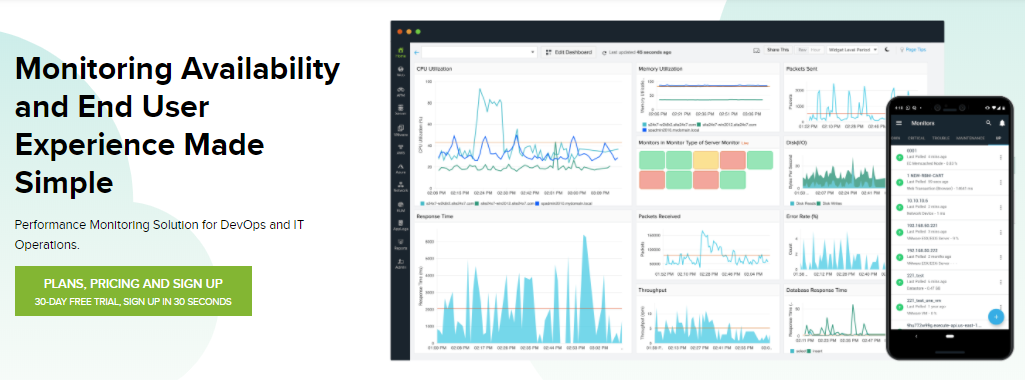
Site24x7 offers website monitoring plans named Web Uptime, Web Perf and Enterprise Plus Web. Web Uptime is $10 per month ($9 billed annually) for 25 websites with 1-minute polling from one location. Web Perf is $39 per month ($36 annually) for 40 websites from eight locations. Enterprise Plus Web is $999 per month ($899 annually) with 30-second polling and 16 locations.
The page offers a 30-day free trial with no credit card, and lists a free forever plan for uptime monitoring of up to 50 resources.
5. StatusCake

StatusCake is a website uptime and performance monitoring service that is quick to set up. The free plan includes 10 uptime monitors with 5-minute tests, one page speed monitor, one domain monitor and one SSL monitor. Paid plans are Superior ($20.41 per month annually, $24.49 monthly) and Business ($66.66 annually, $79.99 monthly), plus a custom Enterprise plan. The pricing page does not state how many test locations StatusCake runs.
6. Uptime.com

Uptime.com lists Website Monitoring from $9 per month with 1-minute checks. The page advertises 100+ probe servers worldwide with IPv4 and IPv6 support, alerts by email and SMS, and more than 20 integrations. It covers uptime, transaction, API and page speed monitoring. There is no free trial, but the site offers a 30-day money-back guarantee for new users.
7. Host-Tracker

Host-Tracker checks your site from 300+ checkpoints worldwide and supports HTTP and HTTPS, ping, TCP port, API, transaction, content, SSL and domain expiry checks, among others. It can alert you by email, SMS, phone call, webhook, Slack, Teams, PagerDuty and other channels. It offers a 30-day free trial and a limited free plan that checks every 30 minutes.
Paid plans billed annually are Complete ($9 per month, 10 monitors, 1-minute checks), Webmaster ($14), Business ($29, 25 monitors) and Enterprise ($99, 150 monitors).
8. ServiceUptime

ServiceUptime monitors your site from outside your network and verifies each detected problem from several locations before it sends an email or SMS alert. It needs no software to install. Plans are Start ($5.95 per month, 3 monitors, 5-minute checks), Standard ($9.95, 6 monitors) and Advanced ($29.95, 3 monitors, 1-minute checks), with lower prices on annual billing. A free monitoring account and a 14-day trial of premium monitoring are offered.
9. SiteUptime

SiteUptime checks from 11 locations across 4 continents and confirms failures from an alternate location before alerting. The Free plan allows 1 monitor with 30-minute checks. Standard ($10 per month) gives 3 monitors with 2-minute checks, and Pro ($20) gives 6 monitors with content monitoring, a public status page and webhooks.
Monitor types include web server, SSL, page content, DNS, POP3, SMTP, HTTP password protection, custom TCP ports, FTP and ping.
10. Dotcom-Monitor

Dotcom-Monitor has provided website monitoring since 1998. It monitors web applications, websites, APIs and SSL certificates, with Lighthouse and Playwright monitoring, DNS, email server, VoIP and port checks, and load testing. The site cites 30+ monitoring locations and a 30-day free trial with all premium features. Plan prices are on a separate page.
11. Paessler PRTG
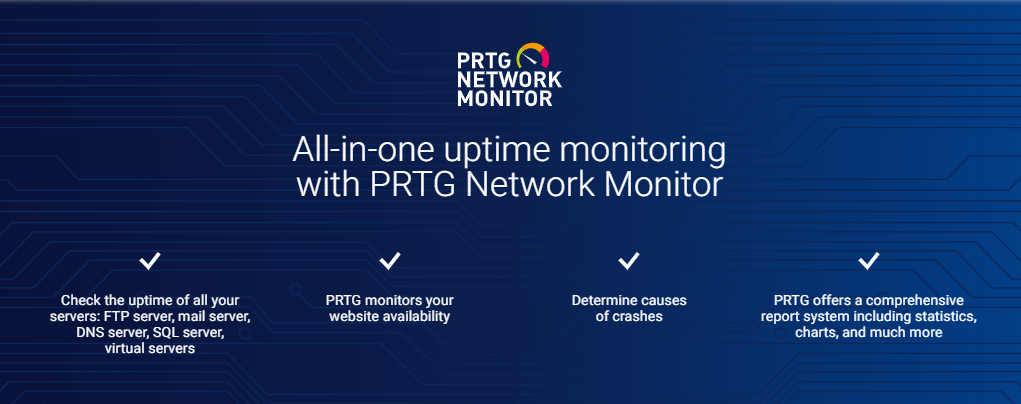
PRTG from Paessler is a network monitoring product with sensors for ping, SNMP uptime, Windows system uptime, TCP ports, HTTP and SSL certificates, so it suits servers and internal systems as well as websites. A free version includes 100 sensors with no time limit. Paid PRTG Network Monitor licences start at PRTG 500 for $200 per month billed annually, covering about 50 devices. You can install it on Windows or use the cloud-based PRTG Hosted Monitor.
12. StatusGator
StatusGator tracks the status pages of more than 12,480 cloud and SaaS services, so you learn when a provider you depend on, such as hosting or a payment gateway, has an outage. It also offers website and ping monitoring, uptime history and a branded status page for your team or customers. Plans are Business, Enterprise and Education, and there is a free trial with no credit card but no free plan.
13. Jetpack Monitor (WordPress)
If you run WordPress, Jetpack Monitor is a free downtime alert that needs only the Jetpack plugin and a working connection. A server checks your homepage every 5 minutes, and the site is marked down only after three servers in different locations also fail to reach it. Alerts go by email to the WordPress.com account that connected Jetpack, and you can add push notifications through the Jetpack or WordPress mobile apps. You cannot add other recipients, so teams should use a dedicated tool above.
The Jetpack plugin has more than 3 million active installations and was updated on 3 November 2026 (version 16.4).
How To Choose an Uptime Monitor
- Check interval. A 5-minute interval can leave an outage unnoticed for up to five minutes; 1-minute checks cut that gap.
- Locations. Choose a tool that confirms failures from more than one location to avoid false alarms.
- Alert channels. Make sure it can reach you the way you will actually respond, such as SMS, phone or Slack.
- Monitor types. Websites need HTTP and SSL checks; shops also benefit from transaction checks on checkout.
- Status page. A public status page tells visitors what is happening during an outage.
Security issues are a common cause of outages, so pair monitoring with the cybersecurity tools you already use.
Uptime Monitoring Tools - Final Words

Downtime costs you visits and sales, and customers who hit an error may not return. Do not wait for them to report the problem. Start with a free plan from UptimeRobot, StatusCake or Jetpack Monitor, and move to a paid tool when you need faster checks, more locations or transaction monitoring.
Frequently asked questions
What is the best free uptime monitoring tool?
UptimeRobot has the most generous free plan, with 50 monitors and 5-minute checks. StatusCake offers 10 uptime monitors with 5-minute tests, and Jetpack Monitor is free for WordPress sites with the Jetpack plugin.
How often should an uptime monitor check my site?
Every 1 to 5 minutes suits most sites. A 5-minute check can take up to five minutes to notice an outage, so shops and busy sites usually pay for 1-minute checks or faster.
What is a good uptime percentage?
99.9% allows about 8.76 hours of downtime a year, and 99.99% allows about 52.6 minutes. Compare your monitor’s report with any uptime promise your host makes.
Does uptime monitoring slow down my website?
Not noticeably. The checks are small requests from outside servers, and they appear in your logs as ordinary visits.
Is Jetpack Monitor enough for a WordPress site?
For a personal or small business site, yes. It checks every 5 minutes and emails one address. If you need several recipients, SMS or faster checks, add a dedicated tool.
What is the difference between uptime monitoring and a status page?
Uptime monitoring tells you a site is down. A status page tells your visitors. Tools such as UptimeRobot, Uptime.com and StatusGator include status pages.
Related reading