
11 min read
Running a Tech Workshop Before You Write the First Line of Code

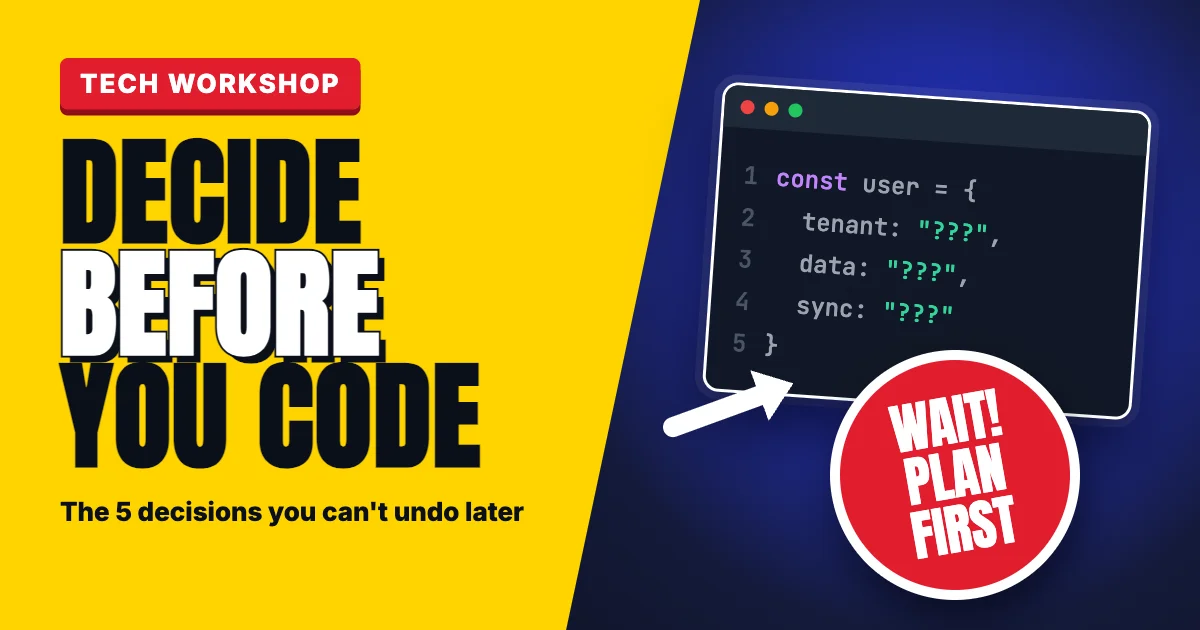
The first week of coding settles questions nobody remembers deciding. A developer picks a shape for the user record, and that shape governs permissions, billing and reporting for years.
Those choices are not wrong when they happen. They are made by whoever is typing, under time pressure, with partial information about where the product is going.
A tech workshop exists to move that set of decisions forward by two weeks and into a room with the people who carry the consequences.
Decisions that cost the most to reverse
Most technical choices are cheap to change later. A handful are not, and those deserve the whole agenda. The data model comes first on that list. How you represent an account and a user decides what stays easy and what turns impossible for years.
Identity and tenancy follow right behind it. Single-tenant or shared, one organisation per user or many, both reach into every screen.
The integration pattern is the third of them. A product that pulls on demand behaves differently from one that syncs nightly, and switching is close to a rebuild.
Hosting and data residency come next. A customer in a regulated market will ask where records live, and moving them later is a project. Platform coverage belongs on the list too. A web-only product that later needs native apps carries assumptions a mobile app development company works around. Hire a mobile app development agency later and it inherits those assumptions without a say.
Build the agenda backwards from reversibility
Rank the open questions by what it costs to change your mind in month six. Spend the day on the top five and leave the rest to delivery.
That ranking is the whole method. It keeps the session off the topics engineers enjoy debating and on the ones quoted back to you in a year.
Put a time box on each item. Ninety minutes is enough to choose between two documented options.
Bring two documented options per question. A web development agency arriving with one recommendation is pitching, and one arriving with five has not filtered. Leave the cheap decisions open on purpose. Writing down that the email provider is undecided stops it becoming an unlogged choice.
What you bring into the room
The output depends almost entirely on the inputs you supply, and none of them need preparation beyond collecting what exists.
Start with a systems inventory you already have. Every tool that holds customer data, with its owner and whether it has an API, changes the integration conversation.
Add your real data volumes next. Record counts, peak users and the size of your largest export separate an architecture that holds from one that looks fine on a slide.
Bring the compliance constraints in writing. Retention rules and audit obligations are design inputs, not paperwork to resolve afterwards. Then bring an honest read of your own team. What your engineers can maintain after the supplier leaves narrows the choices, and web development services bought later get priced against it.
What the session is not allowed to skip
Three outputs make a tech workshop worth its fee, and every agenda should name them before you agree to the date.
The first is a written position on each irreversible decision, with the alternatives recorded.
The second is an estimate range per option, so the cost of the safer choice is visible.
A web development agency that cannot price both options has not thought either through.
The third is a scoped first sprint, which stops the team spending week one deciding what to start. Anything beyond those three is optional, and maturity assessments settle nothing.
Who has to be in the room
Three people from your side decide whether the day works. Without any of them, it produces notes instead of decisions.
Somebody with authority to say no. Without them every hard question moves to a follow-up that happens after coding starts.
The person who owns the data. They know which fields are trustworthy and which the finance team still relies on.
Whoever keeps the legacy integration alive. That knowledge rarely sits in documentation and usually changes the plan. Keep the room small on both sides. Four from your side and three from the supplier beats a dozen attendees who each need context.
The decision record, entry by entry
The output is a document, and its usefulness depends on structure rather than length. Each entry answers the same five questions.
What was decided, in a sentence a non-engineer can read, and which alternatives were set aside.
What this decision makes harder later, stated plainly. Then the owner by name, and what would make the team revisit it.
That last field is the one teams skip and later need. A decision with a revisit trigger is a plan, without one it is a belief. Give the record to everyone who quotes on the work. A website development company reading the reasoning prices differently from one reading a feature list. For a mobile app development company the platform entries matter most.
Debt created before the first commit
Technical debt has a reputation as something teams accumulate through haste. A good share of it gets chosen on day one.
According to Gartner, about 40 percent of infrastructure systems across asset classes have technical debt concerns. (Gartner, 2026)
Read that as a reason to decide deliberately. Some debt is a reasonable trade, and the workshop is where you take it knowingly.
Name the debt you accept in the record. A shortcut with an owner and a revisit date behaves differently from an unspoken one.
What skipping the workshop usually costs
The saving is real and so is the exposure. Two weeks of senior time is visible, and a rebuild in month twelve is larger and later.
According to Phenomenon Studio, a $10,000 to $20,000 discovery phase that prevents a $50,000 redesign twelve months later delivers a significant return. (Phenomenon Studio, 2026)
The same arithmetic applies to technical scoping.
One avoided data migration usually covers the cost of the session several times over.
None of this makes the workshop mandatory at every size. A small marketing site needs nothing of the kind, and web design services for it can start the same week.
The thin slice that follows
A workshop that ends in a document has done half the job. The other half is a sprint that tests the riskiest decision in code.
Pick the thinnest slice through the hardest assumption. One record created through the real integration and visible on one screen. Two weeks is usually enough for that slice. The slice confirms the decision or exposes the gap early, and that timing saves money.
Ask whoever handles web app development to size that slice during the workshop. An estimate produced in the room is more honest than one written afterwards.
Web app development teams also flag the decisions that look cheap on a slide and cost a fortnight in code.
Why two options get priced, not one
Each hard decision should leave the room with a number attached to both answers. The cheaper option is only cheaper once you can see what the other one costs.
Single-tenant and shared tenancy, for instance, price differently at build time and again at every compliance review. Seeing both figures turns an architecture debate into a commercial choice.
Insist on the same treatment for integrations. A nightly sync and a live connection differ by weeks of work. Then hand the numbers to whoever owns the budget. A tech workshop that ends without per-option pricing has given your engineers a preference and your finance team nothing.
Keep both figures in the record. In month eight somebody will ask what the other path would have cost, and the answer should not be a recollection.
How our teams run this on FinTech products
On FinTech builds we put the verification flow on the agenda before anything else. KYC and AML requirements reach into the data model, the audit trail and the onboarding screens at once. Deciding them late is the most expensive mistake on offer.
Our engineers walk through the provider’s sandbox during the session.
The gap between a published API and its real behaviour has moved more of our estimates than any internal disagreement.
We work with the client’s compliance officer in the room, since their constraints are design inputs we cannot guess. That hour settles questions the product team had planned to resolve over weeks.
The session opens a long engagement for us, and our strategists then build with the client team through the first sprints. They keep the decision record current as the build moves.
Expert insight
The measure worth applying to these sessions is the number of questions they kill, in the view of Oleksandr Kostiuchenko, Marketing Manager at Phenomenon Studio. Count the open items the team carried into the room and how many are still open when it closes.
A session that closes most of them has paid for itself before any code exists. One that produces a longer list of questions has told you the product is not ready to be built yet.
What a workshop cannot do
It cannot tell you whether anyone wants the product. That answer comes from users, and no amount of architecture discussion substitutes for it. A tech workshop also replaces no roadmap. It decides how to build what you chose, and choosing stays with you.
It will not settle interface questions in any depth. A UX design agency needs its own sessions with users, and mixing the two produces shallow versions of both.
Book a UX design agency separately once the data model is settled.
And it cannot fix an absent owner. Decisions need somebody to make them, and advisers do not supply that.
Where design and brand work fit around it
Interface work can run in parallel once the data model is settled. Before that, screens get drawn against assumptions that may not survive the week.
Identity work sits further out from the build. Branding companies work on a different clock, and website design services can start in parallel because a marketing page waits on none of these decisions. Website design services and product architecture share almost no decisions, and bundling them hides both.
Branding companies need different inputs from you: positioning and audience research rather than systems and volumes.
Sequence the two so nothing waits. A web design agency can start on the marketing site while the technical decisions are still being written up.
Common mistakes with a pre-build workshop
- Filling the day with technology comparisons instead of the decisions that are hard to reverse.
- Running it without anyone who can say no, so every hard question becomes a follow-up.
- Arriving without real data volumes, which turns the architecture discussion into guesswork.
- Treating the output as a document to file rather than as the brief every supplier quotes against.
- Mixing interface research into the same session, so both sets of questions get shallow answers.
Who else needs a copy of the record
The document is usually treated as an engineering artefact and read by three people. Four other groups work better with it in hand.
Whoever builds the marketing site needs the parts about accounts and sign-up. Website design services designed around a trial that does not exist get rebuilt.
Your design suppliers need the tenancy and roles entries. A web design agency and a UX design agency both draw navigation from that section, whether or not they ask for it. Branding companies need almost none of it, beyond the product naming that ends up in their messaging work.
Your own support lead should read the exclusions. Marketing teams promise what they read, and support answers for whatever actually shipped.
Questions to send before you book the session
Four questions sort a useful supplier from a pleasant one, and all four can be answered by email.
Which decisions do you expect to close on the day, based on what we have sent you. Specific answers show the brief was read.
Who attends from your side, by name and role. Web development services sold by one team and delivered by another show the gap here first. What do we keep if we do not proceed. The record, the estimates and the sprint scope should be yours.
And how does the fee behave if we continue. A web design agency answers that differently from a mobile app development agency, and either answer is negotiable.
What it costs and how to scope it
A tech workshop runs one to three days, set by how many irreversible decisions are open. Longer usually means discovery was skipped.
Keep the list of deliverables short. A decision record, a risk list, an estimate range per option and a scoped first sprint are enough.
Ask for the record within three working days. Documents written a fortnight later lose the detail you paid for.
Then read it against your own plan before anyone starts.
Reading it first makes UI UX design services and the build itself move faster.
Making the call
Count the decisions that would cost more than a month to reverse. One or two mean a short session, five mean the full exercise. If the answer is none, start building. Mobile app development services for a simple app rarely need a formal session first.
Anything above that threshold is worth two days. The product that follows is the same one, decided on purpose instead of by whoever typed first.
Frequently asked questions
How long should a pre-build workshop take?
One to three days for most products, set by the number of hard-to-reverse decisions rather than product size. A single day covers two or three of them properly. Anything longer usually means discovery is missing underneath.
Can our own engineers run it instead of a supplier?
Yes, and what an outside team adds is having seen the same decision fail elsewhere. In-house sessions skip options nobody present has used. Writing the record the same way matters more than who facilitates.
What if we do not know our data volumes yet?
Bring the range you would be disappointed and delighted by, then design against the upper end of year one. Stating that assumption in the record is what matters. A website development agency can price two scenarios instead of guessing one.
Does this replace a discovery phase?
No, because they answer different questions. Discovery tells you what to build and for whom, while a technical session decides how. Running the technical one first produces a well-engineered product nobody asked for.
Is it worth running for a mobile product specifically?
Often more so, since offline behaviour and store requirements are hard to retrofit. A mobile app development agency raises those in the session rather than in month four. Native and cross-platform choices belong in the record too.
Related reading