
10 min read
10 Best Low-Code Platforms to Build Next-Gen Apps


Software is the backbone of modern business, but traditional development is slow, expensive, and resource-heavy. Companies need ways to move fast without sacrificing quality. That is where low-code platforms come in.
These platforms let teams build applications with visual modeling, pre-built components and automation, then add custom code where a project needs it. Enterprises use them for workflow automation, customer portals, internal tools and increasingly for AI agents that sit inside business processes.
Demand for next-generation apps is growing across industries. Whether you are building a custom CRM, an approval workflow or an internal dashboard, the right low-code platform shortens the path from idea to a working app.
Last updated: 7 November 2026
Quick answer
The best low-code platform depends on your stack and budget. Mendix and OutSystems suit large enterprise builds, Microsoft Power Apps fits Microsoft 365 shops, Google AppSheet suits teams working from Sheets data, and Zoho Creator and AppSheet have the lowest published per-user prices here. Mendix, OutSystems, Power Apps, Appian and AppSheet all offer a free way to start.

Low-code platforms compared
| Platform | Best for | Free way to start | Published price |
|---|---|---|---|
| Mendix | Enterprise apps | Free plan, Mendix Cloud only | Standard from €918/month (one app) or €2,295/month (unlimited apps) |
| OutSystems | Large-scale, cloud-native apps | ODC Personal Edition (development only) | Quote based, no public price list |
| Microsoft Power Apps | Microsoft 365 and Azure teams | Developer Plan (not for production) | Premium $20 per user/month, paid yearly |
| Appian | Process automation | Community Edition | Per user, per month, per app; contact Appian |
| Zoho Creator | Small business and startups | 15-day trial, Free Edition with one app | Standard $12/month or $8 billed yearly, per user |
| Salesforce Platform | Salesforce-centered CRM apps | Free developer trial | Not listed on the platform page |
| Betty Blocks | Business users plus developers | See vendor trial terms | Check the vendor pricing page |
| Quickbase | Workflow and project tracking | Check vendor | Check the vendor pricing page |
| Google AppSheet | Apps built on spreadsheet data | Free for up to 10 test users | Starter $5, Core $10, Enterprise Plus $20 per user/month |
| Pega | Case management and customer engagement | Platform Trial | Not published; contact Pega |
Prices are the vendors’ published list prices as read on 7 November 2026, in the currency each vendor shows. Taxes, regional pricing and discounts change the final number, so confirm on the vendor’s page before you buy.
What Are Low-Code Platforms?
Low-code platforms simplify application development by replacing much of traditional coding with visual tools, drag-and-drop components, and automation. Instead of writing thousands of lines of code, users assemble software from pre-built modules, which cuts development time and complexity.
These platforms cater to both technical and non-technical users. Developers use them to speed up workflows, while business professionals can build functional applications without deep programming knowledge. Many low-code platforms also support scripting and API integrations, which allows custom features and room to scale.
Businesses use low-code platforms for everything from internal workflow automation to customer-facing solutions. They reduce reliance on large development teams and help companies adapt quickly when requirements change.
For the wider picture, including where no-code fits, see our posts on the rise of no-code and low-code platforms and no-code tools for business.
Why Low-Code Platforms Matter
Speed and efficiency define success in business today. Companies cannot afford long development cycles, and IT teams are often overwhelmed with requests. Low-code platforms address this by enabling faster delivery with fewer resources.
They can also reduce costs. Traditional app development needs skilled developers, project managers, and months of testing. Low-code platforms offer pre-built components and ready connectors to existing systems, which removes a share of that work.
How to Choose the Best Low-Code Platform to Build Next-Gen Apps
Finding the right low-code platform depends on your goals, scalability needs, and technical requirements. Some platforms excel at enterprise-grade applications, while others prioritize ease of use for non-developers.
Define your needs. First, decide what you are building: internal tools, AI-powered apps, or large-scale enterprise solutions. For complex applications, OutSystems and Mendix are common shortlist picks. For a budget-friendly option aimed at small businesses, Zoho Creator is a good fit.
Check scalability and security. As your business grows, your applications must scale with it. Mendix, Pega, Appian and OutSystems all target enterprise buyers, so ask each vendor for its security and compliance documentation (for example GDPR or HIPAA support) rather than assuming it.
Look at AI and automation. Several vendors now position their platforms around AI agents. OutSystems describes Developer Cloud as an agentic systems platform, Pega promotes its Blueprint tool for turning workflows into build-ready applications, and Betty Blocks describes prompt-based app generation.
Test usability. Usability can make or break the development experience. Use the free tiers and trials in the table above to build one small app on two or three platforms before committing.
Check pricing. Pricing structures vary widely. Zoho Creator and Google AppSheet publish low per-user prices, Mendix publishes monthly plan prices, and OutSystems, Appian and Pega work on quotes, so enterprise budgets need a sales conversation.
Look for support and community. A strong support system and an active user community improve the experience. Microsoft Power Apps and Salesforce both have extensive documentation and forums.
Best Low-Code Platforms to Build Next-Gen Apps
1. Mendix
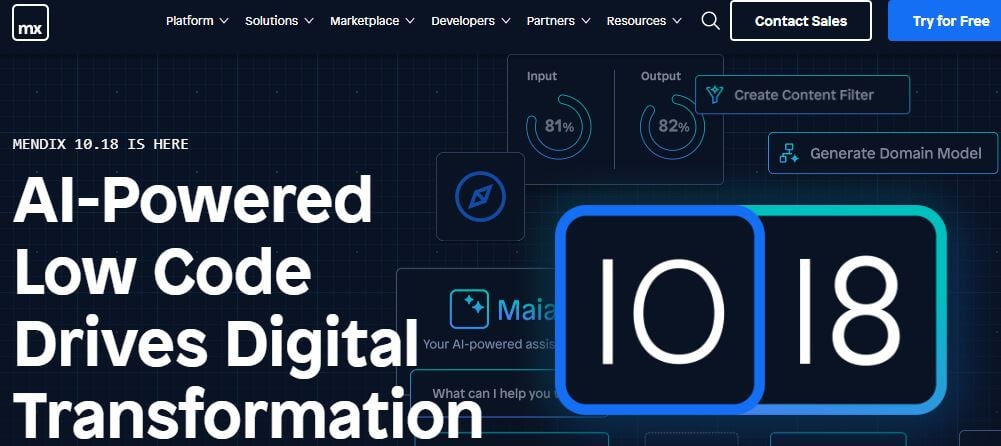
Mendix is built for businesses that need rapid application development without compromising on security. It offers AI-assisted development, collaborative development tools and cloud deployment.
Its visual interface speeds up the design process, and built-in automation tools enhance efficiency. The Mendix pricing page lists a Free plan at €0 with unlimited users for demos, prototypes and small applications (Mendix Cloud only), Standard plans from €918 per month for one app or €2,295 per month for unlimited apps, and quote-only Premium. Standard and Premium prices do not include cloud compute costs. See the Mendix pricing page.
2. OutSystems
OutSystems is one of the best low-code platforms to build next-gen apps, offering advanced features for large-scale applications. It describes OutSystems Developer Cloud (ODC) as a cloud-native, agentic systems platform that runs on AWS with each application in its own isolated container.
You can try it free through ODC Personal Edition, which allows up to 100 internal users and 1 GB of database storage. It has a development stage only, is not meant for production, enters hibernation after 72 hours without activity, and has best-effort support with no SLA. Paid plans are not on a public price list. Details are in the OutSystems Personal Edition FAQ.
3. Microsoft Power Apps
Microsoft Power Apps integrates with Microsoft 365, Azure, and Dynamics 365, which makes it a natural choice for businesses already using these tools. It lets teams automate workflows, build internal tools, and develop customer-facing applications with a large library of connectors.
Microsoft’s pricing page lists a free Developer Plan (three developer environments, a 2 GB Dataverse database, up to 750 automation flows per month) for building and testing only. Running apps in production needs a paid license such as Power Apps Premium at $20.00 per user per month paid yearly, or $12.00 with a 2,000-seat minimum. Microsoft notes that displayed prices are for marketing purposes and may differ at checkout. See Power Apps pricing.
4. Appian
Appian combines low-code development with AI-driven automation, which suits businesses looking to streamline operations. Its drag-and-drop interface lets users design applications while integrating AI, RPA, and workflow automation.
Organizations use Appian to automate business processes and reduce manual errors. Appian lists Standard, Advanced and Premium tiers, licensed per user, per month, per app, with differences in data row limits, RPA bots and monthly AI actions. It does not publish prices, but it offers a free Community Edition with access to a dedicated platform instance. See Appian pricing.
5. Zoho Creator

Zoho Creator is an affordable low-code platform tailored for small businesses and startups. It lets users build web and mobile applications without advanced programming knowledge, with automation features and integration with other Zoho products.
Companies use it for customer portals, workflow automation and internal data management. Zoho lists Standard at $12 per user per month ($8 billed yearly), Professional at $30 ($20 yearly) and Enterprise at $37 ($25 yearly), and shows local prices by country, for example ₹480 per user per month for Standard billed yearly in India. There is a 15-day trial and a Free Edition with one custom app. See Zoho Creator pricing.
6. Salesforce Platform (Lightning)
Salesforce is designed for businesses that want to build applications inside the Salesforce ecosystem and improve CRM, automation and customer engagement. Salesforce now describes its platform as a base for AI agents, data, integration, security and apps, with Agentforce as the headline low-code and agent capability.
Its security and scalability make it a common choice for enterprises managing large customer databases. Salesforce offers a free trial of a non-production development environment, and the platform page does not list prices. See the Salesforce Platform page.
7. Betty Blocks
Betty Blocks describes itself as an AI application generation platform built for digital sovereignty. Its site highlights prompt-based app generation, support for connecting any LLM, MCP server integration, AI portals and AI agents.
Companies use it to create apps without relying on full development teams, with customization available for developers. Pricing and trial terms sit behind the vendor’s own pages, so check them before you commit. See Betty Blocks.
8. Quickbase
Quickbase (often written Quick Base) focuses on workflow automation and process management. It positions itself as a work and complex project management platform, and its current headline product is Pave, an AI app builder that creates custom software from a plain-language description of the work.
Its automation tools help teams track projects, manage resources and cut manual work. Plan names and prices sit on the vendor’s own pricing page, so check it before you commit. See Quickbase.
9. Google AppSheet
Google AppSheet lets users create applications without writing code. It connects with Google Sheets, Excel, and other data sources, which makes it a good option for businesses that want to build on their existing data.
AppSheet lists Starter at $5, Core at $10 and Enterprise Plus at $20 per user per month, with Core included in most paid Google Workspace plans. The free tier allows prototyping with up to 10 test users and no time limit, and Publisher Pro costs $50 per month per app for public apps without sign-in. See AppSheet pricing.
10. Pega

Pega stands out for its focus on customer engagement and process automation, and describes its platform as a way to orchestrate agents, people and systems. Its latest release is listed as Pega Infinity ’26.
Pega promotes Pega Blueprint as a way to go from idea to application quickly, and offers a Platform Trial. Prices are not published. Compliance-heavy sectors such as finance, healthcare and telecom are typical buyers, so confirm that the platform meets your own regulatory requirements. See Pega Platform.

The Future of Low-Code Development
Low-code platforms are redefining how businesses build software. They accelerate development, can lower costs, and make application creation accessible to both developers and non-technical users. The newest shift is AI: nearly every vendor above now sells prompt-based app generation or AI agents on top of its visual tooling.
That does not remove the need for planning. Data models, security reviews and ownership of the finished app still decide whether a project succeeds. Pick the platform that fits your existing stack, run a small pilot, and scale from there.
Frequently asked questions
What is the best low-code platform for beginners?
Zoho Creator and Google AppSheet are the easiest starting points in this list. Zoho Creator offers a Free Edition with one app and a 15-day trial, and AppSheet is free for up to 10 test users, so you can build a real app before paying.
Are low-code platforms free?
Most offer a free way to start, but not free production use. Mendix has a free plan, OutSystems has ODC Personal Edition, Power Apps has a Developer Plan, and Appian has a Community Edition. Production apps usually need a paid license.
What is the difference between low-code and no-code?
No-code tools let non-developers build apps entirely through visual interfaces. Low-code tools do the same but expect developers to add custom code or integrations when the visual tools run out. Our guide to no-code tools for business covers the other side.
Which low-code platform is best for large enterprises?
Mendix, OutSystems, Appian and Pega are built for enterprise buyers and sell on quotes or high-tier plans. Ask each for security documentation, support terms and a pilot before committing.
How much does a low-code platform cost?
It ranges from about $5 per user per month for AppSheet Starter to quote-based enterprise contracts. Mendix Standard starts at €918 per month for one app, and Power Apps Premium is $20 per user per month paid yearly.
Related reading