
8 min read
Community Trust Should Vest Like Equity, Not Be Handed Out

Almost every community owner has, at least once, handed someone real power too early and regretted it. The enthusiastic new member who seemed perfect for a moderator role and turned out to want the badge more than the work. The power user granted elevated privileges in week two who used them to settle scores by month two. The problem in every case isn’t that the person was evil. It’s that trust was granted all at once, on arrival, instead of being earned over time. And there’s a well-understood model for exactly that problem, borrowed from an entirely different world: vesting.
In startups, you don’t hand a new hire their full equity on day one. They earn it gradually, over years, by staying and contributing, and if they leave early or behave badly, they forfeit what hasn’t vested yet. Communities should treat trust and authority the same way, and the ones that do build something far more durable than the ones that hand out roles like party favors.
In this pieceWhat vesting actually is
Why trust is the community’s equity
The fast-grant trap
The cliff: a probation window that grants nothing
The vesting curve: trust that accrues
The clawback: trust has to be revocable
Vesting made visible, in a real profile
Where this lives inside BuddyNext
The test, if you want one
What vesting actually is
Vesting is the mechanism that turns a promise of ownership into ownership actually earned. A startup employee is promised equity, but they don’t own it yet. It vests on a schedule, classically over four years, and it comes with a one-year cliff: leave before month twelve and you get nothing at all, pass the cliff and it starts unlocking, usually monthly, from there. The whole structure exists to reward sustained commitment and to stop someone from grabbing value and walking away early.
Two other pieces matter for the community version. There’s the clawback, where unvested, and sometimes even vested, ownership can be taken back if the person leaves or misbehaves. And there’s the underlying philosophy in a single line: ownership is earned over time, not granted on arrival. That one line is the entire argument for how communities should think about trust.
Why trust is the community’s equity
A community doesn’t have stock to distribute, but it has something structurally identical: trust, and the privileges that come with it. The right to moderate. The right to be heard when there’s a dispute. Elevated visibility, extra capabilities, a voice in how things are run. These are the community’s equity, the valuable things it grants to the people it relies on, and they carry exactly the same risk equity does: hand them to the wrong person too early and you’ve given away something valuable to someone who hadn’t earned it and might abuse it.
Once you see trust as equity, the startup lesson transfers cleanly. You wouldn’t give a stranger a quarter of your company on their first day. You shouldn’t give a new member real authority over your community on theirs either. Not because they’re untrustworthy, but because you don’t know yet, and vesting is precisely the tool for granting value to people whose reliability can only be proven over time.
The fast-grant trap
Communities grant trust too fast for understandable reasons. A founder drowning in moderation work is grateful for anyone who volunteers. A loud, confident new member looks like leadership material. Handing out a role feels like a reward that costs nothing. So the badge gets given, quickly, to whoever seems keen, and the cost only shows up later.
And the cost is real. Fast-granted trust systematically selects for the wrong people, because the members most eager to grab a role early are disproportionately the ones who want the status rather than the work. The member who’d make a genuinely good moderator is often the quiet, consistent one who never asked, while the one who asked on day three wanted the title. Grant trust fast and you tilt your leadership toward the people who campaign for power, which is exactly the opposite of who should hold it.

The cliff: a probation window that grants nothing
The single most useful piece of the vesting model for communities is the cliff, and it maps almost perfectly onto onboarding. A deliberate window at the start, where a new member has zero elevated privilege no matter how active, how loud, or how obviously talented they seem, is not friction. It’s a feature. It’s the community saying, calmly, that trust here is earned over a real stretch of time, and nothing about the first few weeks shortcuts that.
This does two things at once. It filters out the badge-chasers, who lose interest the moment they realize there’s no fast track to status. And it gives the genuinely good future contributors time to reveal themselves through actual behavior rather than first impressions. The cliff costs the community nothing except the discomfort of making an eager newcomer wait, and that discomfort is precisely the thing protecting it from its own early enthusiasm.
The vesting curve: trust that accrues
Past the cliff, trust should accrue gradually, unlocking privileges in steps as a member demonstrates sustained, real contribution, rather than jumping from nothing to full authority in a single grant. This isn’t a novel idea that has to be invented from scratch. The clearest real-world precedent is Discourse’s trust-level system, where members automatically move from level to level, unlocking capabilities like posting links, flagging, editing, and eventually lightweight moderation powers, based on how much they read, post, and return over time. That is vesting of authority, shipped as a product feature, and it works because the privileges become proof of tenure rather than shortcuts around it.
The mechanism that makes this practical is a reputation or points system where standing accrues through participation and thresholds unlock privileges. A member isn’t handed the keys. They cross a line they earned their way to, and everyone can see they earned it. That visibility matters: a role that vested through months of contribution carries a legitimacy that an appointed one never does, because the whole community watched it happen.
The clawback: trust has to be revocable
Here’s the piece almost every community skips, and it’s the one that matters most in the moments that actually threaten a community. Trust that can vest also has to be able to un-vest. A member who earned real standing and then goes toxic, or simply goes inactive and stops showing up, should quietly de-level, losing privileges they’re no longer living up to, the same way a departing employee forfeits unvested equity.
Most communities build the granting path and never build the un-granting path, which leaves them with a growing pile of members who hold authority they earned years ago and no longer deserve. That’s how communities end up captured by an old guard whose trust vested long ago and was never re-examined. A healthy trust system is not just a ladder up. It’s a ladder that people can also, when warranted, come back down, gracefully and without drama, because the privileges were always conditional on continuing to earn them. Building that reverse path is the difference between a community that can course-correct and one that’s permanently stuck with whoever grabbed authority first.
Vesting made visible, in a real profile
Here’s what trust-as-a-vesting-curve actually looks like when a platform makes it concrete, reachable without an account.
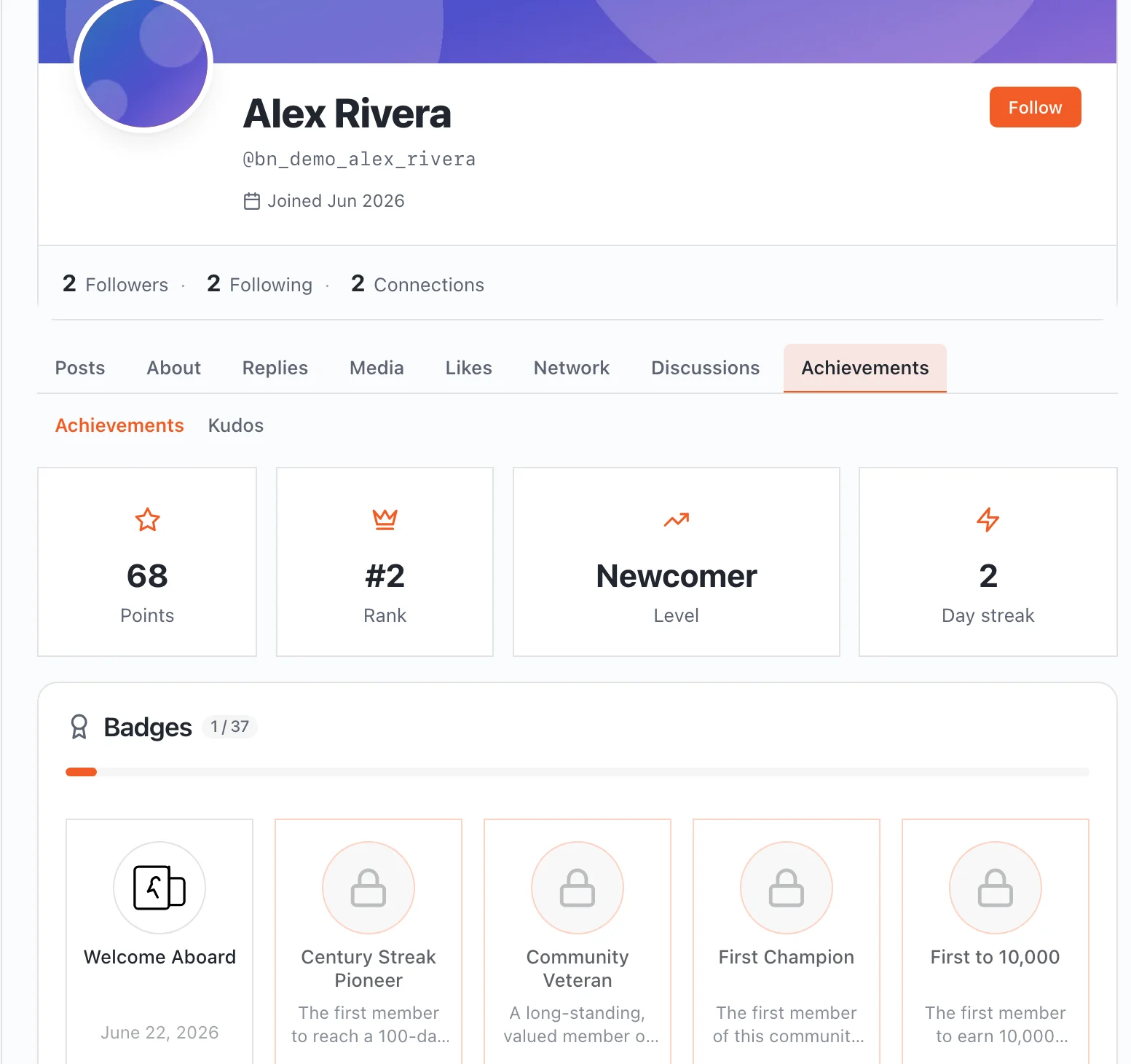
Look at what this profile actually shows: a level, “Newcomer”, earned points, a rank, and a badge grid where the large majority are still locked. That’s a vesting curve made visible. This member’s standing accrued through participation, they’re at the start of the curve, most privileges still unearned, and the locked badges are the not-yet-vested trust waiting to be earned through sustained contribution. Nobody was handed a full set of privileges on arrival. Status here is something that unlocks over time, which is exactly the mechanism this whole argument is built on, shown as a real feature rather than a philosophy.
Where this lives inside BuddyNext
If you’re running the community on BuddyNext, member types and progressive permissions are the raw material for a real vesting structure, capabilities gated behind standing rather than handed out on signup. Pairing it with WB Gamification, free, gives you the accruing reputation curve the whole model depends on: points and levels that build through genuine participation, with thresholds that can gate privileges, the same mechanism the profile above shows. The clawback side, de-leveling a member who goes inactive or toxic, is the piece worth building deliberately, because it’s the one almost no community sets up in advance and the one they most wish they had when the moment comes.
The same logic extends to courses. On Learnomy, privileges and roles can unlock as a student progresses, a teaching-assistant status earned by completing the material rather than assigned on enrollment, which is the exact same vesting curve applied to learners instead of members.
The test, if you want one
Look at whoever currently holds real trust or authority in your community, your moderators, your elevated members, anyone with privileges others don’t have. For each one, ask two questions. Did they earn this gradually through sustained contribution, or was it granted quickly because they were eager or convenient at the time. And if they stopped contributing tomorrow, or started abusing it, is there any mechanism at all to take it back, or would they simply keep it forever by default.
If the honest answers are “granted fast” and “no mechanism to revoke,” you don’t have a trust system. You have a pile of permanent grants, some of which you’ll eventually regret, with no way to unwind them. Vesting fixes both problems at once: it slows the granting down until it’s earned, and it keeps the grant conditional on continuing to deserve it. Trust that’s handed out fast is the fastest kind to lose. Trust that vests is the kind that lasts.
Related reading