
14 min read
Your First Cohort Is Your Founding Community

Every course creator gets a founding community for free, whether they realize it or not, in the form of their first cohort of paying students. Most never treat it that way. The course gets delivered, the students work through it more or less alone, and by the time the creator thinks seriously about “building a community,” those first students have long since finished, moved on, and forgotten the brief window when they would have made the best founding members the space would ever get.
If you’ve read the piece on the cold start problem, this is the version of it that shows up in course-selling businesses, and it has an unusually generous fix: the founding cohort doesn’t need to be recruited from outside at all. It’s already enrolled.
In this pieceThe founding cohort you already have and aren’t using
Why “deliver the course” and “build the community” get treated as separate jobs
The day-one window, and why it closes faster than it seems
The waitlist window: bootstrapping before day one even arrives
What to seed the space with before day one
Why peer teaching matters more here than in most niches
A real course, and the space that should exist next to it
The instructor as first member, not just the content source
Why this differs for cohort-based versus evergreen courses
The failure mode: a course with a dead forum bolted on
What happens across multiple cohorts over time
The pushback: “students just want the content, not a community”
Where this actually lives inside Learnomy and BuddyNext
Why this isn’t the same as a completion certificate or badge
Turning it into something you actually check
The founding cohort you already have and aren’t using
Compare the position of a course creator to the position of a founder trying to bootstrap a community from nothing. The founder has to find, convince, and personally invite every single founding member, one at a time, with no existing relationship to draw on. A course creator already has a list of people who’ve paid real money, on the strength of trusting this specific creator’s expertise, and who are, at the exact moment they enroll, more motivated and more engaged with the topic than they will likely ever be again.
That’s a founding cohort handed over, fully warm, requiring none of the outreach a from-scratch community needs, no cold emails, no convincing, no proving the topic is worth their time. The only thing standing between “a list of students” and “an actual founding cohort” is whether anyone treats them as one.
Why “deliver the course” and “build the community” get treated as separate jobs
The structural reason this opportunity gets missed so often is that course delivery and community building live in different mental categories for most creators. The course is the product, finished, packaged, sold. The community, if it exists at all, gets bolted on afterward, a Discord server mentioned in the welcome email, a Facebook group linked in passing, treated as a nice-to-have rather than the actual mechanism that turns a one-time purchase into an ongoing relationship.
Once delivery and community are separated this way, the community inevitably launches too late, after the cohort’s shared momentum, the thing that made them want to talk to each other in the first place, has already dissipated. The fix is refusing the separation from the start: the community isn’t a bonus attached to the course, it’s where the course actually happens, alongside the video lessons rather than after them.
The day-one window, and why it closes faster than it seems
A newly enrolled student is, for a genuinely short window, more excited about this specific topic than they’ll be at almost any other point in the relationship. That excitement is a real, finite resource, and it decays faster than most creators expect, often within the first one to two weeks, especially for a self-paced course with no external deadline forcing continued engagement.
A community space that opens on day one, when that excitement is at its peak, captures real energy and turns it into the first posts, the first questions, the first “here’s what I built” moments. A space that opens weeks or months later, once the course has been “running successfully” for a while, is trying to recruit members whose initial excitement has already faded into the same passive, low-energy state as everyone else’s forgotten online course purchase.
The waitlist window: bootstrapping before day one even arrives
An underused version of this same principle applies even before a student’s official day one: the waitlist or pre-order period, if the course has one, is itself a legitimate seeding opportunity, not just a sales mechanism. Buyers who commit early, on a waitlist or a pre-launch offer, are frequently the most motivated segment of the entire eventual student base, precisely because they were willing to commit before the course even fully existed.
Opening a space to this early-commit group before the course officially launches, even in a small, private form, lets the founding-cohort dynamic start weeks earlier than it otherwise would, with genuine excitement about what’s coming rather than genuine excitement about material they can already see. By the time the course itself launches to a wider audience, this early group is already primed to be the founding, active core of the space, the same warm-start advantage a brand community gets from its existing customer base, available here through the pre-launch period specifically.
What to seed the space with before day one
Before the first student ever arrives, the space benefits enormously from not being empty, the same principle from the general bootstrapping piece, applied to a course-specific context. A pinned post from the instructor explaining exactly what the space is for and what kind of posts are welcome, specific rather than generic. Sample “share your progress” posts modeling the format, a screenshot of a finished exercise, a specific question about lesson three, so the first real student has an obvious template to follow instead of staring at a blank composer.
If a previous cohort or beta group exists, even a small one, their genuine questions and answers, with permission, seeded into the new space before launch give it real depth from day one. A newcomer arriving to a space with substantive prior discussion behaves completely differently than one arriving to a space with only a single “welcome” post from the instructor.
Why peer teaching matters more here than in most niches
Course communities have a structural advantage most other niches don’t: the entire membership is, by definition, actively learning the same specific thing at roughly the same time, which makes peer teaching an unusually natural seed activity. A student who’s three lessons ahead of another student isn’t an expert, but they’re far enough ahead to answer a real question, and being asked to do so, explicitly, by the instructor, “would anyone who’s already finished the fetch-and-effects lesson want to help answer this” turns a passive student into an active, invested one almost immediately.
This matters for bootstrapping specifically because it multiplies the instructor’s limited time. An instructor personally answering every question is the founder-as-first-member tactic from the general piece, necessary early on, but it doesn’t scale even to a moderately sized cohort. Deliberately inviting slightly-further-along students to answer questions, and publicly thanking them when they do, builds the habit of peer support into the space’s culture from the very first cohort, rather than trying to introduce it later once the pattern of “only the instructor answers” is already established and harder to break.
A real course, and the space that should exist next to it
Here’s a real, live course, reachable without an account, and worth thinking about in terms of what should exist alongside it, not just what the course page itself shows.
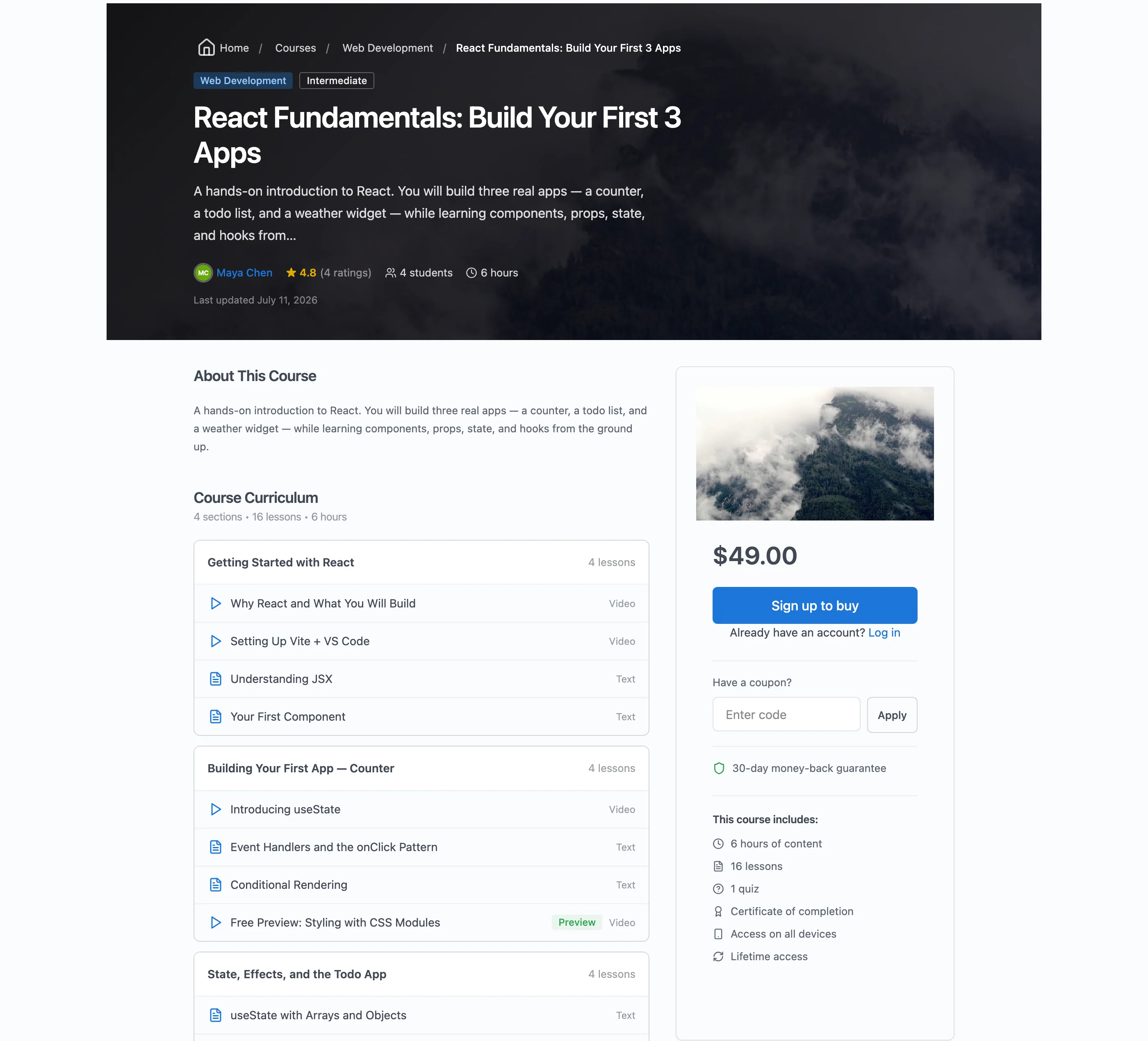
Four real students, a real instructor, real curriculum. Every one of those four students enrolled recently enough that their motivation is still close to its peak. A space seeded before this course’s next intake, with the instructor personally active in it and the existing four students personally invited to be founding members of a slightly larger version of what they already have informally, would very plausibly reach real density before the course’s own marketing brings in the next wave of buyers.
The instructor as first member, not just the content source
The instructor’s job during this window is structurally identical to the founder-as-first-member role described in the general bootstrapping piece, showing up daily, replying to every early post within hours, asking genuine questions rather than only answering them. This is uncomfortable for a lot of course creators specifically, because the instructor persona built for polished video lessons is different from the responsive, slightly-messier persona a live community space needs.
That discomfort is worth pushing through rather than around. A student who gets a real, personal reply from the instructor on their first post in the space forms a completely different relationship with the course than one who only ever watches pre-recorded video. That relationship is what survives past the last lesson and turns a single purchase into someone who buys the next course, refers a friend, or becomes exactly the kind of visible, verified success story the growth loop piece on course certificates covers, and none of that happens if the only version of the instructor a student ever meets is the one on the pre-recorded video.
For instructors who genuinely can’t sustain daily presence for the full length of a longer course, front-loading the effort into the first two weeks specifically, exactly the window described above, matters more than spreading a smaller amount of attention evenly across the whole course. A student who gets real, personal attention in week one and less afterward still forms the relationship. A student who gets diffuse, thin attention throughout never quite forms it at all.
Why this differs for cohort-based versus evergreen courses
A cohort-based course has a natural, built-in founding-cohort mechanism: everyone enrolls around the same time, has the same shared deadline pressure, and is already primed for the kind of synchronous, real-time discussion a new space thrives on. The bootstrapping work here is mostly about making sure the space exists and is seeded before the cohort’s shared start date, not after.
An evergreen, self-paced course doesn’t have that natural synchrony, students enroll on a rolling basis, at different times, with no shared deadline. The founding-cohort tactic still works, but it requires the instructor to be more deliberate about it, personally reaching out to the first handful of evergreen enrollees to invite them into a space, rather than relying on a shared start date to do the inviting automatically. It’s more manual work for less natural momentum, which is exactly why it gets skipped more often in evergreen courses, and exactly why the ones that do it well have a real, durable advantage over the ones that don’t.
One practical workaround for evergreen courses worth considering: batching enrollment into loose, informal waves, even without a hard cohort structure, by sending a personal invitation to the space to everyone who enrolled in the last two weeks, together, rather than individually as they trickle in. This manufactures a bit of the shared-timing advantage a true cohort gets, without requiring the creator to actually restructure the course into a scheduled format.
The failure mode: a course with a dead forum bolted on
The most common version of this going wrong isn’t the absence of a community space, it’s the presence of one that nobody bothered to seed, a Discord server or forum linked in the welcome email with three months of silence in it by the time a new student clicks through. That’s arguably worse than having no space at all, because it actively signals, to a newly excited student, that engagement here isn’t real, precisely the empty-room problem from the general piece, except now it’s actively undermining a purchase that was just made in good faith.
The fix is the same sequencing discussed throughout: seed before the first cohort or the first wave of evergreen buyers ever sees the space, using the instructor and any available prior students as the initial founding cohort, so day one never shows a blank feed.
What happens across multiple cohorts over time
The founding-cohort effort described throughout this piece is heaviest for the very first cohort, and it’s worth being explicit about how it changes from there, because treating every subsequent cohort identically wastes an advantage that compounds. By the second or third cohort, the space already has real density, real prior posts, and ideally a handful of graduated students from the first cohort who are willing to stick around and help welcome the next wave in, the peer-teaching dynamic extended across cohort boundaries instead of confined to a single one.
This is where a well-seeded course community starts to genuinely outperform a freshly bootstrapped one: each new cohort arrives to a space that’s already alive, seeded not by the instructor alone but by the accumulated presence of everyone who came before. The instructor’s disproportionate early effort doesn’t need to repeat at full intensity for cohort four the way it did for cohort one, because the community itself is now doing part of that work. The mistake worth avoiding is assuming this happens automatically. It happens because the first one or two cohorts were seeded deliberately enough to leave something real behind for the next group to walk into, a small, cumulative inheritance that a course launched without any early seeding effort never gets the chance to build.
The pushback: “students just want the content, not a community”
Sometimes true, and worth taking seriously, a meaningful share of students genuinely just want to consume the material and move on, and no amount of good seeding will turn every buyer into an active community member. That’s fine, and it’s not the goal. The goal is capturing the meaningful minority who do want more than passive content, the ones who ask questions, share progress, and would genuinely value talking to other students and instructors, and giving them somewhere real to do that instead of losing them to silence by default, the same silence that swallows most course-adjacent Discord servers within a month of launch.
That minority, even when it’s a small percentage of total enrollment, tends to be disproportionately valuable: they’re the most likely to finish the course, the most likely to buy the next one, and the most likely to refer someone else, exactly the kind of compounding return a well-seeded space is built to capture.
Where this actually lives inside Learnomy and BuddyNext
If you’re running courses on Learnomy paired with BuddyNext, a space tied to a specific course, the same structure shown in the real example above, gives every new student an obvious, natural home from the moment they enroll, rather than a generic, unrelated community they have to be separately convinced to join. Progress tracking and certificates mean students already have something concrete to share the moment they hit a milestone, real seed content that doesn’t require the instructor to manufacture it from nothing.
Why this isn’t the same as a completion certificate or badge
Worth being explicit about the difference, because the two get bundled together in a lot of course-platform marketing. A certificate is proof a student finished something, issued once, at the end. A founding community is a relationship, alive throughout the course and ideally well past it, that has nothing to do with whether any individual student has completed every lesson yet. Treating certificate issuance as a substitute for community seeding misses the entire window this piece is about, the certificate arrives after the course is already over, precisely when a student’s motivation to engage with a new space is at its lowest, not its highest.
The two aren’t competing investments, a good course business eventually wants both, but they solve different problems and happen at different points in a student’s relationship with the course. Community bootstrapping happens at the excited beginning. Certification happens at the finished end. Confusing the timing of one for the other is a quiet, common way course creators end up with a real certificate program and a genuinely empty community space, both technically present, only one of them actually working.
Turning it into something you actually check
Per cohort or per enrollment wave, not just once: what percentage of new students post anything in the space within their first two weeks, while their initial motivation is still near its peak. That number, tracked from the very first cohort onward, tells you whether the founding-cohort opportunity described throughout this piece is actually being captured, or quietly wasted the way it is by default in most course businesses.
Worth tracking alongside it: of the students who post in their first two weeks, how many are still posting or replying by week six, well past the point where their initial launch excitement would naturally be fading on its own. A healthy founding cohort holds a meaningful share of its early posters past that point, because the space itself, not just the novelty of a new purchase, has become a real reason to stay engaged. A steep drop-off between week two and week six usually means the space delivered a decent first impression but never gave returning members enough to come back for a second or third time, worth revisiting the seed content and instructor responsiveness described earlier rather than assuming the cohort simply lost interest on its own.
The first cohort was always going to be the easiest founding community any course creator ever gets. They arrived already paying, already interested, already primed to want to talk about the exact thing the space exists for. The only question is whether anyone showed up in the space with them while they still cared enough to want one, or let that window close the way it closes, quietly, for almost every course that treats the community as an afterthought instead of part of the product.
Related reading