
14 min read
Your People Are Already Gathered Somewhere Else

Almost no hobby community is actually starting from an audience that doesn’t exist yet. The woodworkers, the synth builders, the film photographers, the specific niche a new community is being built around, are already talking to each other somewhere, a subreddit, a Discord server, a Facebook group, a forum that’s technically still running even though it looks like it hasn’t been redesigned since 2011. The job isn’t creating interest from nothing at all. It’s giving people who are already gathered a specific, real, honest reason to move.
If you’ve read the piece on the cold start problem, this is the hobbyist-specific version of it, and treating it as a migration problem instead of a creation problem changes almost every tactical decision that follows.
In this pieceWhy this is a migration problem, not a creation problem
Why people don’t leave a place that already works well enough
Finding the real reason to move, not a generic one
A real, small hobbyist founding portfolio, not a hypothetical
Finding where your specific people already are
The scouting phase before any outreach happens
Migrating people without burning the place they came from
The dual-posting bridge period
Recruiting a small number of anchor members first
What to seed with when everyone already has a portfolio elsewhere
Cross-linking instead of competing outright
Hobbyist-specific failure modes
The pushback: “why would anyone leave a bigger, more active place”
Where this actually lives inside BuddyNext
Why this isn’t the same as poaching a competitor’s users
Turning it into something you actually check
Why this is a migration problem, not a creation problem
The general bootstrapping piece is mostly about generating interest that doesn’t yet exist, convincing someone a topic is worth their time and attention in the first place. Hobbyist communities almost never have that problem. The interest is already real, already active, already producing genuine, high-quality content, somewhere else, often for years before a new space ever enters the picture at all.
That changes the entire shape of the challenge. The question isn’t “how do we get people interested in this,” it’s “why would someone who’s already got a perfectly functional place to talk about this specific hobby bother creating a new account somewhere else.” That’s a much narrower, more specific question, and it has a much narrower, more specific answer than generic bootstrapping advice provides.
Why people don’t leave a place that already works well enough
Inertia in an existing hobby community is real and rational, not laziness. The existing subreddit or Discord already has the accumulated history, the inside jokes, the recognizable usernames, the archive of old threads worth searching. A brand-new space, no matter how well designed or well intentioned, starts with none of that. Asking someone to leave isn’t asking them to try something new, it’s asking them to abandon accumulated social capital and start over, which is a real cost most people won’t pay for a vague, unspecific improvement.
This is why “come join our new community, it’s better” almost never works as a migration pitch on its own. It’s true, from the builder’s perspective, and irrelevant to someone who’s asking a much more practical question: better at what, specifically, that the old place can’t do at all.
Finding the real reason to move, not a generic one
The migration pitch that actually works names something the old platform genuinely can’t do, not something it does slightly worse. A subreddit can’t host a real, permanent portfolio tied to an identity, everything scrolls away into the same undifferentiated feed. A Discord server’s history is effectively unsearchable and disappears from casual view within days. A Facebook group is algorithmically gated, most members never see most posts, and it’s increasingly hostile to anyone who doesn’t want a Facebook account for other reasons.
Each of those is a real, specific, structural gap, not a vague “ours is better” claim, worth confirming through the scouting work described later in this piece rather than guessed at from the outside, and naming the specific gap that matters most to a specific hobby’s specific pain point is what actually motivates the first movers. A woodworking community whose members keep losing track of their own best project photos in an endless Discord scroll has an obvious, concrete reason to want a real, permanent portfolio. A vague pitch about “better community features” doesn’t land the same way at all.
A real, small hobbyist founding portfolio, not a hypothetical
Here’s what the actual destination looks like once a few real people have made the move, reachable without an account.
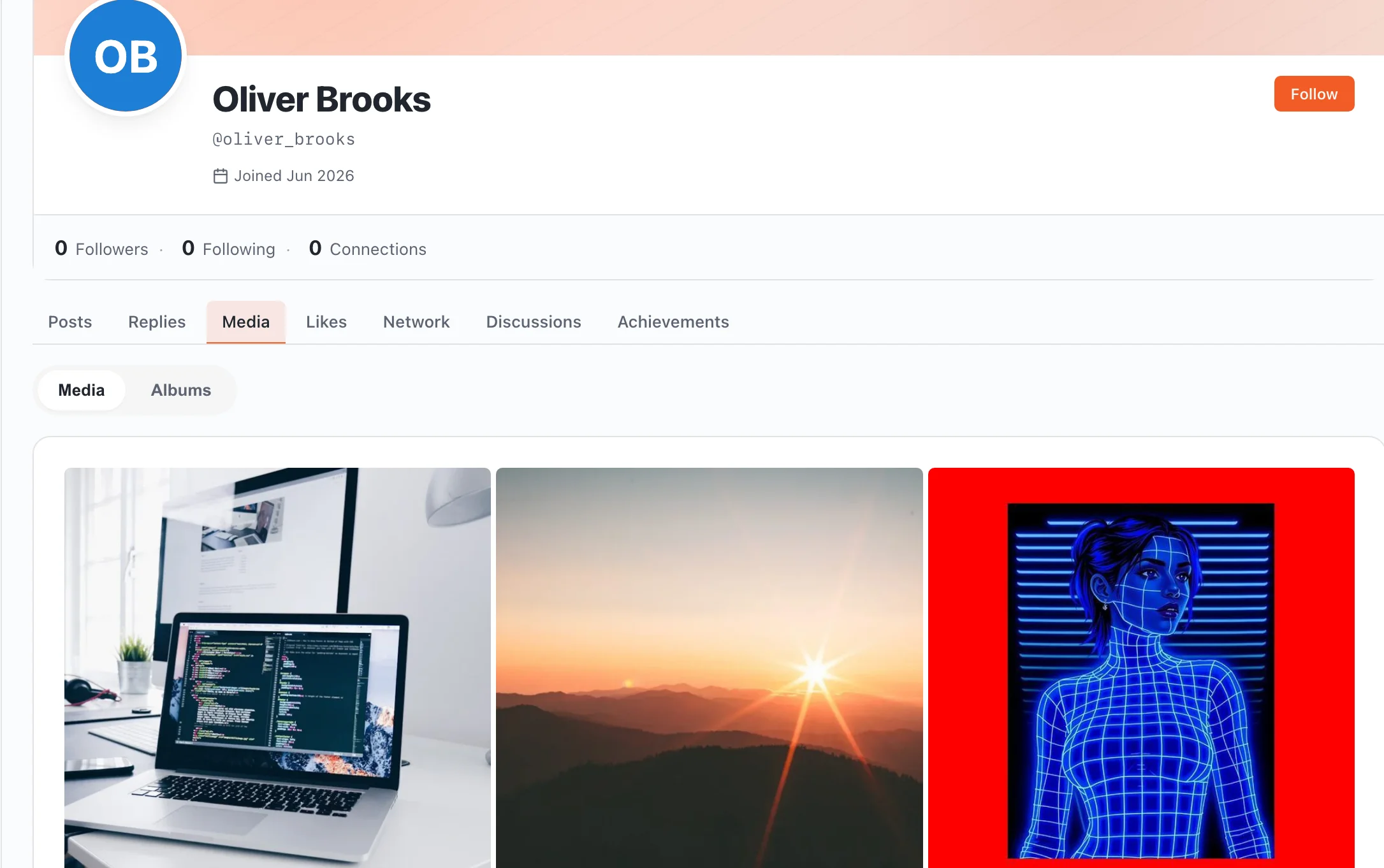
A real, permanent, public portfolio, not a post that will scroll away by tomorrow the way it would on the platform this person almost certainly came from. This is the specific, concrete thing worth migrating for, made visible rather than promised abstractly. A founding cohort recruited with “come see what a permanent home for your work actually looks like,” pointed at an example exactly like this, has something real and specific to evaluate, not just a founder’s word that the new place is better.
Finding where your specific people already are
Before any migration outreach happens, the actual homework is identifying, specifically, where this hobby’s existing conversation already lives, and it’s usually not one single place. A given hobby might be split across a large, general subreddit, several smaller specialized Discord servers organized by sub-technique or region, and a handful of long-running independent forums with small but genuinely loyal followings. Each of these has a different culture, different norms about self-promotion or outside links, and a different tolerance for someone showing up to talk about a new space.
The smaller, more specialized communities are usually the better starting point, not the largest one, precisely because their tighter, more established culture is exactly what makes a genuine, well-earned reputation inside them actually count for something. A big subreddit has more total people but far less tolerance for a newcomer’s migration pitch before it reads as spam. A smaller, tighter Discord server, if the founder is already a genuine, known participant in it rather than a stranger showing up to promote something, is a far warmer, more receptive starting audience.
The scouting phase before any outreach happens
Before inviting a single person, real time spent simply observing the existing communities pays off disproportionately. Which specific complaints come up repeatedly, about the platform itself rather than the hobby, are the actual migration pitch waiting to be discovered rather than invented, and they’re usually said out loud, in passing, by real members long before anyone thinks to treat them as useful signal. Which members post the most genuinely impressive work relative to how little visibility it gets, buried in a fast-scrolling feed, are the highest-value people to eventually approach, since they have the most to gain from a permanent, well-presented home for it. Which members already show up across multiple of the hobby’s scattered spaces are worth prioritizing too, since they’re demonstrably willing to participate in more than one place at once, lowering the switching cost a pure single-platform loyalist would feel.
This scouting phase, done honestly and without any promotional intent yet, often takes several weeks, and it’s worth resisting the urge to skip straight to outreach before it’s done. A migration pitch built on genuine, specific observations from real time spent in the existing communities lands completely differently than one built on assumptions about what those communities are probably like.
Migrating people without burning the place they came from
Worth being explicit about, because getting this wrong can permanently damage a founder’s standing in the exact communities the founding cohort needs to come from: showing up in an existing space purely to promote a competing one, without having been a genuine, contributing member of that space first, reads as extractive, and it usually gets removed by moderators before it does any good anyway.
The respectful version requires the founder to already be a real participant, ideally for a meaningful stretch of time before ever mentioning the new space, and to frame any mention as a genuine option rather than a sales pitch, “I built a place with permanent portfolios if anyone’s interested, no pressure, still active here too.” That framing, and the real standing behind it, is the difference between a founder who gets banned for spamming and one who successfully brings a handful of genuinely interested people along, and it’s worth accepting that this respectful version is simply slower than a more aggressive one, a fair tradeoff for not permanently burning the exact relationships the founding cohort depends on.
The dual-posting bridge period
Almost nobody migrates a hobby community in one clean jump, and expecting a full, immediate switch is a common way this fails. A more realistic, and more honest, expectation is a bridge period where the founding cohort posts in both places simultaneously, the original community and the new space, for weeks or months, gradually shifting weight toward the new one as it accumulates its own real value.
This isn’t a failure of the migration, it’s the actual mechanism by which it succeeds. Each dual-posted piece of content is a small, low-risk trial of the new space that doesn’t require fully abandoning the old one, and enough small trials, over enough time, is what eventually tips a real portion of the group’s attention toward wherever it’s actually producing more value, without anyone having to make a single dramatic, all-or-nothing decision.
Recruiting a small number of anchor members first
Rather than approaching a broad slice of an existing community at once, the more effective sequence is identifying three to five specific people from the scouting phase, ideally the ones whose work most clearly deserves the permanent-portfolio advantage described earlier, and making the migration pitch to them individually, before anyone else. These anchor members serve the same function the general bootstrapping piece’s founding cohort does, except recruited from an existing pool of proven talent rather than assembled from cold outreach.
Once these anchors have real, high-quality portfolios established in the new space, they become the actual migration pitch for everyone who comes after, far more convincing than anything the founder could say directly, since the proof is sitting right there, publicly reachable, rather than being asserted secondhand. A newcomer from the original community who sees a respected peer’s real, permanent, well-presented portfolio is looking at proof, not a promise, which is a fundamentally stronger recruitment tool than any amount of founder-written marketing copy, precisely because nobody had to take the founder’s word for any of it.
What to seed with when everyone already has a portfolio elsewhere
The seeding advantage available here that the general bootstrapping piece doesn’t fully cover: a founding member’s existing best work, already created, sitting on another platform, can be brought over directly rather than requiring anyone to make anything new. Migrating a member’s five best existing pieces, with their permission, into the new space’s permanent portfolio format gives the space real, high-quality content from day one, made by real people whose skill is already established elsewhere, not thin, freshly-created filler.
This does double duty: the space never opens looking empty, and it gives the migrating member an immediate, tangible reason to feel good about the move, their best work now living somewhere permanent and well-presented, instead of buried in an old platform’s scroll.
Cross-linking instead of competing outright
A tactic worth using deliberately during the bridge period: linking back to the new space’s permanent portfolio from posts still being made in the original community, rather than treating the two as competitors that can’t reference each other. A member who posts their usual update in the original Discord, with a real link to a permanent, well-presented version of the same work in the new space, gives every reader of that original post a low-friction, curiosity-driven path to discover the new space on their own terms, without ever receiving a direct migration pitch at all.
This works because it doesn’t ask anyone to choose sides. It simply makes the new space discoverable through content the original community already values, letting genuine curiosity, rather than direct persuasion, do a meaningful share of the recruiting work over time.
Hobbyist-specific failure modes
Beyond the general failure modes, a few specific to this kind of migration. Pitching the move as a wholesale replacement instead of an addition, which triggers exactly the loss-aversion resistance described above. Recruiting from a community the founder was never a genuine participant in, which reads as extractive and usually gets shut down by moderators before it produces anything. And neglecting the bridge period, expecting a clean, immediate switch and concluding the migration failed after two weeks, when a realistic timeline is measured in months, not days.
The pushback: “why would anyone leave a bigger, more active place”
A completely fair question, and the honest answer is that most people won’t leave entirely, at least not quickly, and that’s fine. The realistic goal isn’t emptying the old platform, it’s capturing a meaningful, motivated minority who care enough about the specific structural gap identified earlier, a permanent portfolio, real searchability, an identity that isn’t buried in an endless feed, to make the new space their primary home while the majority stays where they are.
That minority, even if it’s a small fraction of the original community’s total size, is usually more valuable per person than an equivalent number of strangers recruited cold, because they arrive with real skill, real existing work, and a real, specific reason for choosing to be there, rather than vague curiosity.
It’s also worth pointing out that “bigger and more active” is doing a lot of quiet work in this objection that’s worth examining honestly. A large subreddit’s total member count says little about how much genuine visibility any individual post actually gets, and members who feel invisible in a fast-moving, high-volume feed are often the most receptive to a smaller space where their work is actually seen, not despite the smaller size, but because of it. Framing the new space’s smallness as an honest tradeoff, less total traffic, more actual visibility per post, tends to land better than pretending it’s already bigger or busier than it is, an honesty that also happens to be the more durable pitch over time.
Where this actually lives inside BuddyNext
If you’re running the community on BuddyNext, real public member profiles with a genuine, permanent, searchable media portfolio are the actual structural advantage worth migrating for, the same real example shown above. Pairing it with MediaVerse for a gallery-first presentation makes the specific gap named in the migration pitch, a real, permanent home for finished work, concretely, visibly true rather than a promise.
Why this isn’t the same as poaching a competitor’s users
Worth distinguishing explicitly, because the tactics above can sound uncomfortably close to a practice worth avoiding if done carelessly. Poaching, in the sense worth avoiding, means recruiting people away from a place with no genuine improvement to offer, purely to grow a number, often through spammy outreach to people who never asked to be approached. Everything described in this piece depends on the opposite: a real, specific, structural advantage that genuinely serves the people being invited, offered by someone who’s already a legitimate, contributing member of the community they’re recruiting from, with an explicit, honest “no pressure” framing rather than a hard sell.
The practical test worth applying honestly: if the pitch wouldn’t survive being posted publicly, in the open, in the very community it’s aimed at, with the founder’s real identity and real history in that community attached, it’s probably closer to poaching than to a genuine, respectful invitation. The tactics in this piece are built to pass that test, not to work around needing to.
Turning it into something you actually check
Monthly, given how much slower this kind of migration realistically moves than a from-scratch launch: how many pieces of migrated or newly created content exist in the space, and how many of the founding cohort are still dual-posting versus how many have shifted primary activity to the new space entirely. A steady, if slow, month-over-month increase in the second number is the actual signal the migration is working. A flat number for two or three months running usually means the structural reason to move wasn’t specific or compelling enough, worth revisiting rather than simply waiting longer.
Worth watching alongside those two: whether cross-links from the original community, the tactic described earlier, are actually producing organic arrivals with no direct outreach involved at all. This number starts at zero and should begin appearing, even in small amounts, within the first month or two once anchor members have real portfolios worth linking to. A cross-linking strategy that’s producing genuine, unprompted arrivals is a strong signal the migration has moved past requiring the founder’s direct involvement in every single new member, the same self-sustaining threshold the general bootstrapping piece describes for any community, reached here through curiosity rather than through direct, personal invitation.
The audience for almost any hobbyist community already exists, fully formed, somewhere, with real skill and real enthusiasm already on display. The only genuine question is whether the new space gives them something specific enough to be worth bringing a piece of that somewhere new, rather than asking them to start caring about the hobby all over again from zero.
Every tactic in this piece is really one idea, applied several different ways: respect the place people already are, name the specific, real thing the new space does that the old one structurally can’t, and let the proof, an anchor member’s real portfolio, a genuine cross-link, a permanent piece of work finally getting found, do more of the convincing than any pitch or promotional post ever could. That’s slower than a loud public launch. It’s also the version that survives past the first month, because nobody who arrives that way was ever tricked into showing up, and nobody who helped bring them there ever has to feel uneasy about how it happened.
Related reading